A 4-Inch (102mm) Refractor Can Be An Excellent Deep-Sky Telescope And Finally Sirius B
Walter Scott Houston, most often used a 4-inch Clark refractor for his observations of deep-sky objects while writing the monthly “Deep-Sky Wonder’s” column in “Sky & Telescope” magazine for 46 years until his death in December, 1993.
When Sue French picked up DSW’s, she mostly used a 105mm refractor for her deep-sky observations over her twenty years writing the column.
In 1992, I purchased a copy of “The Messier Album” by John Mallas and Evered Kreimer. This book continues to be one of my favorite references concerning the Messier objects.
I would later purchase a copy of the “The Messier Objects” (first edition) by Stephen O’Meara, also using a 4-inch f/5 (500 mm) Genesis Televue refractor.
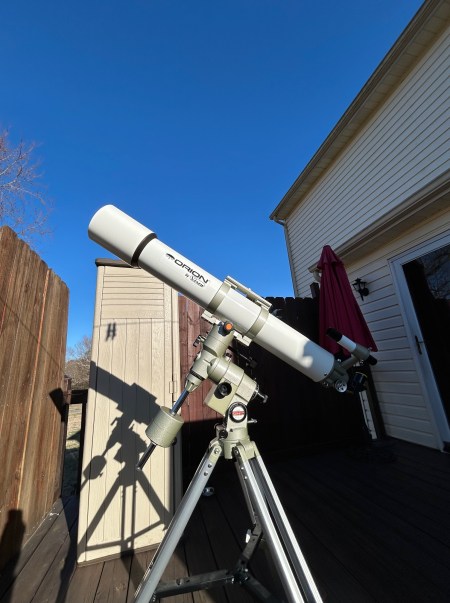
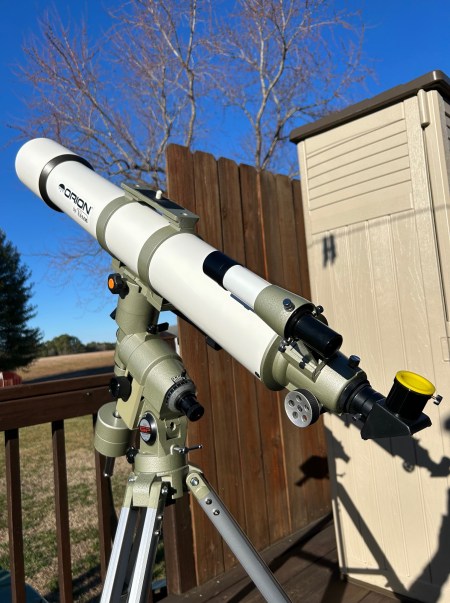
October 1997, I would purchase the 4-inch (102 mm f/9.8) refractor as following. The telescope was made in Japan by Vixen with excellent quality. I have used the scope for double-star work, also planetary, however, it would be used mostly for galaxies, nebula and star clusters. The telescope provides for a nice velvety background with excellent contrast of faint deep-sky objects, and on nights of good seeing it will easily perform at Dawes Limit.

An example of my pencil sketches as following, and seeing the beautiful triple star, Iota Cassiopeia.
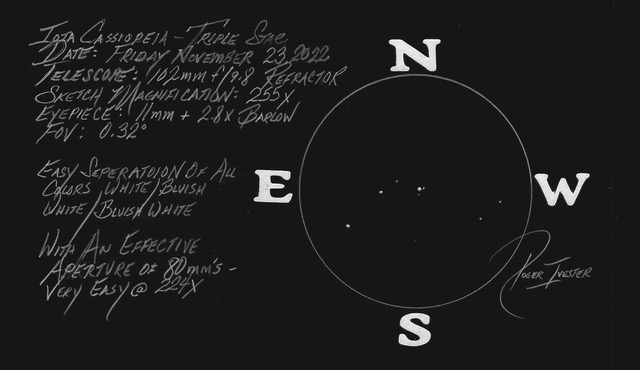
“Finally, after more than 40 years, I was able to see Sirius B, better known as the “Pup.” Date of observation: March 14th 2012
When Sirius B was at a relatively wide separation during the 70’s, I was using a spherical mirror, 4 1/4-inch f/10 Edmund reflector.
March 14th 2012, and using the 102mm refractor:
After letting the telescope cool down for at least an hour and making a few visual test…the seeing appeared very good. An attempt to see Sirius B requires being seated, at least for me.
I adjusted my astro-chair and removed the diagonal, and started with a magnification of 83x, but to no avail. I increased the magnification to 232x, keeping my eye perfectly still, and looking very carefully for more than an hour. Then suddenly, a very faint speck appeared so very close to Sirius, but winking in-and-out.
Knowing the position-angle really helped. However, I could not hold the companion, or Sirius B constantly. It was extremely difficult, but after 40 years, I had finally seen the companion to Sirius.
I have always been interested in observing with a good quality refractor. The superior contrast of a refractor can often times allow views of deep-sky objects to rival or even exceed larger telescopes of more complex designs.
Seeing the companion to Polaris with an effective aperture of 45 mm’s.
 .
.
 rogerivester.com