Deep Sky Observing With A 76mm f/4 Celestron FirstScope: NGC 1502 Open Cluster; Kemble’s Cascade; M82 Supernova And Many Others
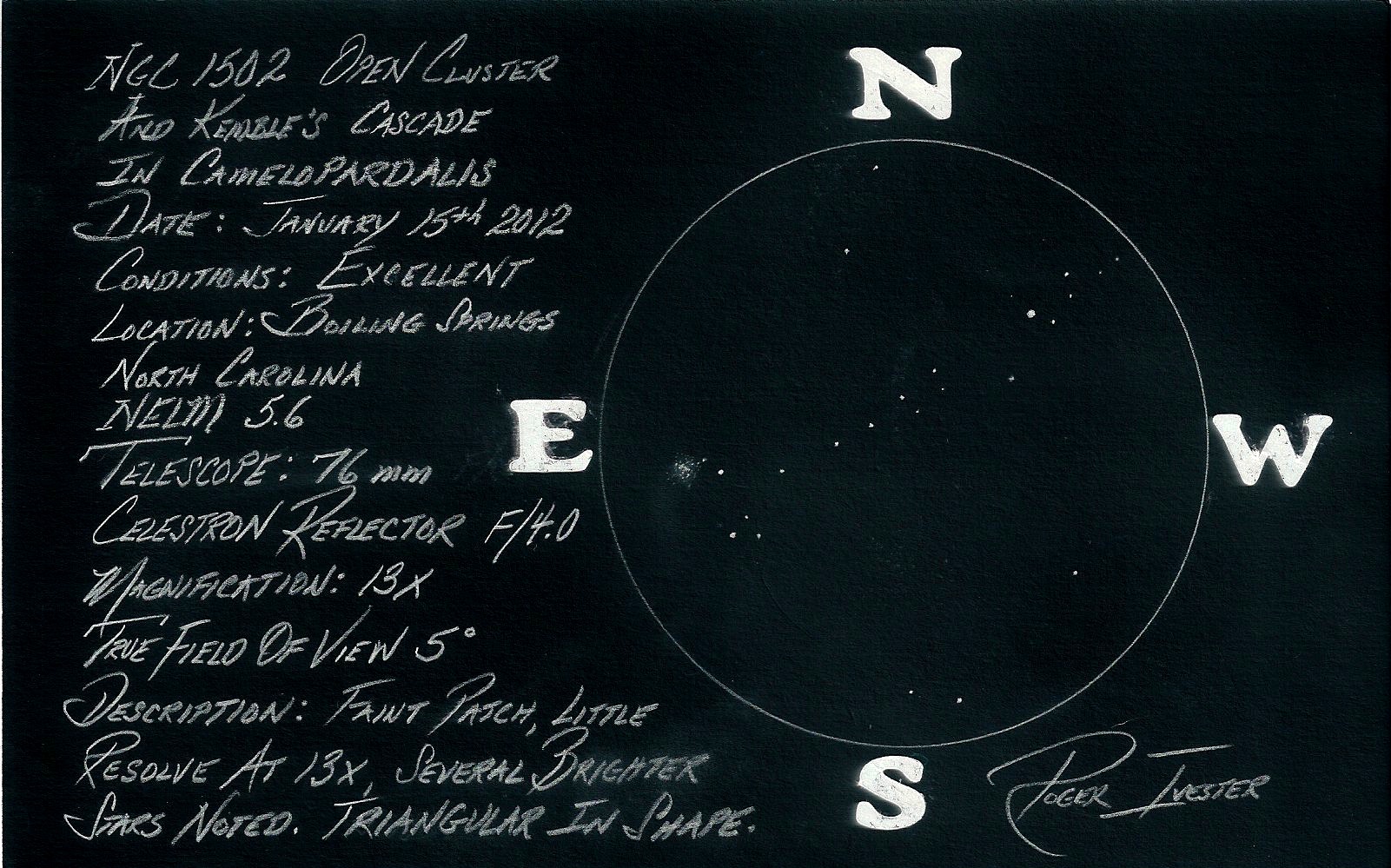
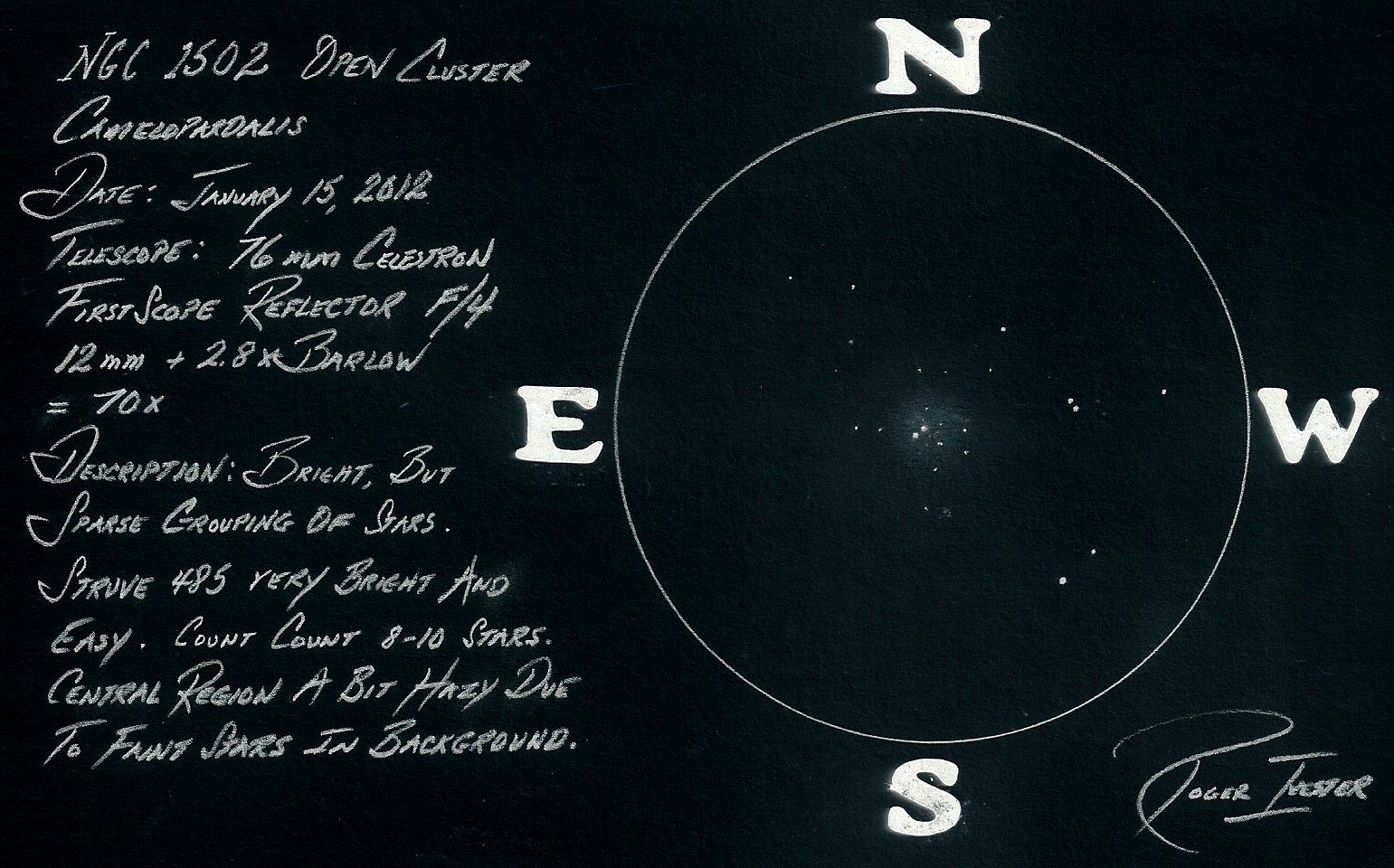
NGC 1502 and Kemble’s Cascade
Date: January 15th 2012
Conditions: Excellent
Location: Suburban backyard in western North Carolina
76 mm f/4 Dobsonian Reflector, using a 24 eyepiece with 60 degree apparent FOV and a 13x magnification.
Telescope: ~4.0º Field of View
Faint patch of triangular shaped group of stars. Double star Struve 485 is in the center of the cluster and appears as a single bright star at low magnification.
This scope presents Kemble’s Cascade as a beautiful and interesting chain of about fifteen stars, with one brighter star noted in toward the middle of the line.
Galaxy M82 and the 2014 Supernova

My granddaughter was visiting from out of town and the forecast was clear skies. I thought this might be the perfect opportunity to share the night sky with her.
It also occurred to me that this would be a great time to see how easy it would be for an eleven year old to use a popular beginner telescope, a 76mm Celestron firstScope.
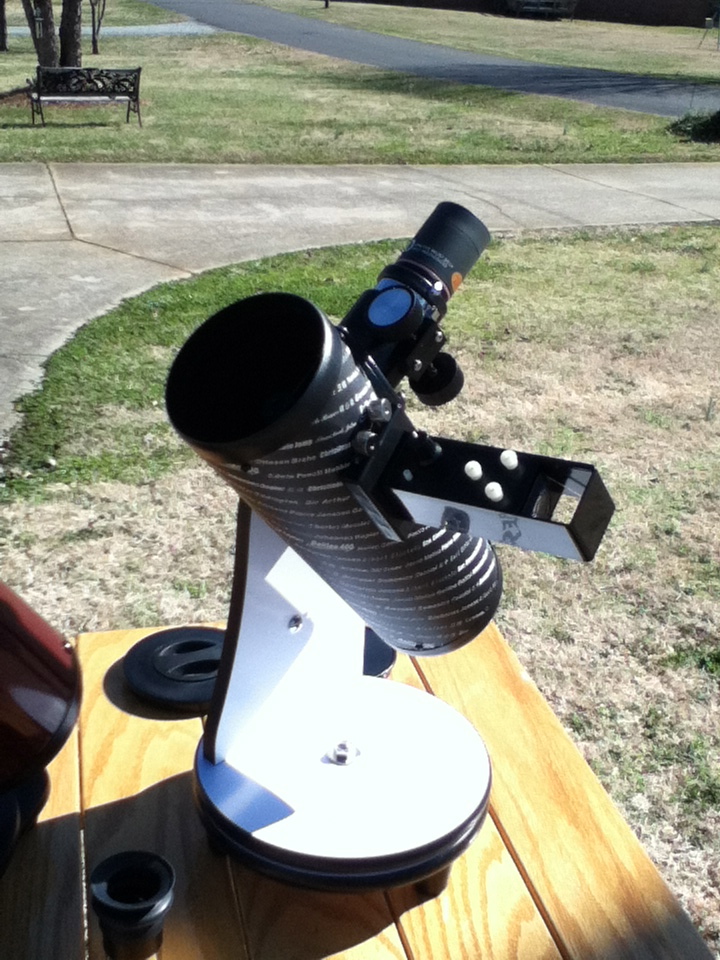
The 76mm Celestron FirstScope (model 21024) has a 300mm focal length for an f/4.0 focal ratio. It comes with two eyepieces for magnifications of 15x and 75x. This telescope sells for about $50 from a variety of vendors. I have a Pelican box full of eyepieces, so we didn’t use the ones that came with the telescope.
It should be noted that the Celestron FirstScope does not come with a finder, which is an essential item. Fortunately, I had a couple Rigel Quik Finders, so I use one with the FirstScope.
The mount is well constructed and moves very smoothly.
Back to observing:
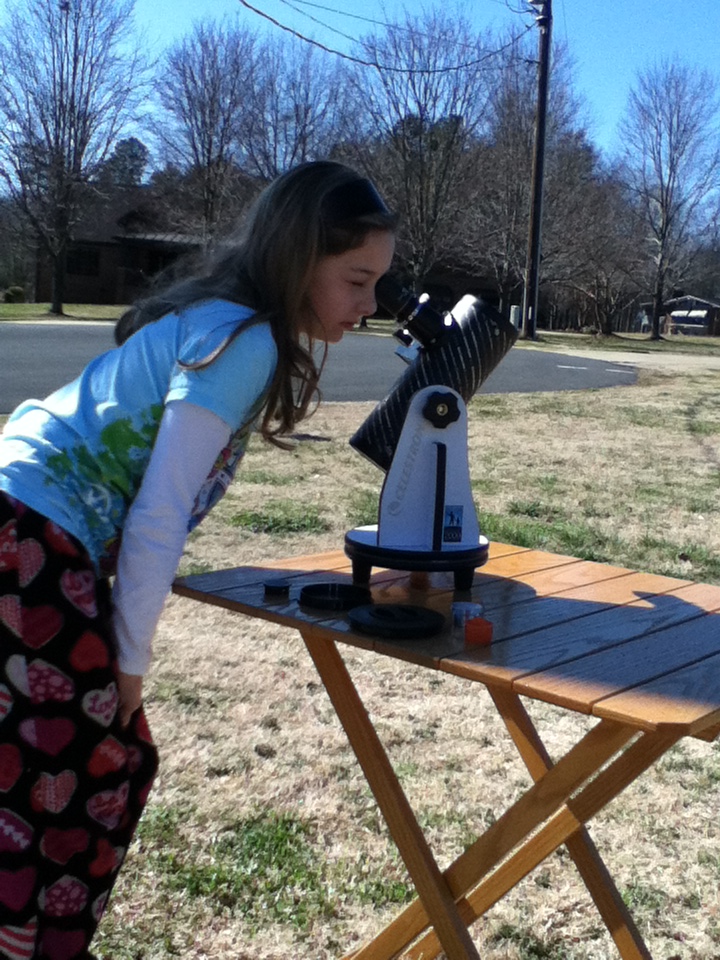
My granddaughter and I were able to observe quite a few deep-sky objects, and we stayed out well over an hour with the temperature below 30º. She learned how to use the Rigel Quik finder to point the scope, and had no trouble using the focuser.
Gracie could see the red star (known as the Espin Star) located in the central region of open cluster M41, and galaxies M81-82 were very easy to see.
She described the two galaxies very well, “one is mostly round and the other is oval” and this was without any coaching. She became very interested in learning about red stars and even pointed out a couple in the sky without a telescope.
On Sunday morning before church, Gracie filled out three note cards with her thoughts and descriptions from the previous night.
She mentioned the Espin star in M41, her perception of open cluster M45, the moon, Jupiter, M42 and the Trapezium. Gracie said she understood the purpose and importance of using a red light when observing. She had leaned about this in a book she had read. I was very impressed!
Her last sentence in her notes: “Then I looked at galaxies M81 & M82…it was a pretty cool night.” Gracie
If you find that amateur astronomy is not your cup of tea…well, you haven’t lost a great amount of money. However, if you discover that astronomy is an interesting hobby, and you desire a larger telescope, there are plenty to select from.
Now to the west coast:
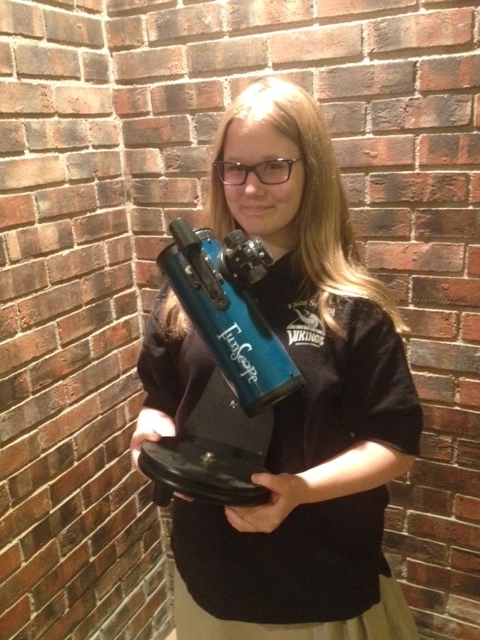
Photo below: My granddaughter from the west coast in 2012 with her Orion 76mm f/4 FunScope. This telescope is basically the same as the FirstScope, but comes with a decent magnified finder scope. The FunScope also has superior eyepieces, as compared to the Celestron FirstScope.
We actually observed from Henderson, Nevada…looking south. It was surprising, how many deep-sky objects we could see, and not very far from the Las Vegas Strip!
Following photo: East Coast granddaughter in 2012 with the 76 Celestron FirstScope
 rogerivester.com