Galaxy NGC 6118: Unanimously Agreed Upon By Amateurs To Be The Most Difficult Object In The Entire Herschel 400 List
After a couple unsuccessful observing sessions during the summer of 2024, I was anxious to try again in the early morning hours of 2025, with cold temperatures and more transparent skies.
March 26th 2024:
4:15 AM: I began with a magnification of 104x and field motion…then moving the galaxy out of the field, and then letting it drift back. Increasing the magnification to 291x, but the view was no better, and the galaxy appearing as only an intermittent blur and less than 50% of the time.
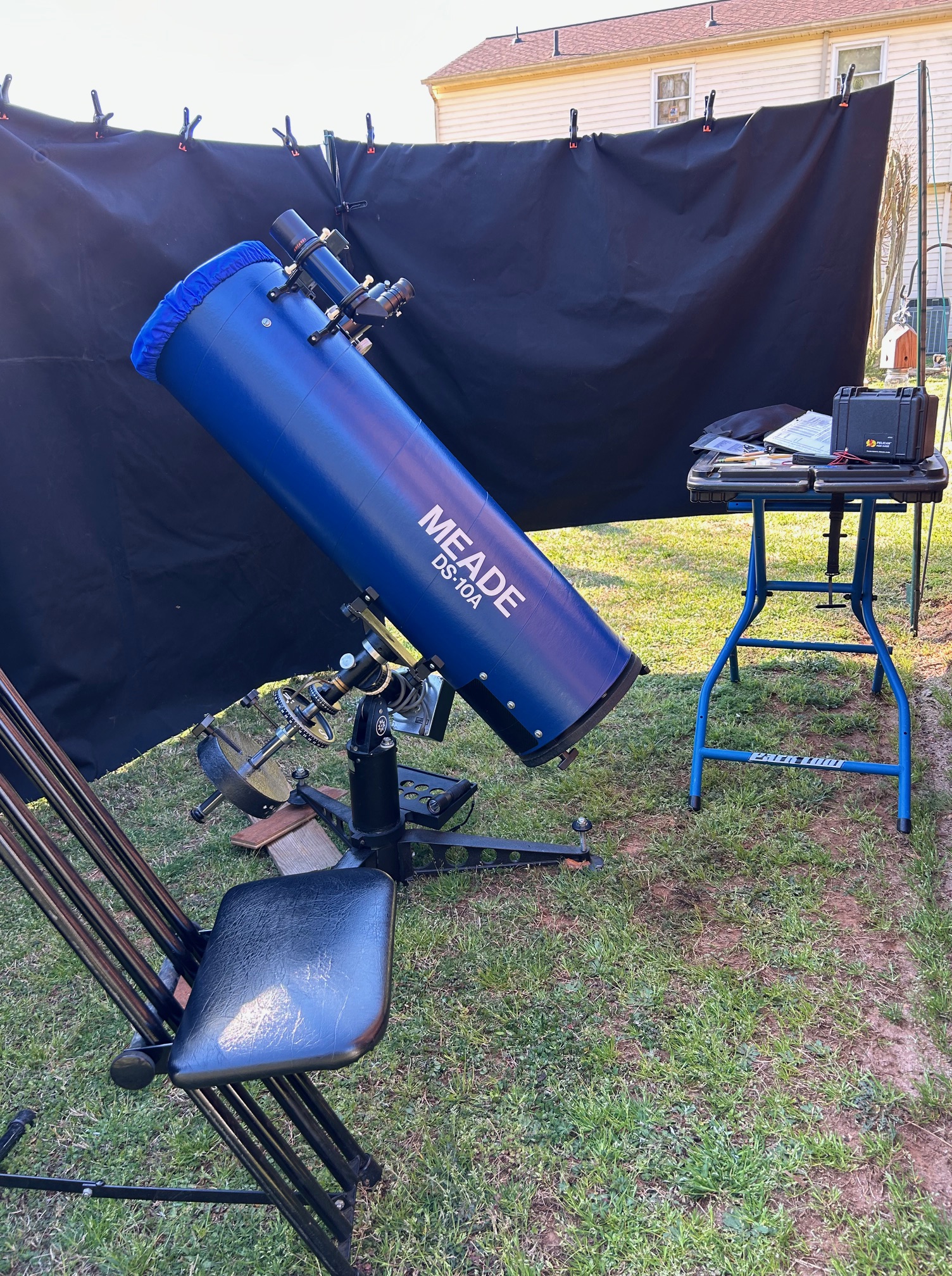
I attempted two very early morning observing sessions in March and April of 2024 from my suburban backyard, but again without success. A dark site is really needed to observe any low-surface-brightness galaxy, especially one as dim and faint as NGC 6118.
However, traveling to a dark-site has been over for many years. The disassembly of a heavy equatorial mount and handling a large solid-tube Newtonian, loading, driving, unloading, reassembly, and then having to do it all again, became just too much. I will just continue to do my best from the backyard.
I just couldn’t forget about this galaxy, and wanted to give it another try.
Saturday morning: May 11th 2024 @ 1:00 AM with a 5.0 NELM overhead, but about 4.0 in the area of the galaxy.
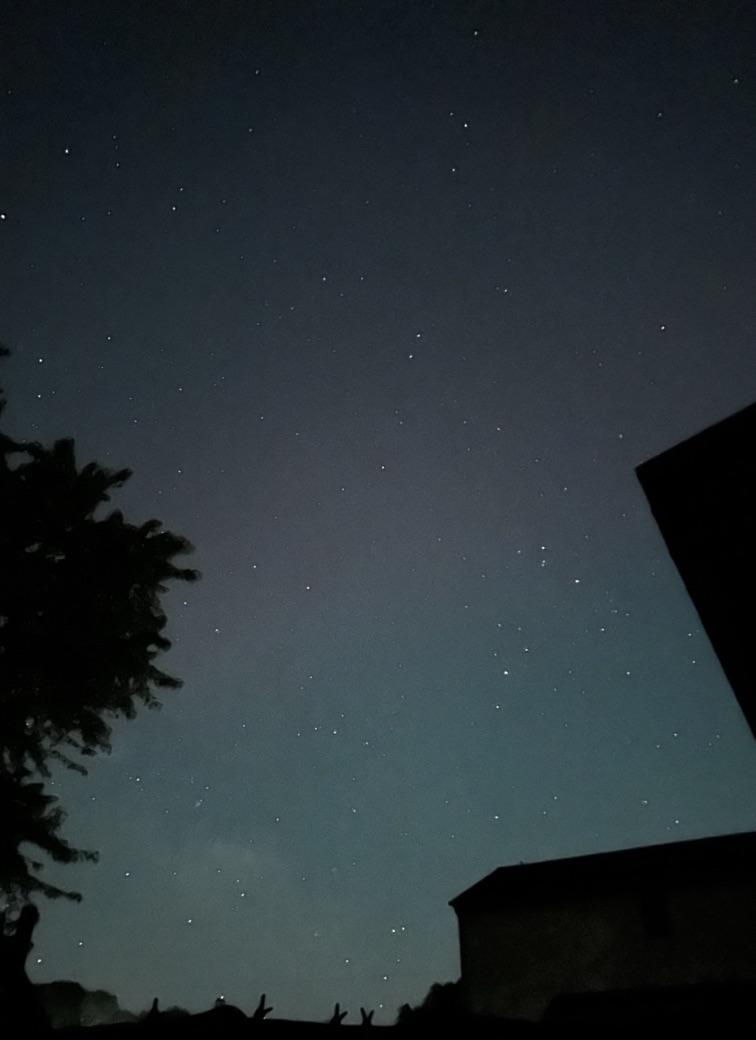
The following cellphone photo is from that night and beside my telescope. Note the constellation Scorpius toward the right lower corner. Now see the brighter pair of stars, almost in the center of the photo, above or north of Scorpius.
The most northern star, is known as “Yed Prior” at mag. 2.7. The second star toward the south or closest to Scorpius is “Yed Posterior” at mag. 3.2. Now move your telescope slightly to the NE of “Yed Prior” and use your star atlas to dead center, where NGC 6118 should be.
If you are a visual observer and observing from a suburban backyard, I wish you luck.
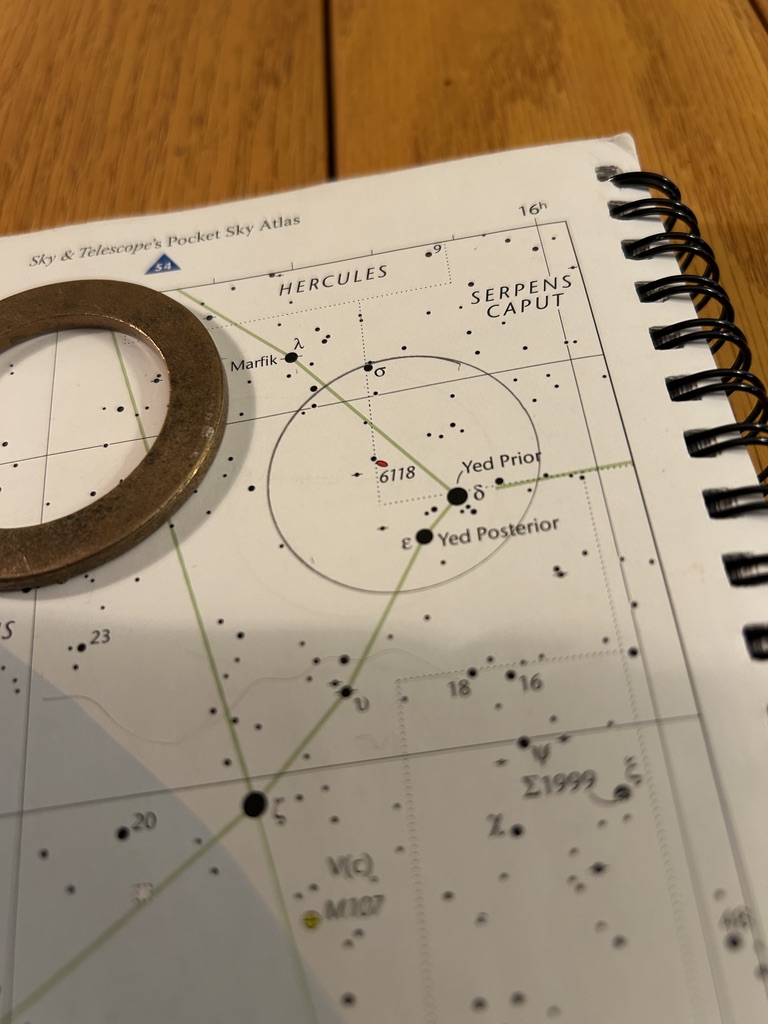
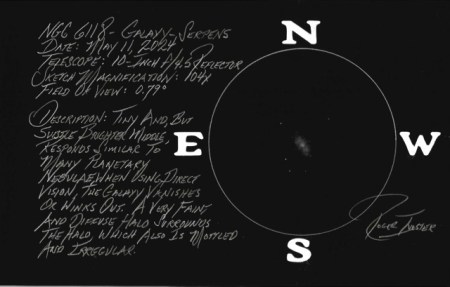
Telescope: 10-inch f/4.5 EQ Newtonian observing notes:
Description: A tiny and subtle brighter middle, which resembles that of a planetary nebula. And like so many planetary nebulae, when using direct vision, vanishes or winks out. The galaxy has a very faint and diffuse irregular halo, which is oriented NE-SW. After my many observing sessions of NGC 6118, it’s easy to understand why its named “The Blinking Galaxy.”
 rogerivester.com