Revised: Seeing Uranus Without Optical Aid? Is It Possible From A Suburban Back Yard, With A 5.5 NELM At The Zenith?
I received an email Saturday morning (March 7th 2025) from expert visual observer, Jaakko Saloranta from Finland. He asked me if I’d ever seen Uranus without optical aid. Seems that Jaakko had a “lively” discussion with some reporters concerning the visibility of seeing Uranus naked eyes.
March 18th 2025: My observation to see Uranus was unsuccessful, as transparency was poor and my NELM was less than 4.8 at the zenith, and the planet has a magnitude of ~ 5.75. And unfortunately, Uranus was already getting into the light dome of Boiling Springs, North Carolina.
After more than an hour of careful observing with a small 6 x 30 finder (by design) then looking over the finder, I could not see the planet naked-eye. I’d suggest this technique is an advantage as opposed to attempting to find Uranus in a mostly blank area of the sky.I used a 4.5-inch f/8 Newtonian on a GoTo mount to locate Uranus. A planet…unlike a deep-sky object does not have a permanent sky address.
My observational attempts are now over until November 2025. The trees and plants (March 22nd) are showing new life and pollen is beginning to fill the sky and reduce the sky transpacy considerably. I’d suggest pollen is similar to snow covering reflection.
I made the following wide-field sky photos last night (March 18th) at 9:30 PM using my iPhone. Can you see Uranus?
March 8th 2025 Observation:
Despite a bright moon, I wanted to use a 4.5-inch Newtonian from my suburban backyard, just to observe the planet telescopically. I’ll then try the small 6 x 30 finder, and then my 7 x 21 Pentax mini-binoculars. I was successful in seeing the planet with all three, but never attempted naked eyes for obvious reasons. Roger
Reports as following…
Alan French (New York)
Long ago, it was the late 1980s or early 1990s, Sue and I made a point of catching Uranus by eye from the Texas Star Party. If I recall correctly, the folks at TSP suggested it because the planet was in a sparser star field than usual. It’s not something I could probably do today.
Observer 2: March 8th 2025 @ 8:30 PM EST
Roger Ivester (North Carolina)
March 8th 2025: 71% illuminated Moon, excellent seeing @ 50º
First let me say, I was using a Goto mount when attempting to see the planet Uranus. A GoTo system would give anyone an advantage. And a faint planet can be difficult to locate…unlike a deep-sky object that has a permanent sky address.
Yes, I know that the objective is to see Uranus without optical aid, but I just had to first see it with a 4.5-inch f/8 Newtonian. It was easy, appearing as a mostly white star using a magnification of 35x. When increasing the magnification to 128x, it still appeared as a star, but now with a greenish tint.
I could easily see with a small 6 x 30 finder scope, but a bit fainter through a pair of 7 x 21 Pentax binoculars. Then when looking over the finder, then alternately looking through the finder, I could not see Uranus without optical aid.
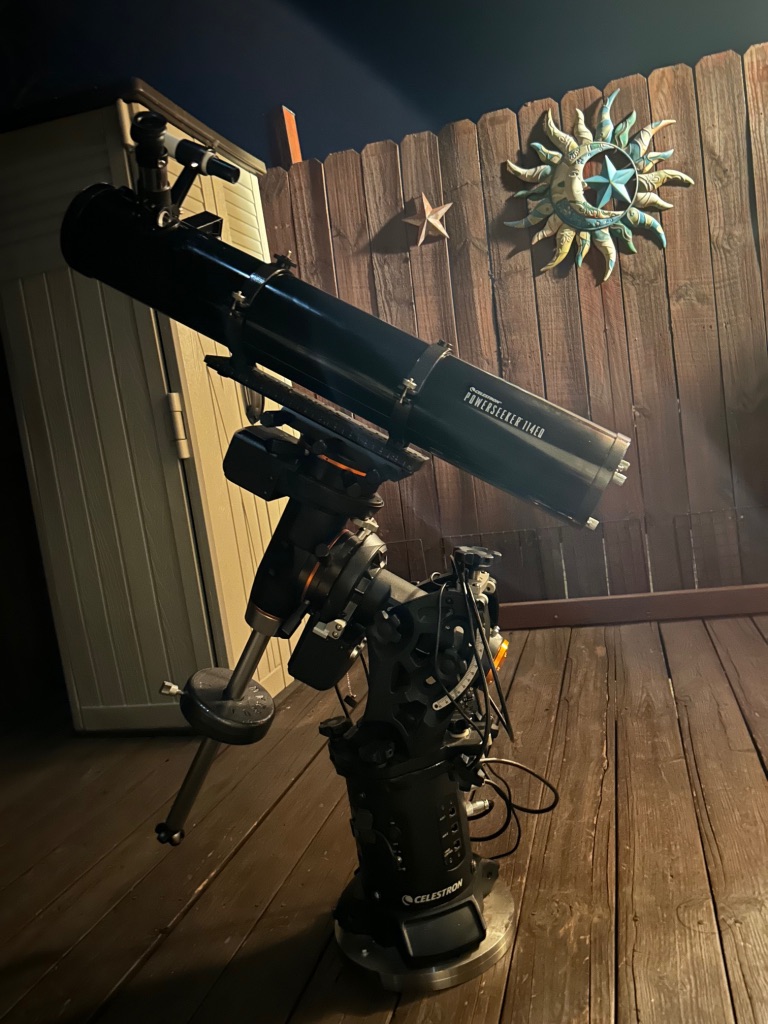
I wanted to document all things on this night, even with a photo of the telescope and mount used. This was a telescope given to me recently by a friend, and I’ve been spending a little time this week tuning it up. I was interested in seeing Uranus with the tiny 6 x 30 finder.
Observer Three: March 9th 2025
Mario Motta (Massachusetts)
Hi Roger,
As it turns out I have such an image, taken five years ago with my 32-inch telescope. The small planet size at such a great distance, does indeed has a slight greenish color, just like you mentioned in your post.
Taken with my 32-inch f/6 telescope, with ZWO asi 071 OSC camera, video the stacked and processed
The second image presents five of the planets moons…and very nicely!
Mario
Supplemental: Successful observation without optical aid by Mario Motta:
I once saw it naked eye from my place in New Hampshire, about 20 years ago with a mag. 6.5 sky.
Observer 4: Jaako Saloranta from Finland:
Hey Roger,
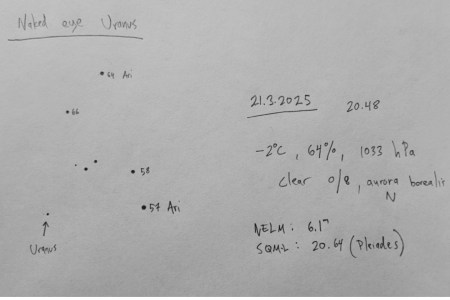
Here’s my sketch of Uranus – this is the original one I made at the site and as I no longer have a working scanner… this is all I could muster with my phone.
I rode my bicycle roughly 10 kilometers west from my house and found a decent, dark spot for myself. Temperature was roughly 27°F so it didn’t take too long for me to get cold after some sweaty cycling! While waiting for full night vision I could see M34, M35 and maybe M36 with the naked eye. Winter Milky Way was faintly visible from Perseus to Monoceros.
But Uranus itself… seeing it was quite difficult because of the low altitude (~30 degrees). I could see roughly down to magnitude 6.5 from the west/zenith but at the general region of the Pleiades I could barely make out 6 magnitude (I managed to saw 65 Arietis only a few times during the 30 minutes I was observing Uranus) stars. I could see Uranus only… maybe 30% of the time with optimal averted vision. See Uranus back in 2011 was a lot easier from Canary Islands (high altitude, higher object altitude, darker skies and younger observer).
After I was done observing, I noticed that green aurora borealis arc in the northern sky. When I eventually got back home, I could see faint aurora glow even at the zenith.
/Jaakko
Observer 5: Steve O’Meara (Tucson)
Hi Roger,
Sometime in the 1980’s, I was outside David Levy’s Tucson home, casually stargazing by eye with Steve O’Meara, when Steve noticed Uranus in the sky.
This entry was posted on March 8, 2025 at 1:34 pm and is filed under Roger's Articles. You can subscribe via RSS 2.0 feed to this post's comments. Both comments and pings are currently closed.




 rogerivester.com