Galaxies NGC 3893 And NGC 3896 In Ursa Major Always Be Sure To Document Your Observations…
Mario Motta: Observer from Massachusetts
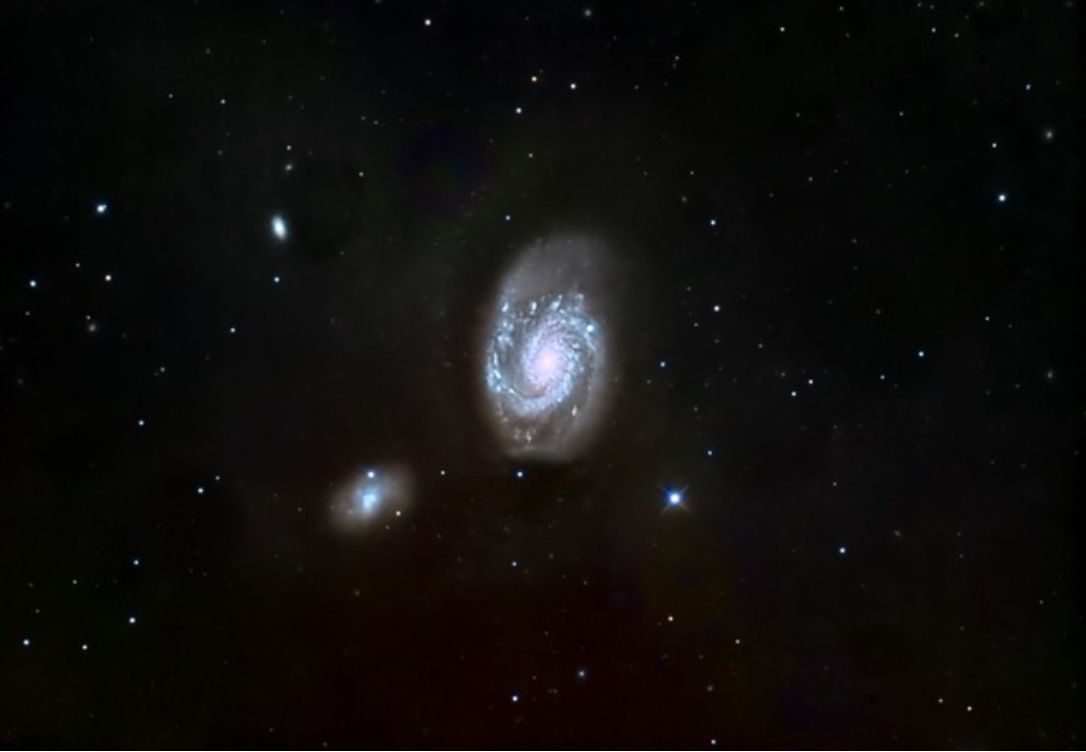
This image took some effort. I captured the galaxy in Lum with my 32-inch this past December from Gloucester, but did not have enough night to get it in color.
I tried in Florida, but it lacks the detail of the 32-inch as it is only 4.5 by 2,4 arc minutes, thus needs the larger telescope for detail. However, I then used a process in pixinsight to combine images from 2 different optical systems, and it worked. So…lum from the 32-inch scope with about 75 minutes lum ZWO 6200 camera.
Then RGB from C14 scope in Florida again ZWO 6200, (about 70 min total), processed then combined with dynamic alignment tool in Pixinsight. Note NGC 3896 close by to the immediate east.This worked, I may try for more such galaxies in color only to add to my 32 inch collection of galaxies in Lum only. Spring is so short a season for all the galaxies available.
Jaakko Saloranta: Observer from Finland
Back in March, the galaxy duo was visible in a good, high (77°) spot in the sky. Using high magnification (304x) with a 4.5-inch reflector, I described the view as follows: Fairly bright, N-S elongated galaxy with a brighter nucleus. Faint mag. 13 star touched the halo in NW.
NGC 3896 appeared as a tiny, fairly faint and slightly SE-NW elongated galaxy just south of a mag. 13 star. Observing conditions were average: NELM around 6.0 with SQM-L readings of 20.20 near the object. Temperatures still dropped well below zero Celsius on the night of 26 March.

Roger Ivester: Observer from North Carolina
I wanted to share an article concerning an observation I made on April 20, 1993. It’s a testament that documenting and taking good notes is indeed a good thing! During some recent cloudy weather, while reviewing past logbook entries, I discovered that I had not followed up on an object viewed on 20 April, 1993. The main object was NGC 3893, a mag. 11 galaxy in Ursa Major. While making my sketch of this excellent galaxy, I noticed a smaller, very faint object, SE and very close. I noted this in my logbook as one to look up later. It was almost ten months later, while browsing through the logbook, that I remembered to follow up on this observation.
I checked Burnham’s Celestial Handbook, Tom Lorenzen’s 1000+, and the Tirion Sky Atlas 2000.0, only to find that none of these sources listed a companion galaxy. I then went to the NGC 2000.0 Catalog by Roger Sinnott, and found the companion listed as NGC 3896, a 14th magnitude galaxy. I was elated to find out this was a faint galaxy. It should also be noted that my observation was made from my back deck, with several unshielded streetlights nearby.
If I had not sketched NGC 3893, it’s possible that I would have missed NGC 3896. If I had not logged the mysterious companion, I probably would never have checked any reference material on a future date.
So, the moral of this story is: Keep a logbook, sketch your observations, and periodically review your notes. You never know what you might find. I was very excited about going back to NGC 3893 and NGC 3896 after twenty one years, and surprised that they appeared exactly as I remembered them.
It’s truly amazing how the brain can remember a faint galaxy pair after all this time.Using a 10-inch Newtonian reflector, I could easily see NGC 3893 at 57x, appearing as a faint oval, oriented NNW-SSE. When I increased the magnification to 200x, the halo became enlarged and I saw a faint stellar nucleus. I also spotted a mag. 13 star on the NW tip.
The faint companion galaxy, NGC 3896, at mag. 14.0 was very difficult, especially when observed from my moderately light polluted backyard. Using 200x and averted vision, it appeared mostly round with low surface brightness. I noted little to no detail. With patience and careful viewing, I saw two very faint stars on the NW tip.

 rogerivester.com