Galaxies NGC 4290 And NGC 4284 Which Can Be A Real Challenge For The Backyard Observer
Sue French: Observer from New York
M40 is a double star near Megrez (Delta Ursae Majoris). Oddly, M40 was once considered a non-existent Messier object. In his 1784 catalogue, Charles Messier described his 40th object as: “Two stars very close to one another and very small, placed at the root of the great Bear’s tail.” Precessing Messier’s coordinates to equinox 2000 takes us right to such a star pair. Messier noted this double while searching for a “nebulous star” reported by Johannes Hevelius. Messier assumed that Hevelius mistook these two stars for a nebula, but the latter was actually referring to a different pair of stars – also without nebulosity.
To locate M40, start at Megrez and hop 1.1º northeast to mag. 5.5 70 Ursae Majoris. Continue that line for 1/4º to arrive at M40. My 4.1-inch scope at 28x reveals an east-west pair of mag. 10 stars, with the western one slightly brighter. Through my 10-inch scope, I see the primary as yellow-orange and its companion as yellow-white.
Two galaxies share the field at 118x. NGC 4290 is a small northeast-southwest oval, and NGC 4284 is a tiny faint spot forming a 1½’ triangle with two mag. 13 stars.
The galaxies are about 140 and 190 million light- years away. Although the distances to its stars are poorly known, M40 is probably an optical (unrelated) pair. Independently discovered in 1863 by the German astronomer Friedrich August Theodor Winnecke, M40 carries the double-star designation Winnecke 4. Winnecke is also the original discoverer of eight NGC objects, and ten comets that bear his name.
Roger Ivester: Observer from North Carolina
Due to our recent bad skies, I was unable to make a new observation of M40, and galaxies NGC 4284 and NGC 4290. I was forced to use a sketch and notes from an earlymorning observation on February 25, 2000.
On that night, I was using a 10-inch reflector from my moderately light-polluted backyard with a 5.8 NELM. It was an especially good night with excellent transparency.
M40, a pair of mag. 10 stars, also known as Winnecke 4, was very easy with a wide separation of about 50 seconds of arc. The pair was oriented mostly east-west and both appeared as whitish-yellow in color.
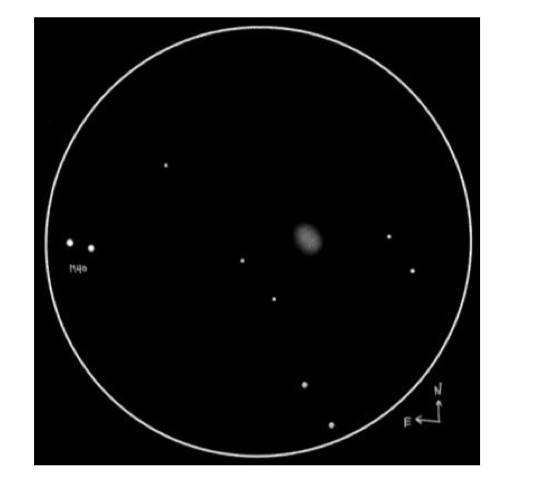
Two faint galaxies were located very close to M40. All three objects were located within a 1/2º field-of-view. Just to the west of M40, lay faint galaxy NGC 4290 at mag. 12.0, elongated NNE-WSW. I saw a very subtle brightness in the central region. Very close and to the west of it was a very faint mag. 14 galaxy, NGC 4284, which was extremely difficult, appearing as a faint, mostly round blur. And during a previous observation from the same location with a friend, and in a side-by-side comparison with the 10-inch reflector and an 8-inch Celestron Schmidt-Cassegrain. We couldn’t see NGC 4284 with the 8-inch SC telescope, but could in the 10-inch Newtonian.
The following pencil sketch was made using various graphite pencils and a blank 5 x 8 notecard with the colors inverted using a scanner.

Jaakko Saloranta: Observer from Finland
Here’s all I’ve got: With a 4.5-inch reflector @ 152x (20′), the galaxy appeared as a fairly faint, NE-SW elongated galaxy, without detail, close to double star M40. NGC 4284 was invisible. Altitude of the object was 74°.
 rogerivester.com