The Most Difficult Objects Of The Herschel-400 List
Galaxy NGC 6118 (Serpens) and open cluster NGC 6540 (Sagittarius).
If you are considering taking on the Herschel-400 list: If can see these two objects, it’s very likely you will be able to see all of the other 398 objects. This is contingent on having an unobstructed sky, and with a minimum of light pollution
During the winter of 1994, I began my effort to see as many of the H-400 objects as possible from my suburban backyard. Due to light pollution, trees and obstructions, I knew it would be impossible for me to see the entire list. I started in earnest and dedicated “the majority of my observing time” for about two years to the list. Many of the small open clusters gave me a problem and were difficult to identify. I called many of these clusters “non-existent” in my notes.
I made notes of all the ~250 objects, and sometimes with a pencil sketch of those worthy of a sketch. However, due to trees, houses and light pollution over two year period, I called it quits.
My story of seeing NGC 6118, which was very difficult from my suburban backyard using a 10-inch f/4.5 EQ Newtonian. I never attempted open cluster NGC 6540, due to its more southerly sky position with severe light pollution.
…I attempted two very early morning observing sessions in March and April of 2024 from my suburban backyard, but again without success. A dark site is really needed to observe any low-surface-brightness galaxy, especially one as dim and faint as NGC 6118.
However, traveling to a dark-site has been over for me now for many years. The disassembly of a heavy equatorial mount and handling a large solid-tube Newtonian, loading, driving, unloading, reassembly, and then having to do it all again, became just too much. I will continue to do my best from the backyard.
Many years ago, I assembled light-block system, made of heavy-duty automotive-marine fabric. This simple, but effective structure has helped me on many occasions over the years to see difficult and faint deep-sky objects. The light-block system is especially helpful in some areas of the southern sky, where light pollution is significant. It’s easy to set up and take down. When the fabric is removed and folded for storage, the steel post and plastic-coated wires remain and are hardly noticeable.
I attribute my ability to finally see NGC 6118 was due to blocking a very bright LED carport light less than 1/8 mile away. This light was shining directly toward my backyard, and brightening up the area of my telescope and observing location significantly. Due to the light pollution in my southern sky…I never even considered open cluster NGC 6540.
Saturday morning; May 11th 2024 @ 1:00 AM, with a 5.0 NELM overhead, but far less in the sky near NGC 6118, due to overlooking the town of Boiling Springs.
With a bit of difficulty and after almost an hour of careful observing, I was finally able to see the galaxy. My portable “make-shift” observatory was the answer to finally seeing this faint and difficult object from my suburban backyard.
I really don’t think this galaxy would be that difficult from a dark-site, and with my 10-inch Newtonian. However, as I’ve mentioned previously, my days of traveling with a telescope have been over for a few years now. I just love the convenience of my backyard and seeing a galaxy this faint, proves that a suburban backyard can still allow effective deep-sky observing.
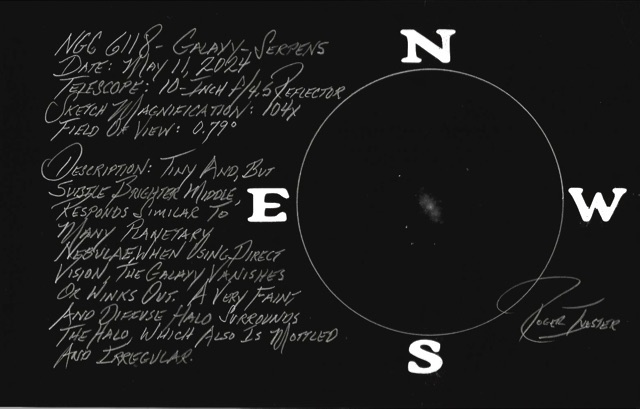
Description: A tiny and subtle brighter middle, which resembles that of a planetary nebula. And like so many planetary nebulae, when using direct vision, vanishes or winks out. I now know why NGC 6118 is known as “The Blinking Galaxy.” The galaxy has a very faint and diffuse halo with mottling, which is oriented NE-SW.
Roger Ivester
The following are some excerpts from an article by Jay Reynolds Freeman concerning his success in seeing all of the H-400 objects using a Vixen 55 mm f/8 fluorite refractor. Yes…a 55mm refractor!
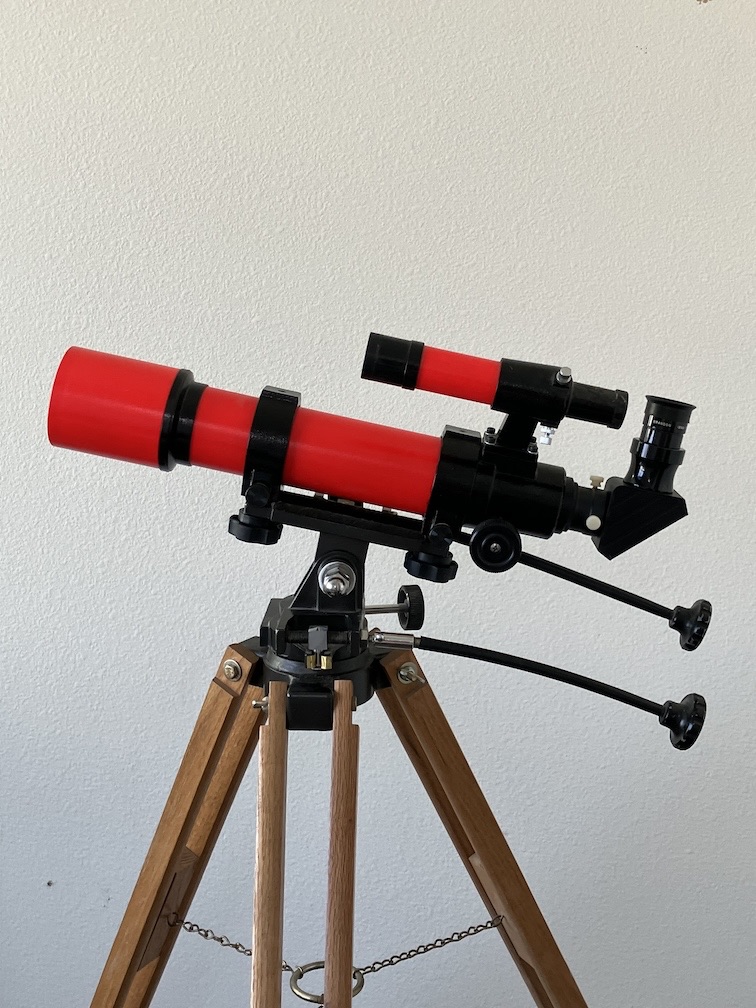
“Seduced by exquisite optics and compact size, I bought a used Vixen 55 mm f/8 refractor, whose objective used the optical material fluorite, in April, 1998. To replace by attitude what it lacked in size, I repainted the tube, and named the telescope Refractor Red, for its new, fluorescent color. I mounted it on an altazimuth mounting from an 80 mm refractor, then set out in pursuit of all the Messier objects. I anticipated the search would not be difficult, for three of my previous Messier surveys had been with less aperture. So I decided to try something harder, too — the Astronomical League’s “Herschel 400″ list. That modern selection from the brighter objects discovered by Sir William Herschel, would be challenging.”
“…As word of my project got around, curious fellow observers asked whether I had tried their favorite difficult Herschel-400 targets. I kept hearing about NGC 6118 and NGC 6540. The former is an obliquely viewed low surface brightness spiral galaxy in eastern Serpens Caput,the latter a little cluster in Sagittarius. One June night, I looked for both from Fremont Peak State Park, a popular observing site near San Juan Bautista, California.”
“Uncommonly good transparency and an incomplete fog layer on the coastal plain below made the high sky quite dark. The North American Nebula was easy with the naked eye: I could detect the “Gulf of Mexico”within it. I looked for NGC 6118 with two eyepieces, alternating between my 12 mm Brandon and a 20 mm Meade Research Grade Erfle, which gave 22x and a 2.5 mm exit pupil.”
“With each eyepiece, I saw a faint, diffuse, and not very centrally concentrated glow, popping in and out at the limit of averted vision, at the charted position. Jiggling the telescope, or moving it slightly with the slow motions, helped a bit. The glow was detectable only ten or twenty percent of the time, but it kept reappearing at the same place. Since I did not see similar fluctuations of intensity at random places in the field, I logged it. That was the toughest object in my Herschel-400 survey with Refractor Red.”
“Its difficulty might stem from not having nearly as large or bright a center as most other galaxies. A bright core seems to draw the eye, and to give the brain a reference point for locating the fainter, outer periphery of the object. Since I had an equally good view at 22x and 37x, I suspect that a magnification between those values might have best suited NGC 6118 that night.”
“Unfortunately, I had not brought a suitable eyepiece. Herschel described NGC 6540 as a faint, sparse, relatively small open cluster, yet what _Millennium_Star_Atlas_ plots is a ten arc-minute globular. Using the 12 mm Brandon, I saw a six or seven arc-minute unresolved circular glow, just barely brighter than the background of the Sagittarius Milky Way, with a smaller, brighter core superimposed.”
…NGC 6540, was easier than NGC 6118.
Explore posts in the same categories: Roger's Articles, Virgo Diamond: Faint Five Star Asterism rogerivester.com