Galaxy NGC 55: The Largest Galaxy In The Sculptor Group
“Some deep-sky objects offer beautiful, breathtaking visual experiences. NGC 55 is one such object.” Walter Scott Houston (Note: WSW’s observations of this galaxy were from Mexico)
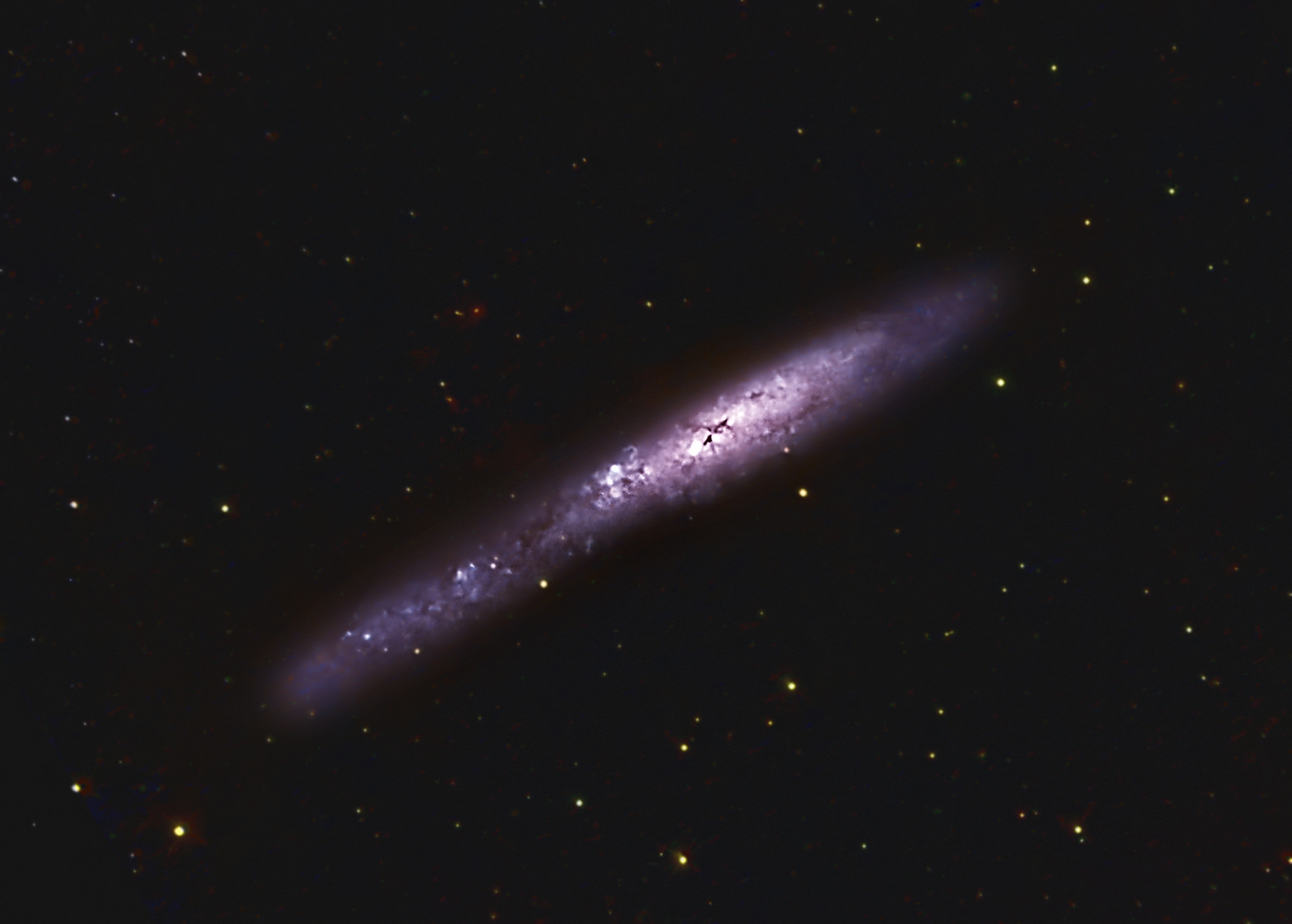
For a nice image of NGC 55, I’m including the following by renowned astrophotographer Mario Motta:
My image was Lum from Gloucester with my 32-inch, combined with RGB from Florida to make a color image. It’s too low in in Massachusetts to get color channels. So, the detail is from the 32-inch combined with color from Florida using a C14. Mario
My journey to observe a challenging southern hemisphere galaxy began on December 8, 2012. The galaxy itself is not particularly difficult to observe; rather, its extreme southern declination makes it challenging to see for many observers living in the continental United States. Roger Ivester
My backyard offers a poor view of the southern sky, so I packed up my 10-inch telescope and headed out in search of a better observing location. In my attempt to see the far-south southern hemisphere galaxy, from my +35º latitude, an excellent southern horizon is required. Any skyglow or light pollution anywhere near the horizon can make the galaxy impossible to see.
So, my story begins on December 8th 2012…
There is a site less than a couple of miles from home, where light pollution was minimal. From there, I could easily identify my starting star, Alpha Phoenicis, shining just above the tree line. I used my star atlas and moved the telescope to the galaxy position, but it remained invisible. A faint skyglow extended roughly 10º above the horizon, which eliminated the contrast, needed to see this galaxy. Then after more than an hour, without success, I packed up and left.
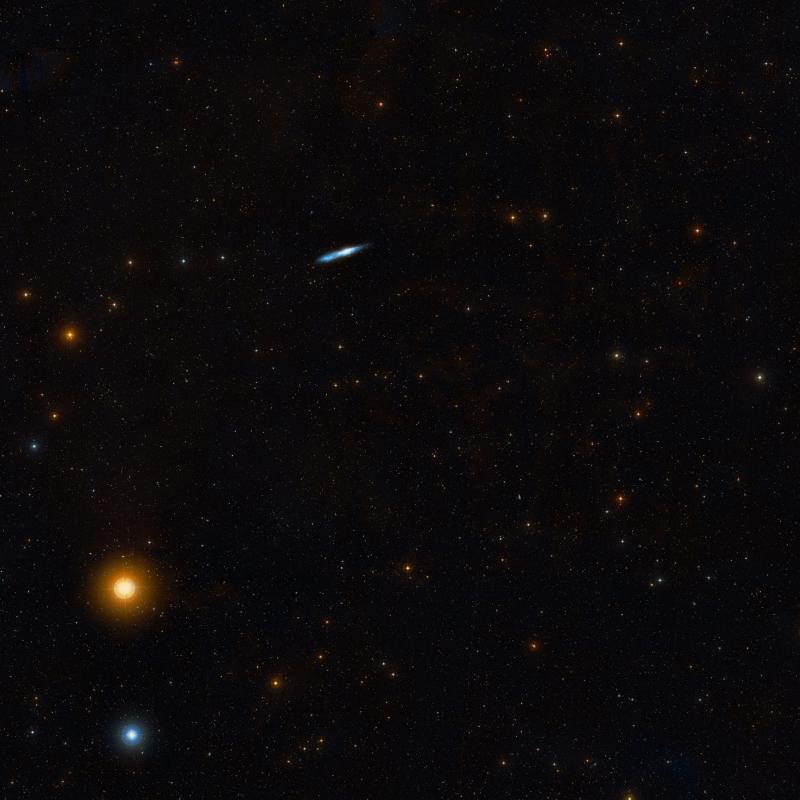
For a wide-field image of galaxy NGC 55 I’ve included the following from: www.wikisky.org
My second attempt was December 13, 2012:
I wanted my wife, Debbie, to come along, as I was still recovering from an accident involving a Ford F-150 pickup truck while riding my bicycle. This occurred just a couple of weeks earlier, in November 2012. I had been struck from behind by the truck’s side mirror. I was fortunate to have not sustained any very serious injuries. However, we got a late start that evening and decided it would be best to choose a location closer to home.
The alternate site was reasonably good, although there was skyglow again extending well above the horizon. After more than an hour of searching without success, I finally gave up.
I have searched for this galaxy on numerous occasions since 2012, including several attempts in November and December of both 2024 and 2025 from various locations, and as late as November 2026.
There is a small mountain peak along the edge of the South Mountains that would make an ideal observing site, for this far south galaxy, but…
Located just 30 minutes from my home, this location is where I observed and sketched both Centaurus A and Omega Centauri. Unfortunately, about five years ago, a large electronic iron gate was installed, effectively restricting access to the property. I’ve made several attempts to contact someone who might be able to help me regain access, but I’ve never received a response.
Today, Debbie, Sophie, and I made the drive to a location that has given amateur astronomers throughout the region countless memorable nights under the stars. It’s been several years since I last observed from Lost Arrow Ranch, but returning today brought back good memories. I have a feeling this just might be the very place I’ve been searching for! And it was good to see Jackie Price, which was the first time in about five years.
I’d just been hoping to find a location a little closer to home, but I think the extra drive is worth it. I’ve noticed that driving at night isn’t quite as easy as it used to be.
Jackie’s late husband, Mike Price, was a lifetime member of the Cleveland County Astronomical Society, a club I helped establish around the time of Halley’s Comet’s last appearance. It was wonderful reconnecting with Jackie and taking a look around the dark-sky observing site, where I had spent so many nights over the years. Some of those nights were bitterly cold, but the chill never seemed to matter when there was a faint, distant deep-sky object waiting to be found in the eyepiece.
I can still remember those hours long observing sessions, over the years, before ending and having frost on my toboggan (what folks in the northern states might call a ski cap or knitted hat). Those were special nights, and returning to the site brought back a lot of fond memories.
Mike was a remarkable man with many talents, one of which was being an acrobatic pilot. I’ll never forget the evening he treated us all to an unforgettable demonstration of his flying skills, performing right over our observing site. To stall a plane in a vertical position, then letting it fall backyards takes nerves of steel. Then before it hits the ground, in a death-dive he pulls the plane up just above the treetops. Incredible! It’s a memory that has stayed with me through the years!
Lost Arrow Ranch encompasses approximately 1,500 acres of some of the most beautiful landscapes on Earth! In an age when light pollution makes truly dark skies increasingly rare, this place is an astronomer’s dream. I’m excited to be returning, and I have a feeling this may be the perfect location to finally catch a glimpse of the elusive southern hemisphere galaxy, NGC 55.
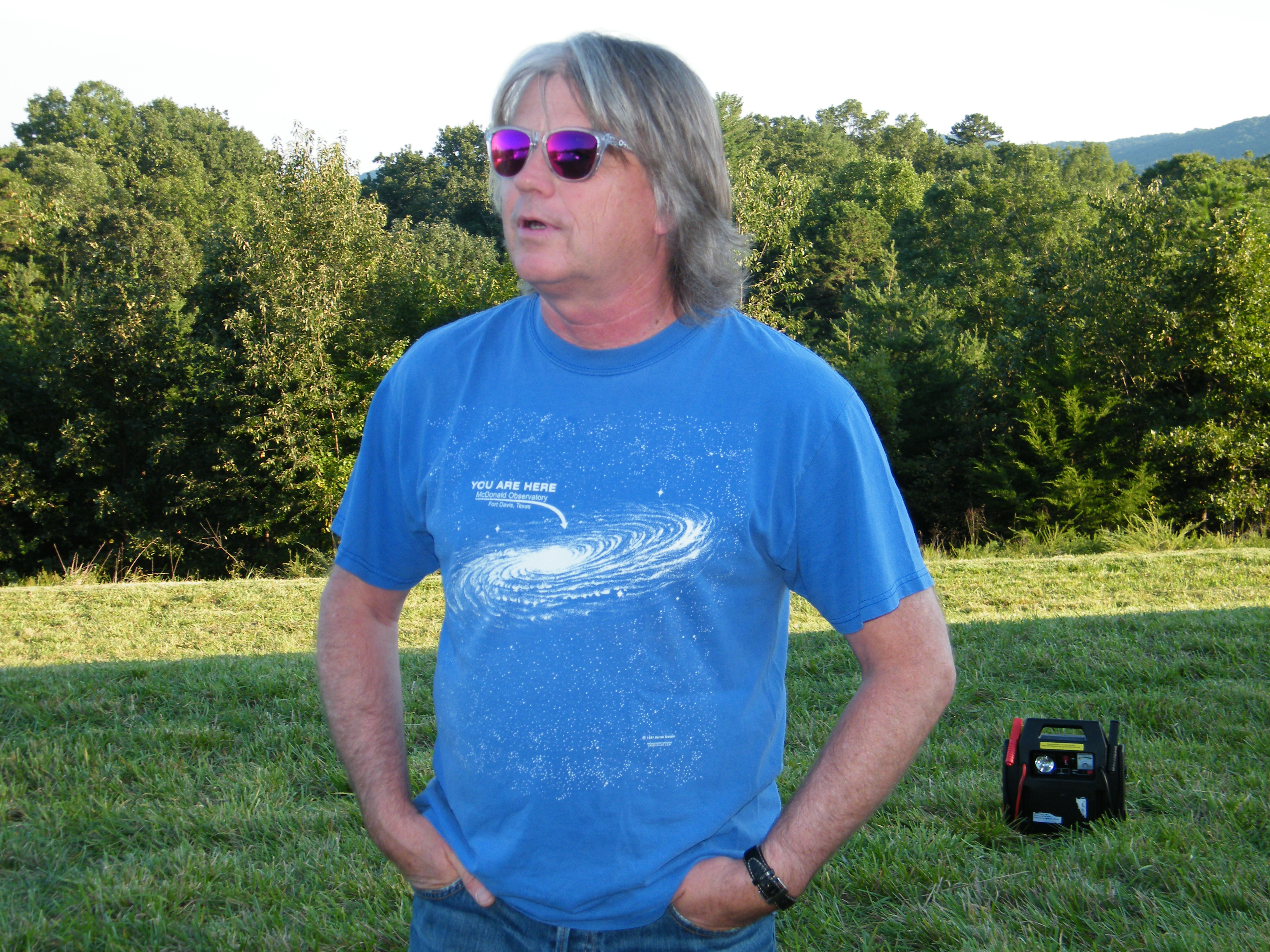
Pictured below is the late Mike Price, who often reminded me and many others, “I’m simply the caretaker of this property.”
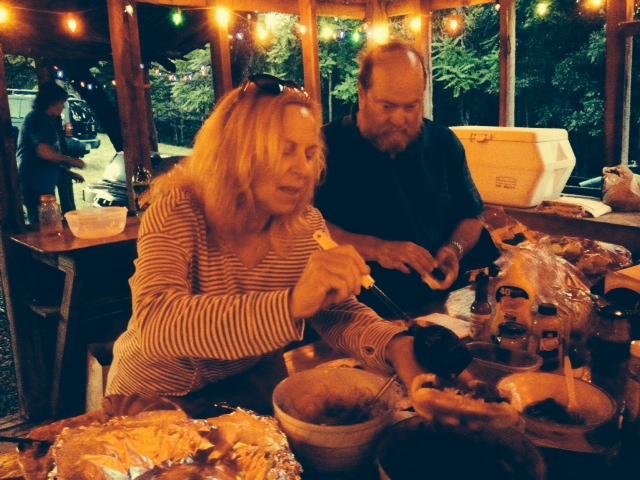
Jackie Price at one of our occasional cook-outs at Lost Arrow Ranch and long-time local amateur astronomer, Bob Eskridge, standing behind.
Club observing at “The Slab” known for a concrete slab, which at one time might have been the foundation for an old house on the property.