Archive for the ‘Work File Only – Observer’s Challenge Reports’ category

Globular Cluster M13 And The Elusive Propeller

June 23, 2012

The great globular cluster, M13 is located high overhead for observers in the northern hemisphere during the summer months, allowing for excellent viewing.  When observing this cluster back in 1977 with my 4 1/4-inch f/10 reflector, the most I could see was a moderately bright ball of unresolved stars.    

While observing M13 with the small reflector, I was unaware of the three dark lanes cutting into the SE edge of the cluster, known as the propeller.  I had never heard of the propeller at that time, but this scope was far too small to see this very faint feature.  However, thirty two years later in May of 2009 using a much larger telescope, I was finally able to see the three dark-lanes.     

A 10-inch telescope “might be considered the minimum aperture” required to see this most unique feature.  If you have plans to observe the “elusive propeller” a magnification of around 200x seems to be the optimum.  

The propeller challenge seemingly became popular due to Walter Scott Houston, columnist and writer of “Deep-Sky Wonders” suggesting that observers look for it.  

Houston first wrote about the propeller in the July 1953 edition of “Sky & Telescope magazine.”  He brought it up several more times through the years, however,  it has been only in recent times that the propeller has gained much attention in the amateur astronomy community. 

Lord Rosse mentioned three dark rifts in the 1850’s, and T.W. Webb in “Celestial Objects for Common Telescopes” noted that the lanes were seen by Buffham, using a 9-inch reflector. 

John Bortle saw the lanes in 1980 using a 12.5-inch reflector, and Dennis di Cicco saw them easily with the 12-inch f/17 Porter telescope during Stellafane in 1981.  (Source: “Deep-Sky Wonder’s” By Walter Scott Houston, selections and commentary by Stephan James O’Meara.  Sky Publishing Corporation, Cambridge Massachusetts)  

In May of 2009, I was able to observe the propeller with both 10 and 12-inch Newtonian’s.  My first sighting of the propeller came when using a friends 12-inch from the southern rim of the South Mountains in North Carolina.  I would rate this site as very good with a NELM of 6.0 (at the zenith) and maybe even better on an excellent night.  

The propeller was fairly easy to see with the 12-inch f/5 reflector from this location.  However, seeing the propeller from my suburban backyard and 10-inch f/4.5 Newtonian, was possibly seem only using my imagination.  🙂

The following sketch was made using Steve Davis’ Meade 12-inch f/5 reflector at 190x, just off Moore Mountain Road in Rutherford, County.  

The sketch was made with a No. 2 pencil and a blank 5 x 8 note card.  The colors were inverted using a scanner.     

M13 And The Elusive Propeller


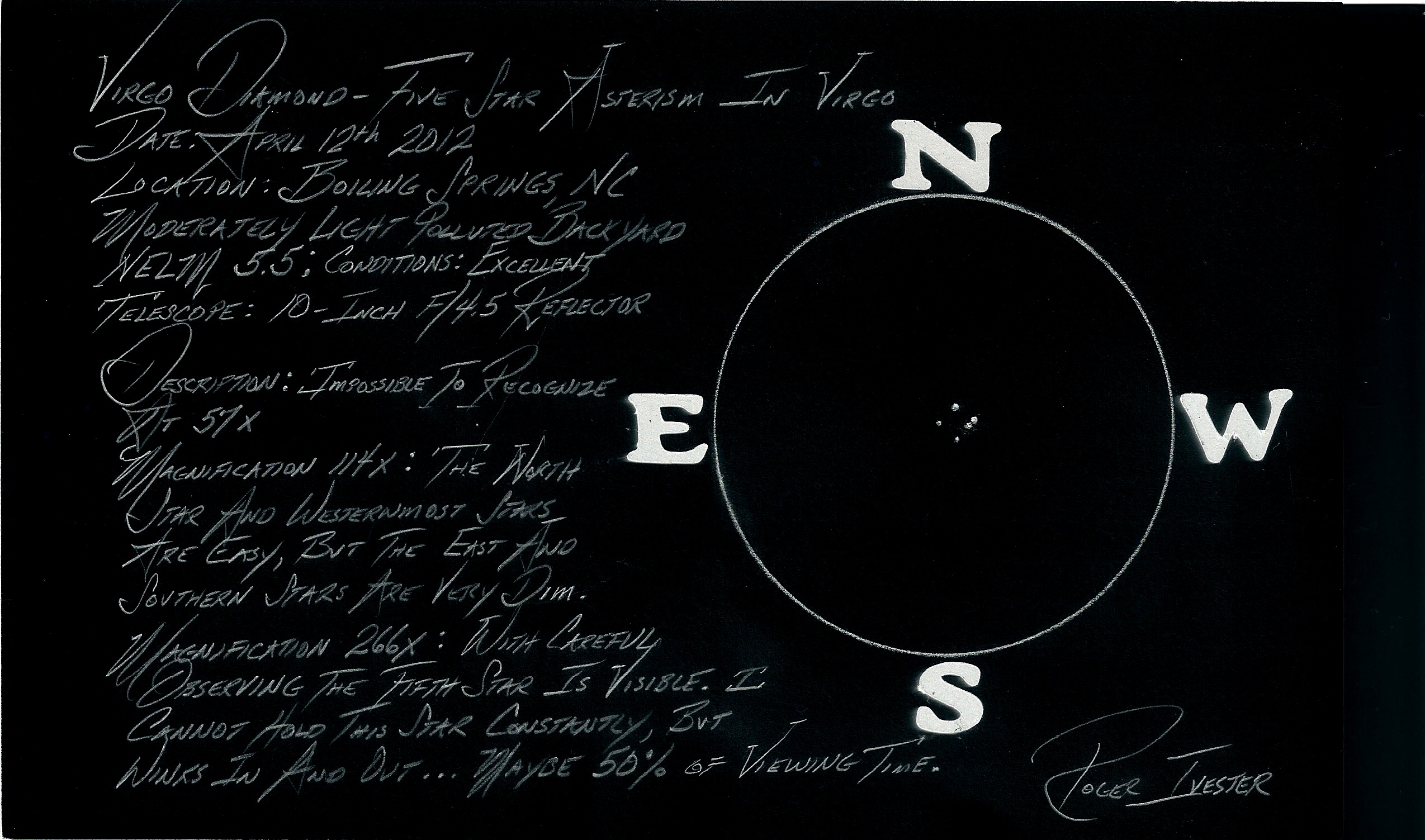
The Virgo Diamond – Faint Five Star Asterism – A True Observing Challenge

April 6, 2012

A very  transparent sky with excellent seeing is critical for viewing the fifth star.   

On the night of April 12th, 2012, the humidity was near 25% and seeing was exceptional.  I knew this could possibly be my last opportunity to observe the  diamond this year under conditions such as this. This proved to be a good decision, as I was finally able to see the elusive “fifth” star. 

The foothills of North Carolina, can be a difficult location to observe from during the months of May through August.  The humidity and haze can be terrible!   

When I first read about the diamond in Sky and Telescope, May 1993, page 110, it became a bit of an obsession with me.  I could hardly wait to see it for myself.  

The diamond in 1993 was pretty much an unknown asterism for most amateurs and still is today.  In the nineteen years since the article first appeared in Sky & Telescope, there seems to be little interest in the diamond, if any at all.  There is virtually no information concerning the diamond on the internet or anywhere else.  I am hopeful this will change in the future. 

You might ask why I have so much interest in such a unique, faint, small and difficult object that is probably unknown to “maybe” 99% of all amateurs.  I would say these are reasons enough.   

The Virgo Diamond gets its first promotion: 

Being a member of the Las Vegas Astronomical Society, I was able to get quite a few of the members interested.  A special Observers Challenge report covering this object was introduced to the LVAS in the Spring of 2009.      

April 27th 2012:  Expert Finnish amateur; Jaakko Saloranta takes a look at the diamond.

 “To be sure this was just not an asterism, I contacted the Big kahuna Matthias Kronberger for his expert opinion.  He used VIZIER for proper motion data and came to the same conclusion I did using ALADIN (PPMX-data).  So the chance of stars simply aligning like this in the sky might seem remote (4% according to Brosch) but none the less the group is unfortunately, just an asterism despite having similar spectra.”  

“I counted the total magnitude of the Virgo Diamond to be 10.4 using star magnitude data from NOMAD.”   JS

Jaakko has an excellent blog site.  “Breath on a Mirror” please go to the upper right under “Blogroll”  and click on!    Roger

NGC 3190 Leo Galaxy Cluster

May 7, 2011

Observer’s Challenge Report:

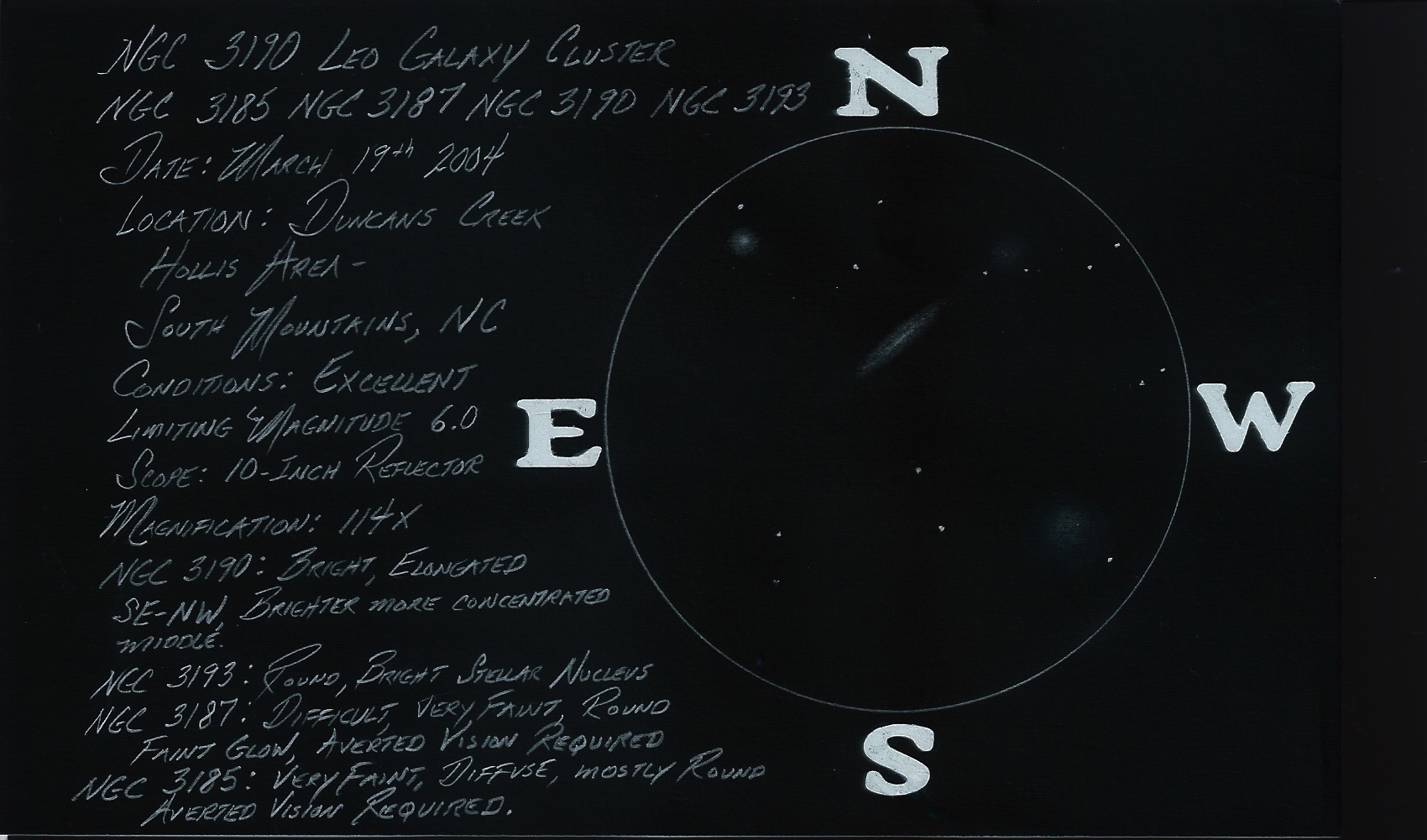
APRIL 2011 OBSERVERS CHALLENGE – NGC-3190

Location: Duncans Creek/Hollis Area, South Mountains, North Carolina. Transparency and seeing:  Both excellent.

Telescope:  10-inch reflector at 114x.

NGC 3185 is very faint and dim with LSB, most often requiring averted vision.

NGC 3187 is the most difficult of the group requiring averted vision and can be seen less than 50% of the time, and cannot hold constantly.

NGC 3190 is fairly bright, elongated with a brighter middle.

NGC 3193 is round and bright with a stellar nucleus located a minute or so from a bright 8.5 magnitude field star.

Roger Ivester

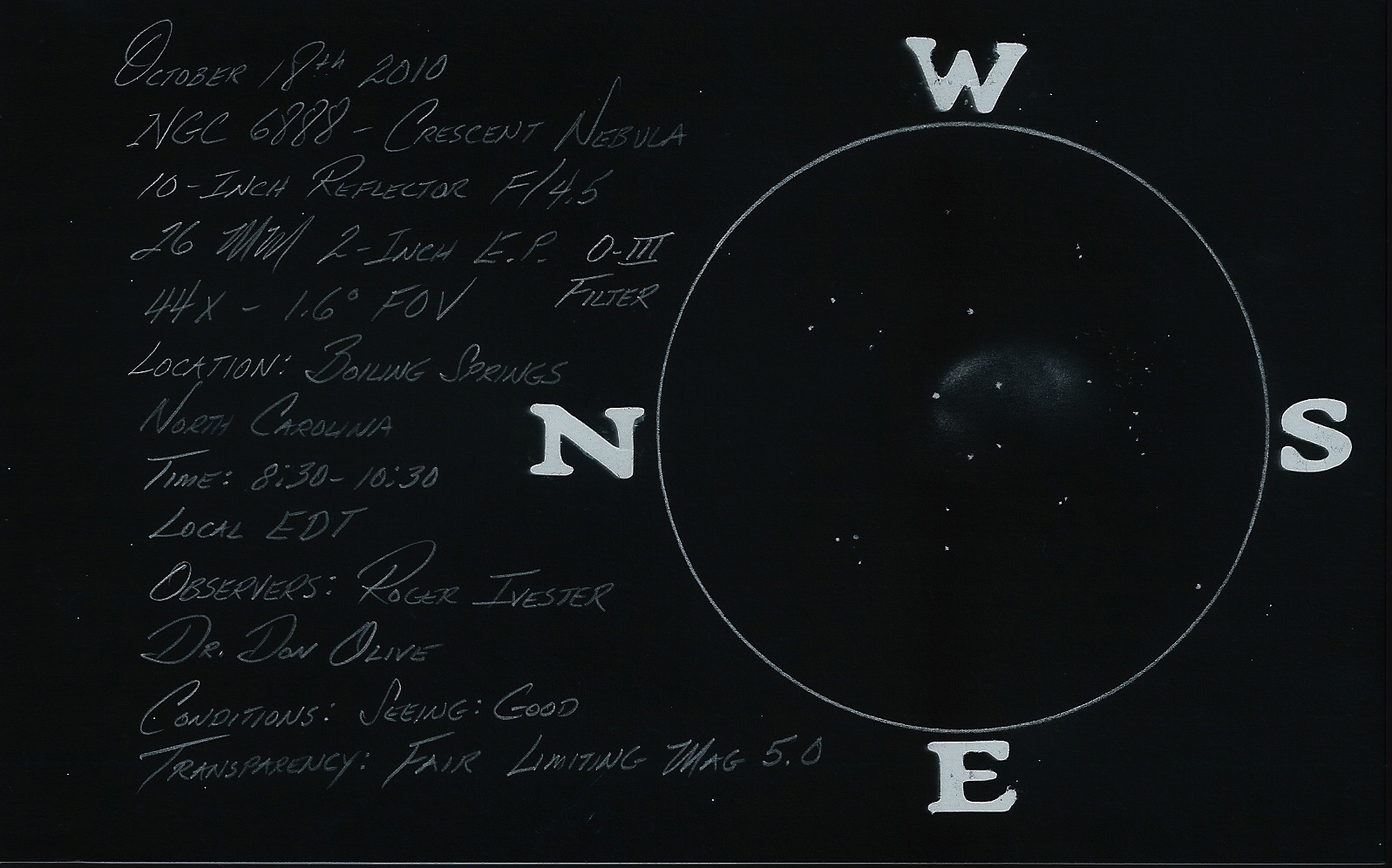
NGC 6888 Crescent Nebula 10-Inch Reflector @ 44x With an O-III Filter

October 13, 2010

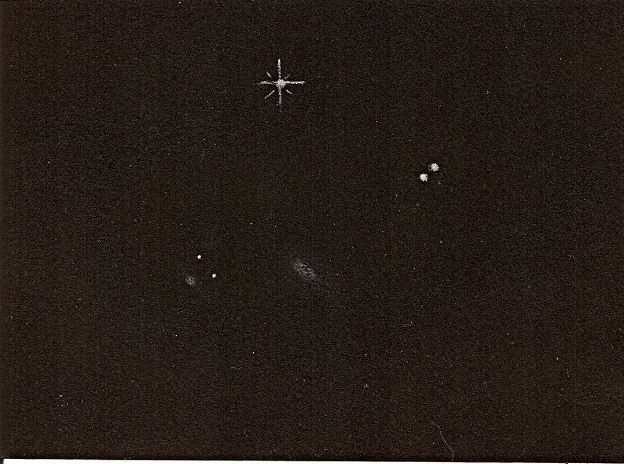
M40 Double Star, and Galaxies NGC 4290 (M11.8) NCG 4284 (M13.5) Telescope: 10-inch reflector @ 142x

May 22, 2010

M-40 Plus NGC4290 And NGC4284

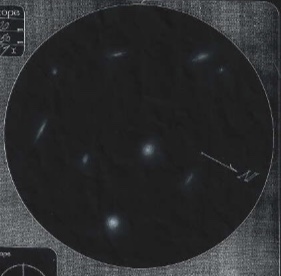
The above sketch was made using a white charcoal pencil on black card stock.   Please note the very faint galaxy, NGC 4284 to the left, making a triangle with two faint stars.   Double Star, M40 makes for an excellent starting point to assist in locating the two galaxies.   roger

“The Virgo 9” Nine Galaxies All within a 1° Field of View, When Centered on M86

May 21, 2010

     A great galaxy group of nine galaxies when (centered on M86) however, there are a number of other galaxies in this area in very close proximity.   

     The “Virgo 9” allows anyone with an 8-inch or larger telescope, the opportunity to use a wide-field eyepiece with greater than a magnification of 100x to observe all nine.  

     I thought this unique galaxy group needed a unique name, and a modern name at that:  The “Virgo 9” sounded perfect.  

       At least three of the faintest galaxies will require a magnification of 150x or greater, or at least they did for me, using a 10-inch reflector from a suburban back yard.   I marked my sketch, changed to the higher magnification, and then sketched them in place.  Attempting to draw to scale, as close as possible. 

      I first found out about this galaxy cluster, from the late Tom Lorenzin, author of “1000+ The Amateur Astronomer’s Field Guide to Deep-Sky Observing.”   http://www.1000plus.com/#fs

     Tom asked me while waiting for darkness in a cow pasture in (March 1993) if I’d ever viewed all nine galaxies within a 1° field of view, when centered on M86.  I had not…

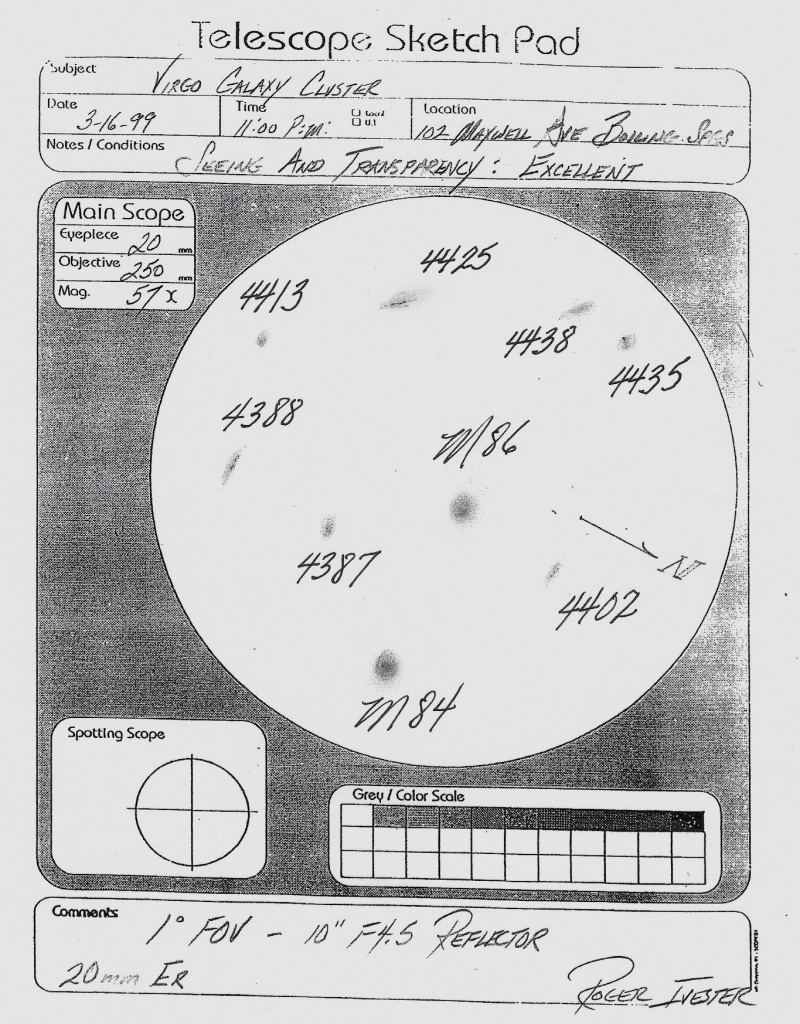
      However, my attempt would come a few years later on March 16, 1999.  My notes from that night are listed below, and my sketch is as following:   

fullsizeoutput_12a0

M 84:  (mag. sfc. br. 12.6)  Bright, with a brighter more concentrated middle, mostly round.

M 86:  (mag. sfc. br. 13.2)  Bright, brighter middle, round, very similar to M84, but not as well concentrated.

NGC 4387:  (mag. sfc. br. 12.9)  A very faint mostly round blur. Difficult at best, requiring averted vision.

NGC 4388:  (mag. sfc. br. 13.1)  Low surface brightness, elongated slash with an E-W orientation.

NGC 4402:  (mag. sfc. br. 13.0)  Very faint slash, low surface brightness.

NGC 4413:  (mag. sfc. br. 14.3)  Small, very faint and dim, diffuse with little concentration, mostly round.

NGC 4425:  (mag. sfc br. 13.2)  Very faint, elongated, axis N-S, small and dim.

NGC 4435:  (mag. sfc. br. 12.6)  Fairly bright, mostly round, stellar nucleus, smaller than NGC 4438.

NGC 4438: (mag. sfc.br. 13.8)  Bright, elongated with a brighter middle.

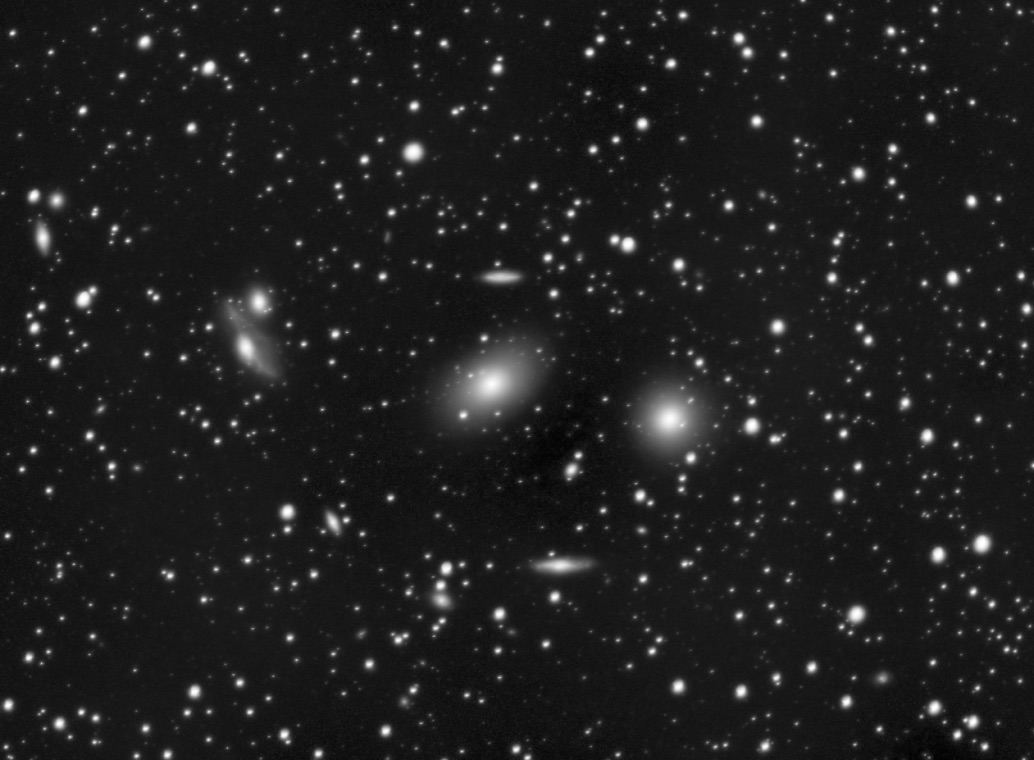
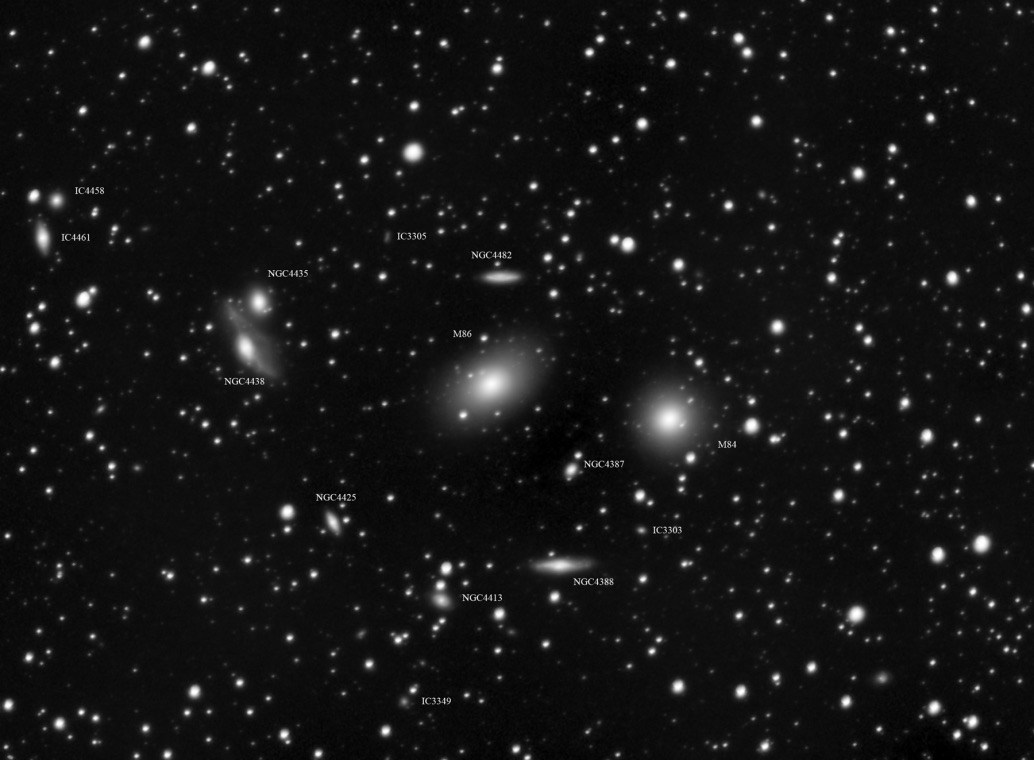
Fabulous image and a great supplemental to this post: An image of the Virgo galaxy group as following by Mario Motta using a 90 mm refractor from Gloucester, Massachusetts.

Galaxies with identification: