An abreviated story of British Airways Flight 009, callsign Speedbird 9, that departed from London Heathrow to Auckland. I’ve compiled the following information from Wikipedia and other sources. The plane was a Boeing 747-236B. Roger Ivester
Actual plane photo as following also from Wikipedia
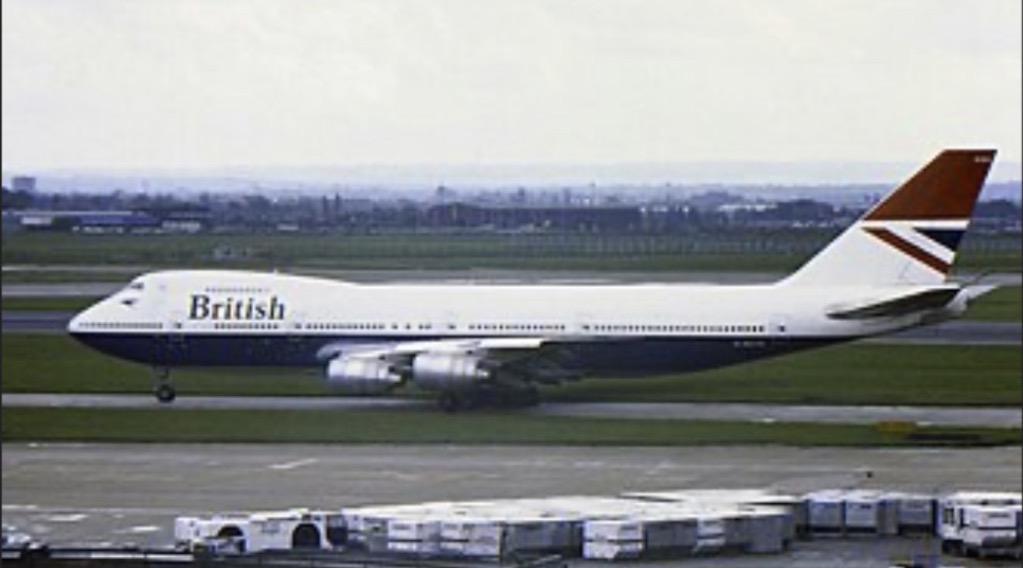
On 24 June 1982, the aircraft flew into a cloud of volcanic dust by the eruption of Mount Galunggung, SE of Jakarta, Indonesia. A catastrophic event occurred….all four engines shutdown.
Selected information as following from Wikipedia and other sources…
On 24 June 1982, the route was flown by the City of Edinburgh, a Boeing 747-236B registered as G-BDXH. The aircraft flew into a cloud of volcanic ash thrown up by the eruption of Mount Galunggung around 110 miles (180 km) south-east of Jakarta, Indonesia, resulting in the failure of all four engines.
Incident or event:
At the time of the incident, the flight crew consisted of 32-year-old Senior First Officer Roger Greaves, 40-year-old Senior Engineer Officer Barry Townley-Freeman, and 41-year-old Captain Eric Henry Moody. The flight crew members had boarded the aircraft at Sultan Abdul Aziz Shah Airport in Kuala Lumpur and were due to pilot the 747-200 for the Malaysia to Perth Airport leg.[4]
As the flight progressed, smoke began to accumulate in the passenger cabin of the aircraft. Passengers who had a view of the aircraft’s engines through the window noted that they were unusually bright blue, with light shining forward through the fan blades and producing a stroboscopic effect.
Around 13:42 UTC (20:42 Jakarta time), the number-four Rolls-Royce RB211 engine began surging and soon flamed out. The flight crew immediately performed the engine shutdown drill, quickly cutting off fuel supply and arming the fire extinguishers. Less than a minute later, at 13:43 UTC (20:43 Jakarta time), engine two surged and flamed out.
Within seconds, and almost simultaneously, engines one and three flamed out, prompting the flight engineer to exclaim, “I don’t believe it—all four engines have failed!”
The flight crew quickly determined that the aircraft was capable of gliding for 23 minutes and covering 91 nautical miles from its flight level of 37,000 feet.
At 13:44 UTC (20:44 Jakarta time), Greaves broadcast a Mayday to the local air traffic control authority, stating that all four engines had failed. However, Jakarta Area Control misunderstood the message, interpreting the call as meaning that only engine number four had shut down.
After a nearby Indonesia flight relayed the message to them, air traffic control correctly understood the urgent message. Despite the crew emergency transponder setting of 7700, air traffic control could not locate the 747 on their radar screens.
Many passengers, fearing for their lives, wrote notes to relatives.
Reports from another source say passengers were in awe of an electrical light storm outside the plane, as the engines glowed white and then stopped.
Owing to the high Indonesian mountains on the south coast of the island of Java, an altitude of at least 11,500 feet was required to cross the coast safely.
The crew decided that if the aircraft was unable to maintain altitude by the time they reached 12,000 feet they would turn back out to sea and attempt to ditch into the Indian Ocean.
The crew began engine restart drills, despite being well outside the recommended maximum engine in-flight start envelope altitude of 28,000 feet. The restart attempts failed.
Despite the lack of time, Moody made an announcement to the passengers that has been described as “a masterpiece of understatement.”
“Ladies and gentlemen, this is your captain speaking. We have a small problem. All four engines have stopped. We are doing our damnedest to get them going again. I trust you are not in too much distress.”
At 13,500 feet (4,100 m), the crew was approaching the altitude at which they would have to turn over the ocean and attempt a risky ditching. Although the crew had guidelines for the water landing procedure, no one had ever tried it in a Boeing 747.
As they performed the engine restart procedure, engine number four finally started, and at 13:56 UTC (20:56 Jakarta time), Moody used its power to reduce the rate of descent. Shortly thereafter, engine three restarted, allowing him to climb slowly. Shortly after that, engines one and two successfully restarted, as well.The crew subsequently requested and expedited an increase in altitude to clear the high mountains of Indonesia.
As the aircraft approached its target altitude, the St. Elmo’s fire effect on the windscreen returned. Moody throttled back, but engine number two surged again and was shut down. The crew immediately descended and held 12,000 feet.
As Flight 009 approached Jakarta’s Halim Perdanakusuma International Airport, the crew found seeing anything through the windscreen difficult, and made the approach almost entirely on instruments, despite reports of good visibility.
The crew decided to fly the instrument landing system, but the vertical guidance system was inoperative, so they were forced to fly with only the lateral guidance as the first officer monitored the airport’s distance-measuring equipment (DME). He then called out how high they should be at each DME step along the final approach to the runway, creating a virtual glide slope for them to follow.
Although the runway lights could be made out through a small strip of the windscreen, the landing lights on the aircraft seemed to be inoperable. After landing, the flight crew found taxiing impossible, due to glare from apron floodlights, which made the already sandblasted windscreen opaque.
Other information as following:
It must have been quite a feeling for the captain, flight crew and all passengers to be able to plant their feet on the ground, and think how close they came to dying.
Captain Moody who was credited with saving the lives of 263 people on that fateful day, passed away peacefully in his sleep on March 19th 2024 at the age of 82. Roger Ivester







Recent Comments