Archive for April 2026

James Mullaney Reminisces: His Review Of The Original Edition Of Starlight Nights (February 1966 Sky & Telescope) Also Meeting Leslie Peltier At His Farm And Home In Delphos, Ohio

April 26, 2026

In 1993, I had just completed observing all objects in the classic book “The Finest Deep-Sky Objects” by James Mullaney and Wallace McCall. I just had to write James (Jim) a handwritten letter, sharing how much I enjoyed the book. A few weeks later I received a letter back from Jim. Those letters began a friendship that continues to this day.

Jim asked me if I’d post the following.

Enjoy…Roger Ivester

I had the honor and privilege of reviewing the original hardcover edition of Leslie Peltier’s classic Starlight Nights: The Adventures of a Stargazer in the February 1966, issue of Sky & Telescope. 

The magazine had just published Wally McCall and my three-part series “The Finest Deep-Sky Objects” and the editors thought I would be a good fit to review Leslie’s book.  This was followed by extensive correspondence with him, which in turn resulted in two visits to Delphos, Ohio, to meet him in person. 

I was there by myself the first time in October, 1968, and among other things he autographed my review copy with the words “Good friend and most kind “reviewer.” With very warmest regards, Leslie Peltier

He let me hold the famed “starberry spyglass” and we inspected his huge observatory with the 12-inch Clark refractor.  But the most thrilling thing for me was that this famed observer let me sit in his seat in the amazing “Merry-Go-Round” observatory with it’s historic 6-inch richfield refractor. Leslie used this telescope for most of his dozen comet discoveries. 

This wonderful afternoon was topped-off by an incredible Sunday dinner made by his wife, Dottie before I started the drive back to Pittsburgh. 

The second memorable visit followed a year later accompanied by Wally McCall.  We both came away from the visits feeling that we were in the presence of a divine being.

James Mullaney

James Mullaney (photo as following) most recently was honored with the naming of an asteroid:
Historical Marker:

The Leslie Peltier story from Grokipeada:

https://grokipedia.com/page/leslie_peltier

The Constellation Corona Borealis Can Be Excellent To Determine The Limiting Magnitude Without Optical Aid

April 15, 2026

I’m using the following AAVSO chart for variable star R CrB to check the NELM (naked-eye limiting magnitude) from my suburban backyard.

I can normally on average, see to magnitude 4.2, but on the morning of (April 17th 2026 @ 4:36 AM EDT) I could see the mag. 4.6 star with direct vision, fairly easy. It is possible with “maybe a bit of imagination” to see the mag. 5.0 star…winking in-and-out with averted vision.

To perform this test accurately, the constellation needs to be a>

When I moved into my current house more than 40 years ago, I could see to magnitude 5.5 most any night at the zenith, but no more. Most of this is due to increased light pollution, as my backyard skies are never really dark anymore, but mostly gray. And adding to the problem, my eyes and night vision are not as good as four decades ago either.

Can you see six stars…seven…what about eight?

I can see six stars most any time if the constellation is overhead. I’m wondering if it will be possible for me to see seven stars on a cold and transparent winter night, which would be seeing to magnitude 5.

I’ve never had or wanted a sky meter, as the NELM has served me well for more than 35 years…no need to change now.

For identification of the primary eight stars and to determine the magnitudes…the (R CrB AAVSO chart) works best with the stars outlined.

Corona Borealis is a beautiful constellation, but seemingly “unknown” by most amateurs these days. There are only two faint deep-sky objects listed in the constellation: Galaxies NGC 5958 and NGC 5961.

From the “Observing Handbook and Catalog of Deep-Sky Objects” by Luginbuhl and Skiff.

NGC 5958: “This object is visible at 75x in 15 cm ….”

NGC 5961: “Though it is a small, moderately faint object for 30 cm, this galaxy has a high surface brightness…”

I’m using my cellphone camera to check T CrB on a regular basis since March 2025. The following photos are dated and with the time. I can easily see six (6) stars in the “Northen Crown.”

Friday April 24th 2026 @ 2:30 AM

April 22nd 2026 @ 10:28 PM:

April 22nd 2026 @ 10:29 PM: I added an additional cellphone photo, less than one minute after the above photo. Note the object in the following to the right and above the constellation.

April 21st 2026 @ 10:36 PM (Corona Borealis is now an early evening constellation)

The following cellphone photo was from the morning of April 20th 2026) at 5:24 AM. Humidity 73%

The following cellphone photo was from the morning of (April 15th 2026) at 5:00 AM.

My first cellphone photo as following from May 1st 2025. I’ve made many others since, but no need to keep since recurrant nova star T continues to sleep.

February 5th 1992: I Purchased The Perfect Telescope From Pauli’s Wholesale Optics

April 9, 2026

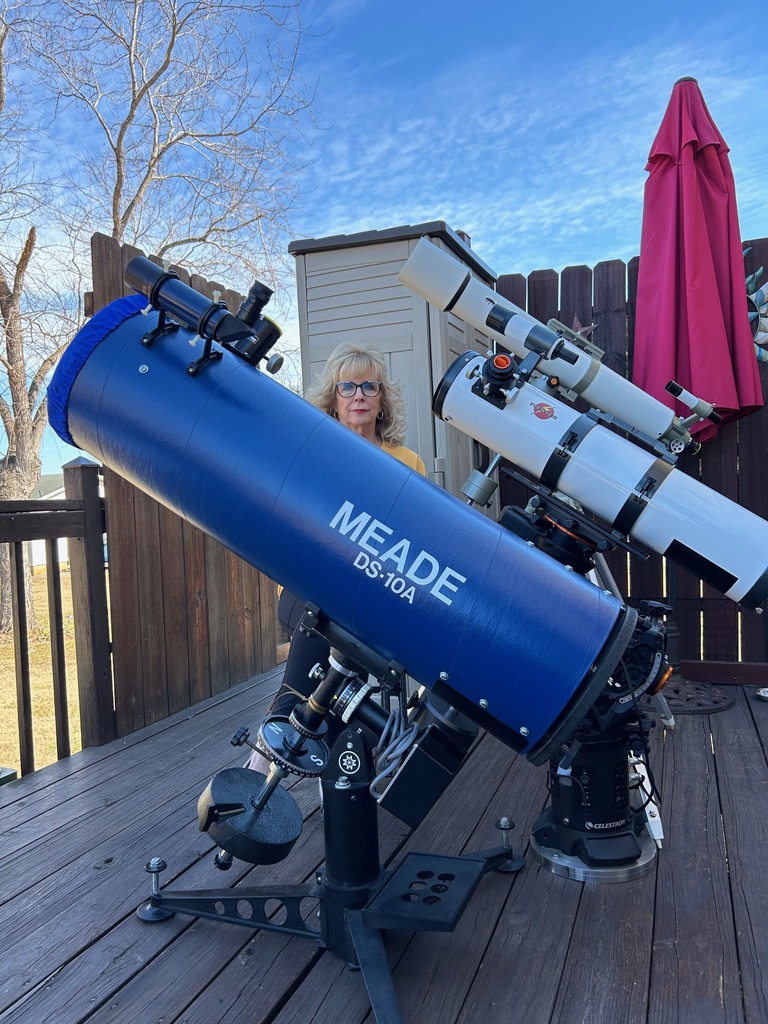
Meade 10-inch f/4.5 EQ Newtonian model DS-10A pictured below.

I’m really glad I talked with Fred Pauli on that February night so many years ago and “made the decision upon his recommendation ” to purchase the 10-inch. At that time, I had no idea I would eventually spend more 1,500 hours with this telescope under a night sky over the next 34 years. I would also make hundreds and hundreds of observing notes and pencil sketches using this telescope. It was a revelation going from a 4-inch telescope to a 10-inch.

The telescope was really large and heavy, but I didn’t care, as the views made the extra effort worth it! However, the time had come for me to find a new owner for this telescope. It was getting heavier and heavier with each passing year and the time had come to find a new owner for this telescope. However, the scope had served me well for more than three decades.

I ordered the telescope from Pauli’s Wholesale Optics in Danbury, Connecticut, on Wednesday, February 5th 1992 at 9:00 PM from the owner himself…Fred Pauli. It was Fred that recommended the 10-inch. This was in the days before email or ordering online. I would purchase a lot of astronomy equipment over the next eight or ten years from Wholesale Optics.

Sometimes I’d call and place an order at 10:00 in the morning, sometimes 10:00 at night, but whenever I’d call, it was always Fred who answered the phone. I’d talk with Fred briefly, give him my Master Card number and would normally receive my order in about a week.

When I got home from work on Monday, February 10th, some large brown corrugated boxes were stacked up in front of my garage door.

I was wanting to purchase a smaller Newtonian, but Fred Pauli recommended a larger 10-inch telescope. At that time, I had no idea I would eventually spend more than 1,500 hours with this telescope under a night sky over the next 34 years. I would also make hundreds and hundreds of observing notes and pencil sketches.

This telescope allowed me to become more active in my local astronomy club: The Cleveland County Astronomical Society, and then about eight years later, the Las Vegas Astronomical Astronomical Society. I had family living there, and still do. It was with my local club that I began writing observing articles for the monthly newsletter.

After becoming a member of the Las Vegas Astronomical Society in about December 2008, I met Fred Rayworth. The both of us were visual observers, and founded the Observer’s Challenge report. Our first report was issued in February 2009. Fred and I compiled the report through about 2017.

After years as a report contributor, Sue French became an administrator in 2018, and then co-editor with myself in compiling the report for its last five years. It was Sue’s notoriety, as an editor for “Sky & Telescope” magazine that helped gain a much wider audience of more serious amateurs. Sue deserves much credit for the report’s success and continued success.

The report continues to have high daily downloads, despite the last report being issued in June, 2024. There are both astronomy clubs and amateurs at-large that continue to use the challenge report for reference or as an observing agenda.

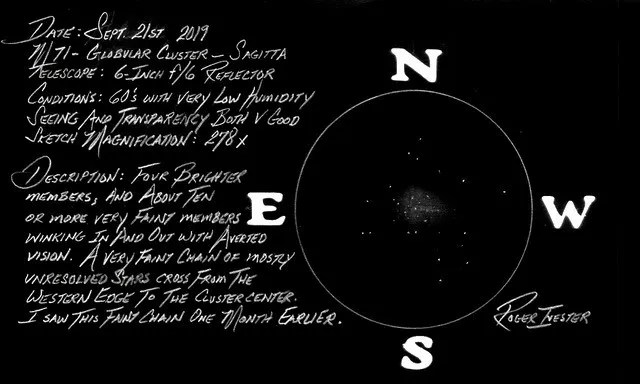
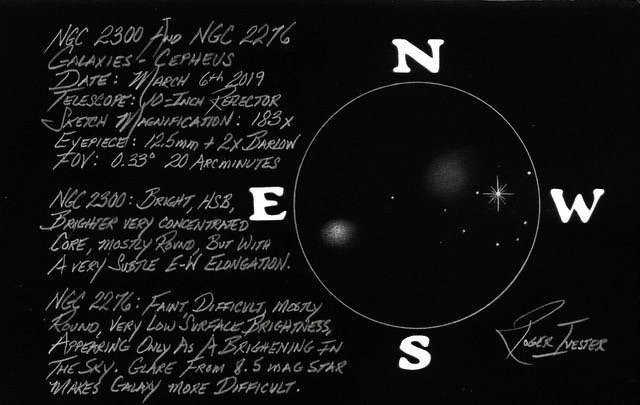
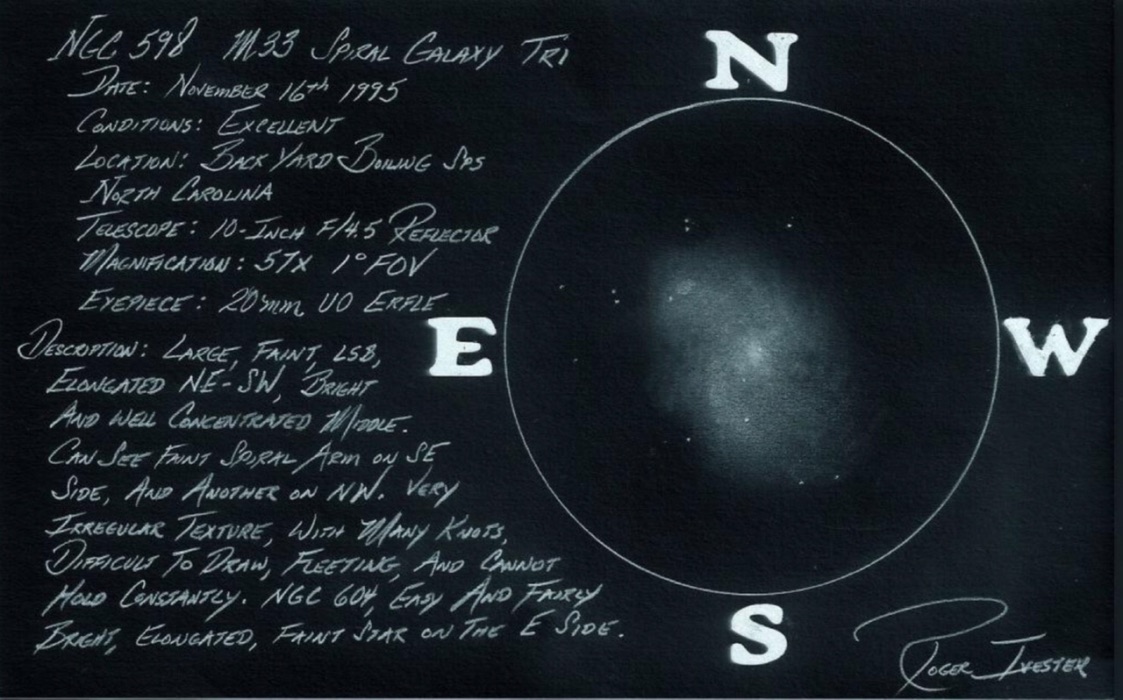
The larger aperture of the 10-inch versus the smaller telescopes I’d been using, allowed me to make far better pencil sketches, and observing notes. A sampling of my pencil sketches without any embellishments, and without the use of a computer. I have hundreds and hundreds of pencil sketches.

Life changes:

After spending so much time and effort over the past 34 years under a night sky…my observing will now be far less and I’ll be going back to using small telescopes. And I have so many other interest, like cycling, weight lifting, history and especially local history. I also need to note, most importantly…I have a family. 🙂

Roger Ivester (North Carolina)

The following pencil sketch shows that serious deep-sky observing can be enjoyed even with an 80 mm refractor.