Archive for September 2026

The Carolyn Hurless Story

September 20, 2026

Last month (August 2026) I gave a presentation to my local astronomy club concerning Leslie Peltier and “Starlight Nights.” I also included information on Carolyn Hurless.  Most amateurs are well aware of Peltier and his contributions to the AAVSO, but “maybe not so much” about Hurless.  I found this out from those attending my recent astronomy club presentation.

Carolyn Hurless photo as following from her online obituary:

I found a copy of her variable star report “Variable Views” online. She published the report for 20 years or so years, and her address is listed at the top. Carolyn self-published the report and funded it entirely on her own until it eventually became more than she cared to…or was able to…take on.


1745 Rice Avenue Lima, Ohio 45805 

The following photos are from Google maps using her “Variable Views” address: (2024 photo below)

July 2014 photo: Carolyn’s husband,  Don passed away in (2015) and might have still been living in the house at the time of the following photo. Google Maps

Excerpts from the AAVSO online page:

Carolyn J. Hurless was the most active and prolific female observer in the history of the AAVSO, with a total of 78,876 observations in the International Database. But that only scratches the surface of this remarkable woman’s life and career as an AAVSO observer, councilor, officer, mentor and ambassador.

Born in Lima, Ohio, November 24, 1934, Carolyn became interested in astronomy at the age of 13 through her love of science fiction. As a young woman, she was invited to join the Lima Astronomy Club, when President Herbert Speer found her name on the borrowers cards of people who had checked out astronomy books from the public library. 

Shortly after that, she decided to make her own 8-inch reflector with the guidance of fellow astronomy club members. When the initial grinding was done, Carolyn found that in her excitement she had hogged out a short focus mirror of f/4, instead of the typical f/8 or f/9 scope most were making at the time. In the end it turned out to be a fine instrument. In fact, the short tube length gave her, as she described it, a “feminine” telescope, easily transported and set up for observing. Most of her observations were made with this telescope and she never felt the need to upgrade to something else.

Carolyn learned variable star observing from legendary AAVSO observer and fellow Ohioan, Leslie Peltier. During a visit to her home in 2011, Don Hurless, Carolyn’s husband, showed me how Carolyn learned the sky and location of the variables in her program. She had marked an X and circled the area around each one in her copy of Norton’s Star Atlas. She memorized the star fields and eventually all the comparison star magnitudes, so that after a few years she didn’t need to use variable star charts any more. In this way, she could whip the telescope around from one field to another quickly, and her annual totals climbed.

Carolyn would make the trip to Delphos, Ohio, a few miles away, to observe faint “inner sanctum” stars with Peltier’s 12-inch refractor nearly every week during their lifelong friendship. She knew she was fortunate to have Leslie as a mentor and was more than happy to pay it forward by mentoring other newcomers and sharing her enthusiasm with other variable star observers around the world.

Her life ended tragically in 1987, when, after years of excruciating pain from an undiagnosed disease, she died of a self-inflicted gunshot to the head. Her husband, Don, never remarried and continued to live in their home in Lima, Ohio, where he taught piano students. Don Hurless died June 15, 2015, at the age of 87.

Discovered in 1981 by Brian Skiff, the asteroid 3434 Hurless was named after Carolyn. Carolyn’s name was suggested by Paul Sventek who provided the citation.

In 2011, the AAVSO successfully ran four pilot programs as a first step towards creating an online education center. We chose to honor Carolyn Hurless by naming this program after her, The Carolyn Hurless Online Institute for Continuing Education (CHOICE). CHOICE was officially launched in 2012, and the AAVSO is proud to carry on in the tradition of this remarkable woman. The following photo was also from the AAVSO site.

I found the following photo via “Cloudy Nights” forums, but not sure who to give credit.

Galaxy M33: 6-Inch Refractor With Antlia RGB Ultra II Filter And ASI 071 Color Camera: By Mario Motta

September 19, 2026

I have been using the new Antlia light pollution filter: This blocks the part of the blue that LEDs produce. All other LP filters work on mercury vapor lights, but virtually useless with LED’s.

The following image of M33 was made last week using a 6-inch refractor and one shot color camera ASI 071, using an Antlia RGB ultra II filter.

Note the extremely bright and glowing H-II star forming region in the spiral arm, known as NGC 604.

I wanted to add what can be seen “visually” from a ~6.5 suburban sky using a 10-inch f/4.5 Newtonian. (November 16th 1995) Roger Ivester

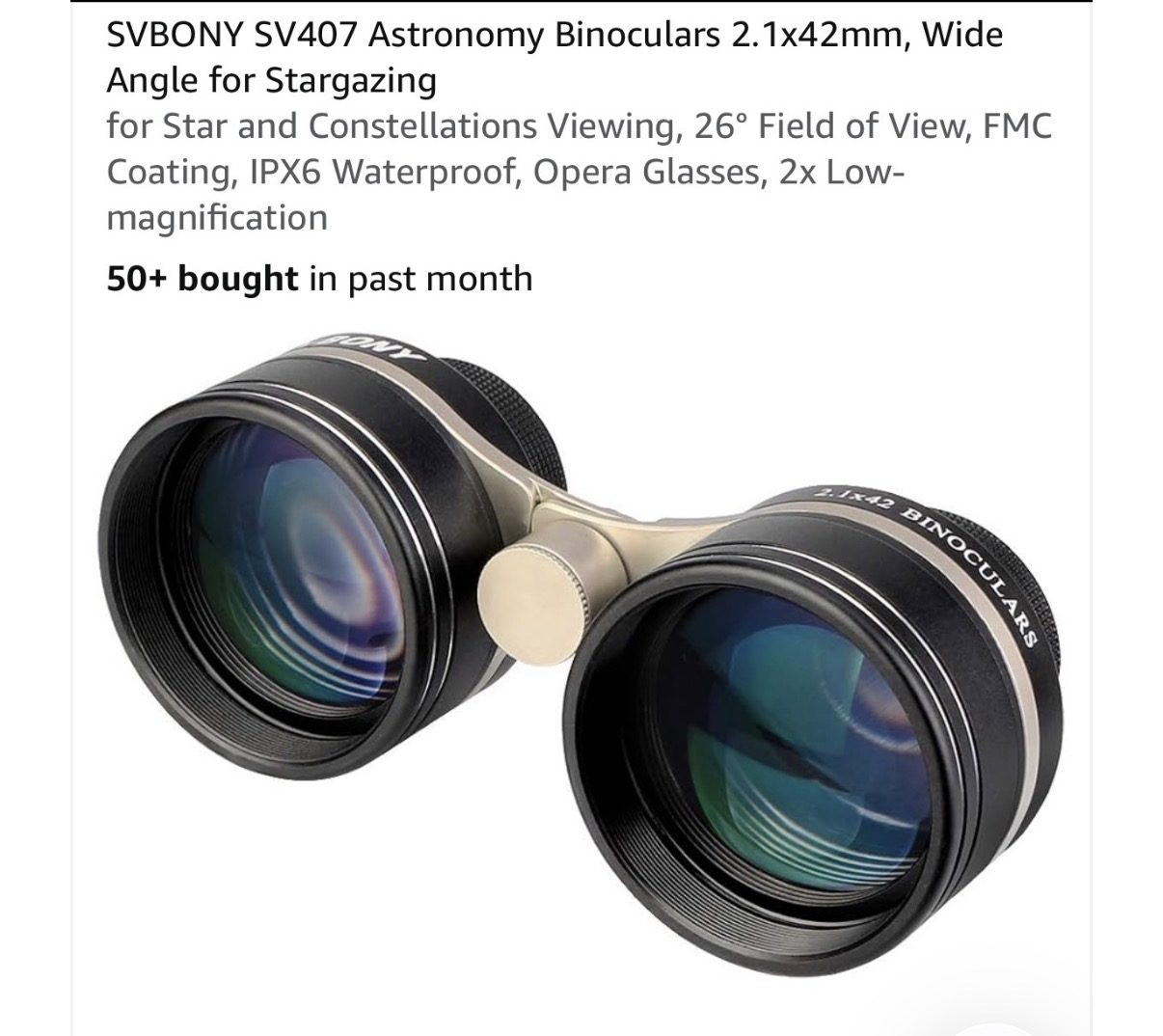
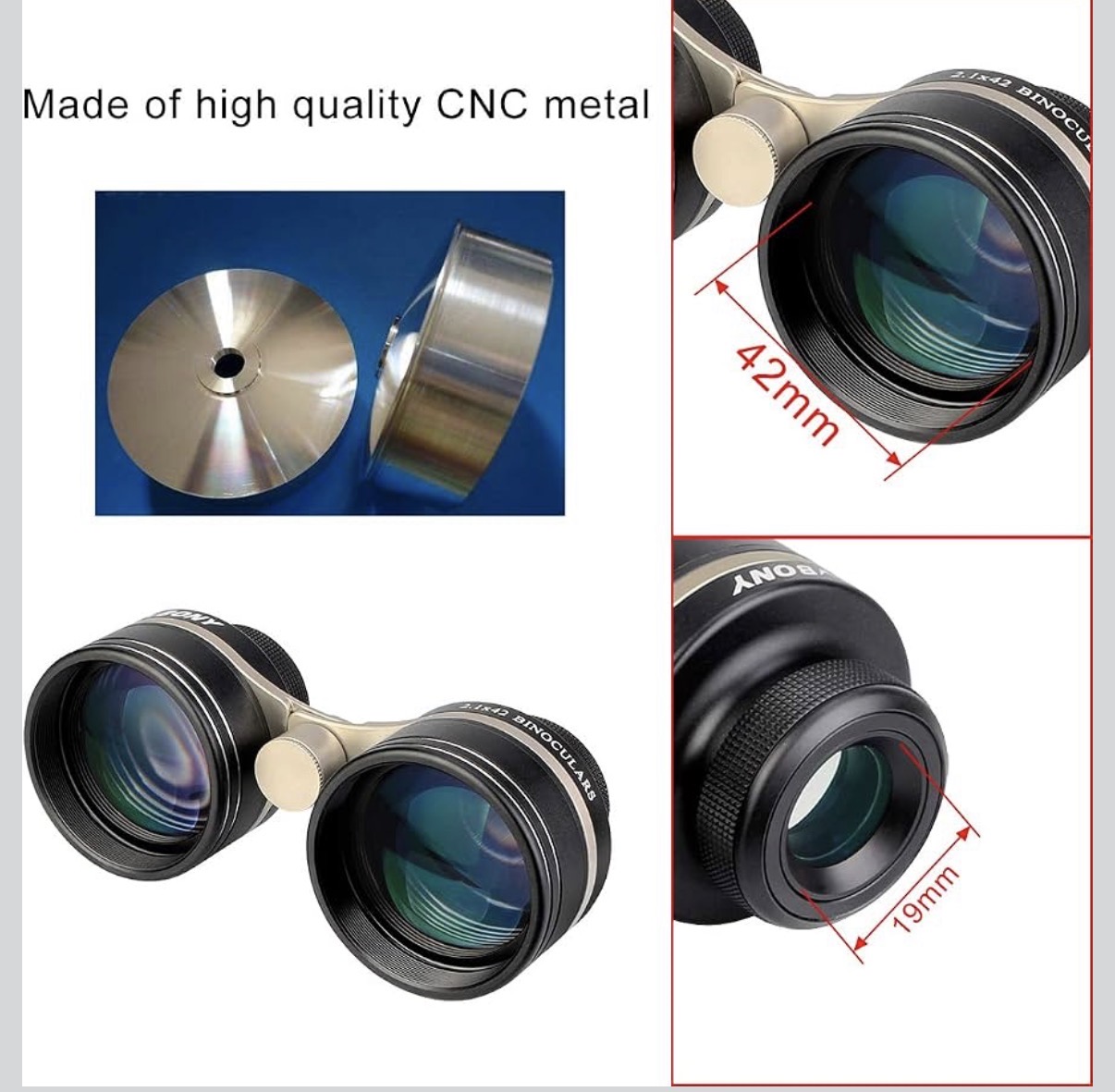
2.1×42 SVBONY Constellation Binoculars And Their Unique Purpose: Review

September 1, 2026

Constellation binoculars are specialized optical devices designed for stargazing, particularly for viewing entire star constellations and celestial objects. They offer lower magnification and a wider field of view, making it easier to observe larger swatches of the night sky as compared to standard binoculars and telescopes.

For more than a year, I had been reading about constellation binoculars and considering whether they might be useful to me. In August 2026, I finally decided to purchase a pair of SVBONY constellation binoculars. The price from Amazon was only $107.99. How could I possibly go wrong?

The binoculars arrived well packaged in a sturdy box with custom-fitted foam for added protection. After removing the foam, I found that it fit perfectly in a small Pelican case. This makes for excellent storage and transport of the binoculars. (See the photo at the bottom of this article)

Shortly after sunset the sky was completely clear: I began looking for Polaris with my naked eyes, but couldn’t see it. I then looked through the constellation binoculars, and Polaris was immediately visible. I started scanning the sky, and gradually, random stars began to appear through the binoculars….stars that were completely invisible to my naked eyes.

It was interesting to see just how many more stars the binoculars revealed, maybe a bit like going back in time (without optical aid) with younger eyes and a dark sky.

I find the binoculars are very comfortable to use, easy to hold, and with excellent eye relief. There is a slight amount of distortion around the edges of the field of view, but I don’t find it particularly objectionable.

My observing notes as following from my Bortle 6.0-6.5 suburban backyard, over several nights, with some early morning sessions.

  • Shortly after sunset: Polaris appearing first through the binoculars is a great demonstration of their light-gathering ability. Other stars that were invisible to my naked eyes suddenly became obvious.
  • Little Dipper:  I could only see three stars naked-eye, but “essentially” the whole constellation through the binoculars.
  • Mizar being visibly double, but not cleanly separated.
  • The long eye relief is a major advantage. Being able to observe while wearing glasses, and actually getting cleaner star images “maybe” because my mild astigmatism is corrected.
  • Corona Borealis observation is another nice example of what these instruments can do. I could see seven stars with the binoculars “before complete darkness” versus one without.
  • Pleiades star cluster appears very small due to the lack of magnification, so conventional binoculars work best.
  • Double Cluster can be seen as two clusters, with resolution of a few brighter outer stars.
  • The Andromeda Galaxy is easily seen with the constellation binoculars.
  • The entire constellation of Orion fits nicely within the FoV.

Terrestrial observations are a bonus. They brighten the nighttime woods just enough for me to see deer walking and wandering about. This is something that’s otherwise invisible without the binoculars.

Walter Scott Houston often discussed holding a nebula filter directly in front of his eye when observing large nebulae. That got me wondering about using the constellation binoculars in a similar way. Their very wide field of view and low magnification, combined with an O-III or UHC filter, might produce some interesting results. However, given the binoculars’ small apertures, I wonder if the filters might make the view too dim.

Observing aurora could prove to be interesting. I’ve previously observed aurora that was photographically obvious, but visually subtle or invisible naked eyes. The constellation binoculars may assist and brighten the colors, but this will only be known with actual observations.

My only other binoculars at the moment are a pair of Pentax 7×21 minis, which I’ve had for nearly 40 years. For many of those years, when the mornings were still dark, I would keep them tucked in my coat pocket. And before getting into the car for work, I’d always spend a few minutes scanning the sky. During the winter months, open cluster M41 was one of my favorite targets. I could easily pick it out with the little Pentax mini’s despite a close streetlight. They provided excellent resolution, but could never see the red color of the famous Espin star. The Andromeda galaxy and so many other deep-sky objects over the years became treats in those early morning very casual observing sessions.

Those few minutes meant more to me than just observing the sky…

….they gave me a little relaxation and enjoyment before starting a day at work that was almost guaranteed to present plenty of problems and stress. Looking up at the stars, even briefly, gave me a chance to clear my mind before the day began.

I feel the constellation binoculars will add to my small and lightweight astronomy devices for those quick and sometimes spontaneous observing sessions. Also remembering what Leslie Peltier said: “Were I to write one prescription designed to alleviate at least some of the self-made miseries of mankind, it would read like this: “One gentle dose of starlight to be taken each clear night just before retiring.”

Observing the night sky without optical aid, or with a pair of small binoculars, seems to be an excellent way to follow Peltier’s prescription before bedtime. It has worked remarkably well for me on many occasions. Roger Ivester