I’ve enjoyed observing double stars for many years, although on a more serious basis around 1992. One of the great advantages of observing double and multiple stars is that they can be enjoyed even under heavily light-polluted skies or with a bright Moon overhead, provided you can locate your target. This makes them ideal objects for urban observers.
Double stars offer plenty of challenges, not only for the observer but also for the telescope. More often than not, however, the real limiting factor is the atmosphere itself, specifically, the seeing. And that’s part of what makes observing them so rewarding!
Comparing double star colors with others can be fun, as seemingly most everyone can and will most often see different colors.
Lets take the double star Eta Cassiopeia with information from “Celestial Objects For Common Telescopes” which was first published in 1859 by the Rev. Thomas William Webb.
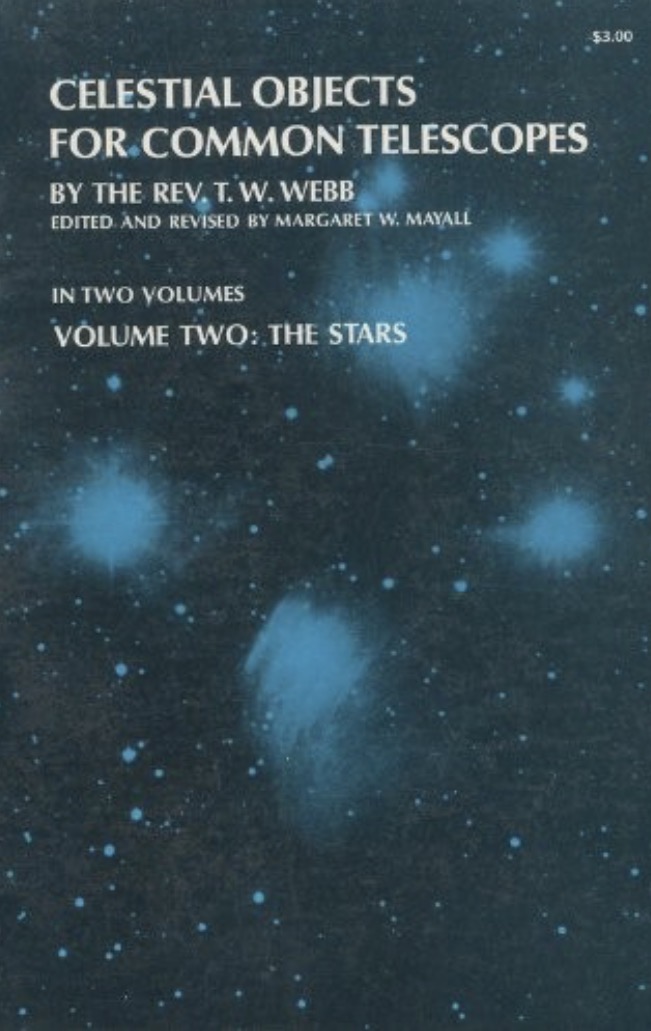
Magnitudes: 3.4/7.5 with a wide separation of ~ 12 arc seconds
Yellow/Purple: By observer Franks
Yellow/Pale Garnet: W. Herschel
Yellow/Pale Garnet: South
Red/Green: Dembowski
Yellow/Generally Red: Espin
From the book “How To Use An Astronomical Telescope” by British observer James Muirden
“This binary has curious and difficult colors: To the writer, A is cream colored and B has a port-white tint.”
My colors: Ivester
Telescopes: 102 and 80 mm refractors and from different observing sessions. Each color combination is from a different night. I have other observational colors, as each and every time I observe a double star I note the colors. As you will see the colors vary with me, as they will for most observers.
Whitish Yellow/Bluish-White – White/Red – White/Rust – Yellow/Red – Whitish Yellow/Bluish White – Yellow/Purple – Yellow/White – Yellow/Blue – White/Red – White/Yellowish Red – Yellow/Orange – White/Red


Recent Comments