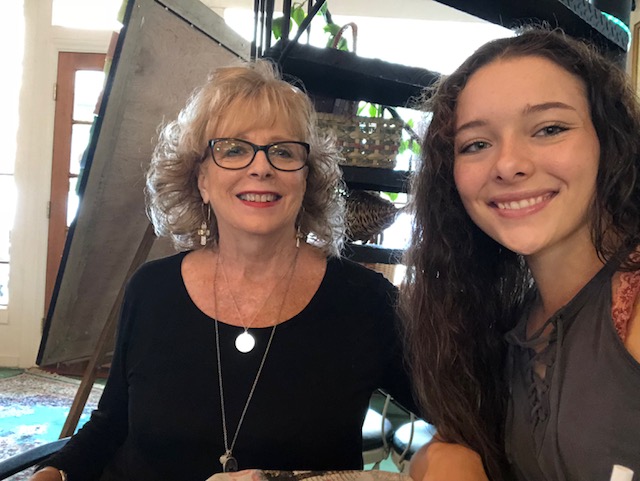
Debbie and I celebrate our 26th Wedding Anniversary today, Sunday, April 12th 2026:
I’ve been wanting to write “Our Story” for quite a few years now. However, I wanted it to be permanent and sharable, so naturally I chose my blog site. It is not only a story, but a love story and the importance of having patience and waiting for God, in His perfect timing, and not our own.Our story would actually cover decades while in the making. But before I can begin, I have to share what would “seemingly be insignificant events” in my life, beginning at sixteen. Every event is so very important, and would happen for a reason, and those reasons would be to eventually Debbie and I together.
Our story will encompass, but touch lightly on the dissolution of both our families, which was sad at the time for all. Unfortunately, divorce happens, but it’s important to accept the ending of a marriage and concentrate on moving forward in a positive way. The best way I can describe this event in our lives would be to quote Psalm 30:5 “…weeping may endure for a night, but joy cometh in the morning.”
We have faced obstacles, such as me losing two jobs, but nothing compares to the loss of Butch, which was devastating to all. Debbie finds this just too painful to discuss, but it had to be included. However, Debbie and I have always had each other for solace, during life’s trials.
The following story should not be considered the definitive story of our life together, but it’s a beginning. I truly believe I could write a book about our love story that is real, unlike a silly love novel, fabricated in someone’s mind.
The first time I saw Debbie was in 1970, while I was working after school at a local textile plant. I had no idea who she was, not even her name. She was not even aware of this until I began writing this story.
I was 16 years old and needed an after school job. My brother, Phillip was working at Dover Mill during this time and helped me. But the job was only to last for two weeks.I would first need a car. I noticed a 1966 Dodge Dart at Dale Costner’s Car Lot in Lawndale. Everything was good, with the exception that someone had taken out the AM radio, and the gas gauge didn’t work. It was definitely not the car I wanted, but was the only car that I could afford, at that time.
I financed the car through Union Trust Company, a local bank in Lawndale, but only after my Dad co-signed the $500 loan. It was actually pretty strange that I’d enter into such an agreement and with a job that would last only two weeks. But I would have to have this car if I was going to meet “or should I say” see Debbie for the first time.
Please keep reading, as again, all of these “seemingly” insignificant things will soon be understood and everything will come together, like pieces of a puzzle.
First day on the job:
On the following Monday afternoon at precisely 3:02 PM, I would leave Burns High School for my first day on the job. I was shown around my work area for a couple of days by the high school guy that would soon be gone for two weeks. After a few days of happy thoughts, I began to wonder what I was going to do after the two weeks were complete. I just put this out of my mind, as God would take care of this, or maybe, I was a bit like Alfred E. Neuman: “What, Me Worry?“
The beautiful girl in a red Camaro:
I had to go outside the plant for something one afternoon, but little did I know this was a divine event, as God showed me the girl I would one day marry. So, while I was outside the plant, I saw a really great looking girl driving a beautiful 1968 red Camaro, with a Poodle on her lap. She drove out from Randolph Road, and onto highway 226. I had a strange feeling in my stomach when seeing this girl, which left me a bit unsettled. However, I would go back into the plant and resume my job, and the girl in the red Camaro, was now just a memory, but a memory that would be long lasting.
I was now into my second and final week of work and my time was running out. But on Thursday of my last week, my supervisor asked me if I’d like to have the job for the remainder of the school year. I said yes. What a great feeling it was to know that my job would last through the rest of the school year, and into the summer, if I so desired.
Paying off my debt and having the title to my car:
I would work another job for a short period on Saturday mornings at Kendall Elastics. This job was working with a few other school kids on Saturday mornings, cleaning up the weave room and other areas of the plant. I would then work my regular job at Dover Mill, from 12:00 noon till 6:00 PM.
I was able to make all of my monthly car payments by carefully budgeting my earnings. And, in less than a year, I would go to Union Trust Company for the last time to make my final payment. I made my payments in person, despite having a checking account. But this time, I would receive the title to my car. It was a happy day for sure and a long time in coming.
But what about the beautiful girl in the red Camaro? Please be patient…
Time passed, and both Debbie and myself lived our lives, totally unaware of what each other was doing. We were two families living our separate lives, raising our boys, going on vacations and all the other things that families do. However, neither family and all involved realized that their timeas a family would soon be coming to an end, and “strangely” both families at almost the same time.
A chance meeting many years earlier on a cold and wintry evening at a local drug store, would one day be the catalyst for a phone call…
It was a cold, wintry and dark evening after work in the early 80’s. I went into a local drug store and Debbie was there also. At this time, I now knew who she was, as I would meet her at a previous event. Debbie was dressed incredibly nice, with a short dress and high-heel shoes. She had the most beautiful blue eyes I’d ever seen. Her eyes were not only beautiful, but so very kind.
I would never forget this chance meeting. However, I now know this was not just a chance meeting, but I’ll share more about this toward the end of our story. More years would come and go, and both Debbie and myself would continue living our lives and never seeing each other for years. However, during the summers of 1988 and 1989 respectively, our paths would cross again on two different baseball fields. During the end of the summer in 1989, we would find out that we were both divorced.
The memory of seeing Debbie in a drug store on a winter evening, so many years earlier would continually be in the back of my mind. This was actually like a small ember, but many years later would begin to grow and ignite. From that chance meeting, I would remember my thoughts and feelings, which would inspire me to call Debbie on a stormy Saturday night in September, 1989.
On September 22nd 1989, Hugo would cause significant amounts of damage in the county. The eye of the hurricane would actually travel over Shelby, which was very unusual for a hurricane, this far inland. The next weekend, I would call Debbie for the first time on a rainy Saturday night (September 30th 1989) and ask her for a date. We decided or agreed on Friday, October 6th, and on our first date we went to Nakato’s Japanese Restaurant in Charlotte.
However, our time was still not yet to be...
Unfortunately, there were times we would go our separate ways and even date other people, but we would always find our way back to each other. However, in the winter of 1994, I was driving home from work one afternoon with the sun almost setting below the horizon, but for some reason…
….and for some strange reason, I turned onto a road that I’d never driven on before. I could see a lone cyclist in the distance, all bundled up with extra clothes. I thought it was getting a bit too late and dim for someone to be riding. So, I would pull up beside the cyclist and was taken aback when I saw….it was Debbie!
Our time would finally come….…
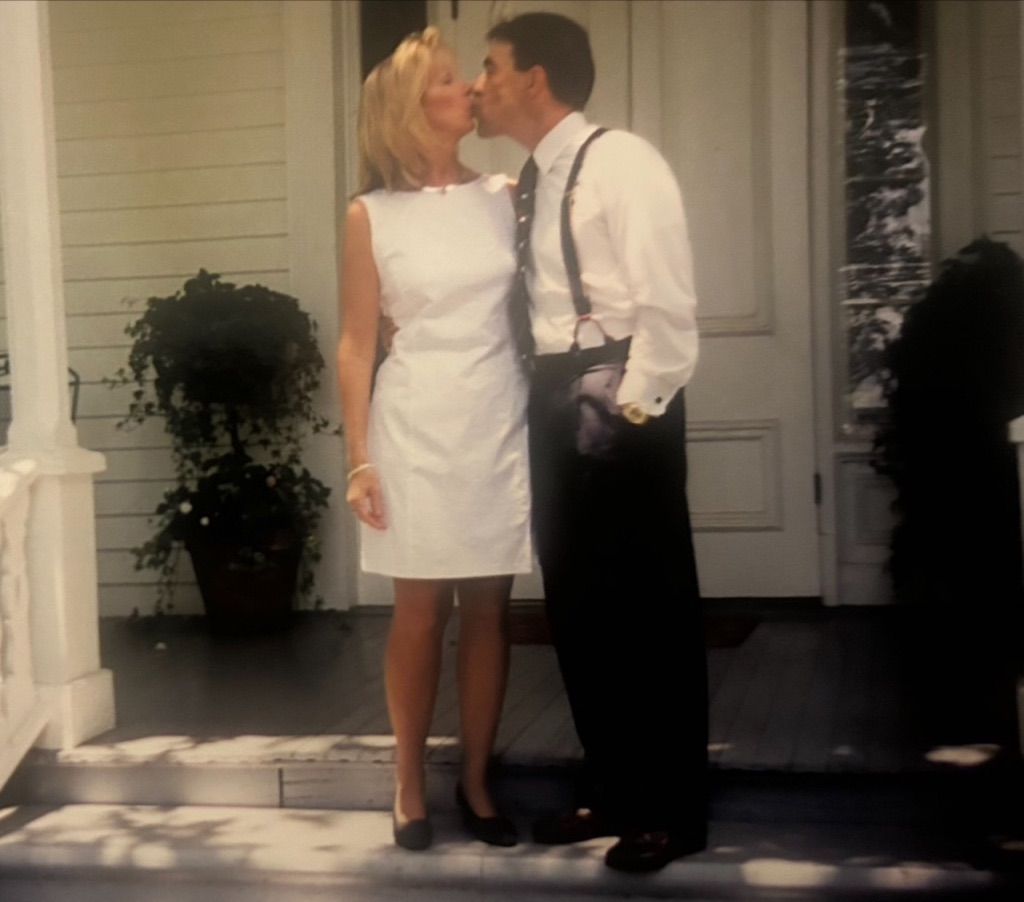
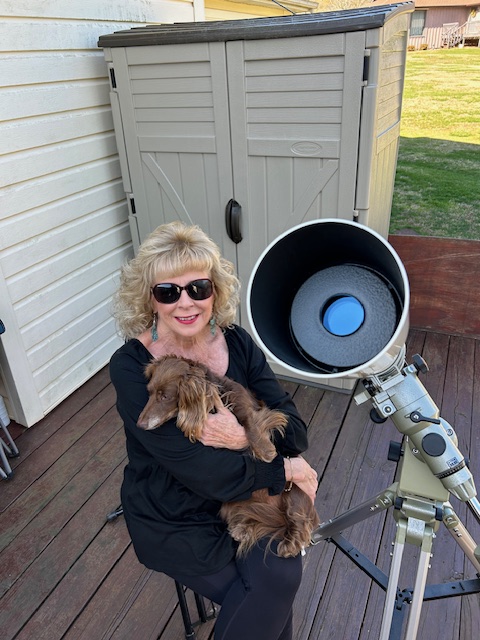
….and from that day, we have been a couple, and never parted again, and would get married on Wedneday, April 12, 2000 at Crestview Baptist Church. We have been almost inseparable since that day, and have enjoyed every minute of it. I’d say probably the only times we are apart would be when I’m riding my bicycle and I can hardly wait to get back home. Debbie and Sophie are always waiting for my return. Really!
Comments:Comments Off on Today, April 12th 2026 We Celebrate Our 26th Wedding Anniversary: I Write This To Insure Our Love Story Never Becomes Lost To Time…
Posted December 26, 2019 by rogerivester Categories:Roger's Articles
Cloudy skies and rain have prevailed for the past few days, but what a nice day it was on Christmas Day to get outside. While relaxing shortly after lunch, I received a message from Mike Ribadeneyra, wanting to go for a bicycle ride. I was actually thinking about a nap, but as a cyclist, when someone offers an opportunity to ride, the guilt can be a bit overwhelming should I decline…and especially for NO good reason.
So, after answering the message, I got up and began to get dressed and checked my bike. It might not be fun preparing to ride, especially when it’s cold outside, being relaxed as I was finishing a good cup of coffee. However, it’s a great feeling of accomplishment when the ride is complete and riding back into my driveway. And this is especially true on Christmas Day when my wife and dachshund are anxiously waiting my return!!
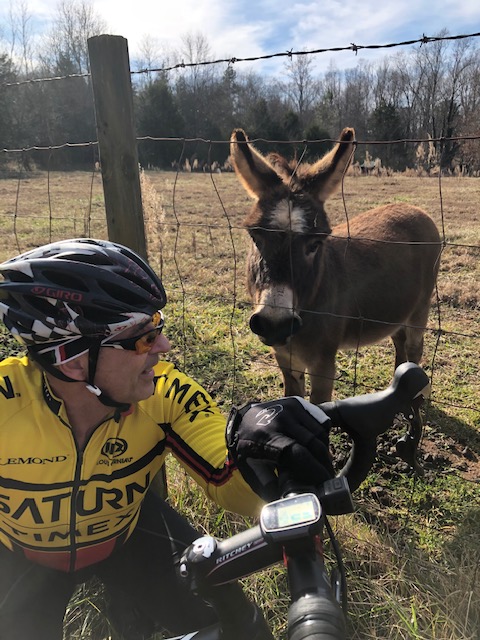
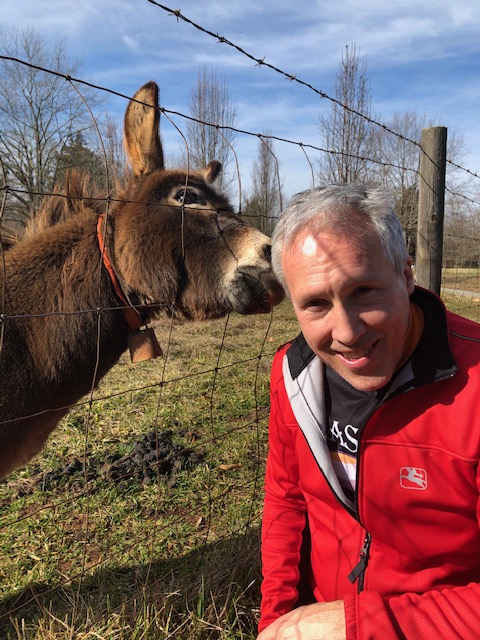
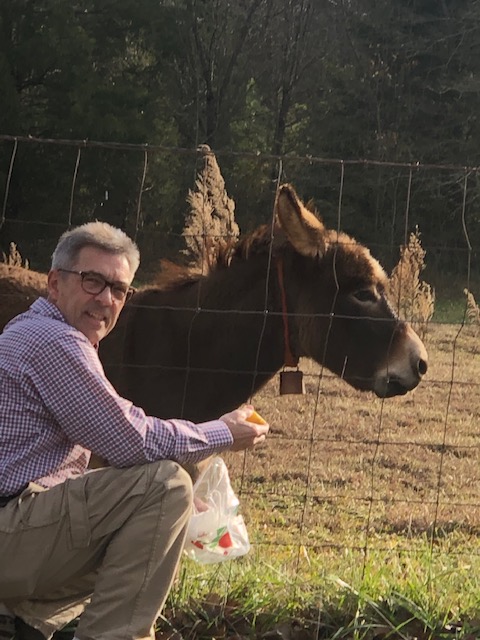
When headed home, we stopped to visit “Albert” the donkey who loves to see us ride by, behind his pasture fence. It’s always great to hear him running…fast as he can, from the bottom of the pasture with his collar bell jingling.
Albert loves for me to bring him an apple, but it has to be quartered. He will chew each piece individually. If a piece falls on the ground, he won’t eat it until I pick it up and offer it to him again. Albert is a bit finicky, but loves the attention…and especially an apple.
Albert is glad to see both Mike and I.
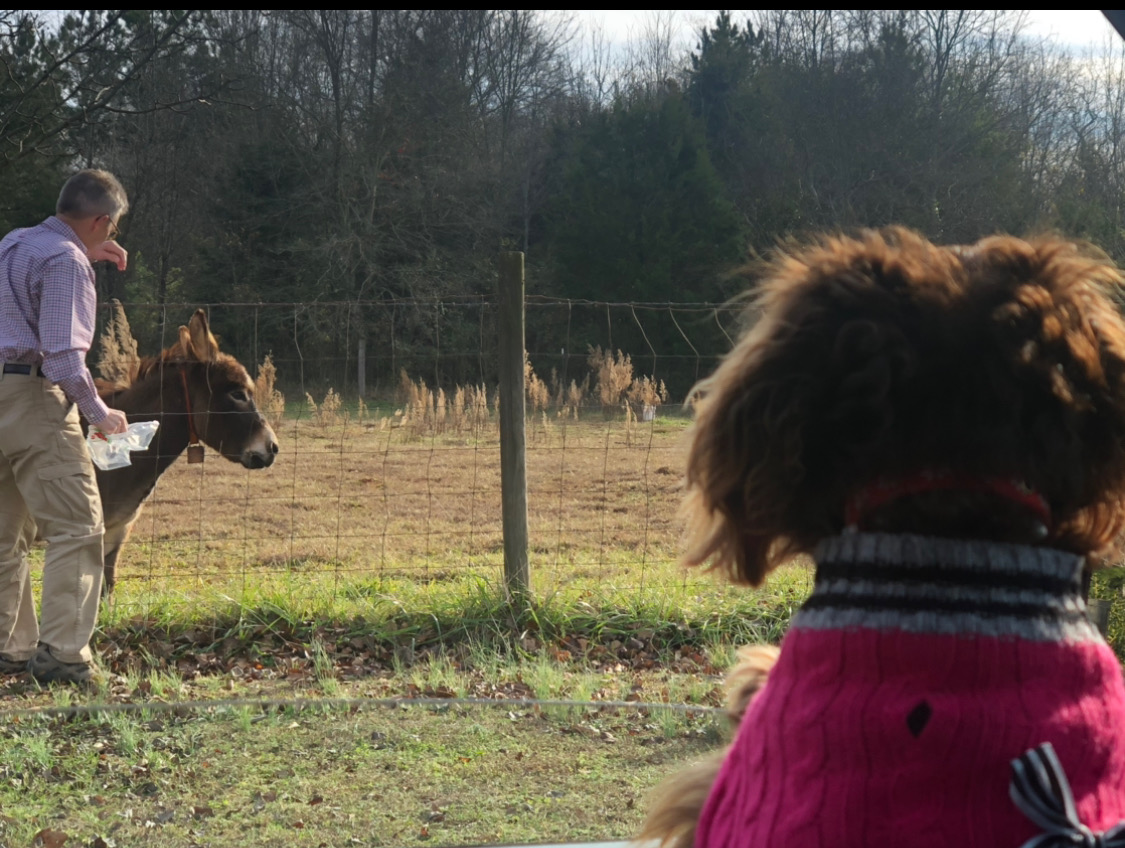
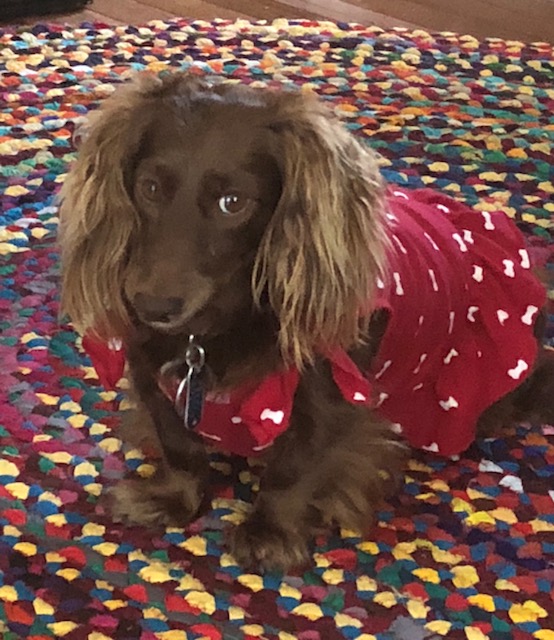
Photo below: Saturday, December 28th, after another ride: Sophie (our Dachshund) enjoys watching me feed Albert.
Comments:Comments Off on Christmas Day 2019: Bicycle Ride
Posted December 7, 2019 by rogerivester Categories:Uncategorized
I became acquainted with Gus Johnson in about 2009 and as time has passed, we became good friends. Shortly afterwards, he became a regular contributor to the Observer’s Challenge report.
Gus has never used a computer, so it has always been necessary for me to call him via telephone, to receive his observation notes each month. However, this has never been a problem for me, as I have always enjoyed our conversations over the years.
In 2018, Gus sent me his autobiography that he had typed himself. Yes, Gus still uses a typewriter. It was my plan to turn his “typewritten” story into a Word document, and then post on my blog site. However, I could never seem to get started. So in November 2019, I put out an email, asking if anyone would be interested in helping me tell the story of Gus Johnson “in his own words”.
A few weeks passed, and I received an email from Nina Craven of Massachusetts. Nina offered to convert the typewritten notes by Gus into a Word document. And she did a fabulous job! Both of us decided that his story should indeed be in his own words. Thank you Nina for your work!
Many of you may not know who Gus Johnson is, or his accomplishments and contribution to the world of astronomy. Roger Ivester
The following information is from wikipedia:
SN 1979C was a supernova about 50 million light-years away in Messier 100, a spiral galaxy in the constellationComa Berenices. The Type II supernovawas discovered April 19, 1979 by Gus Johnson, a school teacher and amateur astronomer.[2] This type of supernova is known as a core collapse and is the result of the internal collapse and violent explosion of a large star. A star must have at least 9 times the mass of the Sun in order to undergo this type of collapse.[3] The star that resulted in this supernova was estimated to be in the range of 20 solar masses.[1]
The researchers observed a steady source of X-rays and determined that it was likely that this was material being fed into the object either from the supernova or a binary companion. However, an alternative explanation would be that the X-ray emissions could be from the pulsar wind nebula from a rapidly spinning pulsar, similar to the one in the center of the Crab Nebula.[4] These two ideas account for several types of known X-ray sources. In the case of black holes the material that falls into the black hole emits the X-rays and not the black hole itself. Gas is heated by the fall into the strong gravitational field.
SN 1979C has also been studied in the radio frequency spectrum. A light curve study was performed between 1985 and 1990 using the Very Large Array radio telescope in New Mexico.[5]
In late 1938 I was born, and lived in Vanergrift, Pennsylvania, which is short, about 40 miles north-east of Pittsburgh.We lived on the bluff overlooking the Kiski River and the Pennsylvania Railroad;trains soon became a big interest of mine that continues to the present, especially steam-powered trains.
From I know not where I acquired an interest in classical music, which also is still a big interest after 68 years. I learned to play violin and organ, though not very well.
One clear starry night I recall, when living on that bluff, but to no avail, as my parents knew next to nothing about stars (or music).The news media reported a bright comet, but I didn’t see it. It scared me.I wasn’t keeping notes then so that comet’s name is gone from me.
In 8th grade, at the Lincoln School in Vandergrift, I chanced upon an article in the classroom encyclopedia, about Mars, with an artist’s version of what Mars looked like as seen from one of its moons.I think that is what sparked my interest in astronomy.I read many books on the subject, well, not really many since school libraries had few on astronomy.Somehow I learned of “Sky and Telescope” magazine.I still have my first issue , for January 1954, and nearly every issue since then.Some 1200 issues take a lot of space, and other magazines I have saved in great numbers.My house is badly a-clutter!
Around 1953 I got my first telescope, a hand-held 8 x 30 spyglass.The optics were good, but hand-held, it was of little use astronomically.About 1954 I was in high school, where I found that I knew more about astronomy than my general science teacher (9th grade).She loaned me a larger telescope, of 15x to 40x, but hand-held.Soon I bought a similar telescope and tried to mount it using a very flimsy music stand, so by the time vibrations died down the object under observation often had drifted out of the field, so I tried some other contrived mounts.I got a few observations with it like of Venus and Mizar and the moon.Saturn’s rings were visible, though tiny.
My father passed away in 1951, and then my mother in 1961.In 1954 she remarried and we then moved to Castle Shannon, a suburb of Pittsburgh.I attended a high school in Mt. Lebanon, about 2 miles away, where there was a pretty fair library and more astronomy books.The librarian acquainted me with the autobiography of John A. Brashear, which I have read numerous times, he being an excellent telescope builder and astronomer at Allegheny Observatory.His book is a joy to read.He, as a beginner who worked at a steel mill, had built himself a 5-in. refractor and a 12-in. f/10 reflector.
I was inspired to get a real astronomical telescope, and seeing an ad in “Sky and Telescope” I got a 3 ½ in. Skyscope, base priced at $30.It had ¼ wave optics, and that was adequate to give fairly good views, at 35x and 60x.A 2.4-in. f/15 Unitron refractor followed, then a Cave 6- in. f/7.8 Newtonian, which really did wonderfully on deep sky and high resolution planetary observing.Suburban skies were light polluted but sometimes I could use high powers.My stepfather had a cabin in the woods at Deep Creek Lake, in western Maryland, where skies were fairly dark.Many trees obstructed the horizons, except to the north and northeast.
My father’s name was Gus E. Johnson like myself.My mother’s was Maryon.My stepfather was Floyd Crouch; he passed away in 1957, as I wrote, my mother passed away in 1961, after which I moved from the Pittsburgh suburb to Deep Creek Lake.I now have an 8-in. f/6 Orion reflector and a very handy 4 ¼-in. f/7 reflector from Three B Optics, from Mars, PA (They advertised “Mirrors from Mars”) and their optics were very good.Alas, as with Cave, no longer in business.Three B’s head optician was Bill Herdman.
With so many surrounding trees I didn’t get very many observations.One memorable observation was made, perhaps my only sighting of M51’s spiral arms was from that home.I remember once carrying (no vehicle) my 55 lb. 6-in. at least a quarter mile so I could see into Scorpius.I’d get set up on the road then a car would come with its bright lights and I’d have to move the telescope. I think I made that ordeal only once.When I observe I like to have a writing desk beside the telescope, and along that road I couldn’t have that.
In around 1973 I got married.The house was too small so we moved around 24 miles away to Aurora, W.VA. to a sort of“farmette”, a couple acres, but with good sky access.My wife didn’t like me out observing, much discord, and a divorce came, a costly one; then I couldn’t afford a good house, so I got this rather dumpy one back near Deep Creek Lake.It has some NW sky then a fairly low horizon NE through SW.I can’t quite see Omega Centauri, but just up over the hill it can be seem dimly.Gamma Velorum can be resolved from that site too, with a 40mm Unitron finder at 12x.From my home site I can reach Theta Eridani, resolving with a 2.4-in. at 21x.Those three are my most southern objects.
More regular observing came with my joining the American Association of Variable Star Observers (the AAVSO).Besides observing long period variables, like Mira, I observed some galaxies, looking for supernovae, though probably not too seriously at first.On April 18, 1979 I invited the pastor of my church to join me observing, for he had an interest in astronomy.I took him on a “tour” of the Coma-Virgo Galaxy Cluster with my 8-in. and Leland Copeland’s “Coma-Virgo Land” chart from the Feb. 1955 “Sky & Telescope”.The pastor’s name is David Long, now a missionary in Botswana.Anyway, when we looked at M100 (NGC 4321) I noticed a little star, about mag.11 near the galaxy’s edge.I kept it in mind and later checked a Palomar photo and the star was not there so I phoned the AAVSO and they put out an alert.By the next day, April 19,1979 it was confirmed, by L. Rosino of Asiago Astrophysical Observatory and R. Kirschner, of the University of Michigan, reported that McGraw-Hill Observatory got its spectrum.
It was reported to be the third time ever that a supernova was discovered by telescope direct vision, rather than photographically.The SN was no longer visible by 1980, but I read that it was by infra-red and/or radio telescopes.I thank GOD for my noticing the SN.Between mag. 10 and 11 are around a half million stars, and I couldn’t have memorized more than a “handful”.
At the autumn meeting of the AAVSO I was awarded a handsome plaque.Some notable observers were also at that meeting: Canadian astronomers Rolf Meier, discoverer of numerous comets, and Warren Morrison, who discovered Nova Cygni with only a 2.4-in. refractor (probably a Unitron). Decades passed and I watched more galaxies just in case.
One interesting observation was made on Feb. 19, 1983.I was looking for Omicron 2 Eridani (40 ERI) and where I expected to find what normally looks like a wide unequal pair, I saw a nearly equal double aligned apx. E-W, puzzling me. I didn’t become aware of what I had until too late.The dim star is a pair of white and red dwarf stars, the latter occasionally erupting; it was flaring!And I didn’t make any timings!
In autumn of 2010 the Harvard-Smithsonian Astrophysical Observatory scientists, using NASA’s Chandra X-ray Observatory satellite discovered x-rays coming from the site of my supernova, which suggested that the SN had left a black hole behind.
All of a sudden I was getting calls from newspapers and the HSAO scientists, and a television interview was made.The “Washington Post” newspaper wrote “…Gus Johnson talks about his black hole discovery 31 years ago.”NOT quite correct; I found the supernova but NOTthe black hole.Dated Nov. 29, 2010.
I have done little observing lately, due to my observing eye having a cataract, which I hope to have fixed this spring 2018.
Like most amateurs I had “aperture fever” but am getting over it.For over 60 years I wanted a 12-in. telescope, but feel now that it would be too heavy to lug around as long as I live here, where light pollution is increasing.A good small telescope on a steady mount can give many wonderful evenings.Just to get a rare clear night is a blessing.My 4¼-in. at 38x can see mag. 12 stars and even my short 2.4-in. at 25x can see mag. 11.3 (and once reached mag. 13.0 at 86x).And there are about 1,000 galaxies in range of my 8-in.
Big automated observatories are putting visual observers “out of business”, yet I feel there are small opportunities for us to find a new nova or maybe even a comet.Don’t give up.It is fun trying.
Gus Johnson
March 7, 2018
Comments:Comments Off on An Astro-biography of Gus Johnson: Visual Discoverer Of Supernova 1979C
It has been my intension for the longest time to begin making some notes of events that I remember while growing up…mostly personal memories, and including a few photos, if possible. I began my quest after lunch (pictured below) on Easter Sunday, 2019, taking a drive out into the county, and thinking about a few events I wanted to write about with a few photos.
However, as of January 2023, I wanted to expand this post, going beyond just personal memories, including “newfound” local history, hence the title “Local History and Memories.”
I’ll be documenting more “historical events” as I remember them, and included in the following:
Date: April 2, 2020: An Army munitions truck explodes on a local bridge during World War II.
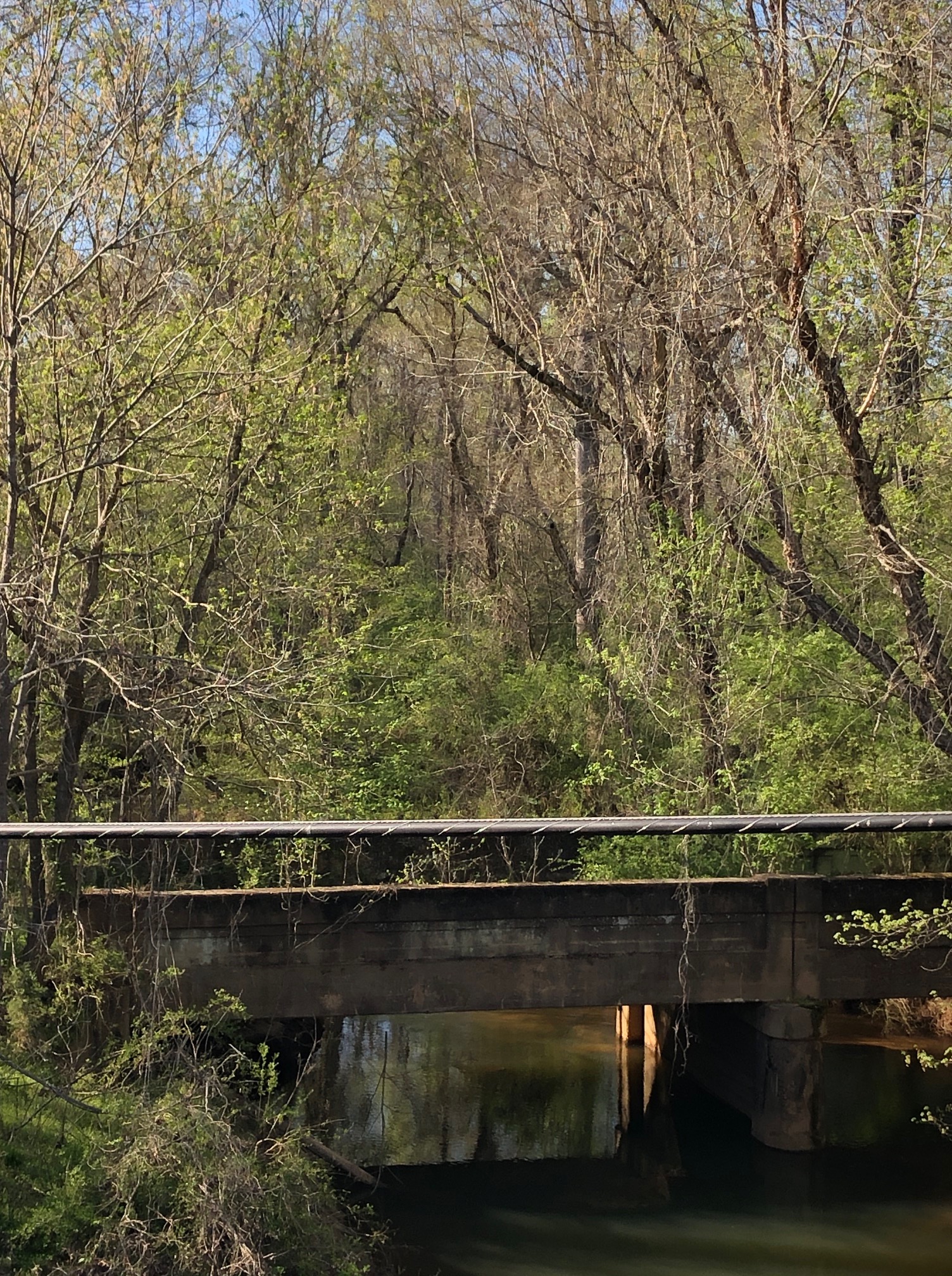
An Army munitions truck exploded on this bridge during World War II. I learned the story from my Dad when I was a kid.
On many Sunday afternoons, my Dad and Mom would take me and my older brother to Lake Lure/Chimney Rock, and we’d drive by this bridge. I still remember the conversations concerning the bridge while in the car, even to this day.
I remember hearing my mother say she could hear the explosion from a distance “as the crow flies” of about 20 miles from our home.
The following are some photos from this afternoon. (Friday, April 3, 2020) Despite being really close to a busy highway, I’d say few people are aware of the bridge and what happened there more than 80 years ago.
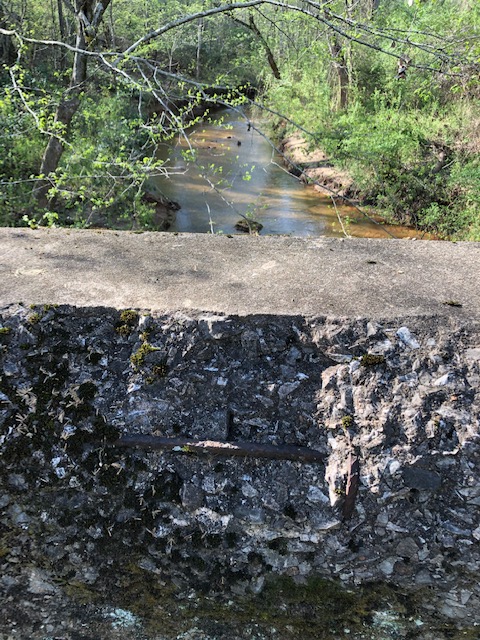
Below: It’s easy to see the damaged concrete side barriers, mostly toward one end and on both sides of the bridge, causing damage well over half the length of the bridge.
So, from this, we can conclude that the truck exploded, either while entering or leaving the bridge.
A bullet penetrated the concrete.
The driver was killed, but was there a passenger or others in the truck? I don’t know. This bridge is now just a distant memory of what happened at this site more than eighty years ago.
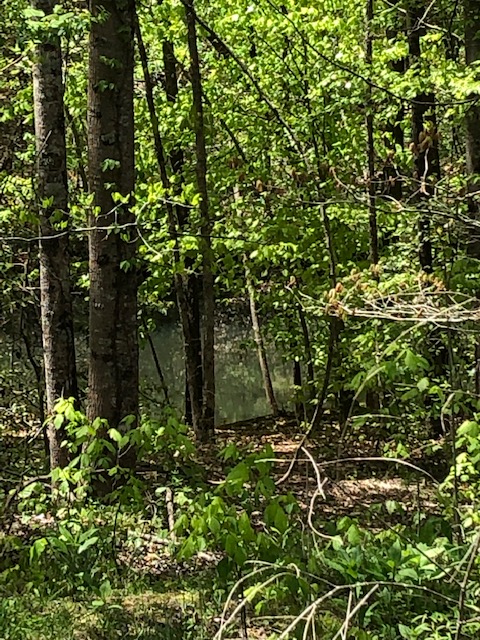
Date: April 21, 2019: The Secret Pond
I found out about this pond in the spring of 1968. I was sick one morning and my cousin Steve, must have been sick also.
However, we both “obviously” started feeling better, as Steve came by to pick me up for some fishing at several local ponds, including this one. I didn’t know this pond existed and have not been back since, until today. Only a very few know of this pond, and maybe it should stay that way. So, I’ll call it the “secret pond.” However, it’s not very far from Polkville or Lawndale, North Carolina.
Sunday 4-21-19
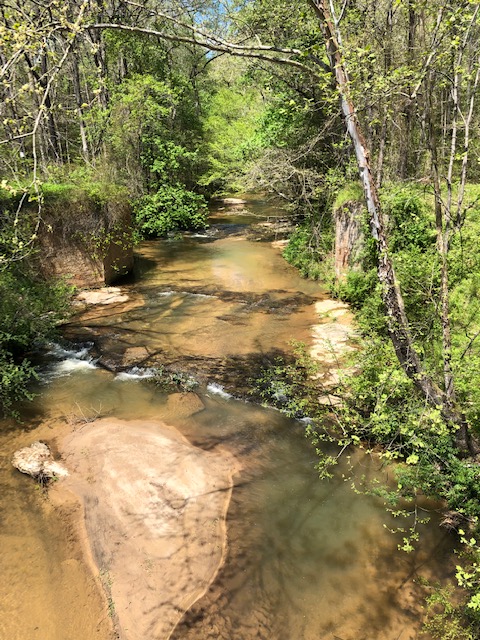
Pictured below: Crooked Run Creek
Note the concrete pillars on each side, toward the top of the following photo. This was where the original bridge crossed the creek on what has always been known as Tan Yard Road. The official name is now, Kistler’s Road.
Note: Tan Yard Road was so named as there was a tannery, very close to the bridge, during the 1800’s.
When I was a kid, this small creek seemed like a raging river. My cousin Myron Edwards told me there was a tavern/hotel and stagecoach stop near this location. And a man was shot and killed at the tavern during the 1800’s, with an “alleged” ghost story of the mans mule, reportedly seen walking in the area for many years following.
The Tan Yard Cemetery:
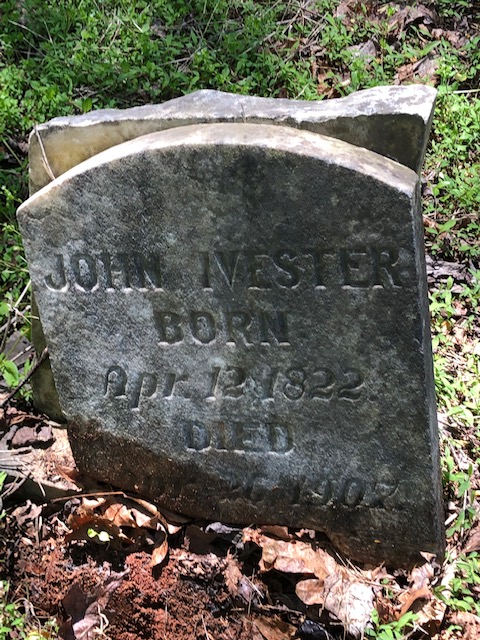
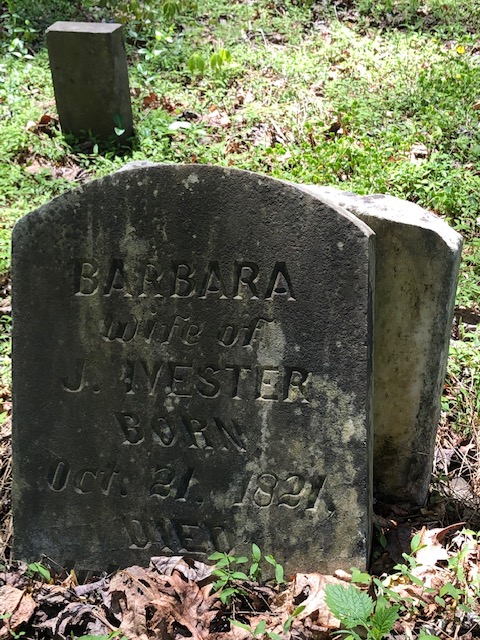
(Photo below) The Tan Yard Cemetery (only a hundred or so yards from the bridge) and has many old graves, some of them being my ancestors.
Click on the following link to see those buried in the cemetery.
Compiled by the Historical Records Survey of North Carolina, 1939:
“Location: 1/2 mile west of Kistler’s Union Church, 5 miles north of Lawndale, on lands of Velus Ivester. This cemetery was formerly used by a church as a burying ground.”
During the fall of the year, normally near Halloween, the MYF of our church would have a hayride. One regular stop would always include the Tan Yard Cemetery, for a spooky walk around the grave stones. At night it was indeed a spooky place, and I never wanted to be there by myself!
And at that time, we didn’t know about the story of the Tan Yard Ghost. If we had, there’s no telling what we might have seen!
The steam engine explosion, as told by Myron Edwards:
Only a couple or so miles from the Tan Yard Bridge, during the summer of 1900, five men were killed during wheat harvest when a steam engine exploded, just off what is Clover Hill Church Road.
Interesting to note…other events of significance during 1900:
That same summer was the Great Galveston hurricane, and also the “famous” 1900 solar eclipse, on May 28th. Wadesboro, North Carolina was one of the most popular locations for astronomers from around the world which came to view this solar eclipse.
The devastating F4 tornado on May 5th 1989:
Upper Cleveland County and two other adjoining counties encountered, late in the afternoon an F4 tornado on Friday evening, at about 6:00 PM. It first touched down on Mauney Road, where a house was destroyed and a woman being killed. Mauney Road was closed for a period, due to fallen trees and other debris.
Note: An F4 tornado has wind speeds between 200 and 260 miles per hour, which is devastating to anything in its path.
About a mile or so from where the tornado first touched down, it would set down again and would go for 30 or more miles, causing many more injuries and deaths, and thousands and thousands dollars of property damage.
Lawndale-Casar Highway:
A log house and also a brick house were completely destroyed and a huge and very heavy bucket truck was turned onto its side, beside the log house.
The tornado came very close to Kistler’s Methodist Church (1/4-mile north of the the destroyed two houses) and for most-part, damaged only the steeple. However, a church a couple or so miles away was completely destroyed.
I remember vividly, about 3/4 miles north of Kistler’s Church, behind F.V. Ivester’s store…a pick-up truck was lifted up, and sitting on top of a pile of uprooted trees. A memorable sight for sure, one which I’ll never forget, but just one of many.
The tornado remained on the ground, all the way to Toluca, and miles beyond. The tornado destroyed a house just south of the junction (highway 18 and 27) and would cause damage, injuries and deaths in at least two other counties.
A piece of wood, propelled by the tornado, penetrated a mortar joint at Kistler’s Church about 1/2-inch, as my car key illustrates. (see photo below)
However, this was not the first tornado that Cleveland County has encountered, which caused damage.
In 1973, a tornado caused damage just south of Boiling Springs, destroying or causing severe damage to Anthony’s Jewelry Store. Little damage beyond this in Cleveland County, but a textile plant in Cherryville received moderate to mild damage.
During the late 90’s, a tornado’s would cause damage to a Hardee’s Restaurant in Boiling Springs.
And then a few years later, another would cause damage to a “then” manufacturing operation, just off of highway 150, also in Boiling Springs. This is the large building that now faces White’s Automotive.
On the evening of (May 23rd, 2022) Cleveland County and especially Boiling Springs had a tornado warning. Fortunately, we had no damage. But it was the first time that Debbie, myself and Sophie got into our safe place under the stairs. Fortunately, in this area…to my knowledge there wasn’t any damage. However, in relatively close proximity in South Carolina, there was some mild damage to some houses.
November 22nd 1963:` Where were you when John F. Kennedy was assassinated?
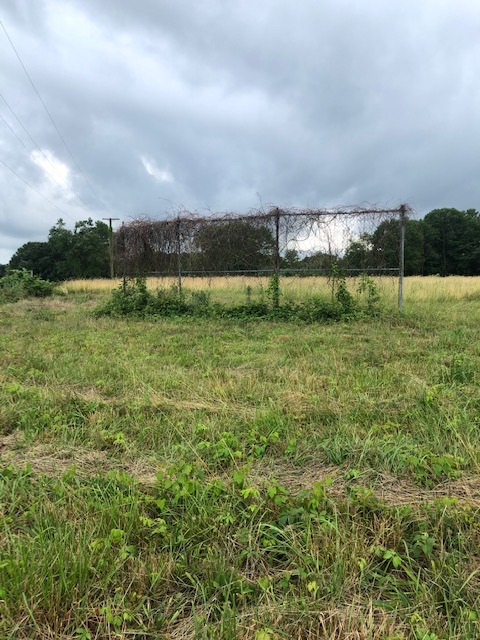
For me: I was in the 5th grade at Polkville Elementary School, on the baseball field during recess, near the baseball backstop.
The date and time of the assassination: Friday, November 22nd 1963 @ 1:30 PM EST. The time in Dallas was 12:30 PM CST. When my classmates and I went back inside the news of the event was being broadcast over the school intercom system, via a wooden speaker in the ceiling corner. We were all looking at a dark brown wooden speaker, as if we were seeing live audio.
Since this event occurred on a Friday, my family watched a black and white television almost continually during the weekend. The funeral was on Monday, November 25th. A horse-drawn carriage would then carry the casket (called a caisson) to Arlington Memorial Cemetery….the final resting place of President Kennedy.
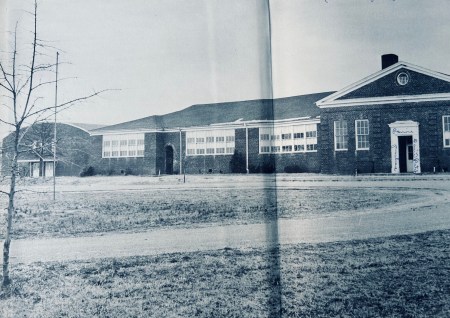
Where is Polkville School today?
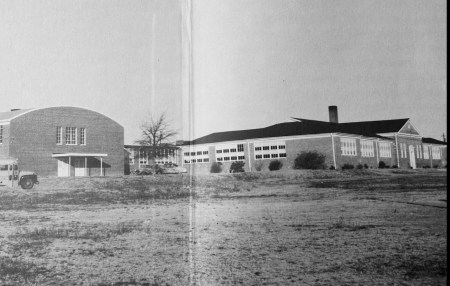
Polkville School was torn down quite a few years ago (maybe about ~2010) with nothing left except the circle drive in front. The school buses were parked around this drive during the day.
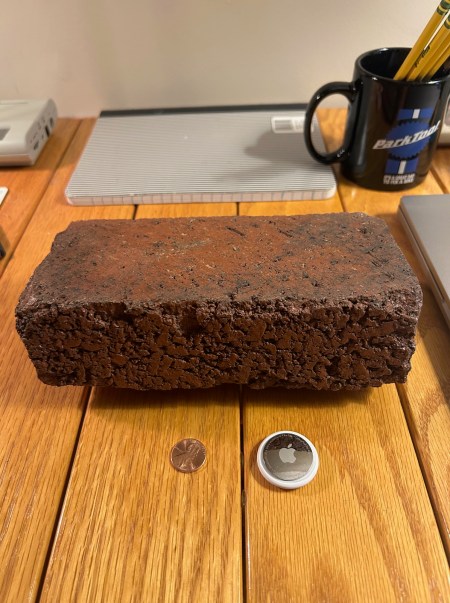
I saved a brick from the school…
The following photographs of the baseball field backstop which is no longer there.
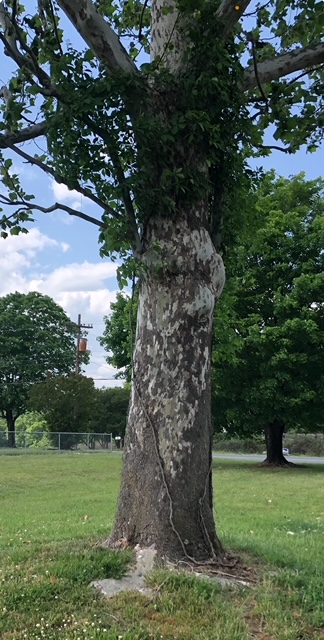
There was and still is a large sycamore tree, directly in front of where my 5th grade class was located. This tree was used for many years to dust the blackboard erasers by students in the afternoons. I was one of the many students that receive the eraser assignment in the grades of the 4th and fifth.
Going to the drive-in, and coming home to witness a plane crash….
November 1965, and my oldest brother Richard took me, my brother Phillip, and Charles Hicks to the drive-in to see a Nascar movie, titled “Red Line 7000.” I was 12 years old at the time, Phillip was 16, and Charlie was 17.
It became really foggy on our trip back home. When we turned off highway 226 and then up the hill heading toward Lawndale on Shelby Road, we saw spotlights and emergency vehicles on the left, just beyond the crest of the hill.
A yellow Piper Cub had crashed within ~100 yards of the highway. We stopped and actually walked to the crash-site. The pilot was killed. I’ll never forget what I saw that night with almost perfect recollection and clarity to this day.
The pilot had to be flying (VFR) or visual flight rules, meaning the pilot operates an aircraft in weather conditions generally clear enough to allow the pilot to see where the airplane is going, definitely not at night.
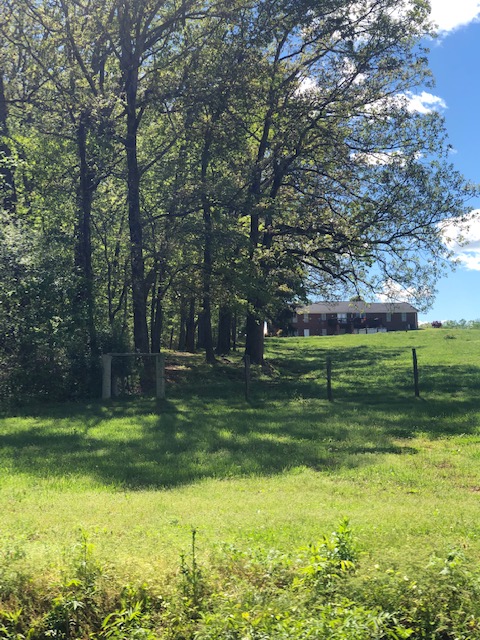
If you look at the crash site photo (as following) the plane crashed just beside the tree line at the edge of the field, and just to the right of the largest tree and behind the two outermost fence posts.
Charlie Hicks would later have a distinguished career in the Air Force; flying A-10’s, Stealth’s and other high-performance fighter planes. He would also successfully make 200 nighttime carrier landings with the Navy.I feel absolutely certain he had no idea while at the crash scene, he would one day become a true “Top-Gun” pilot.
Note: This was not my first personally “witnessing” of an airplane crash, after the fact. However, I have this in another post. The pilot was also killed in this crash. You might be surprised about this crash. I was in the first grade and was with my daddy eating a sandwich at the All-Day BBQ, which had a gravel circle drive on Grover Street inside the city limits of Shelby, before moving years later to 74 bypass.
My witnessing of another plane crash:
I was about six or seven years old? My daddy took me for a BBQ sandwich in Shelby. The location was in the curve going north on Grover Street, just beyond the Shelby Hospital. The “All-Day” BBQ restaurant had a circle “gravel drive” with curb service. It was a favorite hangout for teenagers at that time. A few years later the restaurant would move to 74 bypass.
When we pulled into the restaurant drive…just on the other side of the road, there was a Yellow Piper Cub, standing right on its nose in a completely vertical position. The pilot was killed. It was said or “alleged” that he ran out of fuel after departing Bridges Airport. This was before the current Shelby Airport was built.
A photo of the crash site or location follows:
When looking across the road from the building formerly Bernhardt Furniture, the plane was vertical in the yard, between the two houses. The year was either 1959 or 1960, and I would have been in either the first or second grade.
Supplemental August 25th 2024: I was talking with Joe Champion this afternoon who said that his dad took both him and his brother to see this plane crash also. Quite a few years back, Joe and I rode many bicycle miles together. And during those rides, neither of us would know that we both witnessed this plane sanding on it’s nose, so many years ago.
A man fell out of an airplane!
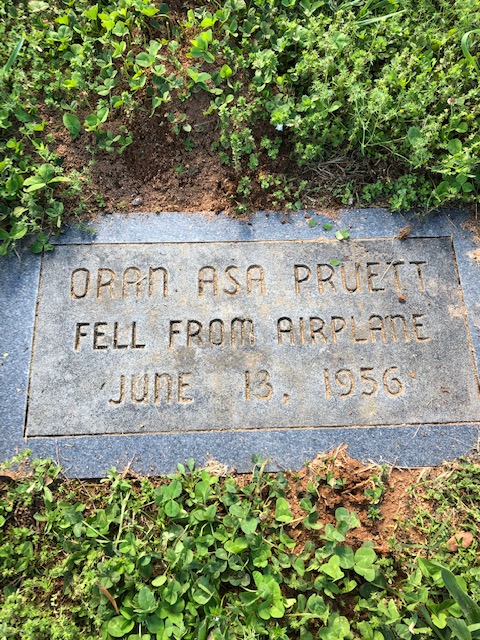
In 1956, a man fell out of a DC-3 and landed in the cemetery of Zion Baptist Church. This is something I’d heard about for so many years while attending elementary school.
June 13, 1956: The date of this event can be seen on the marker pictured below, and is the exact spot of impact. The man’s name was Oran Pruett.
There are lots of stories (which I’ll not get into, as I don’t know the facts) but the short story: Pruett “allegedly” just opened the door and fell out.
Debbie and I had searched the cemetery this afternoon without success, looking for the marker, indicating the exact location of where Mr. Pruett died due to impact.
Without any luck, when we were leaving, but as luck would have it, we met Dennis Wright and his granddaughter riding in a golf cart in the church drive, and told us the following. He said the church custodian heard the sound of Mr. Pruitt descending from the sky, and also the impact.
I remember as a kid, being sick in the late 50’s and very early 60’s, visiting Dr. Edwards, who was my great-uncle (my grandmother’s brother.)
His office or practice was in Toluca, only a few miles from the crossroads of Belwood, just off highway 18.
He was a general practitioner, but delivered over 6,000 babies!
The rock building is still there, but as the photos indicate, it’s in really bad condition with the roof collapsing in many places. The “once” waiting room now has an open sky.
Note the “black” front door in the second photo, which appears to be the original door from at least the 50’s, or the last time I was there. I couldn’t have been more than 10 years old.
I remember the alcohol and sanitary smell, and dreading that “most of the time” a penicillin shot in my hip. That shot would really hurt!
The Delight Alligator: What! An alligator in upper Cleveland County!
The “Delight Alligator” (Delight is a small community, mostly just a crossroads) located between Polkville and Casar.
Yes, there was an alligator, about six to eight feet in length, living in Paul Whisnant’s Pond, in the early to mid-60’s. How did an alligator find its way to that farm pond? No one that I’ve talked with over the years seems to know or remember.
A pond, located on a dirt road that my school bus traveled by so many times, going to Polkville elementary school and back home in the afternoons.
Whatever happened to the alligator, that seemed to have lived in perfect harmony in this farm pond for quite a few years?It was “alleged” or said the alligator decided to leave the pond and venture into the First Broad River, and was later found and killed for obvious reasons.
The story of the “Delight Alligator” seems to be remembered by only a “very few” these days, which is my reason for documenting or writing this story.
Lawndale Snack Shop, operating from the mid-1950’s through ~1965.
While Debbie, myself, and Sophie were in Lawndale today (Thursday, March 24th 2022) I just had to stop and take a few photographs of the former Lawndale Snack Shop and share a few things I remember from those early days.
This was a regular gathering place for “mostly” teenagers. The parking area in front was pretty rough, with washed out ditches and mostly red dirt. No gravel…just dirt. The Snack Shop specialty was hamburgers and french fries. However, since writing this, I’ve been told that “Livermush” sandwiches were also very popular.
Orders would be taken at a small window which is pictured below. The following photo of The Snack Shop as it appears today (March 2022) and no longer a restaurant.
However, curb service was available, for those that chose not to get out of their car. A server would then bring the food out via a tray, that would attach to a partially rolled down window.
I was pretty young during the hay-days of the Snack Shop (about 10-12 years old) but would go there on occasion with my mom and dad. I remember the outside or exterior being painted mostly yellow and the lights underneath the overhang were also yellow.
When coming up the hill from Lawndale at night from a distance, the little “burger joint”appeared as a welcoming beaconof light.
I remember seeing a pink and black 1956 Ford parked out front with finder skirts, which I can see inmy mind even to this day.If only I had a photograph of the parkinglot during a Sunday afternoon in the late 50’s or early 60’s. It might have been possible to see a 1960 Chevrolet 409, a Ford Fairlane with a 406 engine, a Studebaker, a 1958 Plymouth Fury or maybe even a Henry J.
Guys would often times be standing outside their cars and talking, with thesound of “Sherry” by the Four Seasons playing in the background from a car radio.
If you watched the movie “American Graffiti” you might notice a similarity, to the Snack Shop represented similar events during a period in time, not in California, where the movie was based, but in Lawndale, North Carolina.
This little building in my opinion is a landmark, representing a time when a guys car was their personality or identity.
A time when there were no cell phones that would eventually consume the minds of most all on the planet. A time when music was good. A time when most everyone attended church on Sunday morning. A time when Hollywood and professional athletes had no influence on national or world affairs. A time when everyone seemed much more happy, despite having far fewer material possessions. Yes, it was a simpler time, but my opinion, it was definitely a happier time.
The world takes a turn for the worse:
Unfortunately at this time, the Vietnam war was beginning to escalate,illegal and psychedelic drugs were becoming popular in other parts of the country, and the peace and love movement was coming onto the scene in California, and the rest is history.
56 years ago (2025) the First Broad River flooded, closing the Lawndale-Casar highway in August 1969, due to Hurricane Camille and one person died.
I’ll never forget looking down from Dale Pendleton’s Barber Shop and seeing the First Broad River crossing the road with a very swift current crossing the Lawndale-Casar highway. The river was only a hundred or so feet from the parking lot of Neason’s Hardware.
In the early morning hours with heavy rain and darkness, a car traveling from the Belwood Road turned left onto the Lawndale-Casar highway, and drove unknowingly into the river. The car and driver were found the next day “seems” it was a few miles down-river.
Point of entry: Where the guardrail is now currently located.
The heavy rains that caused the flooding was most likely due to Hurricane Camille. I can’t confirm or “definitively” say this, but the time period is right. I was 16 years old and just completed a summer job at a furniture company in Lincolnton, which would have been about the second week of August.
Hurricane Camille made landfall on the Mississippi gulf coast in the early morning hours of August 17th, 1969 and packing (a peak wind of 175 mph) causing tremendous damage inland. Camille killed 259 people and with property losses in excess of $12 billion (2024 dollars). Some rural towns in western Virginia, to this day, even after more than 50 years, have still not recovered. Hurricane Camille is the second most powerful Hurricane on record, second only to the 1935 Labor Day Hurricane.
Following photos:
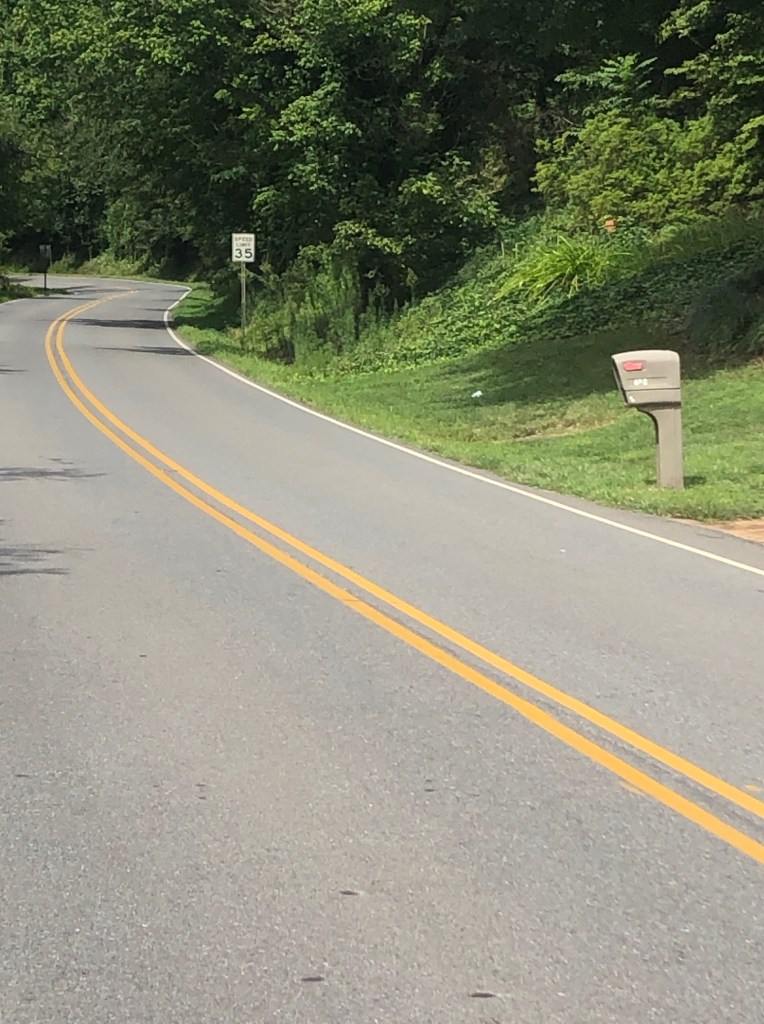
Just to the north of Neason’s hardware, on the Lawndale-Casar highway, the river was a couple feet up on the speed limit sign. The following is a very recent photo.
Comments:Comments Off on Local History and Memories
Posted August 14, 2018 by rogerivester Categories:Roger's Articles
While visiting our family in Mullins, South Carolina over the past few years, we have enjoyed finding some very interesting things.
Only a few miles outside the city limits, there are country roads, agriculture fields, and no houses or lights for miles and miles, and virtually no light pollution.
The next morning….Tuesday August 14th 2018.
When driving in a secluded area, via unfamiliar country roads, you never know what you may find:
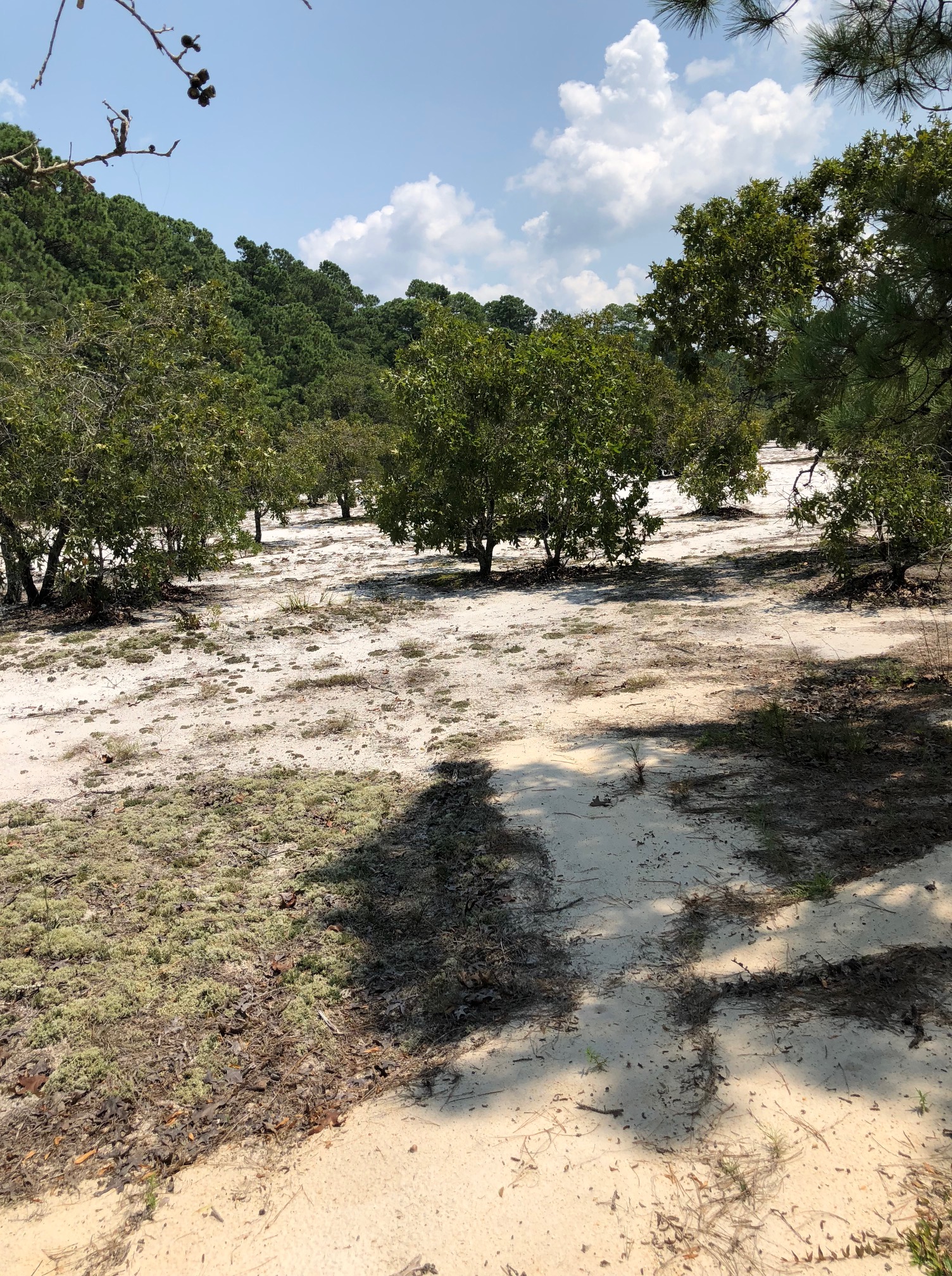
While riding around with my oldest grandson, John-Winston, who just received his learners permit, and I was sharing my wisdom, on how to be a safe driver. During our leisure drive, we found sand dunes, in the middle of a swamp!
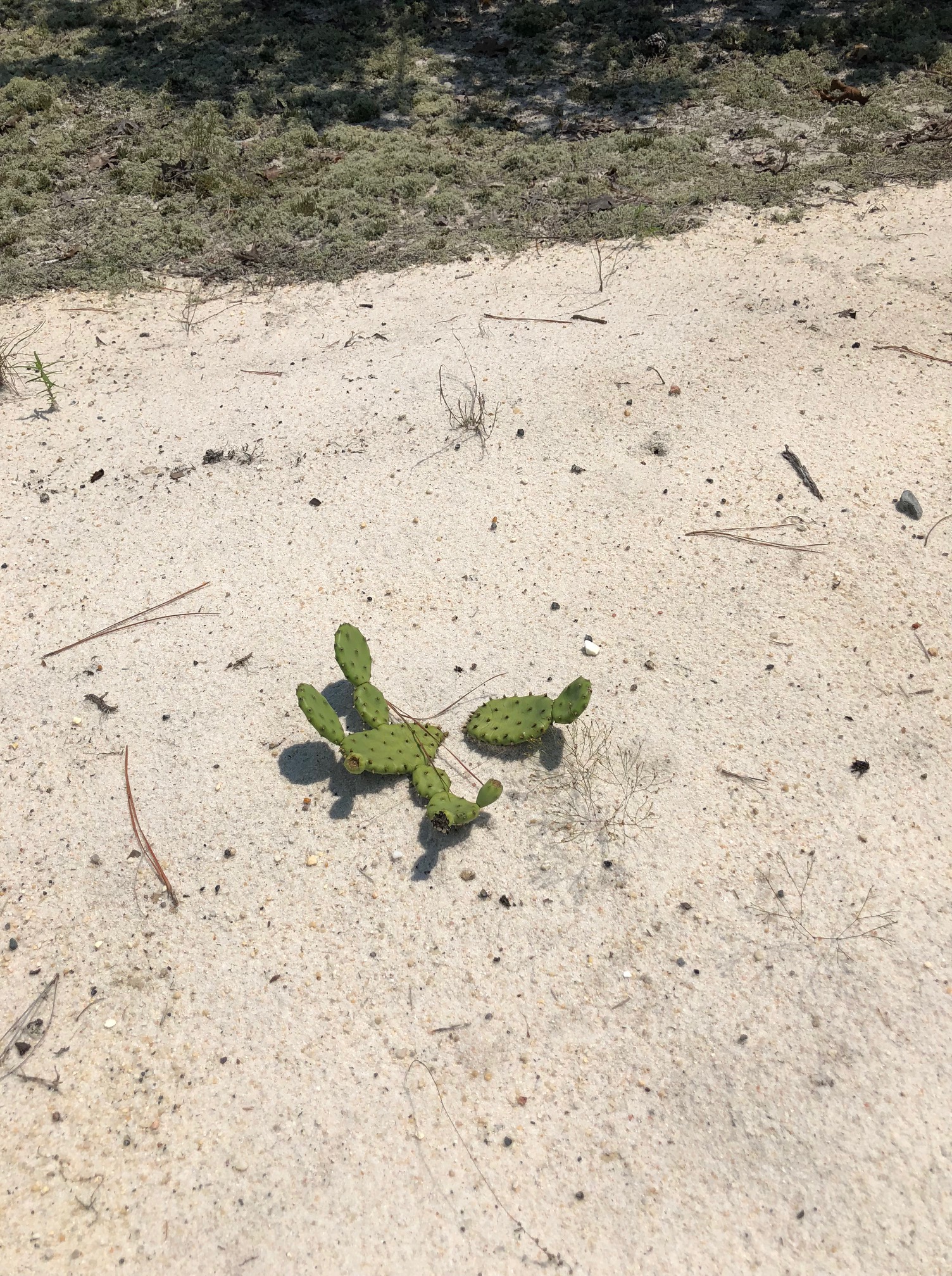
Sand dunes, and a very sandy area….at first resembling snow, all in the middle of a dense forest and surrounded by swamp land.
There were Bald Cypress trees growing out of the black murky water, Spanish moss hanging from the trees, and who knows, maybe even an alligator or two in that dark water!
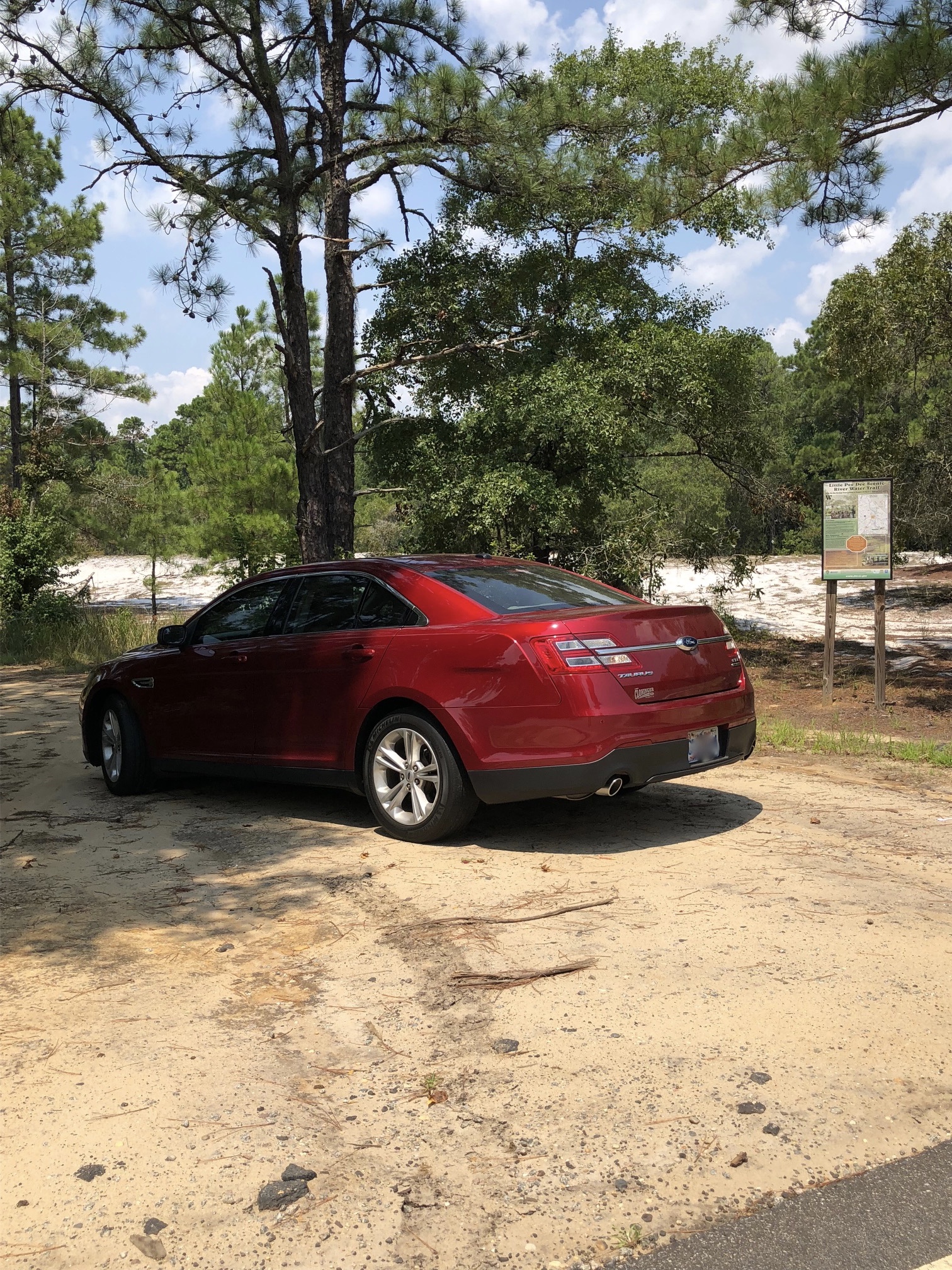
Note: This very remote small sandy area is a protected site. I took some pictures as following, but somehow missed the eerie swamp.
Roger
Stopped and using the car as a size reference, to a part of the protected site:
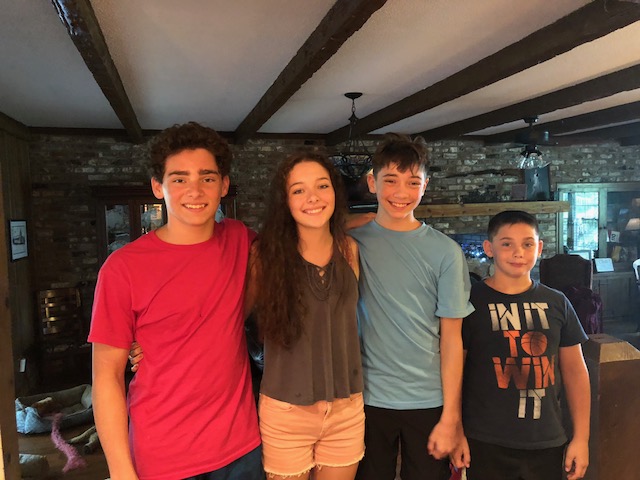
South Carolina Grandkids
Debbie (Grammy) with granddaughter Gracie
Couldn’t leave our Sophie behind! She’s ready to go anytime we are!
Comments:Comments Off on Sand Dunes In The Northeastern Corner Of South Carolina, 50 Miles From The Atlantic Ocean, Swamps, With Virtually No Light Pollution
Tom English has put together an excellent list of twenty-five doubles and five multiple stars, which at first glance would seem to be compiled for only those new to this facet of amateur astronomy. However, for those of us who have enjoyed double star observing for decades, we know there is no such thing as a beginners list.
Double star lists may be compiled of the most difficult pairs due to their close separations and sometimes with unequal magnitudes, or those with wide separations and beautiful contrasting colors. It was the latter which coined the name: “The jewels of the night sky.”
This list contains some beautiful and interesting doubles, all of which can be observed with a small telescope.
The famous double star, Epsilon Bootis is probably the most difficult double on the list, which has always required at least a 4-inch refractor for me. Many observers have reported seeing the companion to Epsilon with a 3-inch aperture.
Are you stressed, too tired to take out that big telescope, but would like to enjoy an hour or so of relaxation under the night sky? So….why not a 60 mm refractor or a 3-inch reflector? And you don’t have to worry too much about a bright moon or ambient lights as both have little effect on “most” double or multiple stars.
Want to become a better double star observer? I’ve listed a few things as following which have helped me over the years:
I’ve never been able to observe through a telescope eyepiece and stand at the same time, much less attempt to separate a very close pair.
And for those extremely close and difficult doubles, an eyepatch is necessary for the non-observing eye.
It’s important to relax the facial muscles and “absolutely” essential to hold the observing eye very still and on-axis….hence the need to be seated.
A good quality astro-chair, as pictured below is a must when observing double stars.
Roger Ivester
Comments:Comments Off on Cline Observatory Double and Multiple Star List – Compiled By Tom English; Consisting of 25 Doubles and 5 Triples
Polaris has never gained much attention as a double star. However, If you’ve had an interest in double stars, but never seemed to get started, Polaris would be a great double to start with, especially with a smaller telescope.
For this project, lets call a small telescope, anything 80mm’s or less.
Information from the “Cambridge Double Star Atlas” by James Mullaney and Wil Tirion, as a reference:
Polaris has a magnitude of 2.1 and the secondary or companion at a much fainter 9.0 magnitude with a wide separation of 19 arc seconds. The extreme difference in magnitudes can make this double more difficult to separate than you might think, especially if seeing is less than good.
Sometimes I check this star frequently, when setting up, to gauge seeing. I have some notes and sketches from years past, and current using some small telescopes.
September 1996: 4-inch Meade Schmidt-Cassegrain f/10, model 2045d: Seeing very good, could easily see the companion at 50x. RI
September 1996: 5-inch C5 Schmidt-Cassegrain, white-tube with the single arm fork. Made in USA. Easy, beautiful and clean. RI
February 1997: 4-inch Meade Schmidt-Cassegrain f/10, model 2045d: Seeing only fair. The companion was visible only intermittently. RI
October 1997: 90mm Meade ETX Astro-Scope, Maksutov-Cassegrain: Seeing was good and the companion was very easy at 52x. RI
December 1998: 102mm Vixen/Orion f/9.8 achromatic refractor: Very easy to see the companion at all magnifications. Roger Ivester
I was unsuccessful during the week of April 8th 2018, using my latest small economy Orion CT80 f/5 refractor.Seeing was only fair, so I’ll try it again in the next night or so. Roger Ivester
April 17th 2018: 102mm Vixen/Orion f/9.8 achromatic refractor: Seeing was very poor, could still see the companion, but only intermittently, using full 102mm aperture. Did not even attempt with an effective aperture of 60mm’s. Roger Ivester
Mike McCabe of Massachusetts was able to see the companion last summer on a night of excellent seeing, using a vintage and classic Sears 60mm f/15 refractor.
Observing notes by Mike McCabe as following, for the night of April 18th 2018: It’s been great getting to know Mike, who is an experienced and skilled observer.
Notes from Mike McCabe:
Well, you really got my interest with your lobbying everyone to try and go see the secondary to Polaris with a small scope. I got lucky here last night – totally unexpected it was – with a clear and stable sky sometime around 9pm local time.
At first I turned my interest to the 10% waxing crescent moon, and I brought out my SV80ED to have a quick look. It was spectacular, with incredible earthshine on the moon and a dark, clear sky around it. There were nearly as many stars in the view as you’d see during an eclipse! I watched the moon occult a star (don’t know which one) and then toured the Haydes, the Pleiades and then Polaris. The 80mm brought out the secondary with no trouble.
I decided to bring out the Sears 60mm f/15. That was a good decision! I put Polaris in the eyepiece and ramped the power up to 112x. In short order I had the secondary in view at an ~5:00 position in the field of view.
I have another 60mm f/15 OTA (a 1980’s era Celestron FirstScope) which I am currently setting up. I’m wanting to complete the Astronomical League’s Double Star list to receive my certificate which I started working on quite a few years ago, but have never finished. Mike McCabe – Massachusetts
Luna Brannon, North Carolina:
March2022: Using a 100mm f/5 achromat with an ES 11mm 82º eyepiece with the employ of a 2.5x Barlow (magnification 113x), I was able to view Polaris and its companion. Applying the 50mm sub-aperture mask allowed me to watch it continuously as the image dimmed, so that I would not lose the companion star. Having committed the star’s position to memory, I was then able to see it again without transitioning directly from the 4-inch aperture. The companion star is easily split in terms of spatial resolution, it’s really just the dimness that’s the problem. From a dark site I imagine it’d be easy to get down to 40mm or less and still see the companion.
Roger Ivester, April 19th 2018:
102mm Orion/Vixen f/9.8 achromatic refractor with an effective aperture of 60mm’s. Seeing excellent: 12.5mm eyepiece plus a 2.8x Barlow for a magnification of 224x. The companion was visible as a tiny bluish dot.
Roger Ivester, April 19th 2018: Orion 80 mm (CT80) f/5 achromatic refractor.
Seeing excellent: 12.5mm eyepiece plus 2.8x University Optics Klee Barlow for a magnification of 90x. The companion was visible as a tiny bluish dot. Very similar to the view using the 102mm reduced to 60mm’s. A beautiful sight in both telescopes.
April 20th 2018: Orion 80mm (CT80) f/5 achromatic refractor. Similar conditions to my observation on the 19th. Using the same eyepiece combinations (90x) and was able to easily see the companion as a tiny bluish dot.
“Celestial Objects For Common Telescopes” By Rev. T.W. Webb – 1859
“Spec. Bin., and slightly var. D., 9 blsh. as I see it.Common test, but only suited for small apertures, being easy with anything much exceeding 2 in.D. has proposed it as a general standard, finding that 80 on 2-in. will show it if the eye and telescope are good; he has glimpsed it with 1 3/10-in. achr.Dawson has glimpsed it with 1-inch.T. T. Smith sees it with 1 1/4-in. refl.In Dorpat achr. it has been perceived by day.De. gives it 8.4 m.”
1 3/10-inch = 33 mm’s
1 1/4-inch = 32 mm’s
1-inch = 25.4 mm’s
The following is a photo of my 102mm refractor with a stop-down mask for an effective aperture of 60mm’s.
Orion (CT80) 80mm f/5 refractor, photo following: I could see the companion to Polaris with this small short focal length achromatic refractor! And when stopped-down to 60mm’s.
My son surprised me with this telescope for my birthday, and it will always be a prized possession of mine. He lives on the west coast, so it was a real surprise for a UPS truck to show up, and not knowing what the delivery was. 🙂
102mm f/10 refractor, stopped down to 35mm f/29 refractor telescope: (See the following photo)
Unfortunately, I’ve never been able to see the companion with the 35mm effective aperture, to-date. (Date: March 20th 2024)
May 2, 2018: This was the third night in my attempt to see the companion using an effective 35 mm aperture. Seeing was only fair, and could not see the companion, nor with a larger 45mm effective aperture.
April 2nd 2018: Report by Richard Nugent as following:
Roger, thanks for inspiring me to observe Polaris and it’s faint companion star, Polaris B. As I mentioned I’ve observed the pair more these past few weeks than in total over the last five decades! I’m glad I did. Here’s my report to date…
Polaris B is about 19” away from Polaris so separation is not the issue. Seeing the B star only requires an aperture with a faint enough limiting magnitude. Of course, on any given night, a telescope’s limiting magnitude is dependent on many factors that are difficult to quantify. Limiting magnitude tables seem, to me, to be overly optimistic!
…..I was finally able to see the companion with a 10-inch Newtonian with a 40 mm effective aperture. Richard Nugent
May 6th 2018: The following report by Roger Ivester
Last night, seeing was excellent, and a 6-inch f/6 reflector, with an off-axis 45 mm effective aperture, could glimpse the companion, but with extreme difficulty. This required over more than an hour, using good breathing techniques, as it’s easy to “involuntarily” hold your breath when attempting a close or faint companion, such as Polaris B. I also used an eyepatch over my non-observing eye, to relax my face.
It’s my opinion, it’s “next to impossible” to observe a difficult double, or any deep-sky object while standing. I always use my astro-chair while observing, and making a pencil sketch. Roger Ivester
Richard Nugent would seem to have the have the modern day record, or at least the only amateur I know personally, who has seen the companion to Polaris with a 40 mm effective aperture. This was using a 10-inch Newtonian with a 40mm off-axis stop-down mask.
Roger Ivester, March 21st 2024 @ 5:30 AM EDT, with an effective aperture of 45 mm’s.
I could see the companion, with an effective aperture of 45 mm’s using a magnification of 233x. However, it was very difficult, and could only see during moments of steady viewing.
Photo of my 45 mm effective aperture…as following.
Comments:Comments Off on Polaris: Seeing the Companion With a Very Small Telescope, Maybe Even As Small As 30mm’s?
Posted February 21, 2018 by rogerivester Categories:Roger's Articles
Edmund Scientific was the company that really fueled my interest in amateur astronomy. From their telescopes and accessories to their many beginners books. My first telescope was an Edmund 4.25-inch f/10 reflector, with an equatorial mount. Not my first choice, but the best my budget would allow at that time. Prior to this, I used my older brother’s 60 mm f/15 EQ refractor. (Photo at the bottom, in an old rented house on a textile mill village, with a street light in the backyard!) However, life would begin to improve.
I was just getting started in my working career or first real job, and most all of my money was required for the essentials of life, with little left over for a telescope and astronomy equipment.
The small Edmund 4.25-inch Newtonian allowed me to see many of the Messier objects to a level I’d never seen before. And at that time, I was living in a highly light polluted area, so the setting circles were like magic. Star-hoping to locate faint deep-sky objects is “almost impossible” with severe light pollution.
I later purchased a larger set of setting circles, also from Edmund, which greatly improved my direct-indexing accuracy and ability to locate fainter deep-sky objects.
I also replaced the “blunted nails” by Edmund, used as index pointers for the setting-circles with machined brass welding rods, with needle-like points for greater accuracy.
Since that early time, I’ve had or owned about twelve other telescopes. Most serious and long-term amateurs will agree; the first telescope of the amateur is only the beginning, with many more telescopes to follow.
I learned quite a bit by reading the many books by Edmund Scientific, and taking my telescope out into my back yard, night after night.
During those early years, it was my desire or goal to see the entire Messier Catalog, which I have completed many times since, but would eventually see over 2,000 more deep-sky objects, complete with notes and pencil sketches.
I’m glad I didn’t quit during those early years, despite all of my obstacles, and regardless of the amount of light pollution, there are always deep-sky objects that can be observed. So, don’t give up!
Comments:Comments Off on Edmund Scientific of Days Past, And My Beginning As An Amateur Astronomer
Posted December 3, 2017 by rogerivester Categories:Roger's Articles
I’m a bit late in finding out (January 2018) but University Optics closed its doors in ~June 2017. I was saddened to hear this.
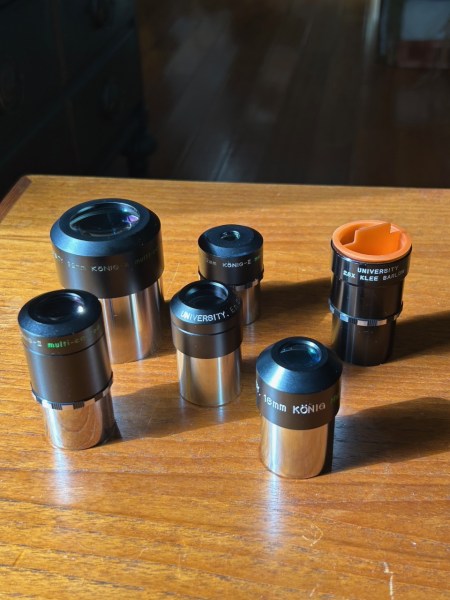
I purchased all of the original UO Konig’s over 30 years ago: A 12mm, 16mm, 24mm in a 1.25-inch format, and a 32mm 2-inch…also a 20mm UO Erfle, and a 2.8x three-element apochromatic Barlow. I have, or have had many other eyepieces over the years, including Televue, Celestron, Meade and others. But I still use my Konig’s quite often, even to this day. As a visual observer, I love eyepieces. However, my last eyepiece purchase was over ten years ago…an 11mm Explore Scientific 82º AF bought in-person, from the Park’s Optical store in Las Vegas.
It’s very sad to see a company that supplied mirror making kits, mirror cells, diagonal holders, and many other low profit items, now out of business after more than 50 years.
University also sold a 6-inch f/8 Newtonian and an 80mm f/5 achromatic refractor in kit forms. The refractor required both assembly and paint. The Newtonian only required assembly. The 80mm was an air-spaced achromat which received many excellent reviews.
University Optic’s will be missed by the amateur astronomy community. So many great “made in America” astronomy companies are no more.
My University Optics eyepiece collection as following, and all still in pristine condition.
Comments:Comments Off on University Optics Closes Doors After 50+ Years
Posted November 7, 2017 by rogerivester Categories:Roger's Articles
My first telescope purchase (1977) and my last eyepiece purchase (to-date) were from brick and mortar astronomy stores, but like most other full service astronomy stores…are no more.
I will always remember my excitement on that late Friday evening, walking in Science Hobbies and purchasing a 4.25-inch Edmund EQ reflector. I really wanted the 6-inch f/8 Super Space Conqueror, but I’d just began my first serious job and money was a bit tight. I’d been looking at telescopes in those little Edmund Scientific catalogs for the longest time.
Science Hobbies was a small family owned hobby store that sold products mostly from Edmund Scientific. For many years they had a big 8-inch Edmund f/6 Newtonian Reflector on a massive equatorial mount sitting in the front window.
Throughout the years, I always enjoyed going to Science Hobbies. It was fun to be able to see and feel many of the products from Edmund. Other than my telescope, I bought a few eyepieces, a pedestal mounted eyepiece holder, books and too many other astronomy related products to list.
My last trip to Science Hobbies:
It was a Saturday afternoon in the mid-90’s, when I decided to visit Science Hobbies, which I’d done so many times before. I got out of the car and went to the front door only to find it locked, and the store was empty. Somehow, I had missed not seeing the rusty sign that hung over the door for so many years and the large 8-inch Newtonian, was not in the front window. The store had closed, and at that moment, a bit of sadness came over me. This would be my last visit to the location that was the former…Science Hobbies.
Now to Scope City in Las Vegas:
When visiting family in Las Vegas on at least a couple trips, one in 2008 and then again in December 2010, I visited the Las Vegas Scope City store. However, I was sorry I didn’t purchase an 11mm Explore Scientific 82º eyepiece while being in the store. When I got home I called back, and placed an order over the phone for the eyepiece. So, to-date, this has been my last eyepiece purchase. I also purchased some very nice engraved 6-inch aluminum setting circles from Scope City, which was the only company that still sold them.
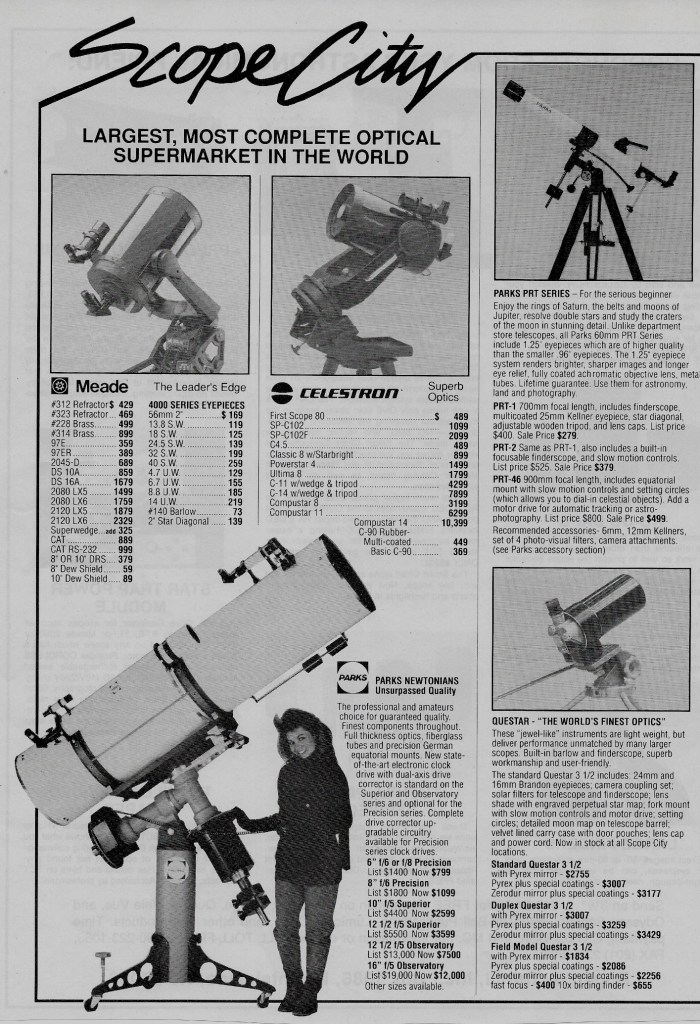
I had always enjoyed seeing the Scope City advertisements in the magazines, showing those big Parks Optical Newtonian’s with massive equatorial mounts.
It was great to be able to visit the Scope City Store, but unfortunately, not very long after my last visit and purchase, Scope City also went out of business.
I have often wondered what happened to the 8-inch Parks Optical Newtonian, on a very heavy duty equatorial mount that was sitting in a corner of the Las Vegas store.
My first telescope was purchased from Science Hobbies in Charlotte, or a retail (brick and mortar) store and later went out of business. And my last eyepiece (to-date) purchase was from a brick and mortar store, being Scope City in Las Vegas, also later to go out of business.
After the demise of Cave Optical in Long Beach, it was Parks Optical that took their place with large equatorial Newtonian reflectors, on a large scale production basis.
Science Hobbies, Scope City, Cave and Parks Optical are all missed, especially by those like myself that have been serious students of amateur astronomy for 40 or more years.
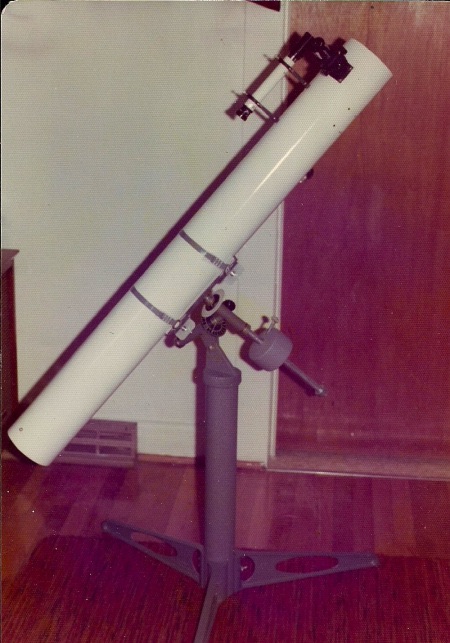
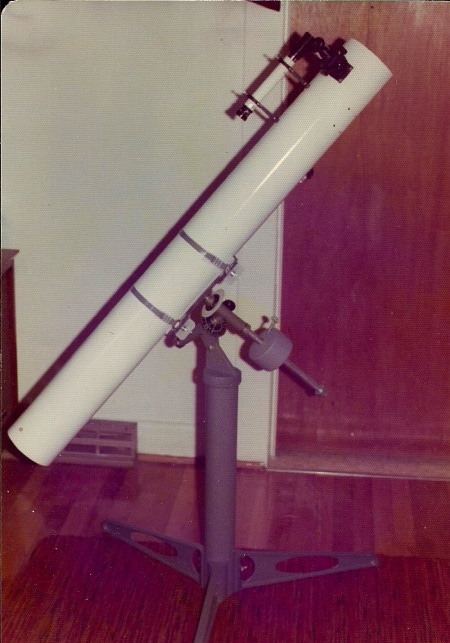
My first telescope purchased from Science Hobbies in Charlotte: A 4.25-inch f/10 reflector which I purchased in March 1977. The following photo was made in a rented hours: An old (built in 1927) mill village house which was incredibly cold during the winters.
My first observation using this telescope was Jupiter from the side yard from that house. And It was using this telescope during the fall of that year from the light polluted backyard that I first observed galaxies M81/82. This was a defining moment for me, as in my mind on that night…I became a real amateur astronomer.
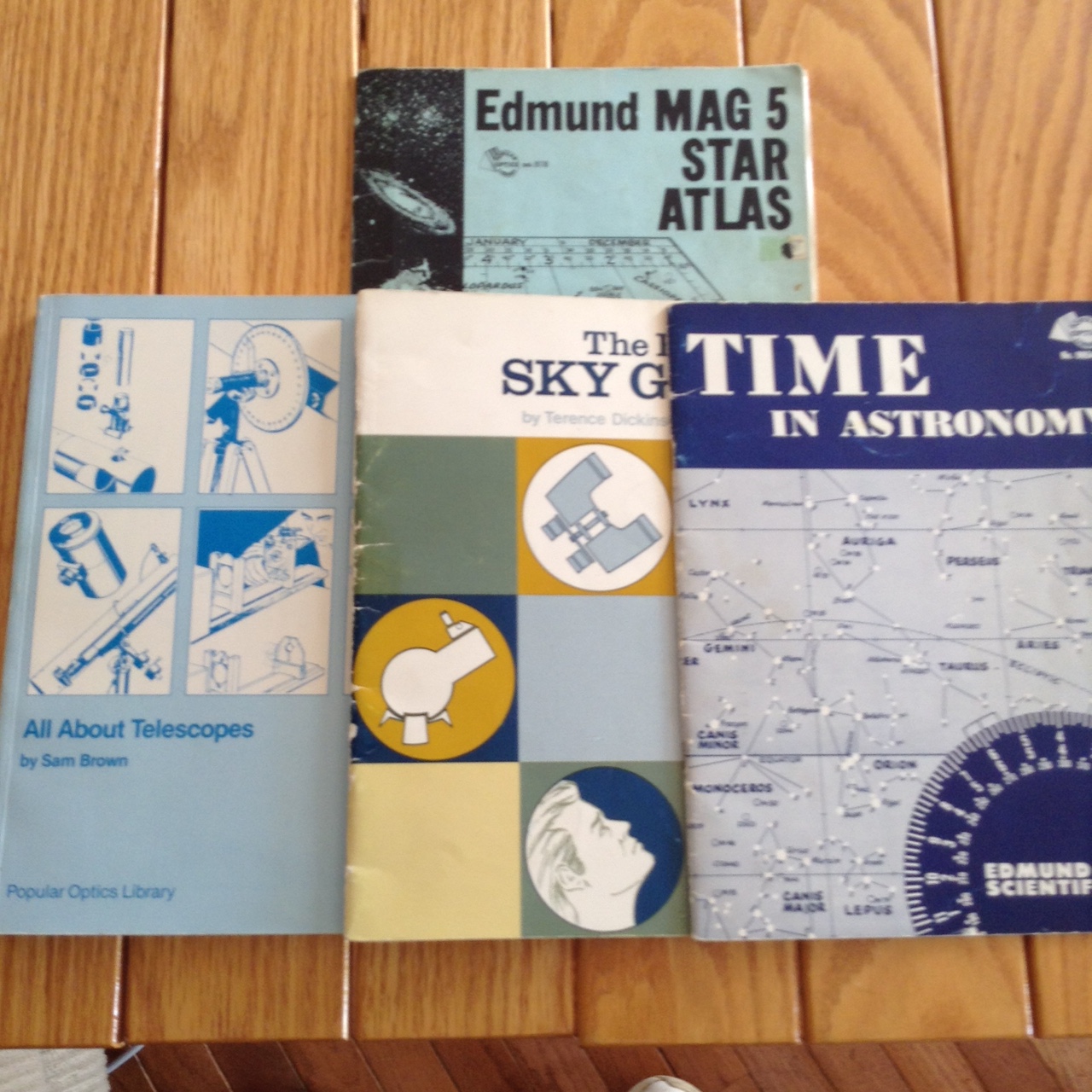
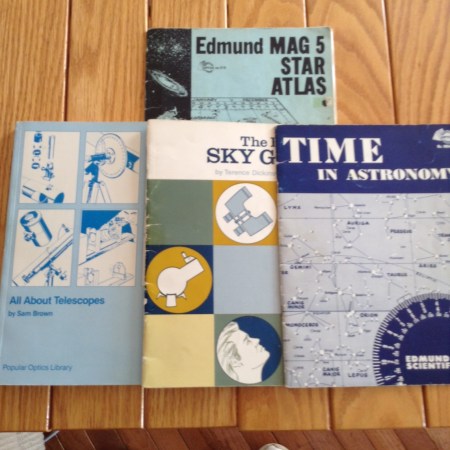
I purchased the following books from Science Hobbies, that taught me so much about amateur astronomy.
Comments:Comments Off on Science Hobbies-Charlotte And Scope City-Las Vegas: My First Telescope And Last Eyepiece Purchase (To-Date) Were From Brick And Mortar Astronomy Stores, But Both Are No More…









 rogerivester.com
Recent Comments