Archive for the ‘Roger’s Articles’ category

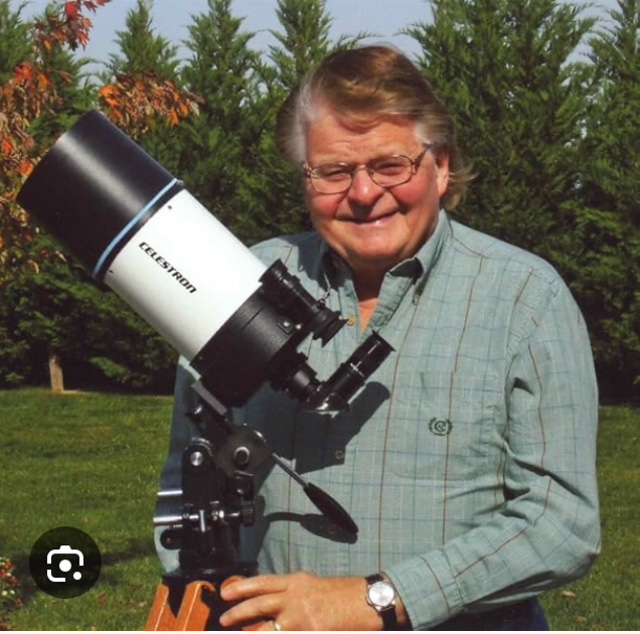
James Mullaney Honored With The Naming Of An Asteroid: All Due To The Efforts Of His Long-Time Friend Glenn Chaple
October 25, 2025

(310120) Mullaney = 2011 DR25 Discovery: 2005-12-01 / L. H. Wasserman, R. L. Millis / Kitt Peak / 695 James Mullaney (b. 1940) is an American astronomy popularizer who has written about observing the night sky with naked eye, binoculars, and telescope. A former Curator of the Buhl Planetarium, staff astronomer at Allegheny Observatory, and an editor for Sky & Telescope and Astronomy, he contributed to Carl Sagan’s Cosmos TV series.

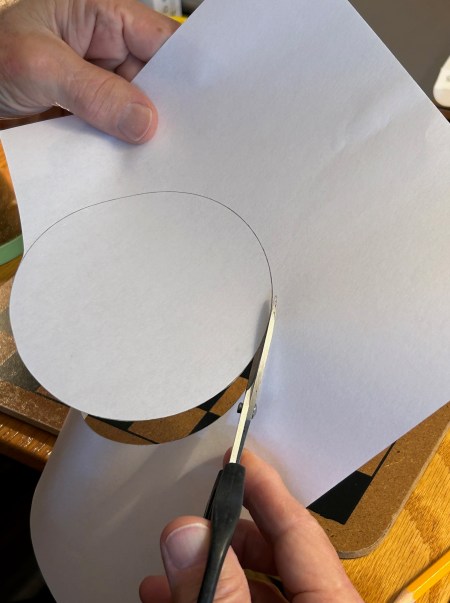
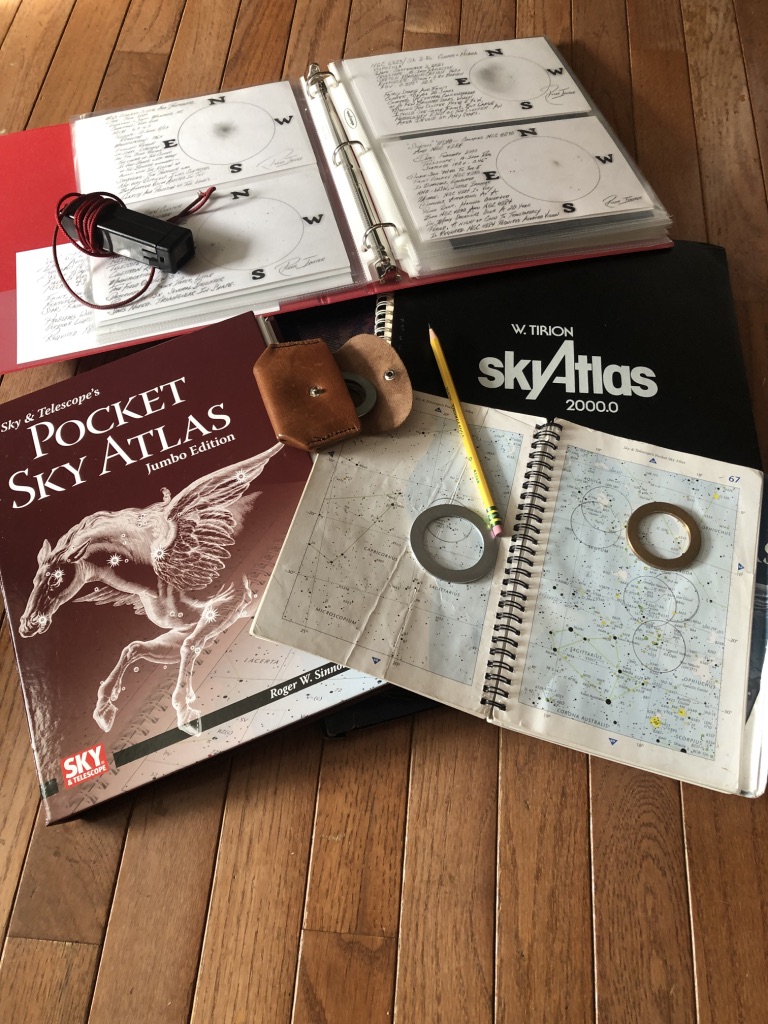
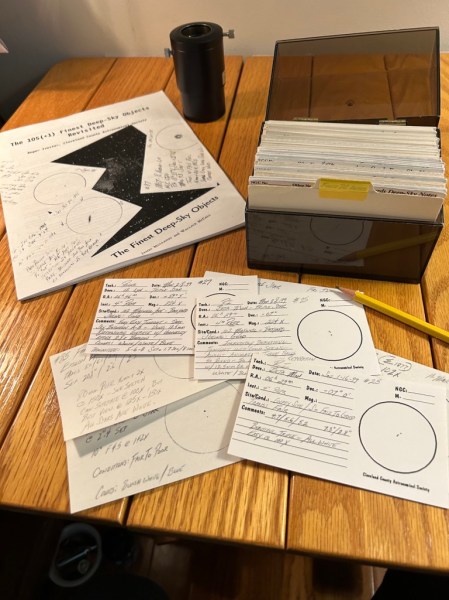
Old Fashioned Visual Observing And Pencil Sketching…The Only Tools Required Are A Telescope, EP, Red Light, Sky Atlas, Pencil, 5 x 8 Note Card With A Drawn Circle. Simple And Fun!

October 22, 2025

Visual observing and locating deep-sky objects manually, making notes and drawing what I see via the eyepiece is fun. I don’t embellish my drawings, but only what I see and with no computer enhancements.

To locate my selected deep-sky objects, for the evening, I just match up my finder view with the atlas and attempt to point the scope at the exact spot.

I use different sizes of brass and steel rings to match my finder(s) field of view. My choice for the last 15 years plus have been the S&T Pocket Sky Atlas’ which are compact and easy to use in the field. The black stars are so much easier to use as compared to atlas’ with white stars on black backgrounds. Plus, I like the larger format pages of the Pocket Sky Atlas’.

If you will notice, I draw circles (on the atlas pages) are for my “selected” objects. I don’t mind all of the drawn circles, soaked pages from dew, which shows the atlas’ have been well used.

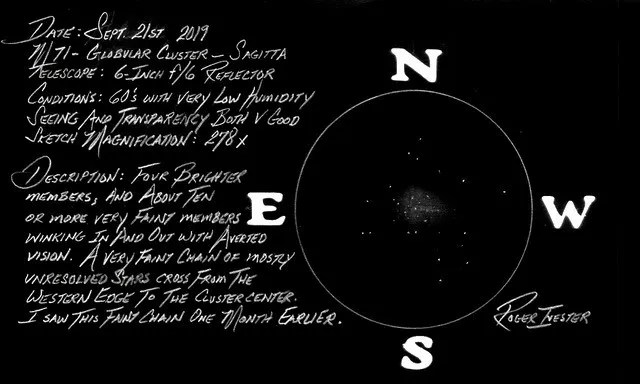
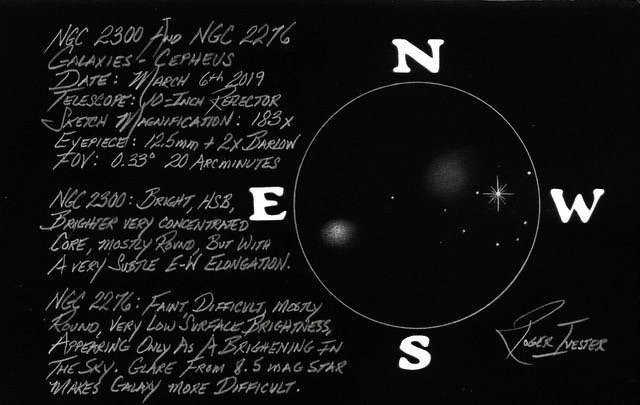
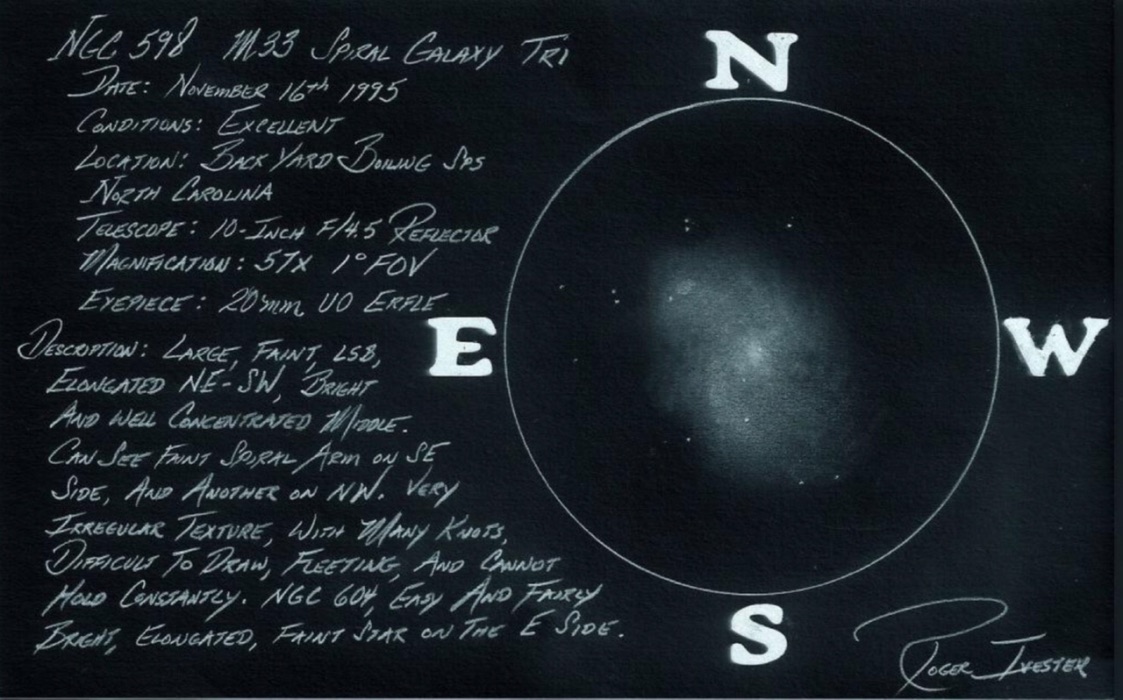
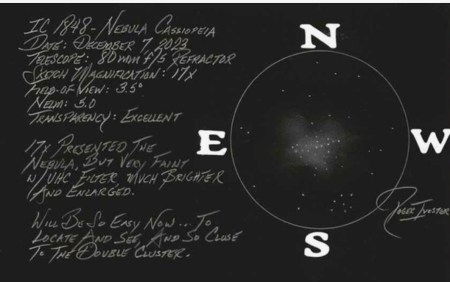
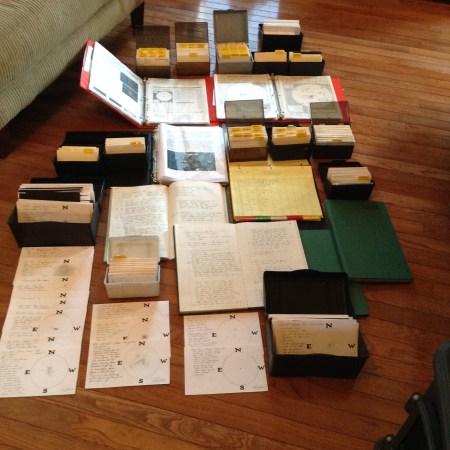
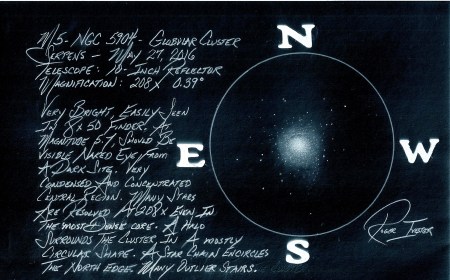
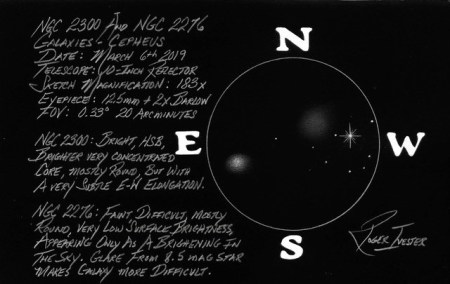
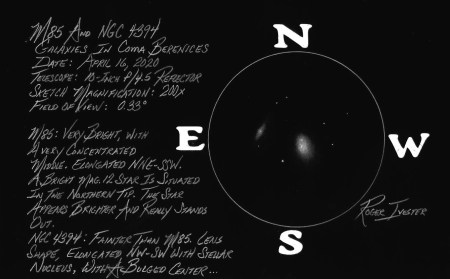
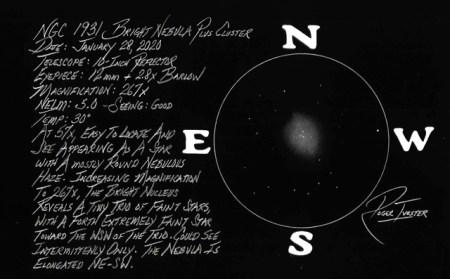
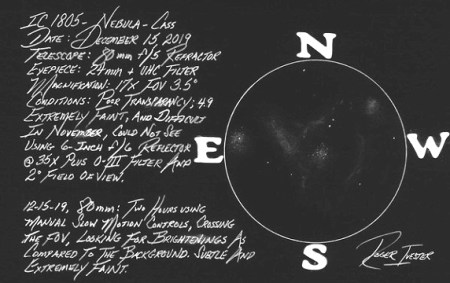
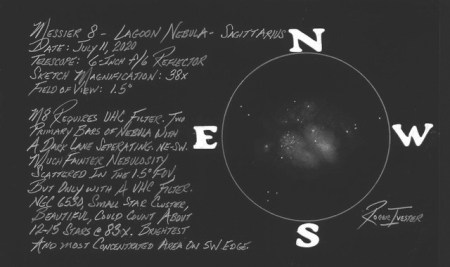
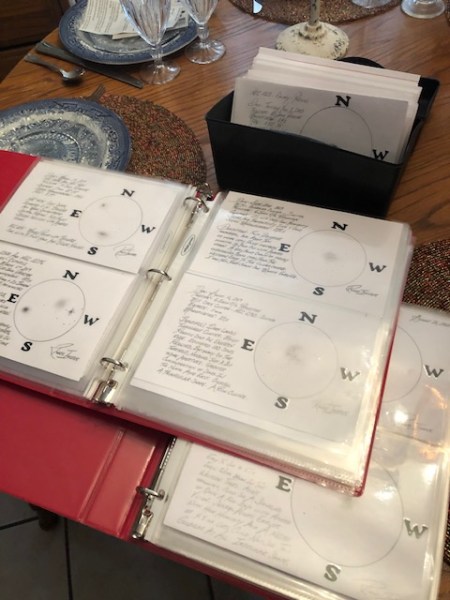
A few examples of my humble pencil sketches. I have more than 200 sketches using this format (5 x 8) and about 1,500 using much smaller 3 x 5 cards.

Galaxy NGC 55 In Sculptor: Difficult For Many Observers Due Only To Its Southern Sky Location

October 17, 2025

NGC 55 coordinates: RA: 00h 14m 54 Dec. -39º 12m

Galaxy NGC 55 is the only deep-sky object that I was not able to locate and see of the entire 185 Observer’s Challenge reports. This was due to the low southerly sky position, and not being able to find an observing location without light glow.

I’m hopeful that I can again attempt to see this galaxy, but from another dark-site, which I’ve already selected. For convenience, light weight and ease of handling, I’m planning to use a 4.5-inch f/8 Newtonian. Update: Wednesday, November 12th: Too much sky glow overlooking a small town about five miles away. I spent about an hour…but no luck. Another disappointment.

November 14th 2025: I attempted from my backyard, and with a lightblock curtain, using my 10-inch, but unfortunately the galaxy was in the trees. It seems that I’m just not suppose to see this galaxy. I’ve just got to find that “perfect site” and I’m not giving up yet, as there is still time this month!

Sue French observing from the Little Caymen Island:

November 30, 2005, Little Cayman Island. 10:10 PM EST. 113/450mm (4 ½-inch f/4)
reflector. Seeing: good, transparency good, sky, very dark. Scope not collimated.
At 14X, easily visible, highly elongated, bright galaxy with brighter elongated core.
Runs ESE-WNW. At 34X, very pretty. Large mottled core. Faint star south edge, west side.
Galaxy extends farther east than west of core. About 28’ X 2 1/2’. Star mentioned above plus
three others cradled south side. At 64X, mottling much more evident. Many faint field stars
visible. Skinny brighter triangle southwest.

October 2, 2010, 9:15 pm EDT, with a 130/819mm (5.1-inch f/6.3) apochromat. The
seeing and transparency were fair. At 23X there was a bright glow around a fairly bright star.
At 37X, the star was in the southern part of a 1¾ arcminute glow. A fainter, 1-arcminute glow
continued south from the brighter one. UHC or O-III filter not helpful. At 63X, the southern
part showed nicely, and there was a faint star in it. At 102X, the southern part was curved
concave west so the whole thing looked like a fat comma in my mirror-reversed view.

October 6, 2010, PSSG. 10:30 PM EDT. 130/819mm (5.1-inch f/6.3) APO. Seeing fairpoor, transparency good. At 37X, although the sky was milky down there, this large galaxy was
visible as ~26”ESE – WNW elongated galaxy. The western half was generally brighter. Mag.
10 star ~5’ SE of eastern tip and mag. 12 star S X E of western tip. ~ 4’ wide. At 63X, showed
up nicely and was quite uneven in brightness. The bright western area broadly brighter toward
the long axis. Eastern had a weaker brightening toward the east end. Three faint stars along
south flank: The brightest one mentioned above, the second brightest was south of the middle of
the western bright patch, the faintest star was on the galaxy’s edge between the two bright
patches. Another star hugged the south side of the west tip.

November 10, 2007, 8:15 pm EST with a 254/1494mm (10-inch f/5.9) Newtonian. The
seeing and transparency were fair. At 43X, this bright nebula spanned about ¼º and was
brightest around a mag. 7½ star in the center. At 68X, the bright central region of the nebula was
elongated north-south, 3 arcminutes tall, with pinched sides and a faint star off the southeastern
edge. At 213X, the pinch was prominent south of the mag. 7½ star, and the nebula section south
of the pinch was fainter than the northern part.

November 2, 2010. 9:30 pm EDT

I’m afraid my description of that observation was just the sketch. The only details were:
254/1494mm (10-inch f/5.9) Newtonian, 67X. Seeing and transparency, fair.

Jaakko Saloranta from Finland: Observing notes for NGC 55, are from the Canary Islands:

As can be suspected of the low declination, this object never rises above the horizon here
in Finland. My latest observation of NGC 55 was made in November last year from the Canary
Islands and specifically from the biggest island, Tenerife. I was observing within the Las
Cañadas caldera at an altitude of 6,670 feet (2,034 meters) with fairly good observing conditions:
naked eye limiting magnitude (NELM) near zenith of 7.1 with SQM-L measurements in the high
21.20s. What makes this observing site pretty good is the high altitude (above the clouds), low
humidity and excellent seeing. They don’t have observatories in here for nothing! My notes
with the 4.7-inch refractor using several different magnifications read as follows:

A gorgeous sight. Huge, WNW-ESE elongated galaxy with a mottled appearance. NW
part of the galaxy contained a bright, elongated nucleus with somewhat mottled appearance.
Two brightenings visible within the halo. Larger and brighter knot appeared as slightly NW-SE
elongated. The smaller and fainter knot appeared as a nearly stellar, roundish spot in the E side
of the galaxy’s halo with a faint mag. 14 star just W of it. A darker void seemed to separate these
two possible H-II regions from each other. Several mag. 10-14 stars in vicinity, within the halo.

My image as following was taken with a 102mm (4-inch) apochromatic refractor at f/6.4 with a SBIG ST2000XCM CCD camera. Note the dark “eye” in the galactic core, with the dark lane angled 60º to the disk superimposed over this.

The following image by Mario Motta at (+42º 36′) from Massachusetts with the galaxy being only 6º’s above the horizon!

This one is really tough being so low in the southern sky, but last night (October 18th 2025) I was able to make the following image. The galaxy was 6º above the horizon when I started and ended. It peaked at 8º at the transit of the meridian. The imagine required two hours of 5 minute subs with my 32-inch f/6.5 reflector telescope, and ZWO6200 camera, processed in Pix. 

I did not attempt color, as it was so low in the sky and have limited time between rising and setting. NGC 55 is actually close at 6.5 MLY in the constellation of Sculptor.

Now I have never tried this before, but decided to experiment, and somehow it worked out.

My 32-inch scope image of NGC 55 was only 6º above the horizon, so I got the brighter central region with detail, but the fainter outer region, especially lower left, was lost in the background glow. I’d made an image from Florida two years ago, and got the entire galaxy, but lacked detail, and did not capture the fainter region (C14)

Adrien Barrajon’s image (which I processed) from New Zealand had color but missing detail, and was taken with an 8-inch telescope.

So, I attempted to combine all images…taking some time, but took the detail of the center, overlapped that on the full image from my C14 from Florida, and then overlaid the color from the New Zealand color data.

The result is the combined data of three different telescopes, of vastly different sizes, and got this combined image. There are many hidden tricks in pixinsight, and I used up quite a few of them to get the following image. 🙂

Mario Motta

NGC 6118: Galaxy In Serpens Caput The Most Difficult Object In The Herschel 400 List – Update: July 17th 2025

July 17, 2025

March 26th 2025: After the problems I’ve had over a couple of years I just had to observe galaxy NGC 6118, again in 2025. So, during the late afternoon of March 26th, I set my mount up and pinned my auto-marine fabric to wires to create my light block system in my backyard.

I need or require this (wires and cloth) and in this part of my backyard for southern hemisphere objects only.

3:45 AM: I minimized everything I’d require for an early morning observing session. I included three selected eyepieces in my small Pelican box, not wanting to bring a large box. And I brought all of my necessary items or tools in a small zipper bag: This included pencils, sketch cards, set-up stars, red lights, the large S&T Pocket Alas and other.

When making an early morning observation, it’s important to have everything ready, without the need to run back inside for necessary tools and items forgotten.

4:15 AM: I was looking in the eyepiece and in the area of the galaxy using an 11mm 82º apparent field eyepiece, for a magnification of 104x and a 0.79º true field. I began using field motion and then letting the galaxy drift back into the eyepiece field, and could see a faint elongated blur, with averted vision, but not constantly.

4:45 AM: Increasing the magnification, so I used 2.8x University Optics Klee Barlow, for a magnification of 291x and with a 0.28º true field, but the view was no better. And still only an intermittent blur, but this time more elongated. The galaxy was at such an altitude it was mostly above the light dome. However, there was another problem going on: A wildfire of over over 3,000 acres was raging in Polk County, which is only about 35 miles away. I’m not sure if smoke was an issue or not, but the sky had a reddish look along the horizon. So, probably likely.

5:14 AM: I lifted my eye from the eyepiece and “Gave Up The Ghost” as related to this galaxy for the final time, not likely to return. This galaxy has acted like a ghost for me, now going on two years.

My quest began in the later summer of 2023, and ended on March 27th 2025, but never being able to see the galaxy to a level I would like. Sometimes it’s important to know when good is enough, and time to quit. I made no new sketches or written notes…

This recording and post update @ 4:28 PM (EDT) on March 27th 2025. It was my plans or hope to attempt this galaxy again in the spring of 2025, however, I have not been able to do so. I’d say, most likely….I’ve made my last observation of NGC 6118 known as “The Blinking Galaxy.”

Roger Ivester

Previous observations as following:

I attempted two very early morning observing sessions in March and April of 2024 from my suburban backyard, but again without success. A dark site is really needed to observe any low-surface-brightness galaxy, especially one as dim and faint as NGC 6118.

However, traveling to a dark-site has been over for me now, for many years. The disassembly of a heavy equatorial mount and handling a large solid-tube Newtonian, loading, driving, unloading, reassembly, and then having to do it all again, became just too much. I will just continue to do my best from the backyard.

Light pollution will only get worse, so maybe the following inexpensive “light-block” system might work for you also.

I use a medium-duty, lighter weight equatorial mount when observing from my backyard which requires star-hopping….not my GoTo mount from my back deck.

Darker skies from my back deck…

Fortunate for me, I was able to get a problem streetlight in front of my house, changed from a 4,000K LED unshielded light to a 3,000K light with a shield, and with optimum orientation away from my house.

A 5,000K multiple-bulb “residential carport light” is now my greatest problem when observing more southerly deep-sky objects. I have to move from my back-deck to my backyard for all deep-sky objects that are less than “about” +15º north declination.

Good news! The above light has been adjusted as following: February 21st 2025

My plans are now to re-observe NGC 6118 at about 1:00 AM, early May 2025, in an attempt to duplicate my 2024 observation. Will the “Blinking Galaxy” be easier with the now “redirected” 5,000K carport light?

The house is now vacant, waiting for a new owner, and still shines from sunset to sunrise, but now, not toward my house.

Date: May 11th 2024 (early AM observation and seeing NGC 6118) despite looking over the town of Boiling Springs, and the terrible “carport” light

Saturday morning: May 11th 2024 @ 1:00 AM, with a 5.0 NELM overhead, but far less in the location of NGC 6118, due to overlooking the town of Boiling Springs, and the problem “carport light” pictured above.

The following cellphone photo is from that night (May 11th) and beside my telescope. Note the constellation Scorpius toward the right lower corner. Now see the brighter pair of stars, almost in the center of the photo, above or north of Scorpius.

The most northern star, is known as “Yed Prior” at mag. 2.7. The second star toward the south or closest to Scorpius is “Yed Posterior” at mag. 3.2. Now move your telescope slightly to the NE of “Yed Prior” and use your star atlas to dead center, where NGC 6118 should be.

With a bit of difficulty and after almost an hour, I was finally able to see the galaxy. One of my greatest problems had been a pesky LED streetlight in close proximity, shinning directly into my backyard. My portable “make-shift” observatory was the answer to this.

Description: A tiny and subtle brighter middle, which resembles that of a planetary nebula. And like so many planetary nebulae, when using direct vision, vanishes or winks out. The galaxy has a very faint and diffuse irregular halo, which is oriented NE-SW. After observing NGC 6118, it’s easy to understand why its named “The Blinking Galaxy.”

The Train of Life By James S. Tippett (1885-1958)

April 20, 2025

Recently, we had a good friend to lose their father. I wanted to say something meaningful and not just “I’m very sorry” and nothing more. So, quite a few years ago, I had read a poem by James S. Tippett, and thought it would be very good to share with anyone who had just lost a loved one. This poem also has great meaning for all of us…to think about and contemplate from time to time. Roger Ivester

The train photo from Public Domain: Strasburg Railroad of Lancaster, Pennsylvania. And “The Train of Life” by James S. Tippett.

At birth, we board the train and meet our parents, and we believe they will always travel by our side.

As time goes by, other people will board the train; and they will be significant i.e. our siblings, friends, children, and even the love of your life.

However, at some station our parents will step down from the train, leaving us on this journey alone.

Others will step down over time and leave a permanent vacuum. Some, however, will go so unnoticed that we don’t realize they vacated their seats.

This train ride will be full of joy, sorrow, fantasy, expectations, hellos, goodbyes, and farewells.

Success consists of having a good relationship with all passengers requiring that we give the best of ourselves.

The mystery to everyone is: We do not know at which station we ourselves will step down.

So, we must live in the best way, love, forgive, and offer the best of who we are.

It is important to do this because when the time comes for us to step down and leave our seat empty, we should leave behind beautiful memories for those who will continue to travel on the train of life.

This poem was written “again” by James S. Tippett, but you might find a similar poem with variations via online. Roger Ivester

April (2025) photo

Revised: Seeing Uranus Without Optical Aid? Is It Possible From A Suburban Back Yard, With A 5.5 NELM At The Zenith?

March 8, 2025

I received an email Saturday morning (March 7th 2025) from expert visual observer, Jaakko Saloranta from Finland. He asked me if I’d ever seen Uranus without optical aid. Seems that Jaakko had a “lively” discussion with some reporters concerning the visibility of seeing Uranus naked eyes.

March 18th 2025: My observation to see Uranus was unsuccessful, as transparency was poor and my NELM was less than 4.8 at the zenith, and the planet has a magnitude of ~ 5.75. And unfortunately, Uranus was already getting into the light dome of Boiling Springs, North Carolina.

After more than an hour of careful observing with a small 6 x 30 finder (by design) then looking over the finder, I could not see the planet naked-eye. I’d suggest this technique is an advantage as opposed to attempting to find Uranus in a mostly blank area of the sky. I used a 4.5-inch f/8 Newtonian on a GoTo mount to locate Uranus. A planet…unlike a deep-sky object does not have a permanent sky address.

My observational attempts are now over until November 2025. The trees and plants (March 22nd) are showing new life and pollen is beginning to fill the sky and reduce the sky transpacy considerably. I’d suggest pollen is similar to snow covering reflection.

I made the following wide-field sky photos last night (March 18th) at 9:30 PM using my iPhone. Can you see Uranus?

March 8th 2025 Observation:

Despite a bright moon, I wanted to use a 4.5-inch Newtonian from my suburban backyard, just to observe the planet telescopically. I’ll then try the small 6 x 30 finder, and then my 7 x 21 Pentax mini-binoculars. I was successful in seeing the planet with all three, but never attempted naked eyes for obvious reasons. Roger

Reports as following

Alan French (New York)

Long ago, it was the late 1980s or early 1990s, Sue and I made a point of catching Uranus by eye from the Texas Star Party. If I recall correctly, the folks at TSP suggested it because the planet was in a sparser star field than usual.  It’s not something I could probably do today. 

Observer 2: March 8th 2025 @ 8:30 PM EST

Roger Ivester (North Carolina)

March 8th 2025: 71% illuminated Moon, excellent seeing @ 50º

First let me say, I was using a Goto mount when attempting to see the planet Uranus. A GoTo system would give anyone an advantage. And a faint planet can be difficult to locate…unlike a deep-sky object that has a permanent sky address.

Yes, I know that the objective is to see Uranus without optical aid, but I just had to first see it with a 4.5-inch f/8 Newtonian. It was easy, appearing as a mostly white star using a magnification of 35x. When increasing the magnification to 128x, it still appeared as a star, but now with a greenish tint.

I could easily see with a small 6 x 30 finder scope, but a bit fainter through a pair of 7 x 21 Pentax binoculars. Then when looking over the finder, then alternately looking through the finder, I could not see Uranus without optical aid.

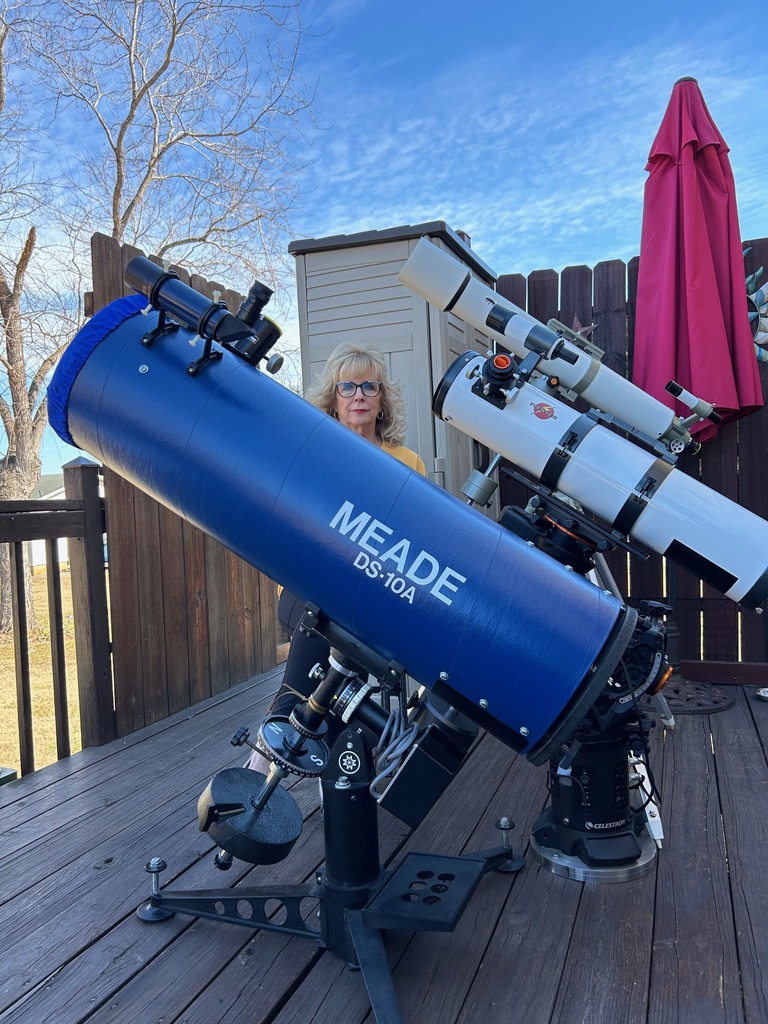
I wanted to document all things on this night, even with a photo of the telescope and mount used. This was a telescope given to me recently by a friend, and I’ve been spending a little time this week tuning it up. I was interested in seeing Uranus with the tiny 6 x 30 finder.

Observer Three: March 9th 2025

Mario Motta (Massachusetts)

Hi Roger,

As it turns out I have such an image, taken five years ago with my 32-inch telescope. The small planet size at such a great distance, does indeed has a slight greenish color, just like you mentioned in your post.

Taken with my 32-inch f/6 telescope, with ZWO asi 071 OSC camera, video the stacked and processed

The second image presents five of the planets moons…and very nicely!

Mario

Supplemental: Successful observation without optical aid by Mario Motta:

I once saw it naked eye from my place in New Hampshire, about 20 years ago with a mag. 6.5 sky.

Observer 4: Jaako Saloranta from Finland:

Hey Roger,

Here’s my sketch of Uranus – this is the original one I made at the site and as I no longer have a working scanner… this is all I could muster with my phone.

I rode my bicycle roughly 10 kilometers west from my house and found a decent, dark spot for myself. Temperature was roughly 27°F so it didn’t take too long for me to get cold after some sweaty cycling! While waiting for full night vision I could see M34, M35 and maybe M36 with the naked eye. Winter Milky Way was faintly visible from Perseus to Monoceros. 

But Uranus itself… seeing it was quite difficult because of the low altitude (~30 degrees). I could see roughly down to magnitude 6.5 from the west/zenith but at the general region of the Pleiades I could barely make out 6 magnitude (I managed to saw 65 Arietis only a few times during the 30 minutes I was observing Uranus) stars. I could see Uranus only… maybe 30% of the time with optimal averted vision. See Uranus back in 2011 was a lot easier from Canary Islands (high altitude, higher object altitude, darker skies and younger observer).

After I was done observing, I noticed that green aurora borealis arc in the northern sky. When I eventually got back home, I could see faint aurora glow even at the zenith.

/Jaakko

Observer 5: Steve O’Meara (Tucson)

Hi Roger,

Sometime in the 1980’s, I was outside David Levy’s Tucson home, casually stargazing by eye with Steve O’Meara, when Steve noticed Uranus in the sky.

Clear skies, Kelly Beatty

A Supernatural Event On A Summer Afternoon…Or Was It Something Else?

February 5, 2025

During the summer of 2023 while my wife, Debbie and I were in Gaffney, South Carolina, we stopped at a drive-thru restaurant. Upon leaving I noticed a person sitting at an outside table under an umbrella, shielding themselves from the sun. It appeared they might possibly have had all of their earthly possessions in a shopping cart. The contents in that cart were piled high and so much so, they were spilling over the sides. 

However, when driving past, a strange feeling came over me, that I just had to stop and talk to this person. I stopped and asked If I could buy them something to eat. They hardly looked up, all the while continuing to write on a sheet of paper. They glanced up with an annoyed look and said:  “I’m not here for you to buy me something to eat” I’m here to pray for you.” I was a bit taken aback, but said thank you.
This person continued writing almost fervently, and I asked: Could I have the prayer to take with me, and read later?  The person said: “No…I’ll read it to you” but saying so with conviction.  
The mysterious person began reading the prayer, but I could not seem to hear or understand anything they were saying.  It was just unintelligible words, and I could not comprehend a single thing being said. After reading the prayer, the mysterious person put their pen and prayer away rather hurriedly.  

There was something else, as strange as it sounds, but I could not seemingly see their face. Maybe I wasn’t suppose to and If asked later, what did they look like, I couldn’t say. 

So, we drove away, but there was traffic in the parking lot of the restaurant and shopping center, and was forced to turn around only a few hundred yards away.  This took, maybe a couple minutes or so, at most. I began thinking about the stranger and our encounter, and just had to go back to see them again. However, upon returning to the table and umbrella…neither the person nor the overflowing shopping cart were there.  We drove around the restaurant, looking in all directions, but the person that just read a prayer to me, was nowhere to be seen.

It would have been impossible to simply leave this fast and with a grocery cart running over with bags of clothes and whatever.  But yes, the person seemingly had just vanished into thin air!  And why would this person…this apparition, after not willing to give me the written prayer, suddenly leave?  And now after almost two years, I continue to think and wonder: Was this truly a supernatural event?  Could it really have been something unworldly, maybe even an angel sent to me for a purpose? It could have been for many purposeful reasons, such as a delay to keep us from from leaving, and getting back on the highway. It could have been for countless other reasons, and one day, I believe this reason, or purpose will be manifested to me.

Angels are mentioned in the bible, almost 300 times. And if you believe in God, you also believe in angels. President George Washington experienced a vision, being described as an angel at Valley Forge, during the American Revolution. This event has been well documented by both Washington and others. And there are countless stories of angel encounters, but most of the time people ignore them, and most often, just don’t believe.

However, I cannot definitively prove anything in my story, and it’s just my own recording of a personal event, that happened almost two years ago, on a summer afternoon. If my wife, Debbie had not been with me, and also witnessed this incredible event, I would never have considered writing this story…

Roger Ivester (Boiling Springs, NC on March 16th @ 6:30 AM EDT, 2025) 

Bird Mountain Observatory Landrum, South Carolina Five Miles From Tryon, NC

October 31, 2024

The following photo was made on (April 25th 1993) when Debbie and I made a trip to Bird Mountain Observatory, located in Landrum, SC.

The primary telescope in the dome is a 7-inch Astro-Physics refractor. The observatory has a meeting room, with a handicap ramp to access the telescope, and full living accommodations.

However today (April 15th 2025) I would “by-chance” see a photo online of the now deserted observatory and from 2009!

April 27th 1993: Debbie is sitting in front of an enlarged photo of the Veil Nebula East, using film. The telescope that was used for the photo was a Takahashi Epsilon 180 astrograph f/2.8 telescope.

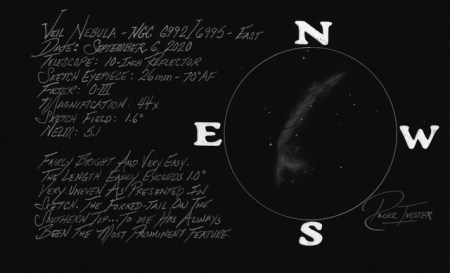
For comparison to the “film photo” behind the couch: My pencil sketch of the Veil Nebula East from my suburban backyard, using a 10-inch Newtonian. This is one of my favorite deep-sky objects!

An update from yesterday: April 16th 2025

When Debbie, myself and Sophie drove to the entrance of the Bird Mountain Observatory we found the locked gate, but despite the locked gate, we had a fun day.

Leaving Observatory Road: April 16th 2025

The three of us still had fun, doing and seeing other things in and around the towns of Tryon, Saluda and Landrum: April 16th 2025

The Shelby Drag Strip Began Operation In The Summer Of 1967 But Closed In About 1972

September 15, 2024

Remnants of the Shelby Drag Strip still exist at current (2023)

The following photograph is a Google Satellite image of what’s left of the Shelby Drag Strip, which is center-left and in the wooded area, behind the “Jaws of Life” facility.

Local drag racer Butch Greene from Polkville, raced in the very first event at the Shelby Drag Strip, during the summer of 1967. Butch was driving a 1955 Chevrolet, with a special 396 cubic-inch “crate engine” and 450 horse power, but unfortunately broke an axle on that first night. However, after repairs, Butch came back in a week or so to beat Van Hatley in the modified class, who was also driving a 1955 Chevrolet, but with a small block.

The Shelby Drag Strip was an NHRA sanctioned track. I didn’t realize this, until reading an old newspaper clipping “saved ” by Butch Greene, as following…

I’d go with my brother Phillip, sometimes to race our 1951 Henry J, but at times, we’d just go to watch. When Phillip was not able to go on occasion, I’d ride with Robert Miller, who was a French teacher at Burns High School. Robert raced most every week with his orange and white 1956 Oldsmobile. I was only 14 years old at the time, so I always needed a ride.

Remnants of the Shelby Drag Strip still exist today as shown in the following recent photos.

Walter McIntyre, was a regular who raced a 1967 Ford Fairlane with a 427 cubic-inch tunnel-port engine. This was a Ford factory drag race car.

Jim Bridges brought two 1966 Ford GT-350’s Mustangs with high-performance 289 engines. One was white (which he raced) and the other was red. He would drive the red one, and tow the white one behind. The stock GT-350 (289 engines) produced 306 horsepower and would run in the 12.40’s at Shelby.

In 1968, Bridges purchased a race engine from Bud Moore Racing with ~400 plus horsepower. He raced this car at both Bristol and Rockingham and others. His best times were in high ~11’s, in the quarter mile. (Bridges was a former Marine pilot, flying an A4 Skyhawk).

Below: Butch Greene and his 1955 Chevrolet with a 396-cubic inch “crate engine” with 450 horse power.

Butch Greene and his 1955 Chevrolet with the “special” 396 cubic-inch race engine at the Shelby Drag Strip. The date as shown on the following newspaper clipping is June 9th 1967.

A regular was Ralph Ledford with his 1962 white Plymouth Valiant, and a world record holder in its class. It was owned and driven by Ralph who I talked with via telephone this afternoon, while visiting Butch Greene. (Date: Wednesday, September 18th 2024)

The Plymouth Valiant had the special “Hyper-Pak” 6-cylinder engine. The Valiant’s best time in the 1/4 mile was in the high 13-seconds at about 98 mph.

Then there was Garland Buff from Casar, who would later own Shady Side Drag Strip, with his son Ronny. Garland raced an English Ford using two engines: One being a Chevrolet 409 stroker engine and at other times using a stroker Oldsmobile engine. He used the same transmission for both engines.

Shady Side Dragway is still owned by the Buff family, but both Garland and Ronnie are now deceased. Shady Side is now one of the most active drag strips in the country, with bracket racing, and hosting national gasser and pro-modified events. From starting out in the 50’s as a dirt strip to now an all concrete state of the art race track. Shady Side is well known throughout the southeast as a world class facility by top drag racers, and is currently in the process of becoming IHRA certified.

Back to the Shelby Drag Strip:

Garland Buff won the gasser class most every week at Shelby. One Friday night, my brother Phillip was runner-up in our 1951 Henry J. Garland took the winning purse of $50, but gave Phillip the trophy, which was really exciting to both Phillip and myself. Garland was very a kind, soft-spoken man, and was always willing to help anyone with his many years of drag racing experience.

When it came to engine building, Phillip always said Garland was a genius. He engineered and did the machining for the stroker kits for both the Oldsmobile and Chevrolet engines as mentioned above.

Phillip and myself would go to the Shelby drag strip on many Friday nights. We would also “again” compete in the gasser class on occasion with a 1951 Henry J. We used a tow-bar to pull the Henry J with our Dad’s 1956 Studebaker. Phillip was 17 and I was 14.

One night during a race, Phillip shifted the Henry J a bit too hard and locked up the transmission in high gear. We managed to hook it back up to the Studebaker, and leaving the engine running. I was able to drive the Henry J in high gear, and in tow, using the clutch and gas to balance the speed with the Studebaker. We were successful in getting home, and fixed the transmission the following day. We raced on what might be referred to as a “shoe-string” budget, with our stock 1951 Henry J.

I remember so well, Tommy Mauney driving his white 1965 GTO to the drag strip. He would jack up this car, remove his street tires and put on racing slicks which he’d brought in his trunk. Seems he would also disconnect the headers at the collector. (?)

Tommy never left drag racing and has become one of the “most renowned and successful professional drag racers” in the country today. Mauney was inducted into the North Carolina Motorsports Hall of Fame.

From the Shelby Drag Strip and a 1965 GTO to his current 200 mph plus, under 4-seconds Pro-Modified Camaro in the 1/8th mile. I like the following cover photo of Tommy’s Camaro from Rockingham Drag Way with credit to the same, and all sponsors listed, including the NHRA.

Photo credit Mecum Auctions: The last Ronnie Sox race car by Tommy Mauney.

My first cousin, and famous world class drag racer Reid Whisnant, was born and raised in Shelby and bought race engines and even race cars from Sox and Martin.

Reid had a close professional relationship with Ronnie Sox for many years. Reid Whisnant passed away in December 2005, from complications from hip surgery, after falling in his race car shop.

Reid moved from Shelby to Atlanta, during the 50’s and founded “Atlanta Race Cars” some years later. I remember going with my older brothers to visit Reid, for a few times in about 1967 and 1968. We were amazed when touring his shop. It was filled with incredible amounts of racing equipment, including race engines on stands, race car chassis, and so much more…even a Sox & Martin Barracuda sitting in the corner.

Reid never raced at Shelby, as he had moved to Atlanta during the mid-50’s, and began racing mostly in Georgia and South Carolina.

The following is one of Reid’s earlier Pro Stock Plymouth Dusters, which he raced at most all national events. Photo credit “hotcars.org

Reid was involved in an “infamous event” with Frank Iaconio from New Jersey, at the 1983 World Championships. An event that is still talked about to this very day! Reid was driving a Dodge Charger at this time.

Click on the following link to read all about this drag racing historical event! Note the incredible “hole-shot” that Reid had over Iaconia, as can be seen in the following link!

A Famous And Historical Telescope Sits Atop Of Roper Mountain In Greenville, South Carolina

August 18, 2024

My wife, Debbie and I were in Greenville, South Carolina on August 17th 2024…meeting with some grandchildren at a mutual easy location. While driving by Roper Mountain, via I-85, I thought about the famous 23-inch (1882) refractor telescope on top of the mountain.  At one time I was a member of the “Roper Mountain Astronomy Club.”

Now this is not just any antique 23-inch historical refractor telescope.  This is the very one that was used by (Princeton Astronomer, Richard Pierson) to see the Martians coming to Grovers Mill, New Jersey, in “The War of the Worlds” based on an 1898 novel by H.G. Wells. This radio show was thought by many to be an actual invasion of the earth by Martians, with many thousands of listeners throughout the country being frightened to death!

Orson Welles (with his booming and dynamic voice) narrated the famous broadcast. Welles played the character of the Princeton Astronomer. This event brought world-wide fame to then 23-year-old Orson Welles.

Roger Ivester

The Daniel Observatory, Roper Mountain, South Carolina:

As a Greenville County Schools facility, the Daniel Observatory is open to the public only during special events.

The Charles E. Daniel Observatory features a very historic 23-inch refractor telescope, the eighth largest of its kind in the nation. The Great Refractor was completed in 1882 for Princeton University and was the main instrument in their Halsted Observatory. The lens was figured by Alvan Clark and Sons of Cambridge, Massachusetts. In 1933, the telescope was entirely rebuilt by J. W. Fecker Company. The U.S. Naval Observatory owned the telescope from 1964 until 1978, when it was offered to the School District of Greenville County.

Funds provided by the Charles E. Daniel Family Foundation were used in renovating the telescope and in constructing the observatory building to house the telescope. The telescope is used to educate, to inspire, and to entertain visitors. On select Friday evenings, the observatory is open for limited public observation, in conjunction with programs shown in the planetarium. 

As following: Commemorative Plaque in Grovers Mill, New Jersey.

Famous landing site of the Martians to commemorate “The War of the Worlds” radio broadcast on October 30th 1938.