Archive for the ‘Roger’s Articles’ category

NGC 6822: A Difficult Galaxy In Sagittarius For Visual Observers; Known as “Barnard’s Galaxy”

July 29, 2024

Discovered by E.E. Barnard using a 5-inch refractor in 1884.

Hubble found it “fairly conspicuous” in a short focus 4-inch finder with a low-power ocular, but “barely discernible” at the primary focus of the 100-inch. Source: “Burnham’s Celestial Handbook”

I took images in RGB, Lum and finally Ha filters, and stretched the Histogram to enhance the stars, then adding the Ha overlay. Total imaging time about three hours, then processed in PixInsight.

I was able to glimpse NGC 6822 on the night of August 23, 2014. During the day, it was mostly cloudy with constant showers. Eventually, it cleared up enough for me to head to my spot at around 23.30. I noticed right away that sky conditions weren’t as good as the night before, and conditions would be deteriorating fast as humidity was on the rise (~95%). I was also somewhat worried about aurora activity (didn’t notice any, but some were noted on the night before) as well as approaching clouds (which eventually came only in the morning). 

After about 20 minutes in the general field of NGC 6822, I was ready to give up, but then suddenly, I got a few glimpses of an elongated, extremely faint patch of nebulosity at the NE edge of the field @ 46x (64′). I could only repeat this observation a few times afterward, but managed to sketch the object nonetheless. 

I looked at the drawing immediately after I got back home at around 2:30 AM, and despite initially being quite skeptical of having actually drawn the object at the right place, it was obvious: I had sketched the galaxy perfectly at the right position! I took a SQM-L measurement from NGC-6822 and it showed 19.80 (20.50 at zenith) at an altitude of 12º. Without a doubt, it would’ve been quite a lot easier to see the galaxy if it was higher in the sky, but it doesn’t get much better than this up here in Finland. 

The second drawing was made back in 2011 from GMARS, in Landers, California. Back then, I described the galaxy as follows: “Low surface brightness galaxy, but weakly visible even with direct vision. N-S elongated with a faint bar running in the middle and overall a slightly mottled structure. Several faint stars visible in the periphery, H-II regions not looked for. Both drawings were made using a 4.5-inch reflector.”

I have attempted to observe galaxy, NGC 6822 from my backyard since the early 90’s. My problem has been due in-part to a pesky unshielded street light in relative close proximity to my house. On the night of about September 14, 2014, using a utility building for a light block, I was surprised and elated to finally see this galaxy. I used a 102mm (4-inch) refractor with a magnification of 63x, and used a dark cloth to cover my head to reduce ambient lighting. 

It was very difficult, and I would continue to check my atlas. After more than an hour, and using a variety of eyepieces…still no luck. I began to wonder if this was going to be another year of not seeing this illusive galaxy.

After another check of my atlas, taking a deep breath, and using a small amount of field motion, I could see a faint brightening…I knew this was it. Moving the telescope slightly back and forth ever so slightly, the faint glow or brightening became obvious. Once I had seen this brightening, I could move it out of the field of view and then find the glow again fairly easily. 

I was finally able to make that long awaited sketch and some notes. I noticed a subtle N-S elongation. The size was fairly large with very low surface brightness. The night was Saturday, September 20th 2014: 

Another observation of galaxy, NGC 6822:

Our local astronomy club met at Lost Arrow Ranch, nestled in the South Mountains for an observing session. This is a really good site and on occasion I’ve estimated the NELM (naked eye limiting magnitude) at mag. 6.5. However, on this occasion, the transparency was not good due to high moisture content in the air. The NELM was reduced to about mag. 5.3, which is not good when attempting to see a faint, low-surface brightness galaxy.

During the event, and using a friend’s 9.25-inch SCT telescope, I was able to see the galaxy, but with difficulty. Quite a few of the group observed it through this scope, but all, having difficulty.

Maybe one night I might attempt using my 6-inch f/6 Newtonian @ 29x, and from my backyard. However, this is contingent on having a clear and good night.

My rough field sketch using a 102 mm refractor from September 2014: This might even be a bit of exaggeration of what I saw.

Barnard’s Galaxy is a member of the Local Group, a small cluster of about 40 galaxies including our own.  It was discovered by Edward Emerson Barnard in 1884, but not recognized as an extragalactic object until the 1920s.

Barnard described his discovery as “an excessively faint nebula” … very diffuse and even in its light. With 6-inch it is very difficult to see, and a 5-inch with a power of 30± with a field of about 1 1/4º it is quite distinct.  This should be borne in mind in looking for it.”

Barnard’s advice is worth heeding.  It is often easier to spot NGC 6822 in a small scope that allows a wide field than in a large scope with a more restricted field.  While Barnard’s Galaxy has been seen in 7 x 35 binoculars, I recommend 2.4-inch (60-millimeter) or larger scopes under moderately dark skies.  I can see the galaxy with my 4.1-inch refractor at 17x from my semi-rural home where the southern sky is awash with the glow from a nearby city.  It is elusive and appears very faint and oblong.  The long dimension measures about 11′ and runs north-south. Sue French

British Airways Flight 009, And The Incredible Event That Occurred On 24 June 1982.

June 18, 2024

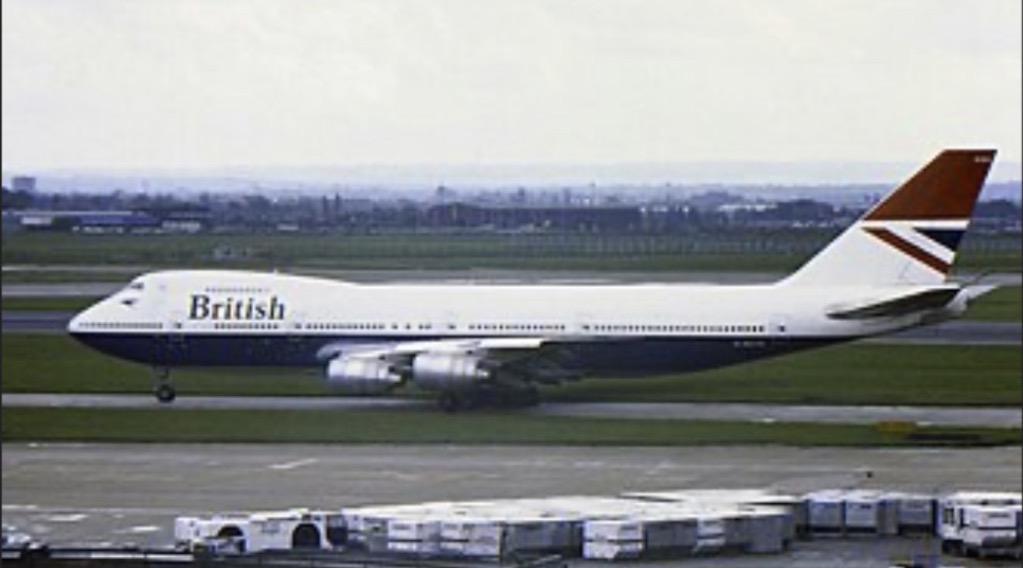
I’m sharing the story of British Airways Flight 009, callsign Speedbird 9, that departed from London Heathrow to Auckland. I’ve compiled the following information primarily from Wikipedia. The plane was a Boeing 747-236B. Photo credit also Wikipedia: Roger Ivester

Actual plane photo as following:

On 24 June 1982, the aircraft flew into a cloud of volcanic dust by the eruption of Mount Galunggung, SE of Jakarta, Indonesia. A catastrophic event occurred….all four engines shutdown.

Selected information as following from Wikipedia:

On 24 June 1982, the route was flown by the City of Edinburgh, a Boeing 747-236B registered as G-BDXH. The aircraft flew into a cloud of volcanic ash thrown up by the eruption of Mount Galunggung around 110 miles (180 km) south-east of Jakarta, Indonesia, resulting in the failure of all four engines.

Partly because the event occurred at night, obscuring the cloud, the reason for the failure was not immediately apparent to the crew or air traffic control. The aircraft was diverted to Jakarta in the hope that enough engines could be restarted to allow it to land there. The aircraft glided out of the ash cloud, and all engines were restarted (although one started vibrating and the crew had to shut it down soon after), allowing the aircraft to land safely at Halim Perdanakusuma Airport in Jakarta.

The crew members of the accident segment had boarded the aircraft in Kuala Lumpur, while many of the passengers had been aboard since the flight began in London.

Incident or event:

At the time of the incident, the flight crew consisted of 32-year-old Senior First Officer Roger Greaves, 40-year-old Senior Engineer Officer Barry Townley-Freeman, and 41-year-old Captain Eric Henry Moody. The flight crew members had boarded the aircraft at Sultan Abdul Aziz Shah Airport in Kuala Lumpur and were due to pilot the 747-200 for the Malaysia to Perth Airport leg.[4]

Shortly after 13:40 UTC (20:40 Jakarta time) above the Indian Ocean, south of Java, the crew first noticed an unusual effect on the windscreen similar to St. Elmo’s fire. Despite the weather radar showing clear skies, the crew switched on engine anti-ice and the passenger seat belt signs as a precaution.

As the flight progressed, smoke began to accumulate in the passenger cabin of the aircraft. Passengers who had a view of the aircraft’s engines through the window noted that they were unusually bright blue, with light shining forward through the fan blades and producing a stroboscopic effect.

Around 13:42 UTC (20:42 Jakarta time), the number-four Rolls-Royce RB211 engine began surging and soon flamed out. The flight crew immediately performed the engine shutdown drill, quickly cutting off fuel supply and arming the fire extinguishers. Less than a minute later, at 13:43 UTC (20:43 Jakarta time), engine two surged and flamed out.

Within seconds, and almost simultaneously, engines one and three flamed out, prompting the flight engineer to exclaim, “I don’t believe it—all four engines have failed!”

Without engine thrust, a 747-200 has a glide ratio of roughly 15:1, meaning it can glide forward 15 (about 9 miles) for every 0.62 miles it drops.

The flight crew quickly determined that the aircraft was capable of gliding for 23 minutes and covering 91 nautical miles from its flight level of 37,000 feet.

At 13:44 UTC (20:44 Jakarta time), Greaves broadcast a Mayday to the local air traffic control authority, stating that all four engines had failed. However, Jakarta Area Control misunderstood the message, interpreting the call as meaning that only engine number four had shut down.

After a nearby Indonesia flight relayed the message to them, air traffic control correctly understood the urgent message. Despite the crew emergency transponder setting of 7700, air traffic control could not locate the 747 on their radar screens.

Many passengers, fearing for their lives, wrote notes to relatives.

The crew began engine restart drills, despite being well outside the recommended maximum engine in-flight start envelope altitude of 28,000 feet. The restart attempts failed.

As pressure within the cabin fell, oxygen masks dropped from the ceiling – an automatic emergency measure to make up for the lack of air. On the flight deck, however, Greaves’s mask was broken; the delivery tube had detached from the rest of the mask. Moody swiftly decided to descend at 1,800 m per minute to an altitude where there was enough pressure in the outside atmosphere to breathe almost normally.

At 13,500 feet (4,100 m), the crew was approaching the altitude at which they would have to turn over the ocean and attempt a risky ditching. Although the crew had guidelines for the water landing procedure, no one had ever tried it in a Boeing 747.

As they performed the engine restart procedure, engine number four finally started, and at 13:56 UTC (20:56 Jakarta time), Moody used its power to reduce the rate of descent. Shortly thereafter, engine three restarted, allowing him to climb slowly. Shortly after that, engines one and two successfully restarted, as well.The crew subsequently requested and expedited an increase in altitude to clear the high mountains of Indonesia.

As the aircraft approached its target altitude, the St. Elmo’s fire effect on the windscreen returned. Moody throttled back, but engine number two surged again and was shut down. The crew immediately descended and held 12,000 feet (3,700 m).

As Flight 009 approached Jakarta’s Halim Perdanakusuma International Airport, the crew found seeing anything through the windscreen difficult, and made the approach almost entirely on instruments, despite reports of good visibility.

The crew decided to fly the instrument landing system, but the vertical guidance system was inoperative, so they were forced to fly with only the lateral guidance as the first officer monitored the airport’s distance-measuring equipment (DME). He then called out how high they should be at each DME step along the final approach to the runway, creating a virtual glide slope for them to follow.  

Although the runway lights could be made out through a small strip of the windscreen, the landing lights on the aircraft seemed to be inoperable. After landing, the flight crew found taxiing impossible, due to glare from apron floodlights, which made the already sandblasted windscreen opaque. Upon disembarking, the flight engineer knelt at the bottom of the steps and kissed the ground.

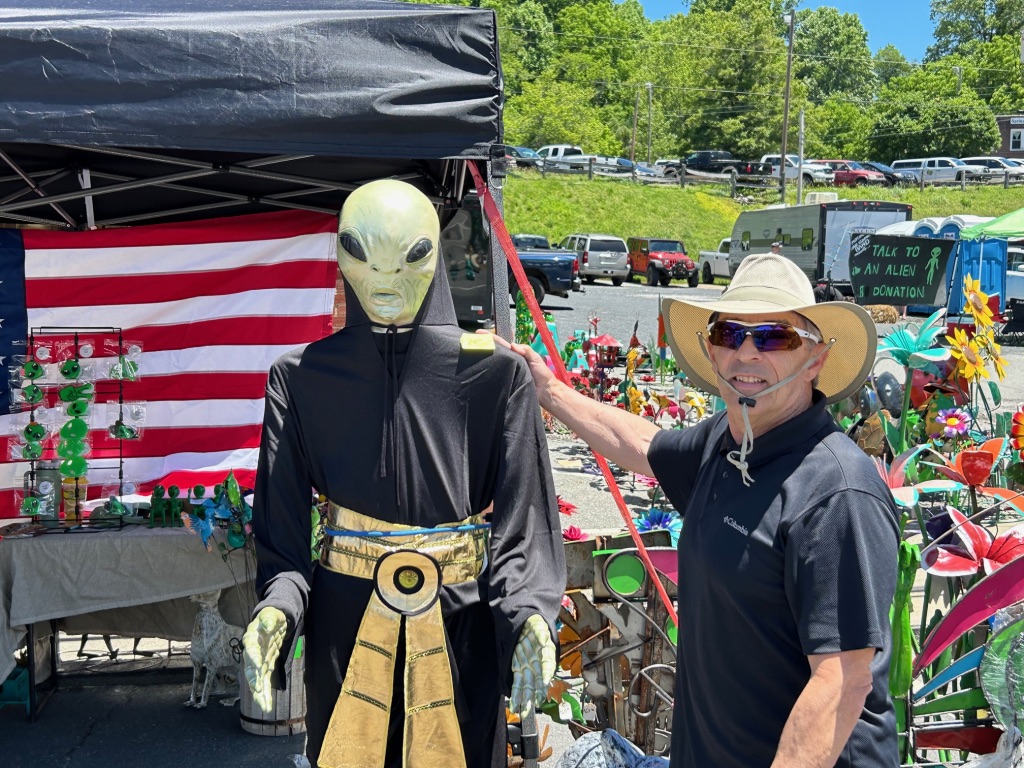
Alien Convention In Spruce Pine, North Carolina: Saturday, June 8th 2024: It Was A Great And Fun Day…Can’t Hardly Wait For June 14th 2025!

June 8, 2024

This was my first time to attend the “Spruce Pine Alien Festival” and so glad I was able to go. What a day it was! I was probably passed by many “Real Space Aliens” but was just unaware at the time.

So here are some photos from the day:

26,000 people attended this one day event last year, and I feel sure there were more or at least as many this year. I had to park at least 1/2 mile away and walk to the downtown area, however, I didn’t mind this at all.

Pictured below: A beautiful Pure Crystal Ball made from Spruce Pine Quartz. Absolutely incredible, and amazing. The finest Quartz in the world comes from Spruce Pine. Computer chips for cars, computers and anything where they are used are made from Spruce Pine quartz.

And also the first mirror that was manufactured for the 200-inch Hale Telescope was made from this quartz. Unfortunately the mirror cracked during the process before completion and another one was made from a new process or material at that time, known as Pyrex. This glass was better able to handle the incredibly heat needed during the manufacturing process.

“Rocks And Things” have an unbelievable stock of collectable rocks, minerals, fossils and anything you can imagine. They have a brick and mortar store and been in business for many years in Spruce Pine.

This incredible quartz ball can be purchased from “Rocks And Things” at (828-765-1667). This is a one of kind item, so consider purchasing while it’s still available. I just didn’t seem to have enough cash in my pocket today. 🙂

Spruce Pine, North Carolina: How It became a part of astronomy history via The Chestnut Flats Mine, due to the incredibly pure Quartz which was used in the manufacture of the first 200-Inch Hale Telescope mirror. As mentioned previously (above) unfortunately that first mirror cracked during the manufacturing process.

Historic photo from days past of the Chestnut Flats mine as following: Photo credit: Mitchell County Historical Society

I found the following article by David Biddix, a Spruce Pine native, who shares some very interesting information. This is not the complete article.

Alex Glover…is the Director of Mining and Environment for Active Minerals International, LLC. He is a licensed professional geologist in nine southeastern states in the United States and has lived in the Spruce Pine area since 1997. He is interested both in the geology of the Spruce Pine Mining District and in its history, which goes back some 170 years.

….I’ve always wondered why ore from the Chestnut Flats Mine near Spruce Pine was chosen for the telescope’s mirror. Recently, I had a discussion with Alex Glover, a local geologist and mining historian who is very familiar with what is known as the Spruce Pine Mining District, a 10 mile-long, 5 mile-wide outcropping of rock from early in earth’s history that contains some of the purest minerals in the world and is the economic lifeblood of this region. This purity was the reason Corning Glass came to this region to find materials for the mirror. Alex speaks about what types of minerals are found in the district….

I purchased the following quartz specimens, pictured on the table below from “Rocks And Things.” Possibly even from the famous Chestnut Flats Mine, or for sure from the same vein of quartz rock. Roger Ivester

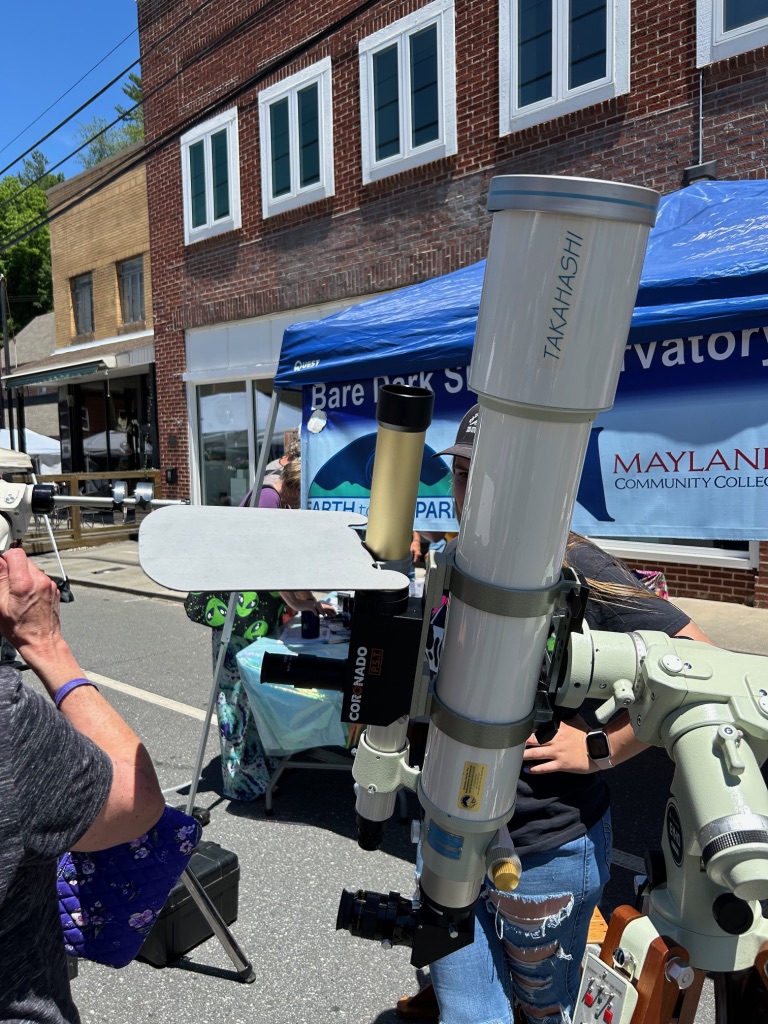
Solar telescopes provided by North Carolina Amateur Astronomers, and friends of mine for many years. Steve Davis and Don Brooks.

After not eating anything all day, I decided to stop at Western Sizzlin’ Steak House in Spruce Pine, for a delicious meal. Despite a large and overflowing crowd, I was able to be seated quickly and with excellent service. I could for sure recommend the Western Sizzlin’ Steak House, for great food and service.

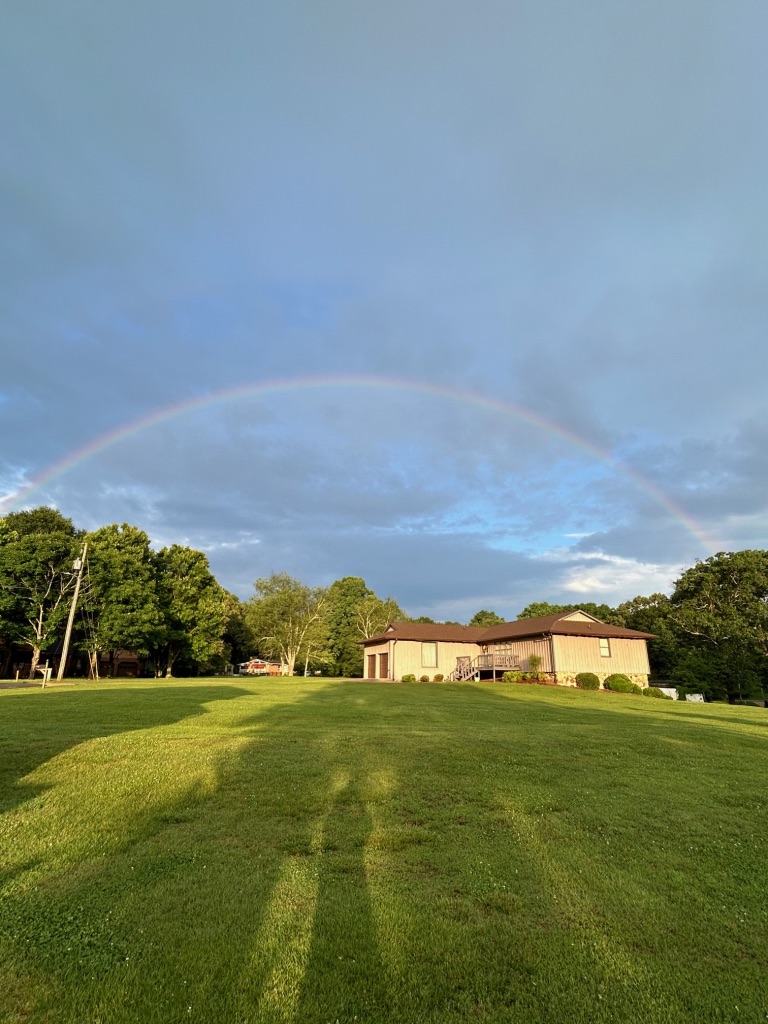
A Very Rare Early Morning Rainbow: Saturday, May 25th 2024 At 7:30 AM Lasting Only A Few Minutes

May 25, 2024

May 24th 2024 at 7:30 AM: While Debbie and Sophie were still sleeping…I walked outside to see this amazing early morning rainbow in the west. This was my first time to see a rainbow at this time of the day, as they mostly occur in the afternoon and in the east. However, maybe more frequent than I’d think, as I’m just not looking at that time of the day. And we all know that a rainbow is always opposite the sun: When a rainbow is seen during the afternoon…the sun is in the west.

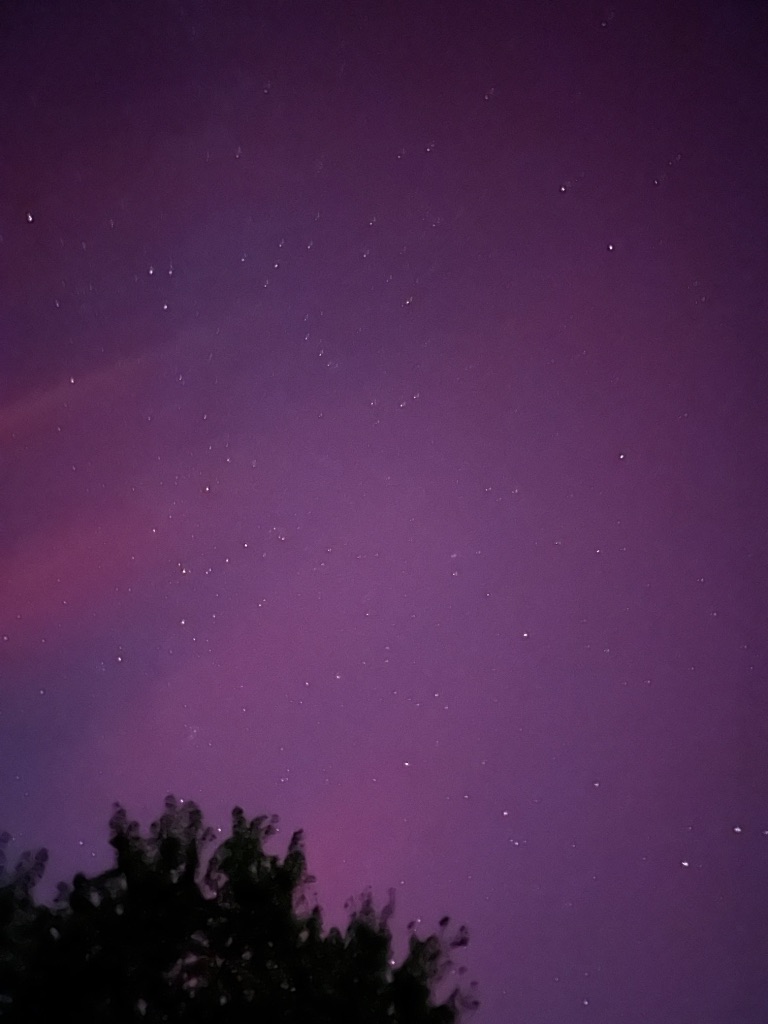
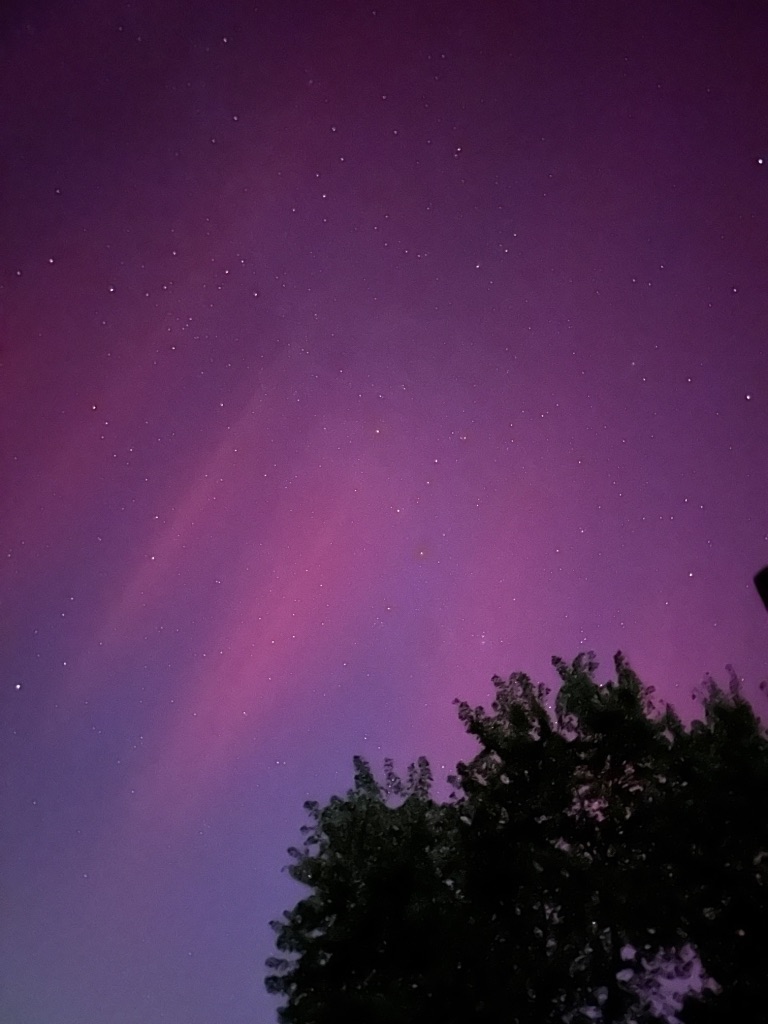
Aurora As Seen From The Foothills Of North Carolina On The Nights of May 10th and 11th 2024: And Again On October 10th 2024 All From My Suburban Backyard At A Latitude 35º 15′

May 22, 2024

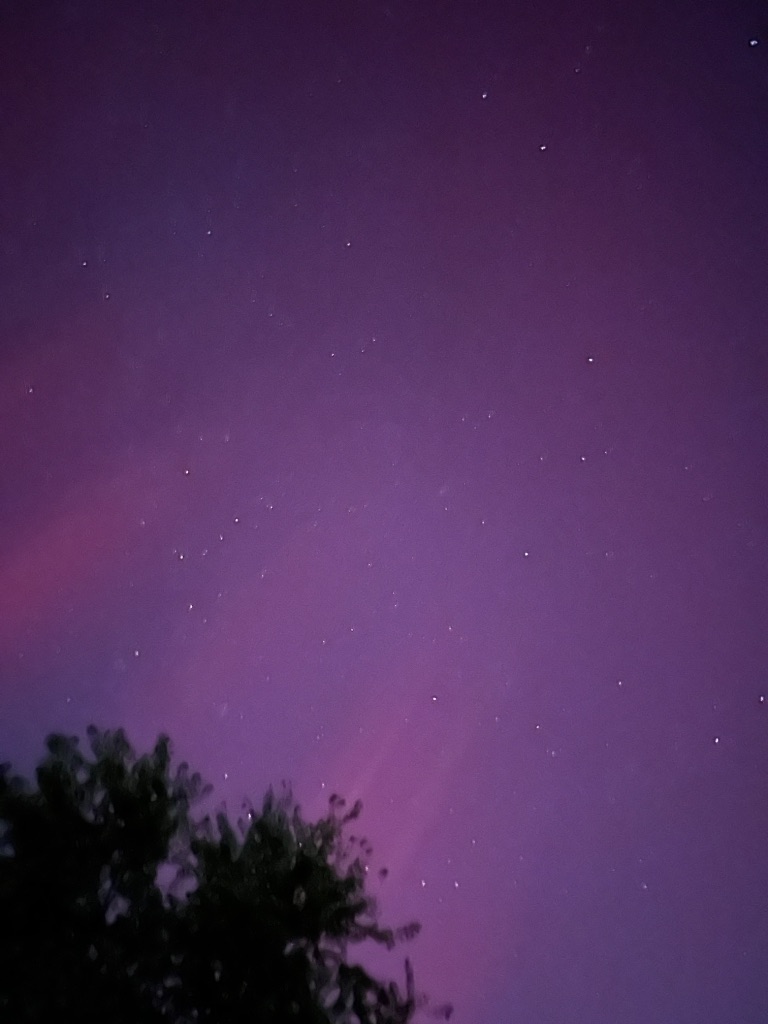
On the night of May 10th 2024, beginning at about 11:00 PM and lasting a couple or more hours. The northern lights enveloped the entire northeastern part of sky with a brilliant red color from my suburban backyard . The Aurora Borealis is rarely seen this far south at a latitude of +35 degrees 15 mins. north latitude.

However, this is not the first time I’d seen the Northern Lights from my backyard.

The following photos were made on the night of May 10th 2024, beginning at 11:30 and shortly after midnight. I was using an iPhone 14 with 3-second exposures, and being handheld.

Photos of aurora using an iPhone 14 (hand-held) on the night of October 10th 2024 as following:

The following photo of the aurora display with the Andromeda Galaxy (the tiny blur near the center of the photo) which is right of the constellation of Cassiopeia. Light pollution is severe in this area of the sky, which reduced the contrast of the aurora significantly.

Galaxy NGC 6118: Unanimously Agreed Upon By Amateurs To Be The Most Difficult Object In The Entire Herschel 400 List

May 14, 2024

After a couple unsuccessful observing sessions during the summer of 2024, I was anxious to try again in the early morning hours of 2025, with cold temperatures and more transparent skies.

March 26th 2024:

4:15 AM: I began with a magnification of 104x and field motion…then moving the galaxy out of the field, and then letting it drift back. Increasing the magnification to 291x, but the view was no better, and the galaxy appearing as only an intermittent blur and less than 50% of the time.

I attempted two very early morning observing sessions in March and April of 2024 from my suburban backyard, but again without success. A dark site is really needed to observe any low-surface-brightness galaxy, especially one as dim and faint as NGC 6118.

However, traveling to a dark-site has been over for many years. The disassembly of a heavy equatorial mount and handling a large solid-tube Newtonian, loading, driving, unloading, reassembly, and then having to do it all again, became just too much. I will just continue to do my best from the backyard.

I just couldn’t forget about this galaxy, and wanted to give it another try.

Saturday morning: May 11th 2024 @ 1:00 AM with a 5.0 NELM overhead, but about 4.0 in the area of the galaxy.

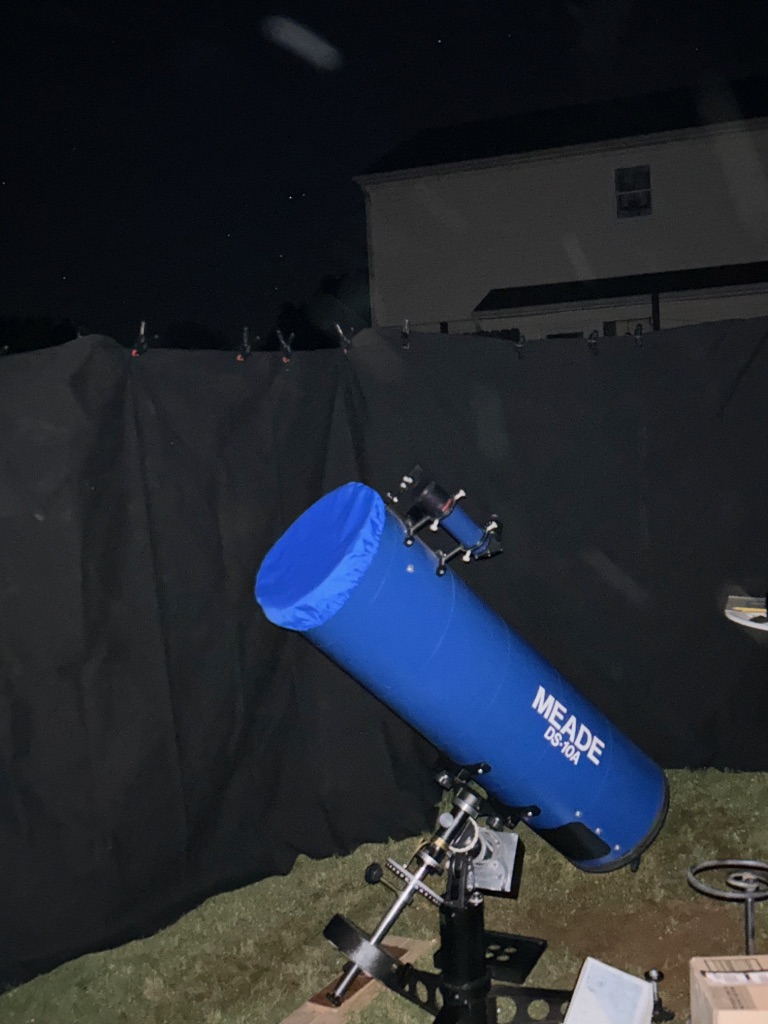
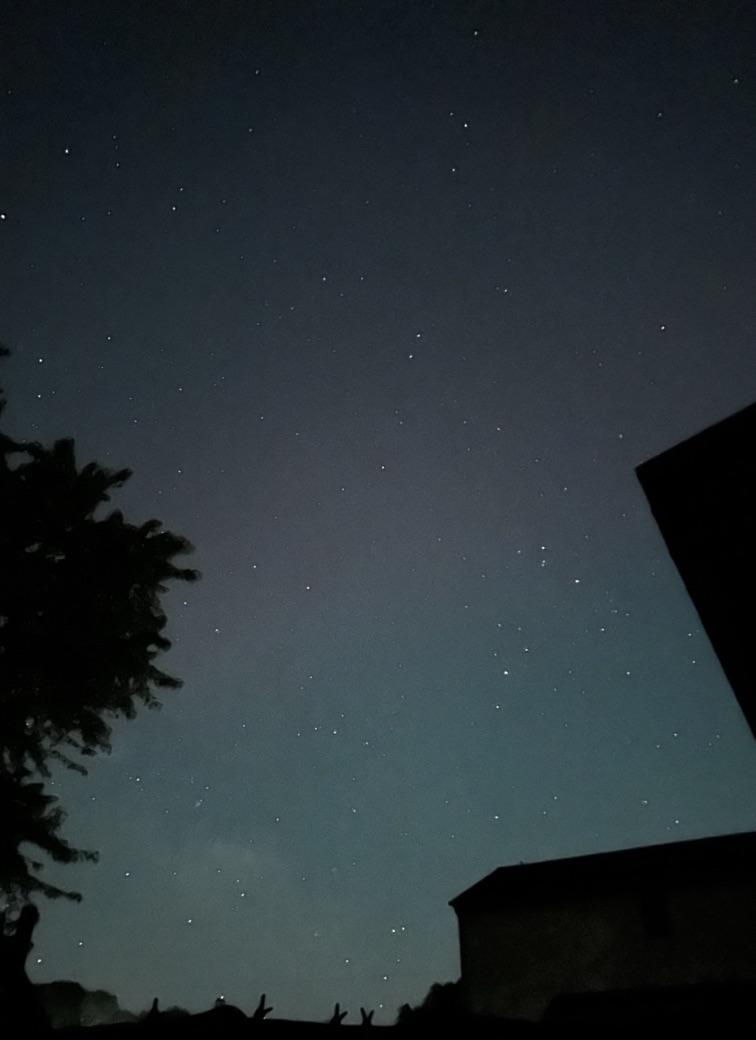
The following cellphone photo is from that night and beside my telescope. Note the constellation Scorpius toward the right lower corner. Now see the brighter pair of stars, almost in the center of the photo, above or north of Scorpius.

The most northern star, is known as “Yed Prior” at mag. 2.7. The second star toward the south or closest to Scorpius is “Yed Posterior” at mag. 3.2. Now move your telescope slightly to the NE of “Yed Prior” and use your star atlas to dead center, where NGC 6118 should be.
If you are a visual observer and observing from a suburban backyard, I wish you luck.

Description: A tiny and subtle brighter middle, which resembles that of a planetary nebula. And like so many planetary nebulae, when using direct vision, vanishes or winks out. The galaxy has a very faint and diffuse irregular halo, which is oriented NE-SW. After my many observing sessions of NGC 6118, it’s easy to understand why its named “The Blinking Galaxy.”
Al Nagler: 2017 Southern Star Astronomy Convention: Little Switzerland, North Carolina

April 14, 2024

I was so sorry to hear about Al Nagler’s passing:

It was the April 2017 Southern Star Astronomy Convention sponsored by the Charlotte Amateur Astronomers Club, when a scheduled speaker for the convention cancelled at the last minute.

I’m not a member of the Charlotte Club, but had helped them over a few years to fill speaker positions at Southern Star.

The Charlotte club officer in charge of Southern Star contacted me about finding a new speaker and asked if I could help in finding “the perfect” person to fill this now vacant position.

I knew that Sue and Alan French were attending NEAF at that time. So, I called Sue via cell phone, and asked if she would talk to Al Nagler and see if he was interested in being a speaker at Southern Star.

Al gave a fabulous presentation concerning “everything anyone would want to know” about eyepieces. I don’t think anyone would know more about the science of eyepieces than Al Nagler. The presentation, to say the least was excellent, and so much so, I even took notes.

Al Nagler and his wife…two great people!

I was able to talk with Al and his wife for extended periods during the event, and also enjoyed having lunch with them in the Wild Acres cafeteria.

Photo as following: Al signing my “1000+ The Amateur Astronomer’s Field Guide to Deep Sky Observing” by Tom Lorenzin at the April 2017 Southern Star Astronomy Convention in Little Switzerland, North Carolina:

The Robert Burnham Jr. Story And His Very Sad Ending, Also The Famous Handbooks

April 11, 2024

My work desk as following with a set of the handbooks, which I still us, but not as much as 20 or so years ago. I actually have two sets of the hardbacks.

The soft-backs are not very durable, especially if used outside, or even with lots of use indoors. Now just my opinion, but every amateur should have a set of Burnham’s in their home library and take them out frequently, and read some of the information. How any mortal being could put together such an amazing amount of work, with so much technical information and self-publish is nothing less than amazing!

Seems that Brian Skiff (astronomer at Lowell) at one time was contemplating a revised version of the handbooks. But, after a careful comprehensive review, “maybe before even getting started” he decided against. (I think I’m correct on this, or at least close.) I can’t remember all of the particulars, but I do remember (why Skiff might have chose not to….and seems the word he used was: Daunting!

For those of us that have been visual observers for at least the past 30 plus years “Burnham’s Celestial Handbooks” were and continue to be invaluable. 

Rather than attempting to write anything about Robert Burnham Jr. there is no need; as so much information can be found in the following links, or other places online.

I don’t think anyone has used the Handbooks more for both indoor and backyard use than Daniel. It was about eight or ten years ago when he sent me a photo of his “soft-cover” set.  They were so well-used that he fabricated steel rings to hold the pages and entire books together!

So, here are the photos that I saw, so many years ago. This is the way all astronomy reference books should look! Roger

The following quotes were taken from Daniel’s Cloudy Nights and personal emails.

Now some of my thoughts…using the handbooks: Roger

I have used the handbooks on many nights outside for reference, with my telescope. One night about 30 years ago, I remember so well using the photos from the handbooks to identify faint galaxies, NGC 147 and NGC 185. This was just one of the many times the handbooks assisted me in my observations.

Many consider the handbooks to be outdated…but not me.

Roger Ivester

Historic Building In Boiling Springs: Beginning As General Store Circa 1910, Then As A Post Office In The 1930’s. A New Coffee And Bakery (Sweet Eats) Will Open Thursday September 25th 2025.

November 11, 2023

Early 50’s: Photo credit Tommy Greene

Wilbur Joseph “Jack” Cash (May 2, 1900 – July 1, 1941) was an American journalist known for writing The Mind of the South

Early life and education

Cash, known as “Jack” throughout his life, was born as “Joseph Wilbur Cash” – he later reversed the order of his given names, and normally used only the initials – and grew up in the mill village of Gaffney, South Carolina. He had three brothers and a sister, of whom he was the eldest. He was educated at the local public school until he was 12, when his family moved to Boiling Springs, North Carolina, 14 miles away across the state border – his mother’s home town – so that his father could become a partner with Cash’s maternal grandfather in a general store there.

…..In 1918 and 1919, at his father’s wish, Cash attended Wofford College, a Methodist school, but left because he objected to the school’s narrow provincialism. He then enrolled in Valparaiso University, a Lutheran college in Valparaiso, Indiana, dropping out around Christmas 1919. In 1920, again at his father’s urging, he entered the Baptist school Wake Forest College, despite it being what he considered to be a “preacher college.”[2]

In the summer, he worked at the hosiery mill at which his father was then the superintendent. Cash graduated in 1922 with an A.B., and then attended law school there for a year, before deciding not to pursue a legal career.[2] Cash later declared that he left law school because it “required too much mendacity.”

…..Cash taught English at Georgetown College in Georgetown, Kentucky, and at a high school in North Carolina, before experiencing a nervous collapse. Throughout his life, Cash suffered from manic depression or affective disorder, which manifested itself in breakdowns, periods of depression, fear of sexual impotency, and physical ailments such as not being able to swallow or choking when he spoke. He also suffered from a hyperthyroid condition, occasional alcoholism and excessive smoking. Cash usually referred to his condition as “neurasthenia“.[7]

From 1926 to 1928, Cash held several newspaper jobs: a year in Chicago writing for the now-defunct Chicago Evening Post; several months with The Charlotte News during which he wrote a wistful philosophical column titled “The Moving Row”; and a four-month stint during the fall of 1928 as the chief editor of a small semi-weekly newspaper, the Cleveland (County) Press, in Shelby, North Carolina.

…..Afterwards, Cash moved back into his parents’ house in Boiling Springs – where he lived with his extended family, including his two brothers and their pregnant wives. He contributed to H. L. Mencken‘s The American Mercury magazine, and received encouragement from Mencken. From 1929 to 1935, Cash wrote eight articles about various aspects of the South,[a] including one in October 1929 called “The Mind of the South”, which would become the basis for the later book.[b]

During the period of primary writing on The Mind of the South (1929 to 1937), Cash continued to live with his parents in Boiling Springs.[9] When his contributions to The American Mercury ended after Lawrence Spivak took over ownership of the magazine, Cash supported himself with freelance weekly book reviews to The Charlotte News from 1935 to 1939, for each of which he received a payment of $3, equivalent to about $60-$65 in 2023.

Cash’s seminal article, “The Mind of the South”, was published in The American Mercury in October

After Cash had some success at The Charlotte News, he finally had the personal and professional confidence he had previously lacked, and his work there helped him to develop his unique style of writing. He also met and fell in love with Mary Bagley Ross Northrup (later known as Mary Maury), a divorced woman who also wrote for the paper, and who helped him to complete the book through his periods of depression, and his continued focus on events in Europe. During this period, Cash would listen to the news on the radio about the Anschluss with Austria, the invasion of Poland, or the fall of France and would pace around the room, biting his nails, hands, and wrists, leaving marks. He would become so upset that he would leave the house and walk the streets at night.[14]

Finally, on July 27, 1940, the last pages of the manuscript were finished and sent to New York. Five months later, on Christmas Eve, Cash and Northrup were married by a justice of the peace in York, South Carolina.[11][2]

On February 10, 1941, The Mind of the South was published by Knopf. The book, an intuitive socio-historical exploration of Southern culture, received wide critical acclaim at the time and garnered for Cash praise from such sources as TimeThe New York Times, The Saturday Review of Literature, and most Southern newspapers of note, although criticism came from the Agrarian group out of Vanderbilt University in Nashville. Cash also received the thanks of Walter White, the director of the NAACP, for the book’s liberalism in regard to race and its exposure of the bigotry of the South.[15] Time said of The Mind of the South “Anything written about the South henceforth must start where [Cash] leaves off.”

Cash and his wife chose Mexico to spend their year on the Fellowship because it was cheap to live there, and they would have to watch every penny; they embarked on their trip to Mexico City on May 30 1941.[2] Cash had been invited by University of Texas president Homer Rainey to provide the main commencement address to the 1941 graduating class on June 2 in Austin, Texas.

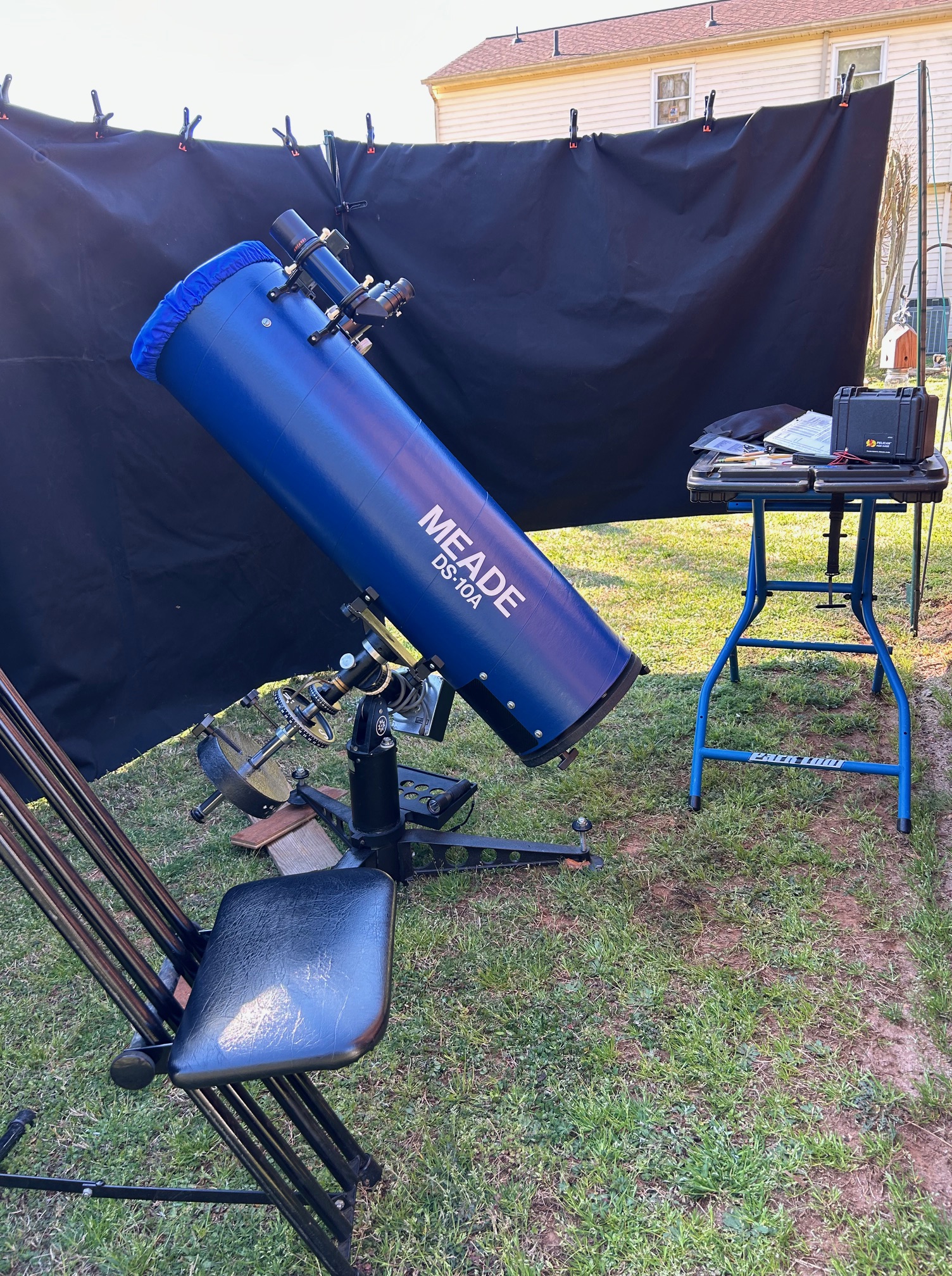
Seeing Sirius B With A 10-inch f/4.5 Newtonian Using A 5 1/4-Inch Effective Aperture And Also With A 102mm FS Takahashi Refractor

October 31, 2023

Now is the perfect time “to attempt” Sirius B: It might be easier than you think. (?)

Surprisingly, I could still see the companion just as well at 7:20 AM in very “dim daylight” and still with a fairly bright moon, as when I began almost two hours earlier. This would show and prove that double stars can be enjoyed with a moon and light pollution.

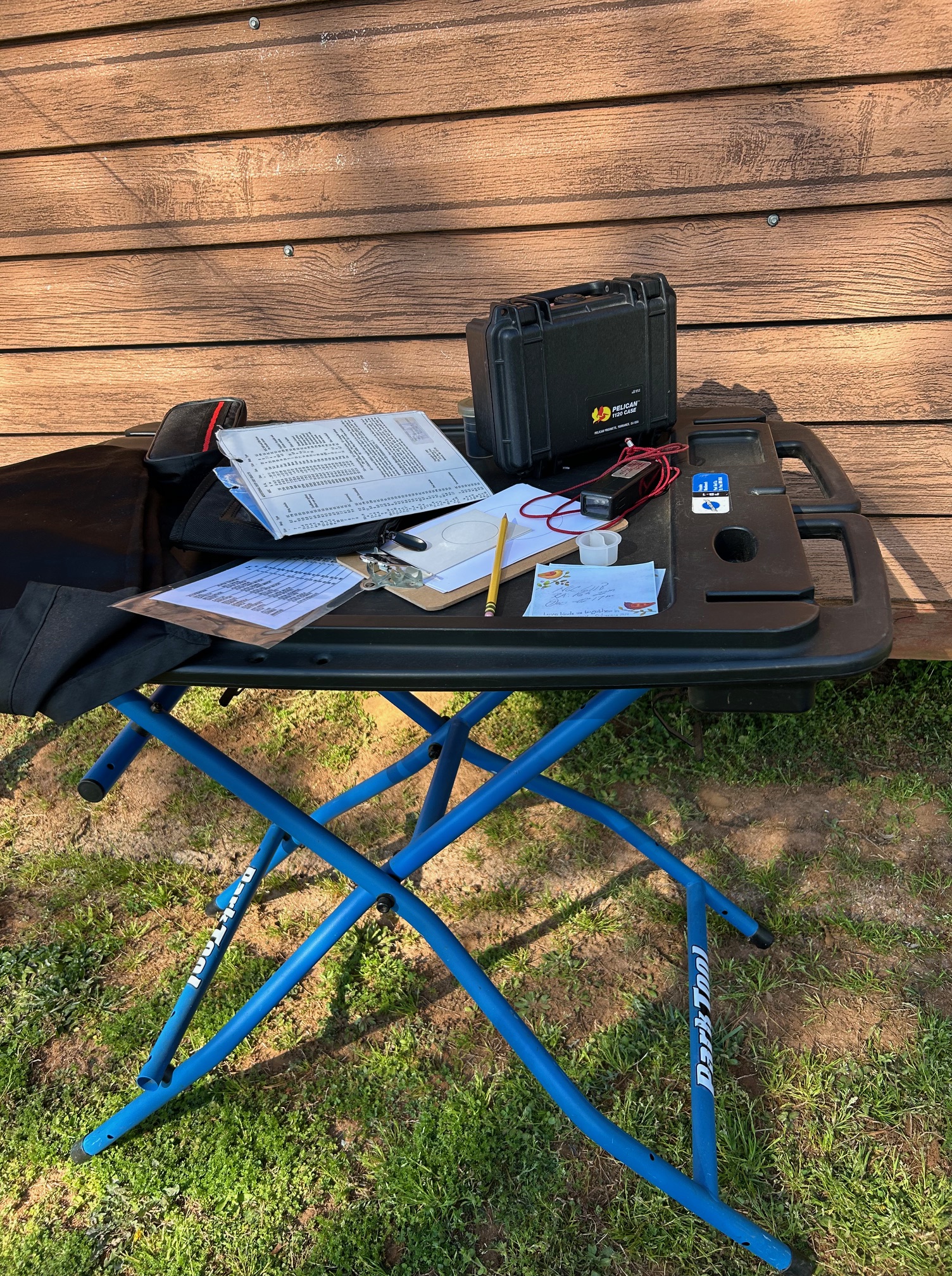
I used a small plastic protractor to help me determine the position angle of Sirius B, and where to look.

My first time seeing Sirius B occurred in 2016, using a 102 mm f/8 FS fluorite Takahashi refractor in March 2016, from Lost Arrow Ranch. My good friend and astronomy associate Don Brooks of many years owns this telescope.

It was actually very easy with this telescope using direct vision. A group of six amateurs took the test.

Roger, thanks so much for the off-axis mask idea….wonderful.

Sirius B:

After several or should say “many” attempts I spotted Sirius B in May 2020, using averted vision. My eyes were tearing, cloth over my head and let Sirius pass through the eyepiece. However, after 45 minutes of struggle, I saw the companion.

To-Date: I have now found and seen the companion, also known as Sirius B several times, but it’s still never an easy. It is important to have a stable and clear sky, and good seeing is “absolutely critical” if you are considering taking on this task.

Interesting; I found if Sirius is in the west and after sunrise, seeing Sirius B is actually easier, which might be surprising to many. Roger Ivester, mentioned the same in his report. Magda