The 2017 Total Solar Eclipse from Laurens, South Carolina A Great And Memorable Day

Posted August 26, 2017 by rogerivester
Categories: Roger's Articles

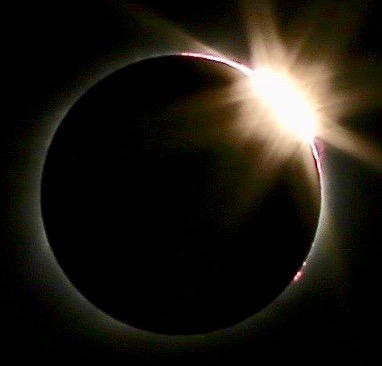
Image of the eclipse, the diamond ring, and Bailey’s beads provided by Barre Spencer and Patrick White using a Canon Rebel with a 200 mm zoom lens.  Location of photo:  Columbia, SC 

(s) Diamond / Baily's Beads 9

A group of folks from various places met outside of an Italian restaurant to enjoy the solar eclipse together.  We were all surprised how few came to this quaint little town to observe this historic event.  The totality duration was ~ 2 mins  34 seconds, and with perfect weather!    

Very comfortable weather, with very low humidity.  Yes…a perfect day, and only 40 miles away from our house.  We drove some back roads, and crossed over I-85, that was bumper-to-bumper.  It actually looked like a parking lot for as far as the eye could see.

The I-85 event reminded me of the day that Deb and I tried to get on the Santa Monica Freeway, in California.  We actually had to pull an illegal turn at the top of the ramp!  

During totality the sky darkened to a surprising level, but not as dark as a clear full moon night. Venus appeared very bright in the western sky and Jupiter in the southeast.  I could not see any stars….naked eye.  

Both Debbie and I were amazed at the sudden flash of the diamond ring.  (See the image above) 

The temperature drop was very significant.  A weather bureau report from Newberry, SC, only 30 miles away, also in the line of totality, had a temperature drop of 11º Fahrenheit .  

I had always wondered what the temperature drop could be during a total solar eclipse, so now I know.

When the sun began to reemerge, we noticed a shimmering of light waves on the pavement under our feet and all around us, known as shadow bands.  A very interesting phenomenon, that I was hoping we’d see, and we did! 

I’m just sorry that I didn’t video a few seconds of the shadow bands, however, they are forever  stored in my mind.  I can just see them now! 

We drove back through country roads and were home in less than 45 minutes.  What an incredible and memorable day.  

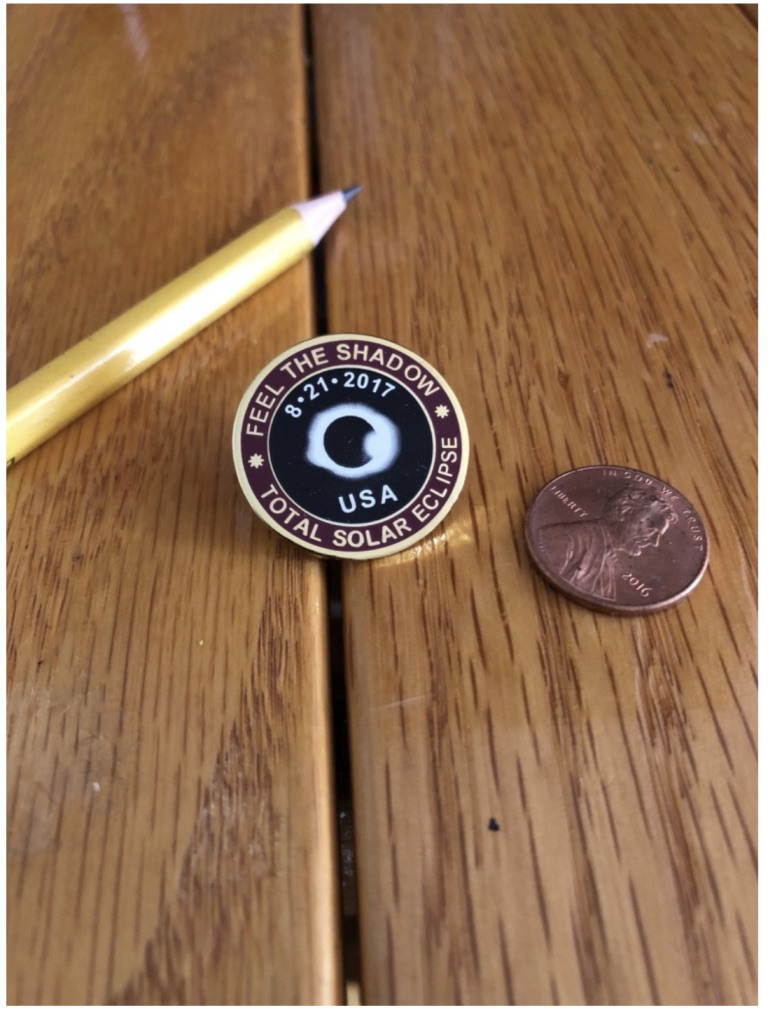
And thanks to John Goss, President of the Astronomical League at that time, sent both Debbie and myself, a very nice and high quality lapel pin.  I wear it often to this day. 

Regarding the 2017 Total Solar Eclipse:  We enjoyed the moment, and the events taking place all around us.

IMG_8976

2017 Astronomical League Total Solar Eclipse Lapel Pin:

Note my 2017 eclipse pin only recently.

Remembering Comet Hale-Bopp March 1997:

Posted August 14, 2017 by rogerivester
Categories: Roger's Articles


Comet Hale-Bopp  
March 1997
10-Inch Newtonian Reflector
Magnification: 160x
FOV: 0.38º

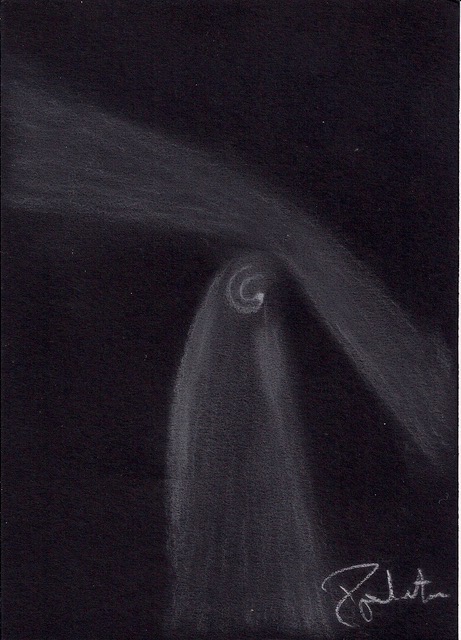
White charcoal pencil sketch as following on black card stock.  The three tails are visible:  The anti-tail, the ion or gas tail and the dust tail are clearly visible.   Roger Ivester (North Carolina)  

 
Image


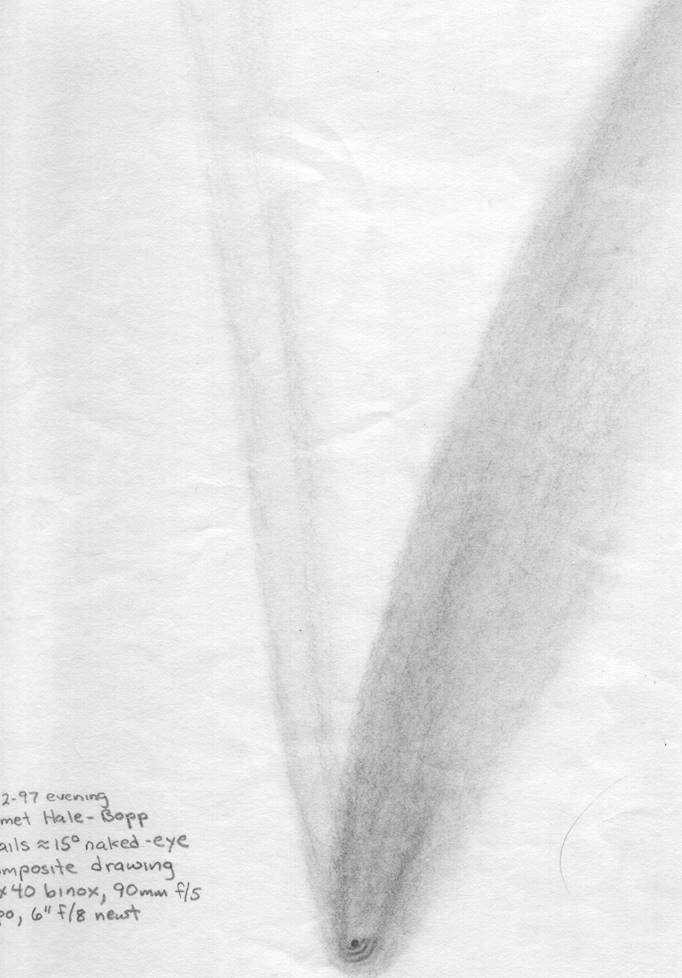
The following sketch by Sue French:  New York  

Unfortunately, the sketch is actually larger than our scanner can copy, so some of the comet is cut off.  The sketch was made on 4/2/1997.  The tail was about 15° long to the naked eye.  To get the tail and the core detail in the same sketch, I used three different instruments: 8×40 binoculars, a 90mm refractor, and a 6-inch reflector. 


After 17 years, my observing partner passed away. Her name was CJ, and Astronomy from my backyard will never be the same.

Posted March 14, 2017 by rogerivester
Categories: Roger's Articles

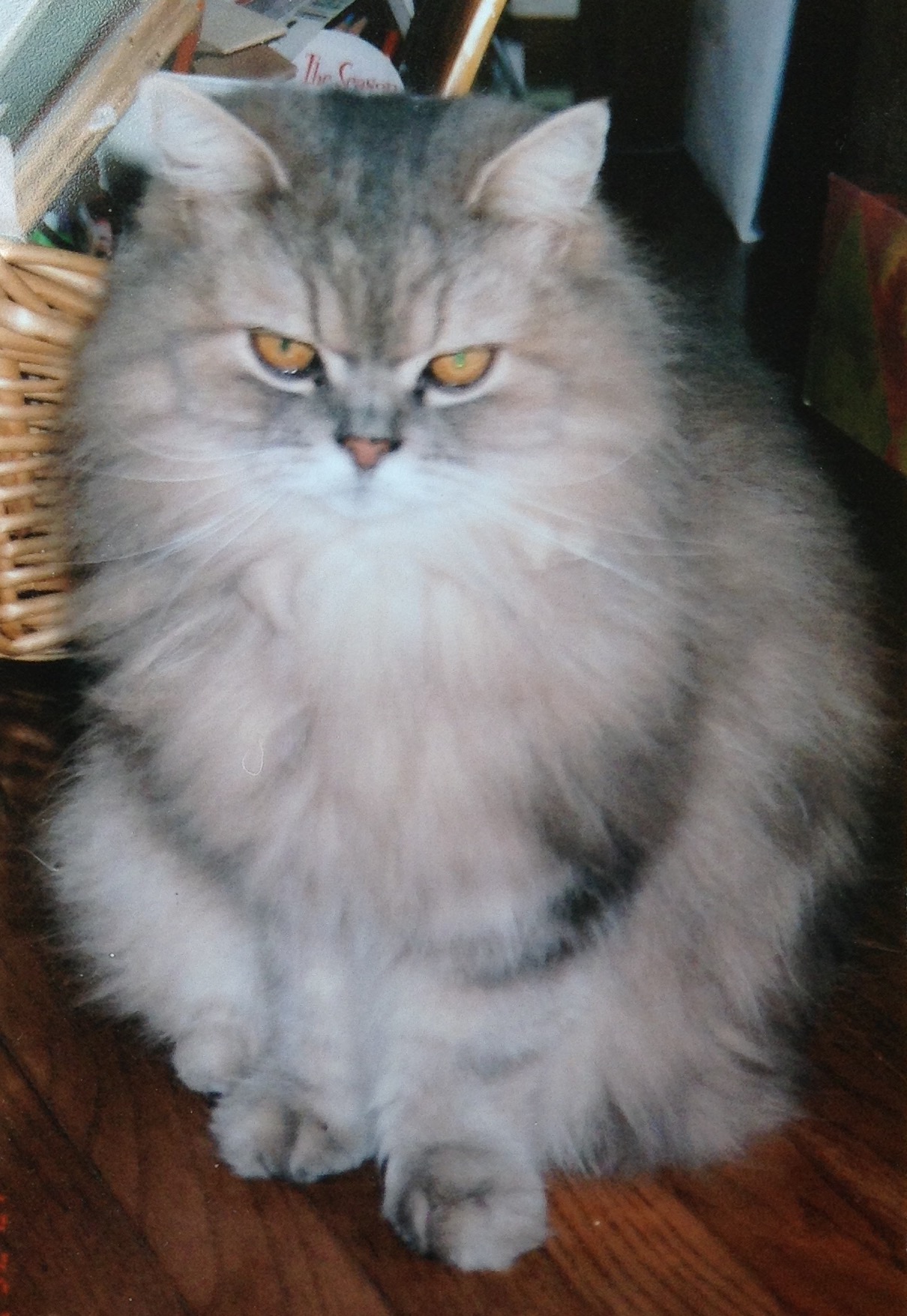
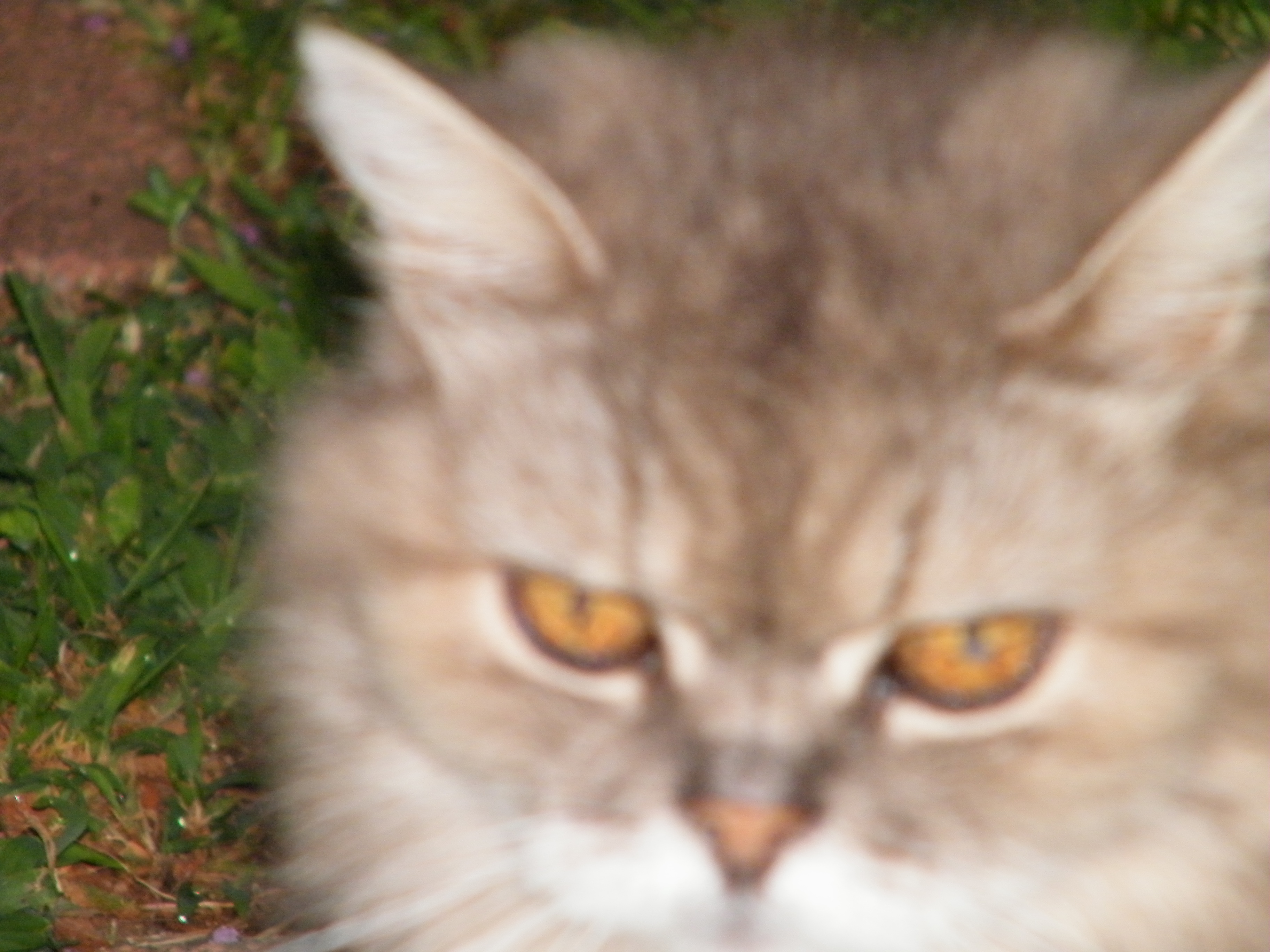
I can still see CJ, our Persian Cat, waiting anxiously at the back door to go outside, while I’d be setting up my telescope on the deck or in the backyard. 

She would walk around, climb the deck, play like she was catching something….pouncing and clawing the ground. However, after a short while, she’d end up on my lap, either due to being cold, or to just feel safe.  

CJ was going to stay with me for only a couple weeks, and then would be moving to California, but that two weeks ended up being almost 17 years.  I’m really glad the move didn’t work out.   

Astronomy from my backyard will never be the same.  

Debbie and I held her in our arms from 11:30 AM till 8:15 PM.  I had my hand on her chest when her little heart beat the last time, after 19 years.  It was a very sad day.  

CJ had a wonderful life.  We treated her like a Princess!    

FullSizeRender

DSCF5111

January 1965: A Very Cold Month With Snow And Lots Of School Days Missed

Posted March 12, 2017 by rogerivester
Categories: Roger's Articles

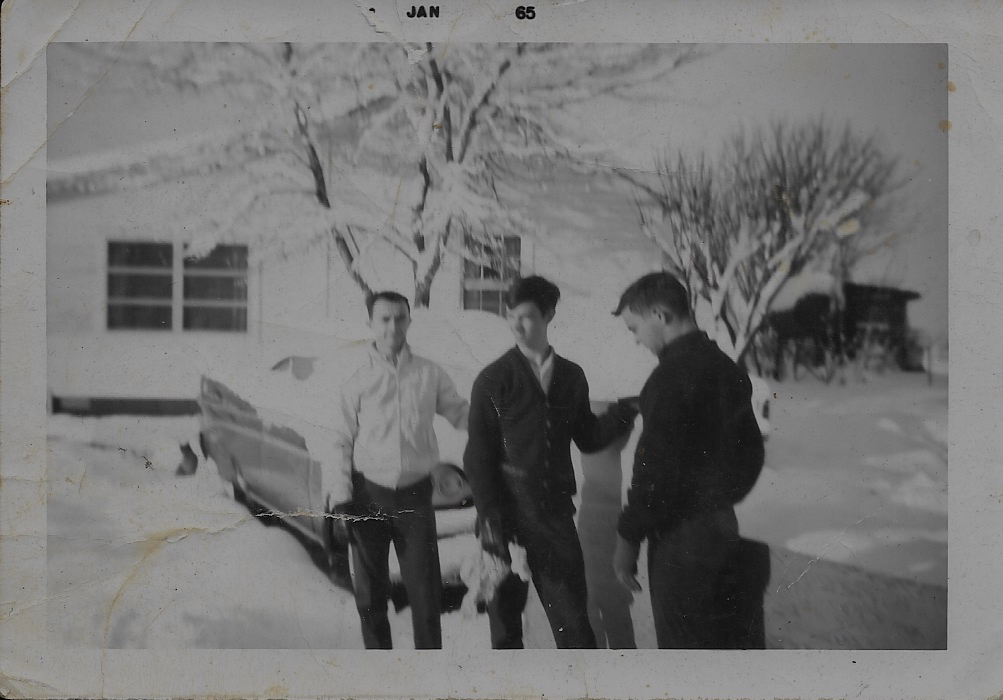
A cold month with a lot of snow and school days missed. During this particular snow, there was more than 12-inches of snow on the ground at one time with extremely low temperatures.

Temperatures dropped into single digits for several days, which caused havoc on plumbing for many, and to make matters worse, deep-snow and ice persisted.

During January of this year, the First Broad River froze solid, something I’d never seen before or since.

This was just one of several snow falls that would occur….extending into the months of February and March of 1965.

In the following photo, L-R, are three of my brothers: Ronny, Phillip and Jimmy who are clearing snow with a 4 x 8 sheet of plywood.

Winter Albireo – Double Star – Known As h3945 and 145 G Canis Majoris – February Observer’s Challenge Object

Posted February 8, 2017 by rogerivester
Categories: Work File Only - Observer's Challenge Reports

This is the 8th year anniversary edition of the Observer’s Challenge, which started out as a three month trial.  Thanks to all who have participated and made this….the 96th consecutive monthly report possible.  The following link is the anniversary report.  Enjoy!

FEBRUARY 2017 OBSERVERS CHALLENGE – WINTER ALBIREO

February Observers Challenge: h3945/The Winter Albireo

Despite the fact that thousands of double and multiple stars lie within reach of even the smallest of telescopes, and are visible on all but the worst of nights even in light-polluted skies, they are the most neglected of all deep-sky objects. (Incidentally, these tinted jewels are deep-sky objects, lying as they do beyond the solar system.) Were I to pick one object that epitomizes an overlooked and neglected wonder of the skies, it would surely be this lovely combo. Its ruddy-orange and greenish-blue components, while over a magnitude fainter than its namesake’s, seem more intensely hued to some observers including myself. Indeed, the primary even appears a fiery-red at times (apparently depending on atmospheric conditions). This pair is striking even in a 2-inch glass at 25x and is absolutely superb in a 6-inch reflector at 50x. So why the neglect? Overshadowed by radiant Sirius to its northwest may be one reason. But I suspect that the real cause is its unusual designation. Having neither a Bayer Greek-letter or Flamsteed number on atlases — nor even a Struve or other obvious double star designation — causes most observers to ignore it. The “h” prefix indicates that it’s one of the discoveries of Sir John Herschel, William’s famous son. (Sir William himself discovered some 800 double and multiple stars in addition to the more than 2,000 clusters and nebulae for which he is best known.) In any case, this Albireo clone certainly deserves to be on every showpiece list!    

 Jim Mullaney, 

Supplemental information as provided by Sue French:

“This double also carries the moniker 145 G Canis
Majoris, though the designation is often
incorrectly listed without the G, which
indicates it’s from the 1879 Uranometria
Argentina by Benjamin Apthrop Gould.”  Sue French 

The following photo of the Winter Albireo by Mario Motta of Massachusetts:

h-3945

Observing notes by Sue French from New York:

The lovely double star h3945 lies about
halfway along and 38′ west of a line connecting
NGC 2367 and Tau. (This double
also carries the moniker 145 G Canis
Majoris, though the designation is often
incorrectly listed without the G, which
indicates it’s from the 1879 Uranometria
Argentina by Benjamin Apthrop Gould.)
It’s the brightest star in the area and
sports 5.0- and 5.8-magnitude components
26″ apart. Although striking in
appearance, this is only an optical pair
whose unrelated stars lie along the same
line of sight. Astronomy author James
Mullaney dubbed this duo the Winter
Albireo for its resemblance to the famous
gold and blue double in Cygnus. In a
small scope, they seem gold and white to
me.   Sue French

Observing notes by Debbie Ivester from North Carolina: 

Date: February 25, 2017
Observer: Debbie Ivester
Object: Double Star h3945; Winter Albireo
Date: February 25, 2017
Seeing: Excellent
Telescope: 6-inch f/6 reflector
Magnification: 73x

A beautiful double star, and definitely the most color I’ve ever seen through a telescope. I saw the primary as yellow and the companion as a vivid blue. My color perception was not arbitrary. I looked at this double several times over a thirty minute period, and each time, I saw the same colors. It was very enjoyable to see this most colorful pair.   Debbie Ivester

Observing notes by Roger Ivester from North Carolina:

Object: h3945 Double Star in Canis Major – 145 Canis Majoris

This wide and colorful double star is known as the “Winter Albireo” a name coined by author and astronomy lecturer, James Mullaney. The component magnitudes are 5.0 and 5.8 with a wide separation of 26 arcseconds. This double is easy to observe even in the smallest of telescopes. I was able to observe this beautiful double with a 76 mm f/4 reflector, but with subdued colors, as compared to larger telescopes. The following are my notes using three different telescopes:

Date: March 2016
Telescope: 102 mm refractor
Magnification: 82x
Colors: Yellow/blue

Date: February 25, 2017
Telescope: 6-inch f/6 reflector
Magnification: 73x
Primary: Deep Yellow/Aqua

Date: February 13, 2017
Telescope: 76 mm f/4 reflector
Eyepiece: 12.5 mm + 2.8x Barlow
Magnification: 67x
Colors: Yellowish/pale blue
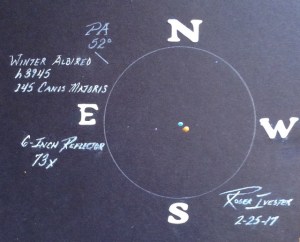
fullsizerender

Observing notes by Steve Clougherty from Massachusetts:

A few of us die hard observers finally got around to checking out h3945 last night using a 25 inch Dobsonian in the Ed Knight Observatory in Westford at the ATMoB clubhouse. Despite only fair seeing, the colors were striking!

Gold and pale Blue; best at low magnification using a 13 mm eyepiece for a magnification of 131x. As always, the colors are more pronounced when slightly defocusing the double.  

Observing notes by Gus Johnson from Maryland

In April, 1975 I observed h3945, a double star in Canis Major using a 6-inch reflector at 59X. It was very similar to the summer Albireo, in Cygnus. Beautiful, yellow primary and blue companion. I easily resolved it with my 10X40 finder. In October, 1980, I observed it with a 4.25-inch Newtonian at 28X. It displayed exquisite colors! Yellow and Blue

Notes from Peter Bealo from New Hampshire: 

As clouds were rolling in from the south at 7:20 PM EST on 2/26/2017 I took a few minutes to observe h3945 with my 80mm f6 apochromatic refractor.

It is indeed a pretty double. Easily split at even 20X, probably would have been no problem with 14 X 70 binoculars, but didn’t have them handy.

With a 9mm eyepiece, the primary appeared yellow with more intense color than the companion. The companion or secondary star was a bluish-aqua. When I switched to a 24mm, the companion color intensity was more blue. Possibly very subjective, but obvious to me!   Peter Bealo

Observing notes by Mike McCabe from Massachusetts:

I was first introduced to these stars a few years ago through an article in Sky and Telescope written by James Mullaney. He called the targets on his list the Top 10 Neglected Deep Sky Wonders and over the ensuing years, I’ve found most of them to be very attractive indeed.

Setting down at the scope about an hour after dinner, I was once again presented with this attractive pair in the eyepiece, and they really did look like the Albireo pair that we’re all very familiar with.

Depending on the aperture of the scope I’m using at the time, I see the colors as pale yellow and pale blue, with the saturation appearing deeper in smaller instruments. Comparatively, the color saturation might be just slightly less than that of the real Albireo, but part of that is likely due to the poor seeing down below 20° off the horizon.

Observing notes by Craig Sandler from Massachusetts: 

Telescope:  8-inch Schmidt-Cassegrain 

Eyepiece:  24 mm 

Tallahassee, FL
Date:  Jan. 24, 2017
Seeing:  Good 
Transparency:  Good
NELM:  6.0

First, some nomenclature. I first found this beautiful object tooling around with my GoTo in the hand control’s “Constellation” menu item, which will bring up notable objects (NGC, IC, Messier and 2x stars) in a given constellation. Under “Double Stars” for CanMajor, the SE8 database gave the designation “CanMaj 145,” so I’ll always think of it that way. Many prefer the Herschel designation, h3945. And Sue French points out the definitive designation is Canis Majoris G 145, “which indicates it’s from the 1879 Uranometria Argentina by Benjamin Apthrop Gould.”

In any event, I was stunned when it came into view in Petersham, MA right at the beginning of winter/end of fall. For my report, I’m using an observation in January from Florida – the first apparition was when the double star was so low it (and the Trapezium) was so low it was boiling in the atomosphere – quite beautifully, I must say. Anyhow, in January the object was high in the southern sky with a stable sky and was beautiful. I think of it as being the state colors of Massachusetts, plus some orange (for the primary) and some purple (for the secondary). I did my usual (sadly) ballpoint pen sketch, because that night I had limited time and a long agenda. Then on Cape Cod in February, I tried a color sketch just for fun. I was not too pleased with the result, but the process is interesting and pleasing. Once I have observed all the Messiers (two to go, saving M56 for Cherry Springs!) and the “Covington 200” (“Celestial Objects for Modern Telescopes”), I believe I’ll be ready to slooow dooown and give my sketches the practice they deserve. C.S. to all!    Craig Sandler 

Observing notes by Fred Rayworth from Las Vegas:

I saw one bright orange star and the other was maybe blue at first. It was hard to tell because seeing was bad. The main star, the brighter one was orange and looked much brighter than the other one, even though the mags. weren’t all that much different. Once in a while, when things settled down for a split second, the dimmer companion’s color slipped through and the color, a tint of aqua came through, reminding me just a bit of Uranus or Neptune.

Observing notes by Richard Nugent from Massachusetts:

I had never before observed h3945 so, thanks for the February challenge. What a beautiful double star! I have been observing it over the last month through telescopes ranging from my 10-inch,  Joe Henry’s 16-inch, Steve Clougherty’s 18-inch and my 20-inch scope.

I saw the stars as burnt orange and pale blue. The companion blue star’s color seemed muted through the 20-inch, but was more pronounced with the 9-inch aperture mask in place. My favorite view came last Sunday evening through the 10-inch at 50x and good seeing. The colors were quite dazzling! I’ll add this to my list of star party objects…h3945 offers the “Wow!” we always hope for. Thanks again!   Richard Nugent

Observing notes by Chris Elledge from Massachusetts: 

I was able to split h3945 with 15×70 binoculars tonight (February27th) after my difficulty yesterday with the stars low on the horizon and my not wearing contacts. With the stars higher in the sky and my astigmatism corrected, it wasn’t difficult thanks to their distinct colors. I would describe the primary to be orange and the companion pale blue.   Chris Elledge

Observing notes by Sharon Mullaney from Delaware: 

Date:  February 20, 2017
Observer:  Sharon Mullaney
Object:  Double Star h3945
Seeing:  Very Good
Telescope: 5-inch Schmidt-Cassegrain
Magnification:  50x

A stunning double star – brilliant in color. I saw the primary as bright yellow and the companion as lavender blue. The companion definitely had a purplish hue,
even after checking back in on this double a few times over the next hour. It was a great night to observe!   Sharon Mullaney

Observing notes by John Goss from Virginia:

The skies in southwest Virginia were near perfect last night. So, not wanting to waste such a rare opportunity, I tried my luck with a few objects, primarily h 3945. My equipment was an 8-inch reflector f/4 reflector and the eyepiece was a 24 mm, giving 32 x. It was easy to find as it is a straight shot from epsilon through delta Canis Majoris. The brighter component appeared orange-gold. The other one was what I would call a “Carolina Blue.” UNC fans know the shade well.

Yes, h 3945 should be on anyone’s top ten multiple star list. It is well worth any observer’s time, even if he or she doesn’t particularly fancy double stars.

John Jardine Goss
Astronomical League President
http://www.astroleague.org

Observing notes by Glenn Chaple from Massachusetts:

I just returned inside after having made a few small-scope observations of h3945. I studied this beautiful pair with a 60mm f/11 refractor and a 114mm f/8 reflector. Finding h3945 was a simple matter of pointing each scope at an area defined by a line traced from omicron-1 CMa through omicron-2 CMa and extended an equal distance beyond. Experimenting with different eyepieces, I found that h3945 was best split (not too close, not too widely separated) by magnifications between 35X and 50X. The golden yellow color of the primary was obvious in the 60mm scope; the bluish hue of the companion wasn’t as apparent. The colors were more vivid in the reflector, with the primary sporting a rich golden-yellow color, the secondary a soft blue tint. This is definitely a showpiece double!   Glenn Chaple

Observing notes by Joseph Rothchild from Massachusetts:

I observed the Winter Albireo tonight with a 6″ f/5 reflector at 53x. The primary appeared copper and the secondary a pale blue.   Joseph Rothchild 

Observing notes by Sameer S. Bharadwaj from Massachusetts: 

I used my 60mm refractor at 30x and then barlowed it to 84x.

Not difficult to find using Sirius, Adhara and Wezen. About the same distance on the other side of Wezen as Adhara. Was at about 24 degrees altitude when I saw it between 7:30 and 8 pm local EST.

Could clearly see a warm orange and cyan blue well separated. The colors are indeed pretty and the contrast is good.   Sameer S. Bharadwaj 
Aerial View Of Meteor Crater Compliments of James Yeager, Pilot American Airlines

Posted December 6, 2016 by rogerivester
Categories: Roger's Articles

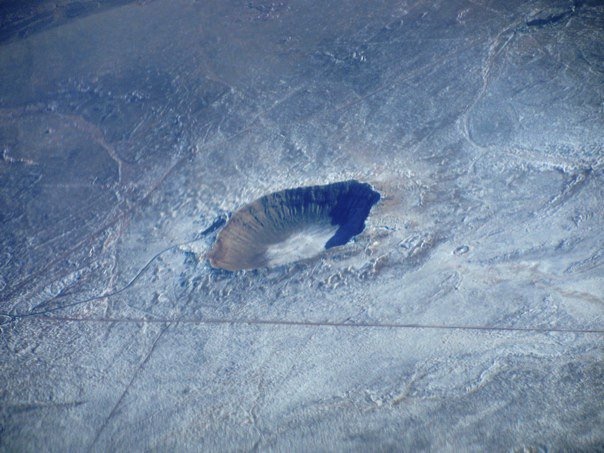
“Snow in Meteor Crater for an ice effect as the sun was starting to set.”  James Yeager 

image3

Mount Potosi, Nevada With Ties To Boiling Springs And Lincolnton, North Carolina: Aerial Photos By James Yeager, Pilot-American Airlines – Article Excerpts From Astronomy Magazine, And Also The Plane Crash In 1942.

Posted December 4, 2016 by rogerivester
Categories: Mount Potosi Observing Complex In Southern Nevada

Mount Potosi: The infamous mountain with ties to Boiling Springs and Lincolnton, North Carolina.

The following paragraph from wikipedia tells the story of the TWA plane crash on January 6th 1942 that killed actress Carole Lombard, with a total of 22 souls being lost. Remnants of the plane are still located on the mountain, even to this day. Due to deep snow on the mountain and difficult terrain, all of the bodies were not able to be recovered. Roger Ivester

TWA Flight 3 was a twin-engine Douglas DC-3-382propliner, registration NC1946, operated by Transcontinental and Western Air (TWA) as a scheduled domestic passenger flight from New YorkNew York, to BurbankCalifornia, in the United States, via several stopovers including Las VegasNevada.[1] On January 16, 1942 at 19:20 PST, fifteen minutes after takeoff from Las Vegas Airport (now Nellis Air Force Base) bound for Burbank, the aircraft was destroyed when it crashed into a sheer cliff on Potosi Mountain, 32 miles (51 km) southwest of the airport, at an elevation of 7,770 ft (2,370 m) above sea level.[2] All 22 people on board, including movie star Carole Lombard, her mother, and three crew members, died in the crash. The Civil Aeronautics Board (CAB) investigated the accident and determined that the cause was a navigation error by the captain.[1]

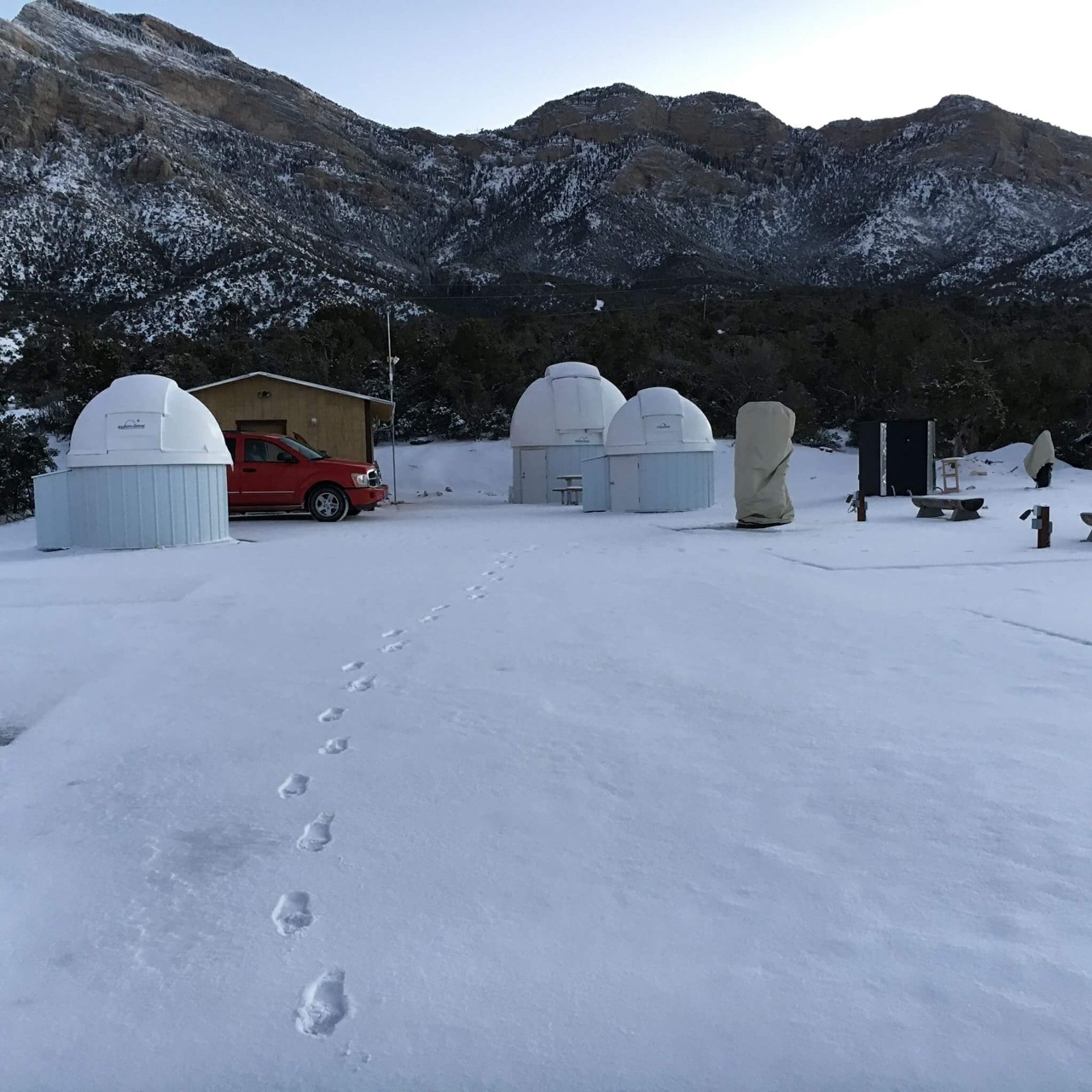
The following aerial photos of Mount Potosi and information by AA Pilot, James Yeager: 

img_4745

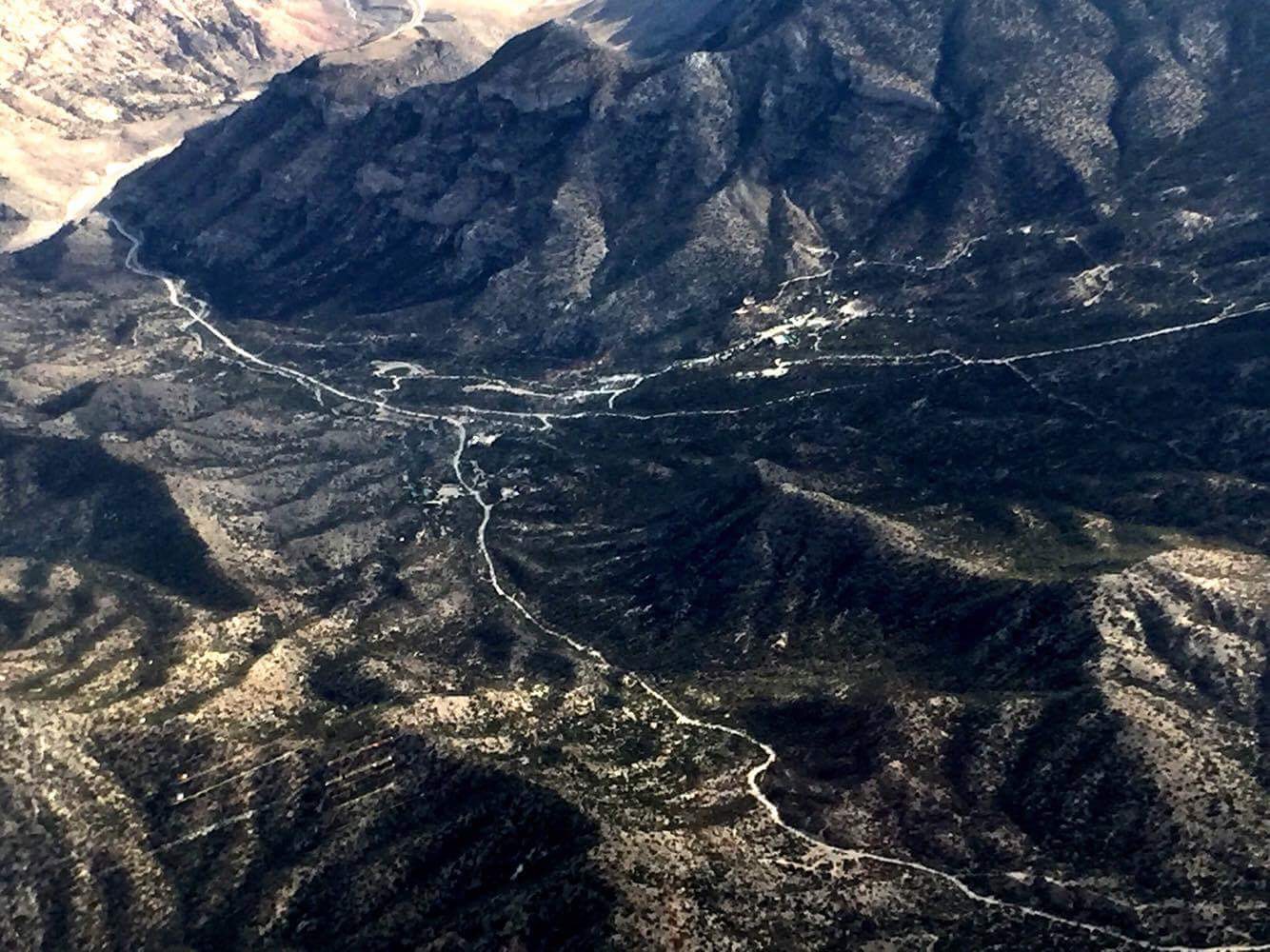
The above aerial photos from an American Airlines Airbus at 13,000 feet:  

“When flying from Los Angeles into Las Vegas, air traffic control will usually give an arrival called KEPEC3, to set you up for a landing on 25L.  Yesterday morning, they vectored us off the arrival and gave us a heading to fly….that allowed me to get a view of a very cool piece of property on Mount Potosi.”  James Yeager, Pilot, American Airlines.

Cockpit view of Mount Potosi in the distance from McCarran International Airport, Las Vegas, Nevada. 

image1

img_2078

The Dr. James Hermann, MD. (14-inch RC Telescope and mount from North Carolina.) 

img_2077

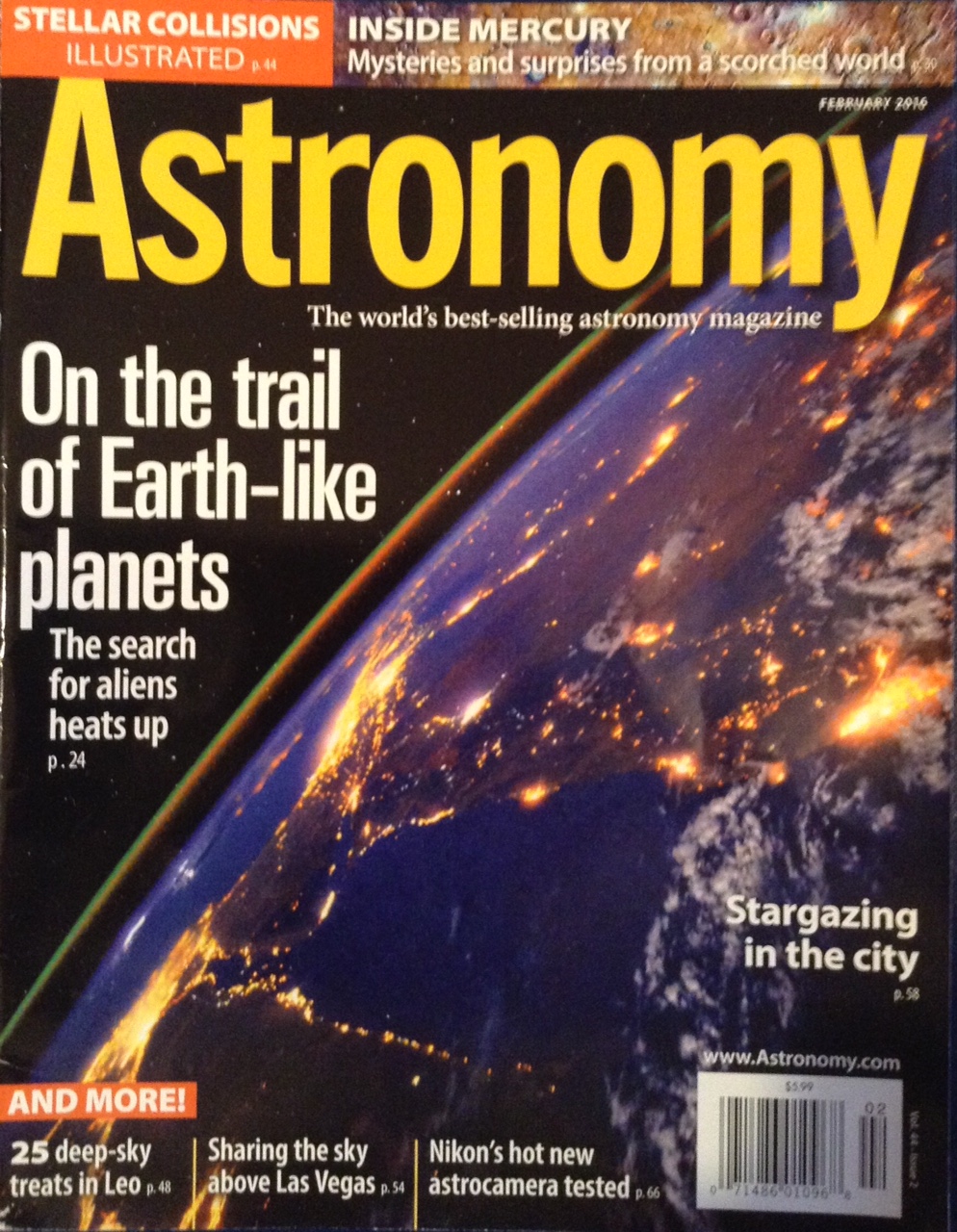
Some brief excerpts from the Astronomy Magazine article, February 2016, pages 54-57, complete with photos of the telescope, domes, pictures of the building process, and other.  By Raymond Shubinski 

fullsizerender

“BE PREPARED. The Boy Scout motto is familiar to everyone, and excellent advice for all. Being prepared requires planning and vision, and this observatory project on a Boy Scout camp southwest of Las Vegas, Nevada, shows both.” 

“A beautiful Officinal Stellare telescope now sits housed at an elevation of 5,680 feet on Mount Potosi, 25 miles from the world famous and incredibly bright…Las Vegas strip.”  

“Jim Gianoulakis is the prime mover behind the efforts to bring this level of astronomical experience to Southern Nevada.  He has been involved in the LVAS for more than 10 years.  His passion for amateur astronomy, coupled with that of the current president of the LVAS, Rob Lambert, has made this project bloom on a desert mountain.”

The flame is lit:

“The catalyst of the project came in August 2012.  Gianoulakis, then president of the LVAS, received a message from Roger Ivester, an LVAS member living in Boiling Springs, North Carolina.  Ivester knew of an individual looking to gift a scope and mount to a group with a good use for it.”

“Gianoulakis and Lambert collaborated on the proposal, which was accepted, and the project was off and running.  James Hermann, a North Carolina resident donated the scope, a 14-inch Officinal Stellare Pro RC-360.  The gift also included an Astro Systeme Austrian equatorial mount.  The value of this donation is $50,000.”  

Note:  James Hermann, MD is an emergency room physician.  Roger Ivester

Other facts:

“…members started looking for donations.  An initial gift of $2,500 came from the LVAS  membership.  Then the club raised an additional $10,000 from Las Vegas individuals and businesses.  

“Dan Johanneck at Explora-Dome in Litchfield Minnesota promised 11.5-foot dome and 8-foot domes for the Project.”

“Now where to put the observatory?  The Las Vegas Area (Scout) Reservation southwest of the city. Located on the reservation is Camp Potosi where scouts can camp and work on many of their merit badges.  With an elevation of more than a mile and shielded from the direct glare of the strip, Mount Potosi was an excellent candidate for a future observatory.  So, the LVAS entered into discussions with the council.  It was a win-win arrangement.  The LVAS gets the land on Mount Potosi within the scout camp.  In exchange, the LVAS will provide assistance with the merit badge program and organize viewing events.”  

Again, this is a four page article, and the above is just to give you an idea what the Mount Potosi Observing Complex is all about.  

Roger Ivester

The Cygnus Fairy Ring – Asterism In Cygnus

Posted September 10, 2016 by rogerivester
Categories: The Cygnus Fairy Ring - Asterism in Cygnus

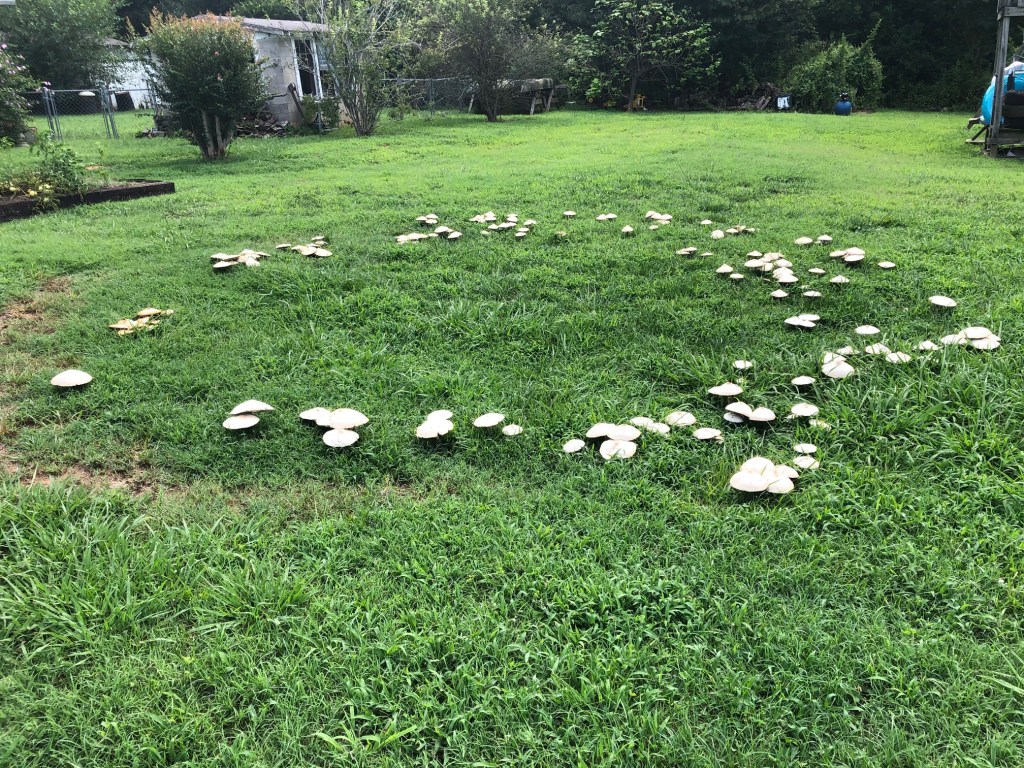
A real Fairy Ring, more about it toward the bottom of this post. Why I didn’t get off my bicycle and walk into the center…read on.

The following pencil sketch was made by the writer, using a 10-inch reflector @ 57x with a 1.1º true field of view, a blank 5 x 8 notecard with the colors inverted using a scanner.  Only a No. 2 pencil and an eraser were used.            

Scanned Image 160890002

The Cygnus Fairy Ring as viewed with a 10-inch f/4.5 reflector on August 13, 2015.  Transparency was poor due to very high humidity, but seeing was excellent.

The asterism was easy to locate and see using a 32mm eyepiece @ 36x with a 1.8º FOV.  The most recognizable member of the group is double star H1470 with the primary being a ruddy or rust color.

When increasing the magnification, using a 20mm eyepiece @ 57x with a 1.1º FOV, I could see at least eight or more separate pairs of double stars making a circle.   

While taking a bicycle ride I came across a yard with a true 360º Fairy Ring.  I just had to stop and take this photo as it is pretty rare.  

The mushroom Fairy Ring gained recognition, its name, warnings and legends from hundreds of years ago in Europe. 

“DO NOT” Step Into the Ring!  

It is generally felt that fairy circles are to be avoided as dangerous places as they’re associated with malevolent beings.

If you dare to enter a ring, many myths warn that you will die young. You also become invisible to the mortal world, unable to escape the ring, or you are transported instantly to the fairy realm. You might also lose an eye for your foolishness. Either way, you will be forced to dance around the ring until you die of exhaustion or madness!

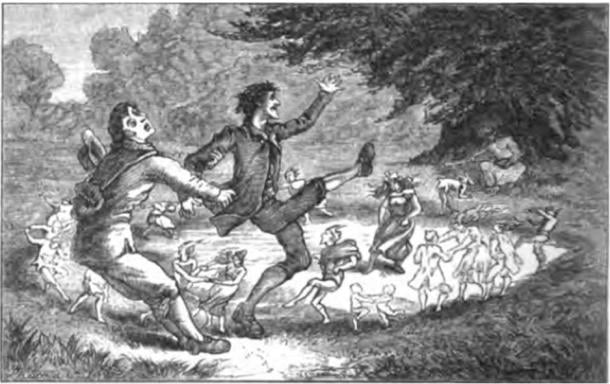
"Plucked from the Fairy Circle" A man saves his friend from the grip of a fairy ring.

“Plucked from the Fairy Circle” A man saves his friend from the grip of a fairy ring.  Public Domain

To avoid this terrible, cavorting fate, you can take specific measures, such as running around the ring nine times (nine times only, as 10 is too many and will undo the procedure). It is said that to enter the ring without penalty you can run around the ring during a full moon, but only in the direction the sun travels during the day.  If you do this, you might hear the fairies dancing underground.

M92 Globular Cluster in Hercules and “Trouvelot’s Hook”

Posted August 1, 2016 by rogerivester
Categories: Work File Only - Observer's Challenge Reports

The Observer’s Challenge complete report:  Click on the following link:  JULY 2016 OBSERVERS CHALLENGE – M-092

The following write-up and sketch by Jaakko Saloranta of Finland, one of the most talented and gifted visual observer’s in the world today.  Roger Ivester 

Messier 92

The baby brother of Messier 13. Brightest star in the cluster is magnitude 12.1 so it is fairly easy object to resolve. However, it is a difficult naked eye object: barely visible with optimal averted vision at an altitude of 57 degrees. Easily visible with a 8×30 binoculars as a non-stellar smudge.

Forms a triangle with two 10th magnitude stars. Partial resolution is achieved – only a handful of stars visible – with a 3 inch refractor @ 133x (23′). With a 4.5 inch SkyQuest XT @ 152x (20′) M92 appears as fairly well resolved, with a few dozen stars visible. Bright core, might appear slightly elliptical but is probably just an illusion caused by unresolved stars NW of the nucleus.

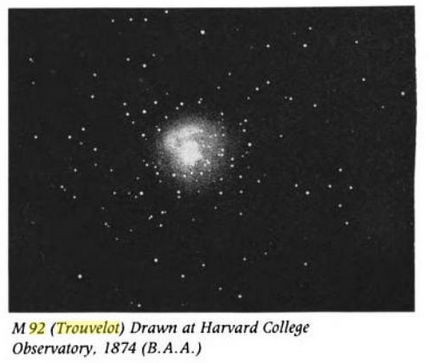
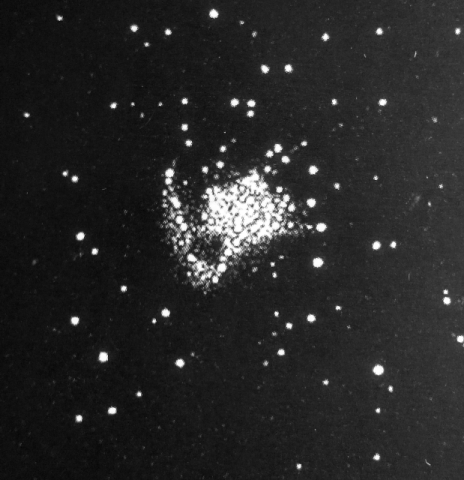
Messier 92 contains a little known small feature nicknamed “Trouvelot’s Hook” (named after 19th century French astronomer Étienne Léopold Trouvelot) . It is a hook-shaped chain of stars with dark bays at both sides. The feature is visible in two separate sketches made by Trouvelot. The first one is from 1874 and the second from 1877. Both sketches of M92 are made from Harvard College Observatory.

Having seen Roger Ivester’s notes on M92, it is obvious that Roger has noted – at least a part of – “Trouvelot’s hook”. He described it as “a faint chain of four stars follows the flattened edge”. This is part of the very same chain sketched by Trouvelot! I personally could not make out the dark lane sketched by Roger. I only saw a couple of bright stars just E of the cluster’s core.

Pencil Sketch By Jaakko Saloranta of Finland:

M92_2015_LVAS_1

The following sketches by French Astronomer, Trouvel0t. The first one was made in 1874 and the second 1877, both from the Harvard College Observatory.

M92_Trouvelot

Below:  Sketch by Trouvelot in 1877

DSC_0659


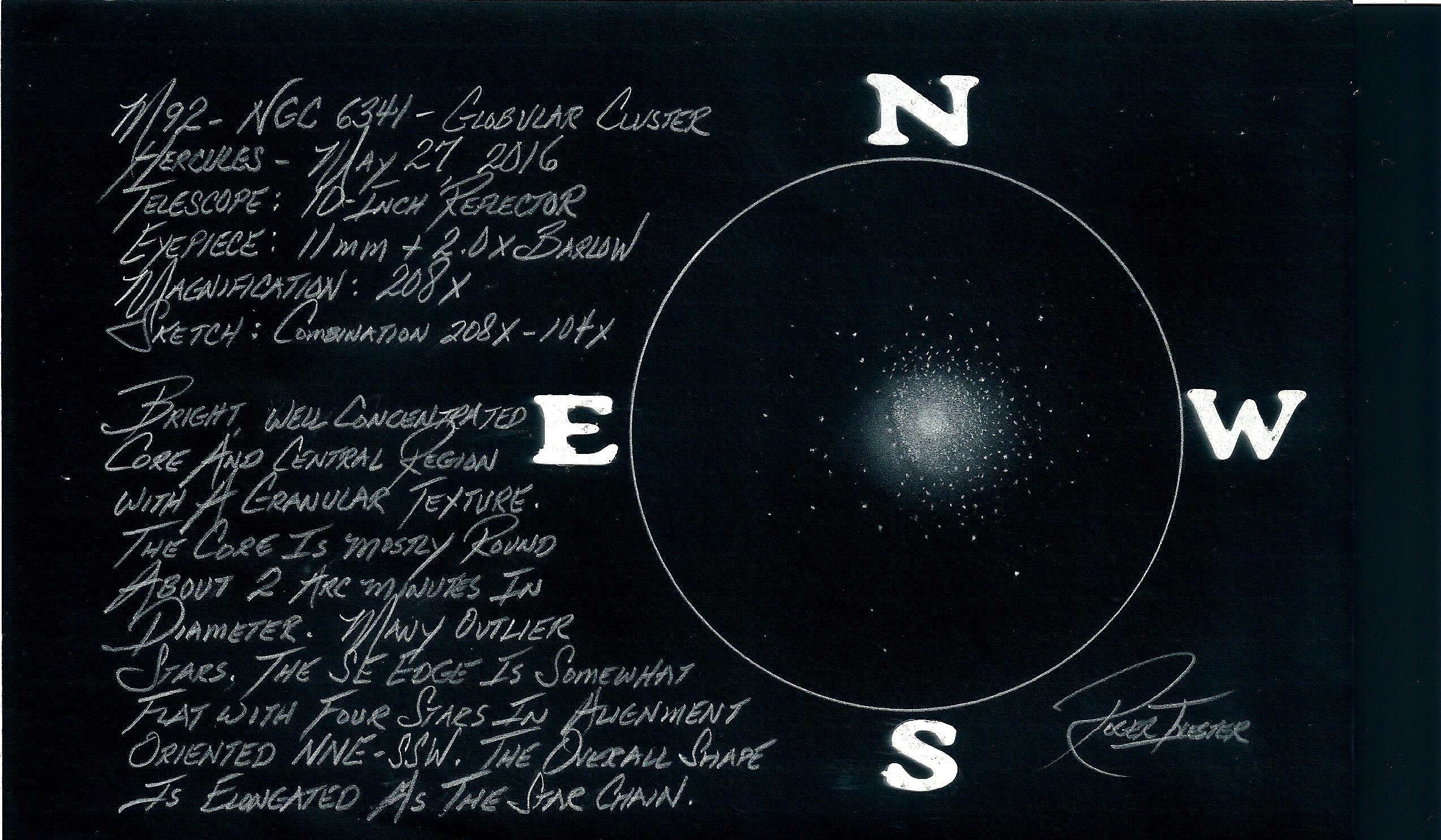
The following information and pencil sketch by the writer.  RI 

M92 – NGC 6341 – Globular Cluster in Hercules:  Date: May 27, 2016

Telescope: 10-inch f/4.5 Equatorial Reflector

Eyepiece: 11 mm – Also Other Observations With The Employ Of a 2.0x Barlow
Magnifications: 104x and 208x intermittently

Bright with an intense round core and a granular texture at 104x. When increasing the magnification to 208x, excellent resolution of stars in the outer regions and in the halo, with many outliers.

The overall shape has a subtle N-S elongation. The NNE-WSW edge is flat, which is one of the more noticeable and recognizable features of the cluster. When using averted vision a faint chain of four stars follows the flattened edge. These stars were not visible on two of the three nights of observations, and appeared intermittent or not constant.

The following is a pencil sketch using a 5 x 8 blank notecard, with the colors inverted using a scanner.  Please note the faint star chain on the eastern side of the cluster, on both my sketch and Jim Dire’s image.  It was extremely difficult for me, requiring averted vision, and could only see intermittently on the third night of observations.

Roger Ivester 

Scanned Image 162110000

M92:  The following image and text by James Dire of Hawaii

M92

James Dire, Ph.D.

M92 is the middle in size and brightness of three globular cluster located in the constellation Hercules. The brightest and largest is M13 while the smallest in our sky is NGC6229. All three globular clusters can be spied with an 8-inch or larger telescope.

Globular clusters are highly compact groupings of tens of thousands to millions of stars. There are approximately 150 of these clusters forming a spherical halo around our Milky Way galaxy. Globular clusters are also known to exist in other galaxies. The Andromeda galaxy probably has 2-3 times as many as the Milky Way.

M13 is the brightest globular cluster visible in the northern hemisphere and the third brightest visible from Earth. At magnitude 5.8, has a diameter of 25 arc minutes, nearly as large as the Moon. In comparison, at magnitude 6.4 M92 is roughly half as bright. It spans 15 arc minutes. Although both appear in Charles Messier’s famous catalog, he did not discover either of them. Edmond Halley discovered M13 in the year 1715 and Johann Bode discovered M92 in 1777.

M92 is found six and one-third degrees north of Pi Herculis, the northeastern-most star in the Keystone. Like M13, M92 can easily be spied in 50mm binoculars or finder scopes. Many stars can be resolved in both clusters using telescopes. Larger apertures will reveal more individual stars. I recommend eyepieces that yield 100x, or higher if the seeing is steady.

At magnitude 9.4, NGC6229 is quite a bit more challenging to find than M92. NGC6229 is located just north of the center of Hercules’ club, or 11 degrees north of M13. The easiest way to find it is to center the 5th magnitude star 42 Herculis in the eyepiece and hop two degrees to the southeast. William Herschel discovered NGC6229 in 1787. He was also the first to resolve stars in M92 six years later.

My image of M92 was taken with a 10-inch f/6 Newtonian with a Paracorr II coma corrector yielding a 1753mm focal length. The scope was atop a Paramount ME German equatorial mount and the image was taken with an SBIG ST-2000XCM CCD camera. The exposure was 20 minutes. The brightest star in the field of view, left (east) of the cluster, is HD156821 shining at magnitude 9.76. The faint star to the left of this is a 16.1 magnitude star. The yellow orange star on the northeast side of the cluster is HD156873, magnitude 9.98. The third brightest star in the field, to the lower right of the cluster shines at magnitude 10.9. None of these stars are members of M92.   James Dire 

The Importance of Documenting Observations For Future Reference And Observing With A Purpose

Posted February 5, 2016 by rogerivester
Categories: Roger's Articles

Observing with a purpose for me, is having an objective or agenda for observing. This might be to observe the Messier catalog, the Herschel-400 list or even some personal lists of objects. If you can’t decide what to observe: The Astronomical League has plenty to consider.

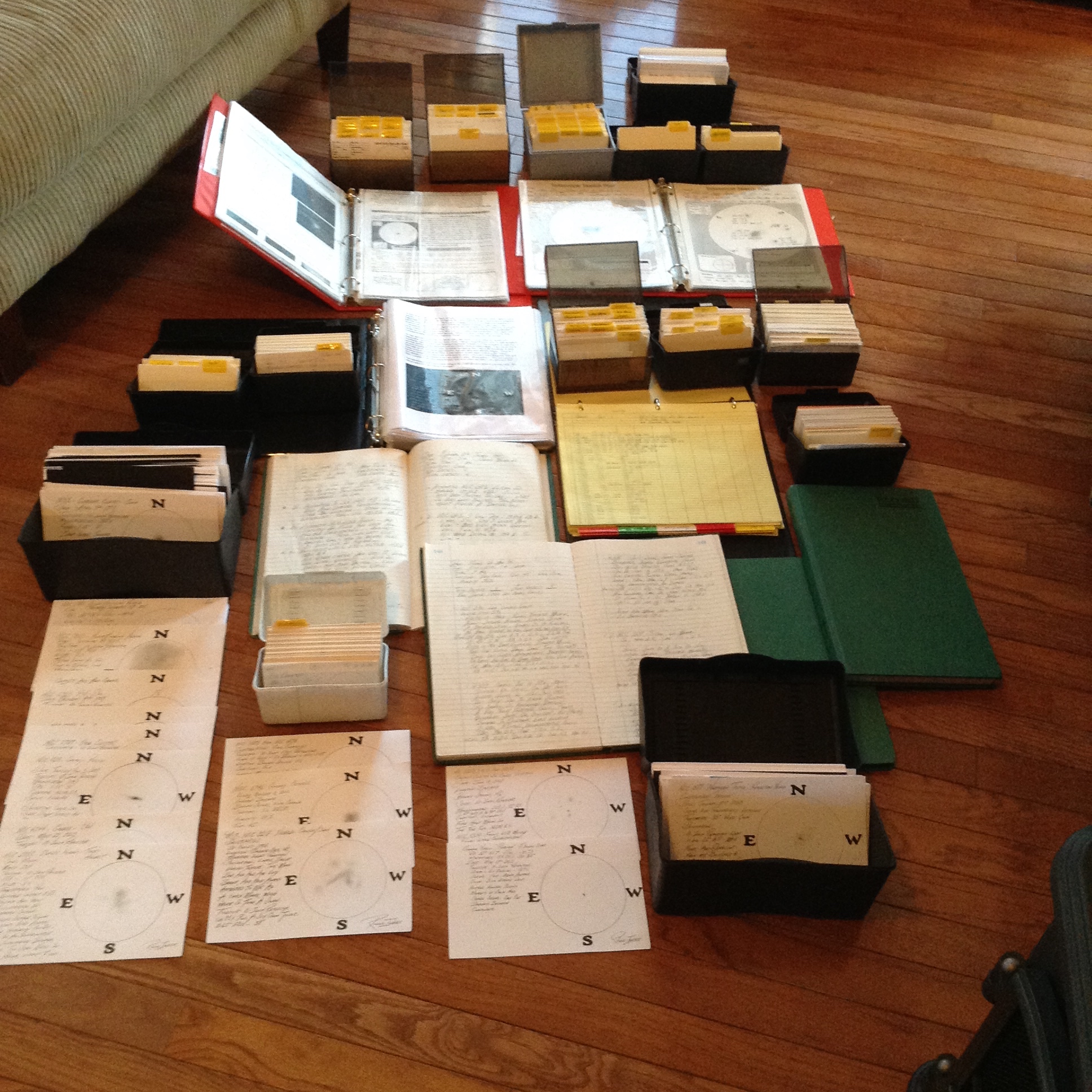
Some of my observing notes, pencil sketches and deep-sky articles as following:

IMG_1452

     When I purchased my first serious telescope in March 1977, one of first observing reference books was “The Finest Deep-Sky Objects” by James Mullaney and Wallace McCall.  This book featured observing notes for double stars, galaxies, nebulae, star clusters, and a few prominent red stars.

“1,000+ The Amateur Astronomer’s Field Guide to Deep-Sky Observing” by Tom Lorenzin:

      In the early 90’s I began using “1000+” almost exclusively. I really liked how Tom documented his observations, which were relatively brief, but saying so much.  

Visual observing for me is attempting to see the faintest of detail in deep-sky objects, then recording in words, and for some objects, making a pencil sketch.  

Roger Ivester

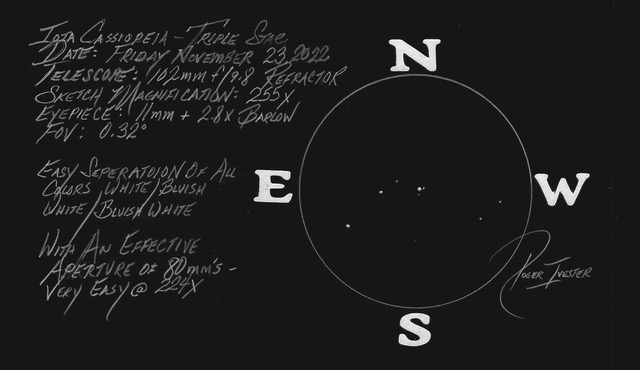
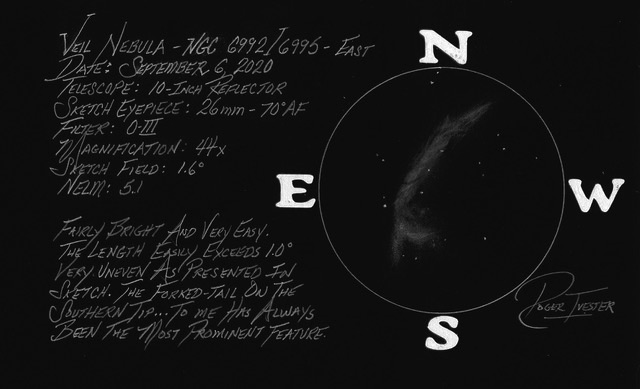
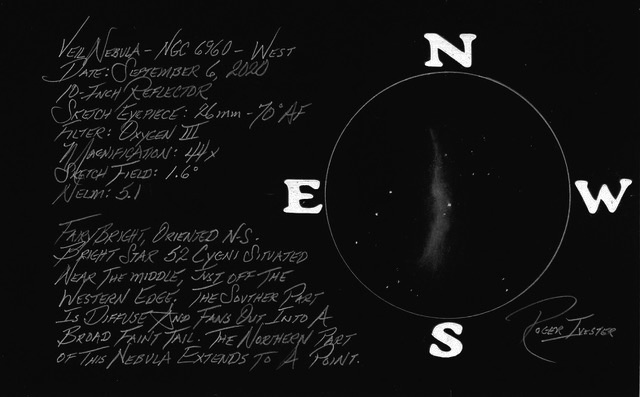
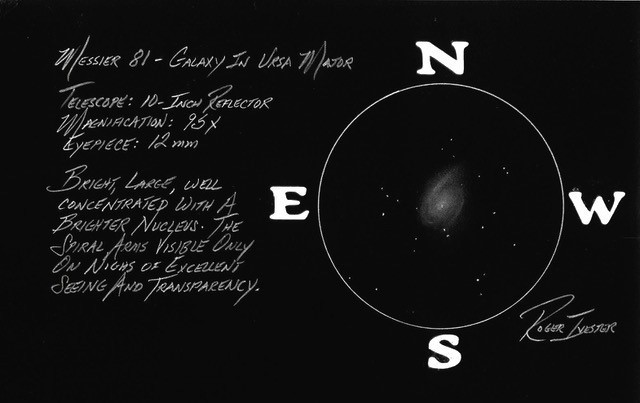
An few examples as following of my pencil sketches and observing notes:

Iota Cas Roger inv

unadjustednonraw_thumb_3b08

unadjustednonraw_thumb_3b07

Rogers M-081 Inverted

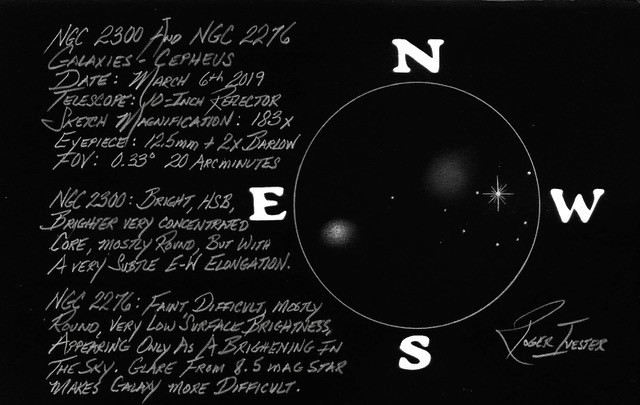
Rogers NGC-2300 Inverted

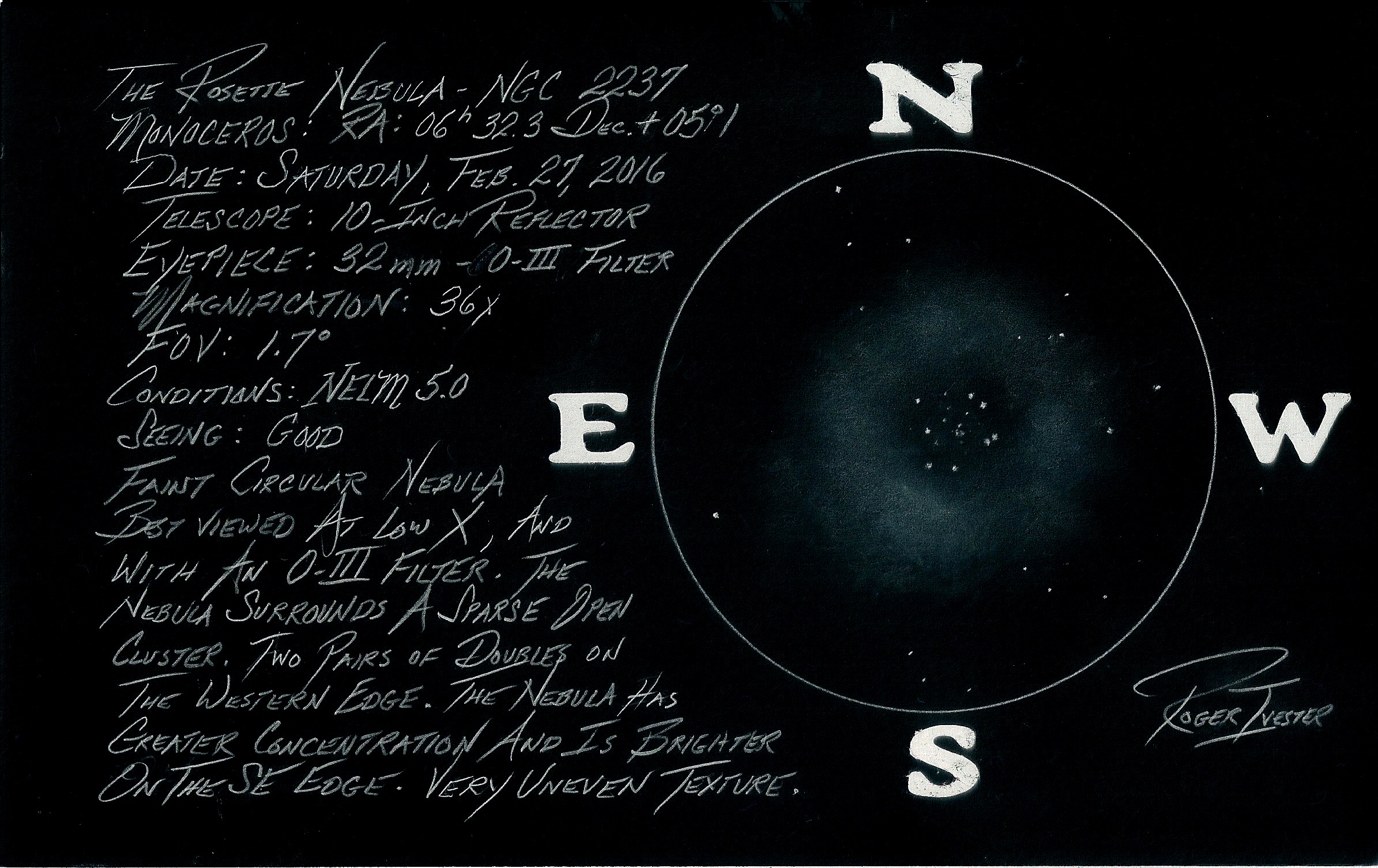
Scanned Image 160920001

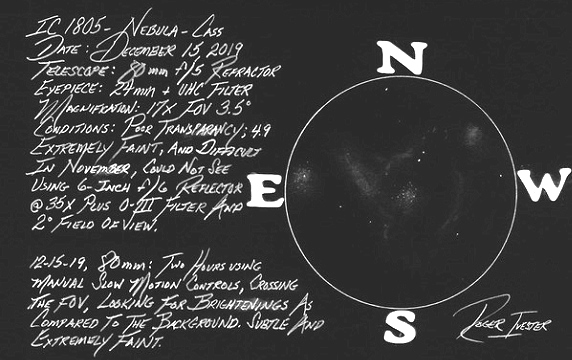
Roger IC 1805

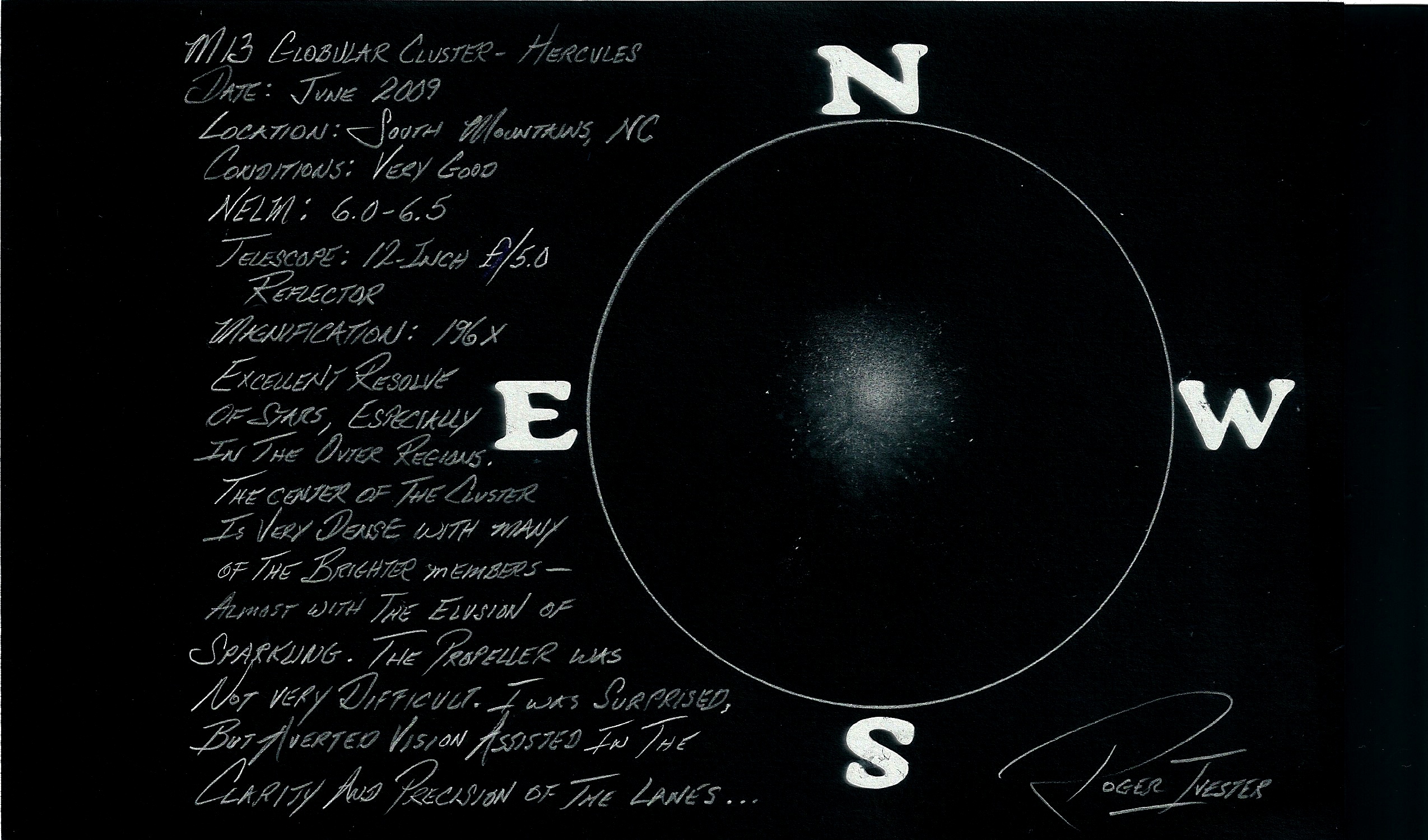
M13 And The Elusive Propeller

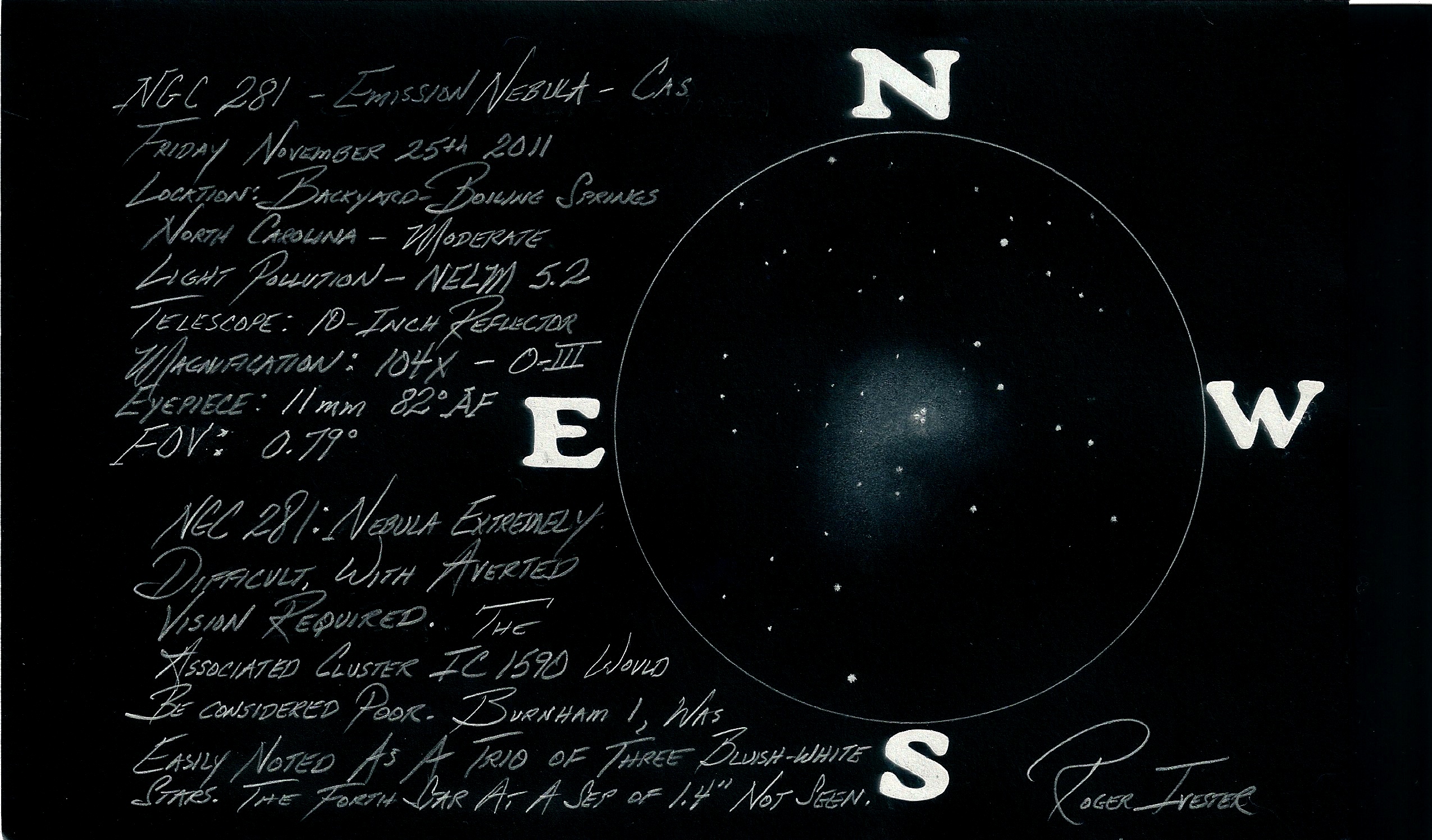
Pacman Nebula - NGC 281

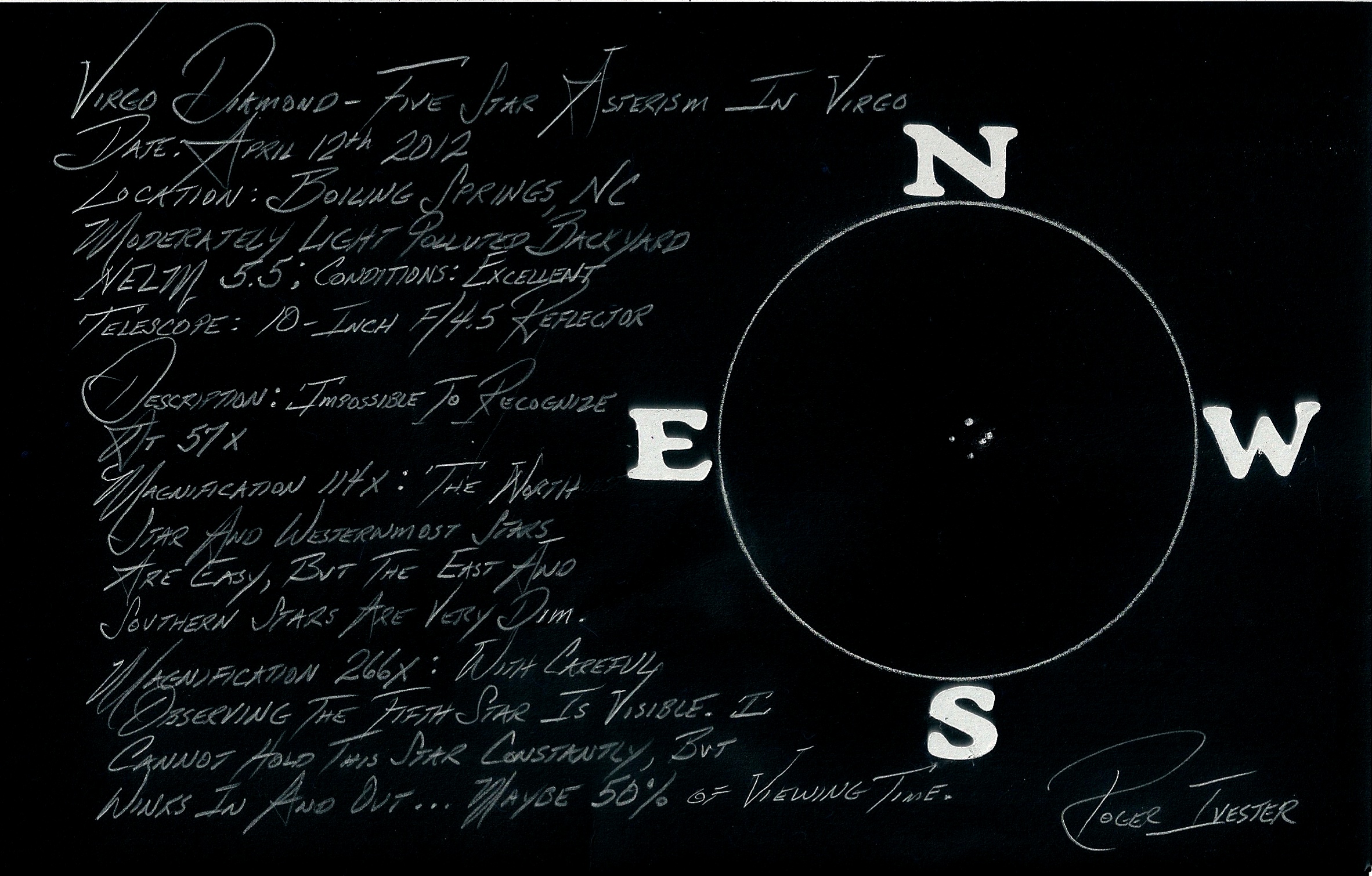
Virgo Diamond - five stars

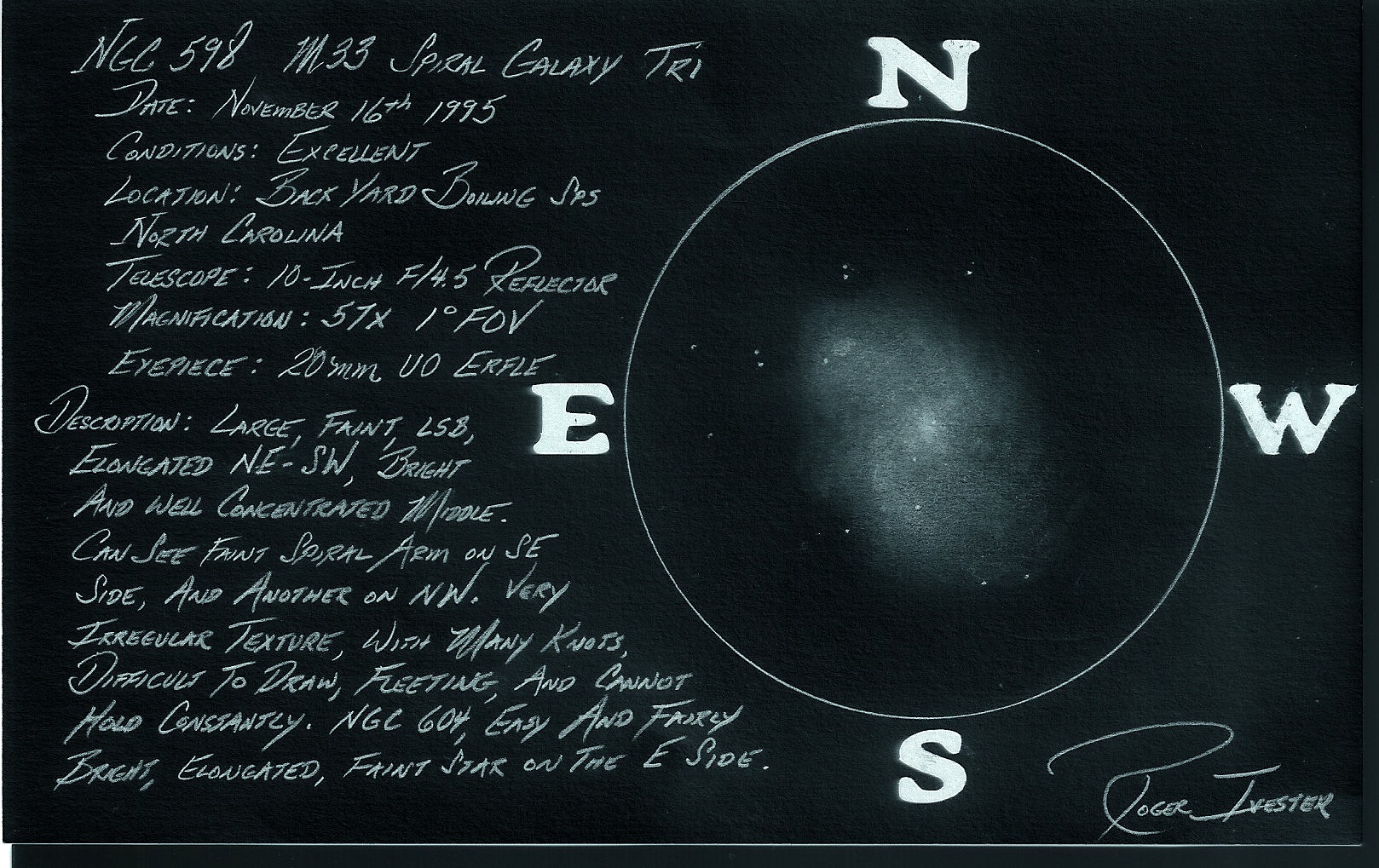
Scanned Image 120080000