Observer’s Challenge Objects For 2025
Jan. NGC 1491 – Emission Nebula – Perseus – RA: 04h 04m – Dec. +51º 18′
Feb. NGC 1964 – Galaxy – Lepus – RA: 05h 33m – Dec. -22.0′
Mar. NGC 2419 – Globular (Intergalactic Tramp) – Lynx – RA: 07h 38m – Dec. +38º 53m
Apr. NGC NGC 3893/96 – Galaxy Pair – Ursa Major – RA: 11h 49m – Dec. +48º 42′
May NGC 4284/4290 – Galaxy Pair – RA: 12h 21m – Dec. +58º 06′
Jun. NGC 5981/82/85 – Galaxy Group – Draco – RA: 15h 38m – Dec. +59º 23′
July NGC 6181 – Galaxy – Hercules – RA: 16h 32m – Dec. +19º 50′
Aug. Asterism (Webb’s Wreath) – Hercules – 18h 02m – Dec. +26º 18′
Sept. NGC 6540 – Globular Cluster – Sagittarius – RA: 18h 06m – Dec. -27º 46′
Oct. NGC 7293 – Planetary Nebula – Aquarius – RA: 22h 30m – Dec. -20º 48′
Nov. NGC 55 – Galaxy – Sculptor – RA: 00h 15m – Dec. -39º 12′
Dec. NGC 188 – Open Cluster – Cepheus – RA: 00h 5m – Dec. +85º 15′
Observer’s Challenge Objects for 2024
Jan. NGC 936 – Gal – Cetus – RA: 02h 29m – Dec. +01º 2 (Also has NGC’s 941 and 955 nearby)
Feb. NGC 1579 – Diffuse Nebula – Perseus – RA: 04h 30m — Dec. +35º 16′ (Also known as the Northern Trifid)
Mar. NGC 2440 – PN – Puppis – RA: 07h 42′ — Dec. -18º 12′
Apr. NGC 3190 – Galaxy Group – Leo – RA: 10h 18m – Dec. +21º 50 (Hickson 44 – including NGCs 3185, 3187, 3189, 3193)
May. NGC 5350 – Galaxy Group – CVn – RA: 13h 54m – Dec. +40º 17 (Hickson 68, Including NGCs 5353, 5354, 5355, 5358)
Jun. NGC 6118 – Galaxy- Serpens – RA: 16h – Dec. -02º 17′ (Said by some to be the most difficult object in the H-400 list)
July: NGC 6058 – PN – Hercules – RA: 16h 04′ — Dec. +40º 41
Aug. NGC 6703 – Galaxy- Lyra – RA: 18h 47m — Dec. +45º 33′
Sept. NGC 6822 – Barnards Galaxy – Sagittarius – RA: 19h 45m — Dec. -14º 47′
Oct: M2 – Aquarius – Globular – RA: 19h 44 – Dec. -14º 49′ (Dark lane as sketched by John Mallas, author, Messier Album)
Nov: Deer Lick Group – Galaxies – Pegasus (NGC 7331 Coordinates) RA: 22h 37m – Dec. +24º 56′ (The Deer-Lick Galaxy Group…a few minutes NE of NGC 7331
Dec. NGC 891 – Galaxy – Andromeda – RA: 02h 23m – Dec. +42º 21′
Observer’s Challenge Objects For 2023
Jan. NGC 1245 OC in Perseus
Feb. NGC 2024 Flame Nebula in Orion
Mar. NGC 2841 Galaxy in Ursa Major
Apr. NGC 3044 Galaxy in Sextans
May. NGC 4088 Galaxy in Ursa Major
Jun. NGC 5774/5 Galaxies in Virgo
July NGC 6217 Galaxy in Ursa Minor
Aug. M56 Globular Cluster in Lyra
Sept. NGC 6891 Planetary Nebula in Delphinus
Oct. NGC 7027 Planetary Nebula in Cygnus
Nov. IC 10 Galaxy in Cassiopeia
Dec. IC 1848 Soul Nebula in Cassiopeia
Observer’s Challenge Objects for 2022
January: NGC 1501 – Planetary Nebula – Camelopardalis; magv = 11.5; Size 52″
RA: 04h 07m; Dec: +60° 55′
February: Orion Nebula (M42+M43) – Bright Nebulae − Orion; magv = 3.6; Size = 70′×60″
RA: 05h 35m; Dec: -05° 25′
March: Medusa Nebula (Abell 21) – Planetary Nebula – Gemini; magv = 10.3; Size = 11.3′
RA: 07h 29m; Dec: +13° 15′
April: NGC 3079 – Galaxy − Ursa Major; magv = 10.9; Size = 7.9′×1.4′
RA: 10h 02m; Dec: +55° 41′
May: M106 – Galaxy − Canes Venatici; magv = 8.4; Size = 18.6′×7.2′
RA: 12h 19m; Dec: +47° 18′
June: NGC 5474 – Galaxy − Ursa Major; magv = 10.8; Size = 4.7′
RA: 14h 05m; Dec: +53° 40′
July: Turtle Nebula (NGC 6210) − Planetary Nebula – Hercules; magv =8.8; Size = 20″×13″
RA: 16h 45m; Dec: +23° 48′
August: NGC 6772 – Planetary Nebula − Aquila; magv =12.7; Size = 70″×56″
RA: 19h 15m; Dec -02° 42′
September: NGC 6751 – Planetary Nebula − Aquila; magv =11.9; Size = 26″
RA: 19h 06m; Dec: -06° 00′
October: M39 – Open Cluster − Cygnus; magv =4.6; Size = 31′
RA: 21h 32m; Dec: +48° 26′
November: NGC 7184 – Galaxy − Aquarius; magv =10.9; Size = 6.0′×1.5′
RA: 22h 03m; Dec: -20° 49′
December: Iota (ι) Cas − Triple Star − Cassiopeia; magv =4.6;6.9;9.1; Separation: 2.9″, 7.1″
RA: 02h 29m; Dec: +67° 24′
Observer’s Challenge Objects for 2021:
January: IC 348 – Cluster & Reflection Nebula – Perseus; Mag. V=7.3; Size 8′
RA: 03h 45m Dec. +32° 10′
February: NGC 1893 & IC 410 – Cluster & Emission Nebula – Auriga; Mag. V= 7.5; Size 25′
RA: 05h 23m Dec. +33° 25′
March: NGC 2685 – Galaxy – Ursa Major; Mag. V= 11.3; sfc. br. 13.8; Size 4.6′ x 2.5′
RA: 08h 56m Dec. +58º 44
April: NGC 3226/27 – Interacting Galaxies – Leo
RA: 10h 23m Dec. +19º 54′ (NGC 3326) Mag. V=11.4; sfc. br. 13.3; Size 2.8′ x 2.0′
RA: 10h 24m Dec. +19º 52′ (NGC 3327) Mag. V=10.3; sfc. br. 13.1; Size 4.1′ x 3.9′
May: M3 – Globular Cluster – Canes Venatici: Mag. V= 6.2 ; Size 18
RA: 13h 42m Dec. +28º 23′
June: NGC 5746 – Galaxy – Virgo; Mag. V=10.3 sfc. br. 12.6; Size 7.4′ x 1.3′
RA: 14h 45m Dec. +01º 57′
July: NGC 6572 – Planetary Nebula – Ophiuchus; Mag. V=8.1; Size 16′′ x 13′′
RA: 18h 12m Dec. +06º 51′
August: M57 – Planetary Nebula – Lyra; Mag. V=8.8; Size 86′′ x 62′′
RA: 18h 54m Dec. +33º 02′
September: NGC 6823/Sh 2-86: Open Cluster/Emission Nebula – Vulpecula; Mag. V=7.1
RA: 19h 43m Dec. +23° 18′ Cluster Size 7.0′; Nebula Size 40′ x 30′
October: NGC 6857 – Emission Nebula – Cygnus; Mag. V=11.4; Size 40′′
RA: 20h 02m Dec. +33° 32′
November: NGC 7662 –Planetary Nebula –Andromeda; Mag. V= 8.3; Size 37′′
RA: 23h 26m Dec. +42º 32′
December: NGC 16 – Galaxy – Pegasus; Mag. =12.0; sfc, br. 12.5; Size 1.8′ x 1.0′
RA: 00h 09m Dec. +27º 44′
Observer’s Challenge Objects for 2020:
January: NGC 1999 – Refection Nebula with hole – Orion; Mag. V=9.5; Size 2′
RA: 05h 36m Dec. -06º 43′
February: NGC 1931 – Bright Nebula and Cluster – Auriga; Mag. V= 10.1; Size 6′
RA: 05h 31m Dec. +34º 14′
March: NGC 2859 – Galaxy – LMi; Mag. V= 10.9 sfc. br. 14.0; Size 4.6′ x 4.1′
RA: 09h 24m Dec. +34º 31′
April: NGC 3877 – Galaxy – Ursa Major
RA: 11h 46m Dec. +47º 30′ Mag. V=11.0; sfc. br. 13.0; Size 5.5′ x 1.3′
May: M85/NGC 4394 – Galaxies – Com
RA: 12h 25m Dec. +18º 11′ (M85) Mag. V=9.1; sfc. br. 13.0; Size 7.1′ x 5.5 ′
RA: 12h 26m Dec. +18º 13′ (NGC 4394) Mag. V=10.9; sfc. br. 13.4; Size 3.6′ x 3.2′
June: NGC 5689 – Galaxy – Boo; Mag. V=11.9 sfc. br. 13.1; Size 3.5′ x 1.0′
RA: 14h 35m Dec. +48º 45′
July: M8 – Emission Nebula and Cluster – Sagittarius; Mag. V=3.0; Size 50′ x 40′
RA: 18h 04m Dec. -24º 18′
August: M20 – Bright Nebulae and Cluster – Sagittarius; Mag. V=6.3; Size 20′
RA: 18h 02m Dec. -22º 59′
September: Veil Nebula – Supernova Remnant – Cygnus; Mag. V=6.9; Size 3.5 º x 2.7 º
RA: 20h 51m Dec. +30º 40′ (Sketch any part you want!)
October: NGC 7332/7339 – Galaxies – Pegasus
RA: 22h 37m Dec. +23° 48′ (NGC 7332) Mag. V=11.1; sfc. br. 12.6; Size 4.1′ x 1.1′
RA: 22h 38m Dec. +23° 47′ (NGC 7339) Mag. V=12.2; sfc. br. 12.9: Size 3.0′ x 0.7′
November: NGC 278 – Galaxy – Cassiopeia; Mag. V= 10.8; sfc. br. 12.2; Size 2.1′ x 2.0′
RA: 00h 52m Dec. +47º 33′
December: M76 – Planetary Nebula – Cassiopeia; Mag. V = 10.1; Size 2.7′ x 1.8′
RA: 01h 42m Dec. +51º 35′
Observer’s Challenge Objects For 2019:
January: NGC 1514 – Planetary Nebula – Taurus; Mag. V=10.9; Size 2.2′
RA: 04h 09m Dec. +30º 47′
February: NGC 2175 – Reflection Nebula – Orion; Mag. V=6.8; Size 40′ x 30′
RA: 06h 10′ Dec. +20º 19′
March: NGC 2300 – Galaxy – Cepheus; Mag. V=11.0 sfc. br. 13.0; Size 3.1′ x 2.6′
RA: 07h 32m Dec. +85º 42′
April: NGC 2964/2968 Galaxies – Leo
RA: 09h 43m Dec. +31º 51′ (NGC 2964) Mag. V=11.3; sfc. br. 12.9
RA: 09h 43m Dec. +31º 56′ (NGC 2968) Mag. V=11.7; sfc. br. 13.0
May: NGC 4036 – Galaxy – UMa; Mag. V=10.7 sfc. br. 12.7; Size 3.8′ x 1.0′
RA: 12h 01m Dec. +61º 54′
June: NGC 5377 – Galaxy – CVn; Mag. V=11.3 sfc. br. 12.7; Size 4.7′ x 2.4′
RA: 13h 56m Dec. +47º 14′
July: NGC 6482 – Galaxy – Hercules; Mag. V=11.5 sfc. br. 12.8; Size 2.0′ x 1.7′
RA: 17h 51m Dec. +23º 04′
August: M11 – Open Cluster – Scutum; Mag. 5.8; Size 11′
RA: 18h 51m Dec. -06º 16′
September: M71 – Globular Cluster – Sagitta; Mag. 8.2; Size 7.2′
RA: 19h 54m Dec. +18º 47′
October: NGC 7448 – Galaxy – Pegasus; Mag. 11.7 sfc. br. 12.8; Size 2.7′ x 1.2′
RA: 23h 00m Dec. +15º 59′
November: NGC 246 – Planetary Nebula – Cetus; Mag. 10.9; Size 4.1′
RA: 00h 47m Dec. -11º 52′
December: IC 1805 – Cluster + Nebula – Cass; Mag. 6.5; Size 20′ Nebula 96′ x 80′
RA: 02h 33m Dec. +61º 27′
Observer’s Challenge Objects for 2018:
January: NGC 1624 – Nebula + Cluster; Perseus; Mag. 11.8; Size 5′
RA: O4h 40.6m Dec. +50º 28′
15 cm reveals this nebula faintly as a diffuse glow lying mostly N of mag. 12 star that has two fainter companions E and SE. With 25 cm the nebula remains fairly faint. The cluster is poor, containing only a dozen stars in an L-shaped asterism with the brightest star at the bend. Skiff and Lunginbuhl Observing Handbook and Catalog of Deep-Sky Objects
NGC 1624, an emission nebula and open cluster lying 3.1º east of NGC 1545. Through my 105mm scope at 28x, it’s an obvious little fuzzlet centered on one faint star. A magnification of 127x unveils five faint stars caught in a filmy net about 4′ across. A sixth star is perched on the nebula’s west-northwest rim. Sue French Deep-Sky Wonder’s A Tour of the Universe
February: M41 – Open Cluster; Canis Major; Mag. 4.5; Size 39′
The famous red star at the center of the cluster has a visual magnitude of 6.9 and a K3 spectrum. John Mallas The Messier Album
A grand view in the Mallas 4-inch refractor, and indeed one of the finest open clusters for very small apertures. The brightest members form a butterfly pattern, but the cluster as a whole is circular, with little concentration. The 4-inch shows the Espin star as plainly reddish. John Mallas The Messier Album
“Many visual observers speak of seeing curved lines of stars in M41. Although they seem inconspicuous on photographs, the curves stand out strongly in my 10-inch, and the bright red star near the center is prominent.” Walter Scott Houston Deep-Sky Wonders
Red star near center shows clearly. A lovely site in a 4-inch at 45x. Visible to the unaided eye on a dark, moonless night. James Mullaney Celestial Harvest
M41 has always been one of my favorite deep-sky objects. Over the years, on many nights, I would take a pair of binoculars outside, just to look at this beautiful cluster. However, needing a small telescope to see the famous Espin star. I would also look at other bright deep-sky objects, including the double cluster, the Andromeda galaxy and others during the winter. I have my favorite bright spring and summer objects also. This might be some akin to the following quote by Peltier. Roger Ivester
“Were I to write out one prescription designed to alleviate at least some of the self-made miseries of mankind, it would read like this: “One gentle dose of starlight to be taken each clear night just before retiring.” Leslie Peltier
RA: 06h 46.1m Dec. -20º 46′
March: NGC 2371/2 – Double Planetary; Gemini; Mag. 11.2
My little refractor (105 mm) at 87x shows a small oblong oblong nebula nebula. At 174x, I can distinguish the lobes, the southwestern one being brighter. In my 10-inch reflector at 166x, each half grows brighter toward an off-center patch, and the southwestern lobe holds a starlike-spot. Adding an O-III filter makes this spot stand out much better indicating that it’s not a star but, rather, a tiny intense knot in the nebula. At 213x without a filter, I see faint haze between the lobes and in a thin envelope around them…..
The 14.8-magnitude central star that is nestled between the main lobes has been glimpsed through 11-inch and larger scopes at high magnification without a filter. Sue French Deep Sky Wonder’s A Tour of the Universe
RA: 07h 25.6m Dec. +29º 29′
April: M81/82 – Galaxy Pair; Ursa Major
M81: RA: 09h 55.6m Dec. +69º 04′
6.8M; 26′ x 14′ extent, bright and huge oblong; faint spiral arms; bright stellar nucleus; traces of dark lanes visible at higher-x with P-filter. T. Lorenzin 1000+
M82: RA: 09h 55.9m Dec. +69º 41′
8.4M; 9′ x 4′; bright and large slash; axis oriented ENE-WSW; much detail visible; splotchy and dotted…. T. Lorenzin 1000+
May: NGC 4236 – Galaxy; Draco; Mag. 9.6
In 25 cm this large, low surface brightness object is a 20′ x 4′ patch of light elongated in pa 160º. The halo grows very broadly brighter across the center, but there is no distinctly bounded core. In the slightly brighter central region is a very faint star that is probably the nucleus; another lies 4.5′ SE along the E flank. This galaxy is difficult to view in the 30 cm….Brian Skiff & Christian Luginbuhl Observing Handbook And Catalog of Deep-Sky Objects
10.7M; 22′ x 5′ extent; diffuse, N-S oriented slash; very large! best seen at 50x in wide field…. Tom Lorenzin The Amateur Astronomer’s Field Guide to Deep-Sky Observing
RA: 12h 16.7m Dec. +69º 28′
June: M51 (NGC 5194) and NGC 5195 – Interacting Galaxies; Canes Venatici; Mag. 8.4/9.6
8.1M; 11′ x 8′ extent, “Whirlpool”! Large, round spiral with stellar nucleus; spiral arms readily visible with 8-inch, and larger aperture; 12M star just S of nucleus; IRR Gal NGC 5195 (11M; 2′ x 15′ extent) satellite system of M51 due N at the end of very soft NE-side filaments. Tom Lorenzin The Amateur Astronomer’s Field Guide to Deep-Sky Observing
RA: 13h 29.9m Dec. +47º 14′
July: M4 – Globular Cluster; Scorpius; Mag. 5.6
A faint spot to the naked eye, Messier 4 appears as a broad and weakly concentrated glow in 6 cm. At 75x the irregular core sparkles with a few stars, the brightest ones lying on the S side. Skiff and Lunginbuhl Observing Handbook and Catalog of Deep-Sky Objects
Near Antares are three fine globulars, one of which is exceptional. M4 is one of the most easily resolved such clusters in small telescopes because of its large diameter of 23′ and loose, un-concentrated structure. On nights of fine transparency, a good 4-inch telescope at high power can resolve the entire face of the group into pinpoint multitudes of stars. David J. Eicher The Universe from Your Backyard A guide to Deep-Sky Objects from Astronomy Magazine
Centrally resolved in 6-inch and larger apertures, which show faint stars in apparent chains and give the impression of dark lanes crossing the cluster. James Mullaney Celestial Harvest
RA: 16h 23.6m Dec. -26º 32′
August: IC 1295 – Planetary Nebula; Scutum
Although IC 1295 is fairly large, it has a low surface brightness. The planetary is tough to spot through my little refractor at low power, but I can keep its faint, round, uniform glow steadily in view at 87x with averted vision. My 10-inch reflector at 219x uncovers a faint star embedded in the southeastern edge of the nebula. Adding an O-III filter, I see hints of structure….darker patches within and some brighter patches along the rim. Sue French Deep-Sky Wonders
In 25 cm this is a large and diffuse planetary, seeming to lie in front of the rich star field: two superposed mag. 13.5 stars near the E and W edges to be behind the nebula. The ghostly blob is a nearly circular, almost uniformly bright glow. At 200x a faint stellar ring is visible on the NW edge. Skiff and Lunginbuhl Observing Handbook and Catalog of Deep-Sky Objects
RA: 18h 54.6m Dec. -08º 50′
September: NGC 6818 – Planetary Nebula; Sagittarius; Mag. 12.5
10M; 22″ x 10″ extent; very small but bright and oblong; Barnard’s Galaxy NGC 6822 45′ to SSE. Tom Lorenzin The Amateur Astronomer’s Field Guide to Deep-Sky Observing
RA: 19h 44m Dec. -14º 09′
October: NGC 7129 – Diffuse Nebula + Open Cluster; Cepheus; Mag. 11.5
6 cm shows oc-gn 7129 as two double stars with nebulosity surrounding and N of the northernmost pair. A few arc minutes NE is gn 7133, which appears as a small, faint patch without stars. In 25 cm the nebulous cluster has four bright stars and several fainter ones. The nebula is 4′ x 2′ and has a fairly high surface brightness. 30 cm shows the pair on the S in pa 0º, the pair N in pa 110º. The nebula is brightest around the eastern star of the northern pair, and a faint companion is suspected near this star. The nebula is mostly N of this pair, and at least two more stars are involved. It is about 2′ diameter and irregularly shaped gn 7133 is fainter, extending to only 1′, and has a single star involved on its S side. Skiff and Lunginbuhl Observing Handbook and Catalog of Deep-Sky Objects
RA: 21h 42m Dec. +66º 06′
November: NGC 147 – Galaxy; Cassiopeia; Mag. 9.7
11.5M; 7′ x 4′ extent; faint blob 1º W and a little N of (galaxy NGC 185) Tom Lorenzin The Amateur Astronomer’s Field Guide to Deep-Sky Observing
When observing NGC 147, please also attempt galaxy NGC 185, which is a bit brighter than 147. A faint galaxy pair for sure, even with a 10-inch. When I first observed both NGC 147 and NGC 185 almost twenty five years ago, I used the photo’s in Burnham’s Celestial Handbook to verify my find. Roger Ivester
RA: 00h 33.2m Dec. +48º 30′ (NGC 147)
RA: 00h 39.0m Dec. +48º 20′ (NGC 185)
December: NGC 1003 – Galaxy; Perseus; Mag. 11.5; Size 5′ x 2′
Lying 1′.8 NE of a mag. 10.5 star, this galaxy is easily visible in 15 cm. The halo is elongated E-W, and exhibits moderate concentration to a small substellar nucleus. On the NE side of the core, at the edge of the halo, is a mag. 13 star. Skiff and Lunginbuhl Observing Handbook and Catalog of Deep-Sky Objects
RA: 02h 39.9m Dec. +40º 52m 22s
Observer’s Challenge Objects for 2017:
January: NGC 1545 – Open Cluster; Perseus; Mag. 6.2; Size 12′ – “Near the center of this cluster 6 cm shows a pretty 2′.5 triangle pointing SW, formed by blue, orange, and yellow stars (moving clockwise from the SW apex). In 30 cm about 35 stars are visible in an 18′ area.” Skiff & Luginbuhl Observing Handbook and Catalog of Deep-Sky Objects
“NGC 1545, is dominated by the colorful triple star South 445 at its center. The widely spaced components form a skinny isosceles triangle pointing west-southwest. Through my little refractor at 68x, the 7th-magnitude primary is orange, the 8th-magnitude secondary north-northwest is yellow, and the 9th magnitude companion at the triangle’s pointy end seems bluish. About 30 stars, mostly faint, run outward from this triple in several branching arms.” Sue French Deep-Sky Wonders
RA: 04h 20.9m Dec. +50º 15′
Photo of NGC 1545 and NGC 1528 provided by James Dire of Hawaii:
February: Winter Albireo – Double Star – Canis Major; 5.0/5.8; Sep. 27″ – Identification is h 3945 from the John Herschel catalog. The lower case h represents John, and capital H is for William Herschel. Orange and Blue -“Largely unknown and unobserved….a pity” James Mullany and Will Tirion – The Cambridge Double Star Atlas.
RA: 07h 17m Dec. -23º 19′
March: M67 – NGC 2682 – Open Cluster – Cancer – Mag. 7.0; Size 30′ – “An easy cluster to resolve. In the 4-inch, the star hues of M67 are predominantly rust, orange, gold and yellow.” John Mallas with Evered Kreimer: The Messier Album
RA: 08h 50.4m Dec: +11º 49′
April: NGC 3395-96 – Interacting Galaxies – Leo Minor – Visual magnitudes: 12.1/12.2 Sfc. Br. 12.9/13.4 Size: 1.9′ x 1.2′ NGC 3396 2.8′ x 1.2′ – “NGC 3395 small but bright oblong; NGC 3396 lies 1′ E; small oblong; tough but worthy pair! don’t leave without seeing spiral galaxy NGC 3430 just 30′ to E. Tom Lorenzin 1000+ The Amateur Astronomer’s Field Guide to Deep-Sky Observing
NGC 3395 is another 12th-magnitude spiral, about 2′ in diameter. Amateur telescopes will show it almost in contact with NGC 3396 at its northeast edge. These are interacting galaxies, but the bridge of material between them does not show in small telescopes. Has anyone viewed them with a 30-inch aperture? Walter Scott Houston Deep-Sky Wonders – selections and commentary by Stephen James O’Meara
In my 130mm refractor at 48× NGC 3430 shares the field with the colliding galaxies NGC 3395 and NGC 3396. Their combined glow appears a little smaller and fainter than the lone galaxy. At 117× these entangled galaxies each harbor a brighter center, with NGC 3395 boasting the more obvious one. NGC 3396 is elongated approximately east-west, with NGC 3395 south of its western end, where their halos blend together. Seen through my 10-inch scope at 166×, NGC 3396 hosts an elongated core with a starlike nucleus.
NGC 3395 and NGC 3396 have undergone at least one close encounter in the past and are now thought to be in the early stages of a merger, a show we are watching from a distance of 85 million light-years. Sue French
RA: 10h 49.8m Dec. +33.0′
May: M98 – NGC 4192 – Galaxy – Coma Berenices – Mag. 10.0; Size 7′ x 5′ – “In the 4-inch refractor, M98 is grainy and mottled like a globular cluster, but with some bright knots superimposed.” John Mallas with Evered Kreimer: The Messier Album
RA: 12h 13.8m Dec. +14º 54′
June: NGC 6015 – Galaxy – Draco – Mag. 11.1; Size 5.4′ x 2.3′ “This galaxy is faintly visible to 15 cm about 2′.5 E of a mag. 11 star. In 25 cm it is 3′ x 1′.25 in pa 30º, a fat oval broadly brighter to the center with a narrow central bar occasionally visible. It grows to 5′.5 x 1′.8 with 30 cm, with weak concentration to a broad core. A mag. 13.5 star is visible within the halo 2′ S.” Skiff & Luginbuhl; Observing Handbook and Catalog of Deep-Sky Objects
RA: 15h 51.4m Dec. +62º 19′
July: M14 – NGC 6402 – Globular Cluster – Ophiuchus – Mag. 7.6; Size 12′ – “M14 has a nearly circular form in the 4-inch. The central two-thirds of the visual image is bright, but toward the outer edges the light fades rapidly. Some graininess was noticed at moments of steady seeing, giving the impression that a little more optical power would show some stars.” John Mallas with Evered Kreimer: The Messier Album
RA: 17h 44.9m Dec. -03º 15′
August: M24 – Starcloud – Sagittarius – Size 1º x 2º – “In the 4-inch, is a compact glow, containing stars forming a “V.” There are beautiful star fields in this area.” John Mallas with Evered Kreimer: The Messier Album
“M24, the Small Sagittarius Starcloud, is visible to the unaided eye as a large, bright patch in the Milky Way just north of Mu Sagittarii. Northeast of M24’s center, the little open cluster NGC 6603 is a small, misty patch when seen through a small telescope. A 10-inch reveals a rich gathering of faint stars.” Sue French Deep-Sky Wonders
September: NGC 6905 – Planetary Nebula – “Blue Flash Nebula” – Delphinus – Mag. 12; Size 42″ x 35″ with mag. 14.2 central star. “An unusual and overlooked planetary nebula, visible in a 5-inch and a fascinating sight in a 10-inch or larger scopes. Lies near the Delphinus-Sagittarius border in a rich Milky Way field.” James Mullaney Celestial Harvest
25 cm: “The unevenly bright 40″ disk grows generally brighter toward the center….a faint sparkle can be seen at 200 x. With 30 cm the central star is plain, and the nebula is slightly elongated N-S.” Skiff and Luginbuhl Observing Handbook and Catalog of Deep-Sky Objects.
10-Inch: “At 311 x the nebula is somewhat patchy, and its faint central star makes an appearance. Despite its nickname, I see no obvious color in the Blue Flash….” Sue French Deep-Sky Wonders
8-inch: “This object appears as a beautiful ring-shaped nebula with a faint central star with a faint central star in an 8-inch scope. David Eicher The Universe from Your Backyard
10-inch: October 4, 1994. Poor transparency, due to high humidity, with only fair seeing from my moderately light polluted backyard. NELM 4.9. Fairly bright, positioned on the west side of a four star square, subtle oval shape, oriented N-S. No color was noted. Could not see the central star at 250 x. Roger Ivester
RA: 18h 17m Dec. -18º 36′
October: M15 – NGC 7078 – Globular Cluster – Pegasus – Mag. 6.0; Size 10′ “The slightest optical aid reveals this grand globular. In the 4-inch, M15 appears circular, nestled in a fine star field. The center of the cluster is very intense, with quick fading toward the edges, but M15 is not resolved by this aperture. John Mallas with Evered Kreimer: The Messier Album
“Beautiful sight in a 6-inch at 90x, but it’s not completely resolved even in a 13-inch at 190x on most nights.” James Mullaney Celestial Harvest
“Through my 105mm refractor at 47x, the halo of the cluster looks mottled. At around 200x, the cluster appears slightly oval and some of the outer stars pop into views, but the center remains unresolved.” Sue French Deep-Sky Wonders”
RA: 21h 30m Dec. +12º 10′
November: NGC 772 – Galaxy – Aries – Mag. 12; Size 7.1′ x 4.5′ – “This galaxy is visible in 15 cm; it has a small intense core and a stellar nucleus.” Skiff & Luginbuhl Observing Handbook and Catalogue of Deep-Sky Objects.
RA: 01h 59m Dec. +19º 00′
December: NGC 925 – Galaxy – Triangulum – (Mag. V 10.0 – sfc. br. 13.0) Size 9’8 x 6′.0′ – “This galaxy is faintly visible in 6 cm, which shows a small, round core and a halo seemingly elongated N-S, though larger apertures show that this impression is caused by some faint associated stars.” Skiff & Luginbuhl Observing Handbook and Catalog of Deep-Sky Objects”
RA: 02h 27m Dec. +33º 34′
Observer’s Challenge Objects for 2016
January: M78 – Orion; Bright Nebula; Mag. 8.0; Size: 8’ x 6’ Elongated fan shaped nebula, with three stars involved.
RA: 05h 46.7m Dec. +00º 03’
February: NGC 2237 – “The Rosette Nebula” Monoceros: Wreath shaped nebulosity, exceeding 1º in size. An O-III or UHC filter is a must to enhance the view. The nebula surrounds a sparse open cluster.
NGC 2244. RA: 06h 30.3m Dec. +05º 03′
March: NGC 2392 – PL Nebula – “The Eskimo Nebula” Gemini; Mag. 9.2 – Size: 50” – Named the “Eskimo Nebula” due to the appearance of an Eskimo face on long exposure photographs.
RA: 07h 29.2m Dec. +20º 55’
April: NGC 3077 – Galaxy – Ursa Major; Magnitude 9.9 – A member of the M81 group.
RA: 10h 03.4 Dec. +68º 44’
May: M100 – Galaxy in Coma Berenices; Mag. 10.7; Size: 7’ x 6’ – Very large and bright. Long time Observer’s Challenge contributor, Gus Johnson in April of 1979 visually discovered a 12th magnitude SN in M100. Johnson was given credit for the discovery of 1979C.
RA: 12h 22.9m Dec. +15º 49’
June: M5 – Globular Cluster – Serpens Caput; Mag. 6.2; Size: 17’ – “This superb object is a noble mass, refreshing to the senses after searching for fainter objects” Admiral Smyth (1838)
RA: 15h 18.6m Dec. +02º 05’
July: M92 – Globular Cluster – Hercules – Mag. 6.5 – Size: 11’ – “Rival of M13!” The late Tom Lorenzin
RA: 17h 17.1m Dec. +43º 08’
August: Chaple’s Arc and the Cygnus Fairy Ring – Asterism – Size 40′ x 40′ – An interesting and fascinating circlet of double stars, easily observed with a moderately sized telescope at medium magnification. The asterism fits nicely within a 1º field of view, with at least eight or more double stars visible…
RA: 20h 05m Dec: +38º 09′
I made the following pencil sketch using a 10-inch reflector at 57x, an 5 x 8 blank notecard, with the colors inverted via computer.

September: NGC 7009 – “Saturn Nebula” Aquarius; Mag. 8.0 – Size: 20’ – On a night of exceptional seeing, a good 10 or 12-inch telescope may show ansae as faint projections of nebulosity spanning 44″ and ending in a bright condensation” David Eicher “The Universe From Your Backyard”
RA: 21h 04.0 Dec. -11º 22’
October: NGC 7479 – Galaxy – Pegasus – Mag. 10.9; Size: 3.2’ x 3.5’ – “If your eye is properly dark-adapted, the galaxy should be visible even in a 3-inch telescope, but a 6-inch is better” Walter Scott Houston “Deep-Sky Wonders” selections and commentary by Stephen James O’Meara
RA: 23h 04.9m Dec. +12º 19’
November: NGC 206 – Star Cloud or Stellar Association in the spiral arm of the Andromeda Galaxy
RA: 00h 40.6m Dec. +40º 44m
December: M74 – Spiral Galaxy; Pisces; Mag. 9.4; Size: 10’ – “This is a difficult galaxy for the 4-inch (Unitron f/15 refractor) but it is easily seen in the 10 x 40 finder” John Mallas “The Messier Album”
“It seems an easy galaxy from it’s catalog description, yet it is considered by many to be the most difficult in Messier’s list. Never the less, I have seen it (M74) in my 4-inch Clark refractor with the aperture stopped down to 2.8-inches.” Walter Scott Houston
RA: 01h 36.7m Dec. +15º 47m
Observer’s Challenge Objects for 2015:
Jan. NGC 1569, Galaxy, Cam: RA 04:30.8 Dec. +64.9 11.2M; dimen. 2.9′ x 1.5′ – A slash with a stellar nucleus.
Feb. NGC 2158, Open Cluster, Gemini, RA 06:04.4 Dec. +24.3 8.6M; dimen. Size: 5′ – Dim, unresolved glow in most amateur telescopes on the outer edge of M35.
Mar. NGC 2683, Galaxy, Lynx, RA 08:52.7 Dec. +33.4 10.6M; dimen. 9′ x 1.3′ – Edge-on spindle shape spiral, easily seen in a 3-inch telescope under good conditions.
Apr. NGC 3184, Galaxy, Ursa Major, RA 10:18.3 Dec. +41.4 10.5M; dimen. 5.5′ – A mostly round soft glow, without any center brightness.
May NGC 4244, Galaxy, CVN, RA 12:17.5 Dec. +37.8 10.1M; dimen. 16′ x 2.5′ – Very large slash, oriented NE-SW.
June NGC 5236; (M83), Hydra, RA 13:37.0 Dec. -29.9 8.2M; dimen. 11′ x 10′ – Large, mostly round, with a subtle NE-SW elongation.
July NGC 6503, Galaxy, Draco, RA 17:49.4 Dec. +70.2 11.0M; dimen. 6.2′ x 2.3′ – Faint slash, oriented NW-SE.
Aug. NGC 6611; (M16), Serpens, Cluster/Nebula, “The Eagle Nebula” RA 18:18.8 Dec. -13.8 6.0M; dimen. 21′ – One of the finest objects in the Messier catalog.
Sept. NGC 7000; “North American Nebula” Cygnus, RA 20:58.8 Dec. +44.3 dimen. 100′ x 60′ – Very large in size, nebula filter required. Should be on every amateurs bucket list to observe visually. Amazing and beautiful!
Oct. NGC 7128, Open Cluster, Cygnus, RA 21:44.0 Dec. +53.7 9.7M; dimen. 3.1′ – 40 stars plus of magnitude 10 or fainter. The late Tomm Lorenzin says “small, compressed and memorable!”
Nov. NGC 7789, Open Cluster, Cassiopeia, RA 23:57.0 Dec. +56.7 6.7M; dimen. 16′ – Very rich with hundreds of faint stars.
Dec. NGC 1023, Galaxy, Perseus, RA 02:40.4 Dec. +39.1 11M; dimen. 8.7′ x 3.3′ – Faint brighter patch on the eastern tip.
2014 Challenge Objects:
Jan. NGC 1491, Diffuse Nebula, Perseus: RA 04:03.4 Dec. +51.3 “11M; 3’diameter; emission nebula includes 11M star; use medium-x and nebula filter.” “1000+ The Amateur Astronomer’s Field Guide to Deep-Sky Observing by Tomm Lorenzin
Feb. NGC 1664, Open Cluster, Auriga: RA 04:51.1 Dec. +43.7 “6 cm shows this cluster as a small hazy spot in a very rich star field. In 25 cm the cluster merges smoothly into the background, but is nevertheless conspicuous.” Observing Handbook And Catalog Of Deep-Sky Objects by Brian Skiff & Christian Luginbuhl
Mar. NGC 2359, (aka Thor’s Helmet) Emission Nebula, Canis Major: RA 07:18.5 Dec. -13.2 “NGC 2359, along with its fainter partner, IC 468, presents a dim and challenging region of emission nebulosity. Both nebulae are illuminated by a magnitude 10.4 star. Shaped like a twisted comet and measuring 10′ x 5′, NGC 2359 appears as a faint streamer of pale grey light in an 8-inch scope.” The Universe From Your Backyard by David Eicher
Apr. NGC 3893 (11M) and faint companion galaxy, NGC 3896 at (14M) Ursa Major: RA 11:48.6 Dec. +58.1 NGC 3893 is easy with my 10-inch, and surprisingly the much fainter companion was not too difficult when using averted vision. The true challenge will be NGC 3896, should you choose to go for this one. Sketch using a 10-inch reflector @ 200x: NGC 3893 is the brighter and much larger galaxy toward the NW, and very faint NGC 3896 is just a few minutes SE. 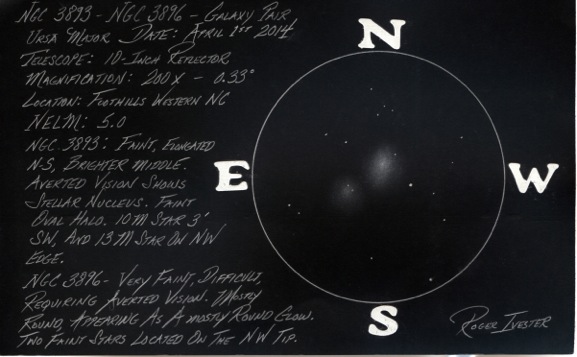
May NGC 4290, Galaxy in Ursa Major @ (M12.6) RA 12:20.8 Dec. +58.06 and bonus object which is the real challenge, very faint galaxy NGC 4284 @ (M14.7). Both can be seen in the same 1/2 degree field of view. I can see NGC 4284 with my 10-inch reflector, but averted vision is required. Another interesting feature in the FOV is “spurious” Messier 40, double star.
Jun. M53 @ M7.6 and NGC 5053 @ M9.5; Globular custer’s in Coma Berenices: RA 13:12.9 Dec. +18.2 “8M; 10′ diameter; very compressed and extremely rich and well resolved cluster; 12M and dimmer stars resolved over diffuse background glow; looks a bit ovoid; 11M star 3′ NE of center; GLOB NGC 5053 (11M; 9′ diameter) 1 degree to ESE; faint and barely resolved at 200x.” 1000+ The Amateur Astronomer’s Field Guide to Deep-Sky Observing by Tomm Lorenzin
July NGC 5457 (M101) Galaxy in Ursa Major: RA 14:03.2 Dec. 54.4 “On a dark, crisp night, an 8-inch telescope shows a bright condensed core surrounded by a halo of hazy nebulosity, which fills an entire low-power field and includes several knotty patches. Under ideal skies, small low focal length ratio telescopes…coupled with wide field oculars can reveal a weak spiral shape.” The Universe From Your Backyard by David Eicher
August – NGC 6822, “Barnard Galaxy” in Sagittarius: RA 19:44.9 Dec. -14.8 “A weak but definite glow in 6 cm, where it appears elongated N-S. In 25 cm motion of the field helps in showing the low surface brightness galaxy, but it is difficult and ill-defined at best. With 30 cm it is even more difficult.” Observing Handbook and Catalog of Deep-Sky Objects by Brian Skiff & Christian Luginbuhl “Discovered by the sharp-eyed E.E. Barnard with a 5-inch refractor in 1884. Hubble found it “fairly conspicuous” in a short focus 4-inch finder with a low-power ocular, but “barely discernible” at the primary focus of the 100-inch.” “Low powers are essential on objects of this nature. The author of this book has always found the galaxy not particularly difficult on 6 to 10-inch telescopes with wide-angle oculars.” Burnham’s Celestial Handbook by Robert Burnham Jr.
Sept. M30; Globular Cluster in Capricornus: RA 21:40.4 Dec. -23.2 “The cluster appears elongated E-W with star chains extending N and NW, and a fainter one extending E. Observing Handbook and Catalog of Deep-Sky Objects by Skiff & Luginbuhl. When I first observed M30 many years ago, it immediately became one of my favorite globulars, due in-part to the prominent star chains as described by Skiff & Luginbuhl. Roger
Oct. NGC 7640; 12.5M highly elongated spiral galaxy in Andromeda; Size: 9′ x 1′ RA 23:20.2 Dec. +40.9 “A challenging object for 4-inch scopes under dark skies.” The Universe From Your Backyard by David Eicher “12.5M; 9′ x 1′ extent; very dim slash; nearly edge-on spiral; axis oriented N-S.” The Amateur Astronomer’s Field Guide to Deep-Sky Observing by Tomm Lorenzin
Nov. NGC 404, Elliptical Galaxy in Andromeda: RA 01:09.4 Dec. +35.7 “Known as Mirach’s Ghost and also Komorowski’s Comet.” To read more about “Comet Komorowski” please go to: http://www.rogerivester.com and then click on “The Ted Komorowski Story” in the category section. It had been my desire for the past 25 years to find out more of the facts about this most interesting amateur. The project was a little bigger than I thought, and I ended up spending quite a bit of time putting it all together. A special thanks to Ken Dwight from Houston and Gayle Riggsbee from Charlotte for sharing their memories of Komorowski and also Tom English of North Carolina for his research of the Sky & Telescope DVD collection. Thanks also to Sky & Telescope Magazine for giving me permission to use this information. It’s my hope that all who choose to read “The Ted Komorowski Story” will find it to be as interesting and of be of value and importance to the history of amateur astronomy. I’ve observed NGC 404 with small telescopes, including an 80 mm refractor, however, sometimes with difficulty, appearing as a faint round glow in the glare of Beta Andromedae.
Dec. NGC 672, Spiral Galaxy in Triangulum: RA 01:47.9 Dec. +27.4 “Direct vision. Elongated oval easily visible with even brightness across the face.” Observe Herschel II by the Rose City Astronomers – Astronomical League
Challenge Objects for 2013:
Jan. NGC 1579, Diffuse Nebula, Perseus: RA 04:30.8 Dec +35.3 “The Northern Trifid” “8′ x 12′ extent, surrounds 12M, star mottled in The Amateur Astronomers Field Guide to Deep-Sky Observing by Lorenzin
Feb. Melotte 71, Open Cluster in Puppis: RA 07:37.5 Dec -12.1 “With my 105mm scope at 87x, I get the impression of a diamond crushed into fine powder powder with the surviving chips casting glints of light.” Sue French “Deep-Sky Wonders” P-59.
Mar. M46/NGC 2438, Open Cluster and Planetary Nebula: RA 07:41.8 Dec -14.8 “A magnificent cluster at low power. It is circular without any pronounced bunching of stars near the center, yet the brightest ones form many geometrical patterns. The planetary nebula is difficult to locate. It is oval, nonuniform in brightness, and blue-gray in color. In the 4-inch refractor of author Mallas, NGC 2438 is best seen at medium to high power.” John Mallas “The Messier Album” (Mallas was using a 4-inch f/15 Unitron refractor)
Apr. NGC 2672 @ M11.6 and NGC 2673 @ M12.9, Galaxy Pair; Cancer: RA 08:49.4 Dec +19.1 “This is an interesting pair of galaxies only 40″ apart. 15 cm will show 72 faintly, but its companion is too faint. With 25 cm, NGC 2672 is easy to see. NGC 2673..high power shows it.” Skiff & Luginbuhl “Observing Handbook and Catalogue of Deep-Sky Objects”
May Gamma Virgo, (Porrima) Double Star: RA 12:41.7 Dec -01.5 Magnitudes 3.5/3.5, Sep. 2.0″ Famous bright binary system with 171-year period that’s now becoming tighter with each passing year! “This wonderful pair has been widening ever since they closed up out of all telescopic reach in 1836” – written in 1859. “I was astonished, on gazing at its morning apparition in January (1836), to find it a single star!” Currently very tight in 3- & 4-inch glasses, but still relatively easy in a 5-inch under good seeing. James Mullaney “Celestial Harvest” Very easy to see both stars on a night of good seeing using a 102 mm refractor. Roger Ivester
Jun. NGC 5466, Globular Star Cluster, Bootes: RA 14:05.5 Dec +28.5 “NGC 5466 is difficult to spot in telescopes of 3-inches or less in aperture. A 6-inch scope typically shows this cluster as a 5′ diameter hazy glow without individual stars, although on a night of exceptional seeing some of the brightest of NGC 5466’s stars are visible with this aperture. A 10-inch telescope at high power shows a uniformly lit nebulous glow with a sprinkling of tiny glowing cluster members. David Eicher “The Universe From Your Backyard”
July Galaxy Trio, NGC 5981@ mag 13, NGC 5982 @ mag 11.1 and NGC 5985 @ mag 11.1; Draco: RA 15:37.9 Dec +59 23 “NGC 5982 is easiest to spot and can be seen in my 105mm scope at 28x. The best view of the trio, however, comes at a magnification of 102x. Sue French “Deep-Sky Wonders” Pages 137-138.
Aug. NGC 6791, Open Cluster; Lyra: RA 19:20.7 Dec +37.9 “Faint but very rich swarm for medium to large apertures” James Mullaney “Celestial Harvest.” August 16th 2012 with poor transparency, (NELM 4.0) my 10-inch reflector presented a faint glow with the resolve of only a few brighter members. This cluster can be difficult.
Sept. NGC 7044, Open Cluster; Cygnus: RA 21:13.0 Dec +42.5 “NGC 7044 when observed with my 10-inch reflector is extremely difficult, presented a faint haze, and sprinkling of some very faint stars at 250x. The shape of the cluster appears irregular but a bit elongated. A couple of brighter stars was noted on the ENE edge.”
Oct. IC 5146 (Cocoon Nebula) Cygnus: RA 21:53.5 Dec +47.3 “At first I couldn’t see the nebula, but when I added a hydrogen-beta filter, it was immediately apparent.” (Using a 105mm refractor) Sue French “Deep-Sky Wonders” Pages 260-261.
Nov. IC 1747, Planetary Nebula, Cassiopeia: Magnitude 12.1. RA 01:57.6 Dec +63.2 “This nebula is discernable with a 30 cm in the center of a triangle of mag. 13.5-14 stars. The object is 15″ diameter and fairly well concentrated.” Skiff & Luginbuhl “Observing Handbook and Catalogue of Deep-Sky Objects.” “12.1M; 13″ diameter; very small, bright and round, requires N-filter and high x; 30′ SE of 3M Epsilon CAS.” Tomm Lorenzin “1000+ The Amateur Astronomer’s Field Guide to Deep-Sky Observing” IC 1747 appears faint and small, but fairly easy from my backyard using a 10-inch reflector at 200x. It is pretty fain, very small, irregular round shape, and averted vision is required. At low power it appears as a faint star enveloped by a thin nebulosity.
Dec. NGC 40, Planetary Nebula, Cepheus: RA 00.13.0 Dec +72.5 “12.4M; oblong with 11.5M center star; 13M star” Tom Lorenzin “1000+ The Amateur Astronomer’s Field Guide to Deep-Sky Observing.”
2012 Challenge Objects:
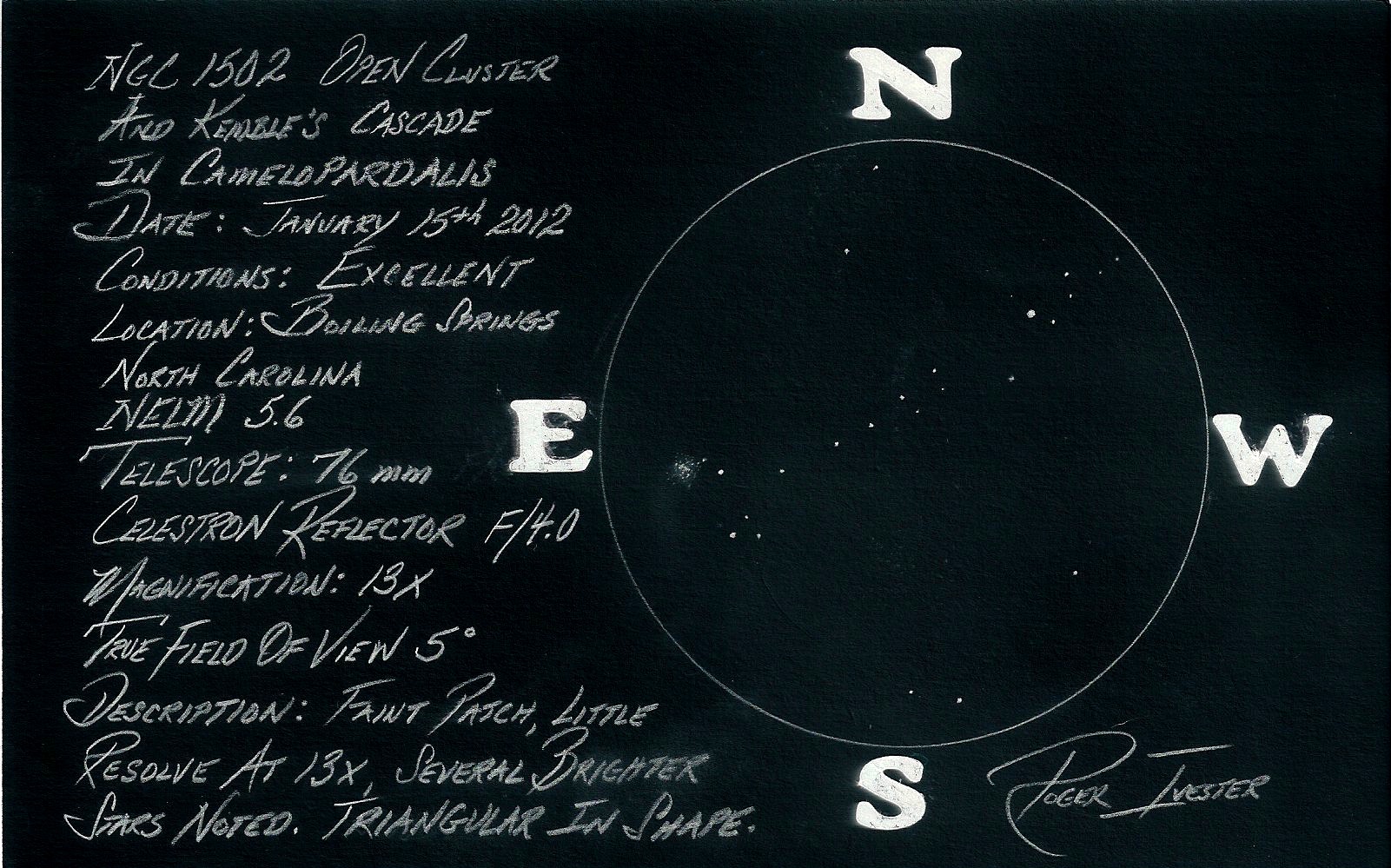
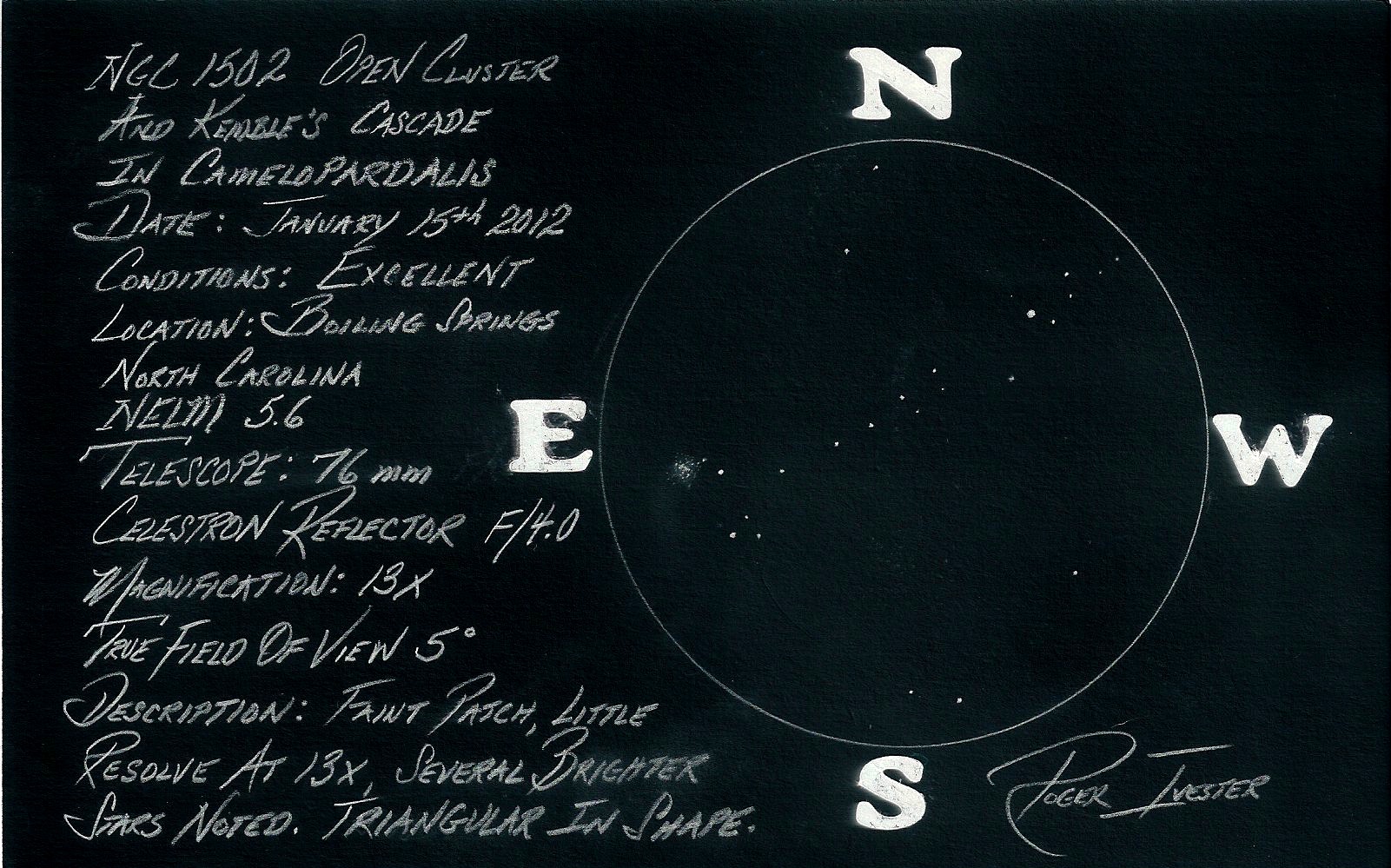
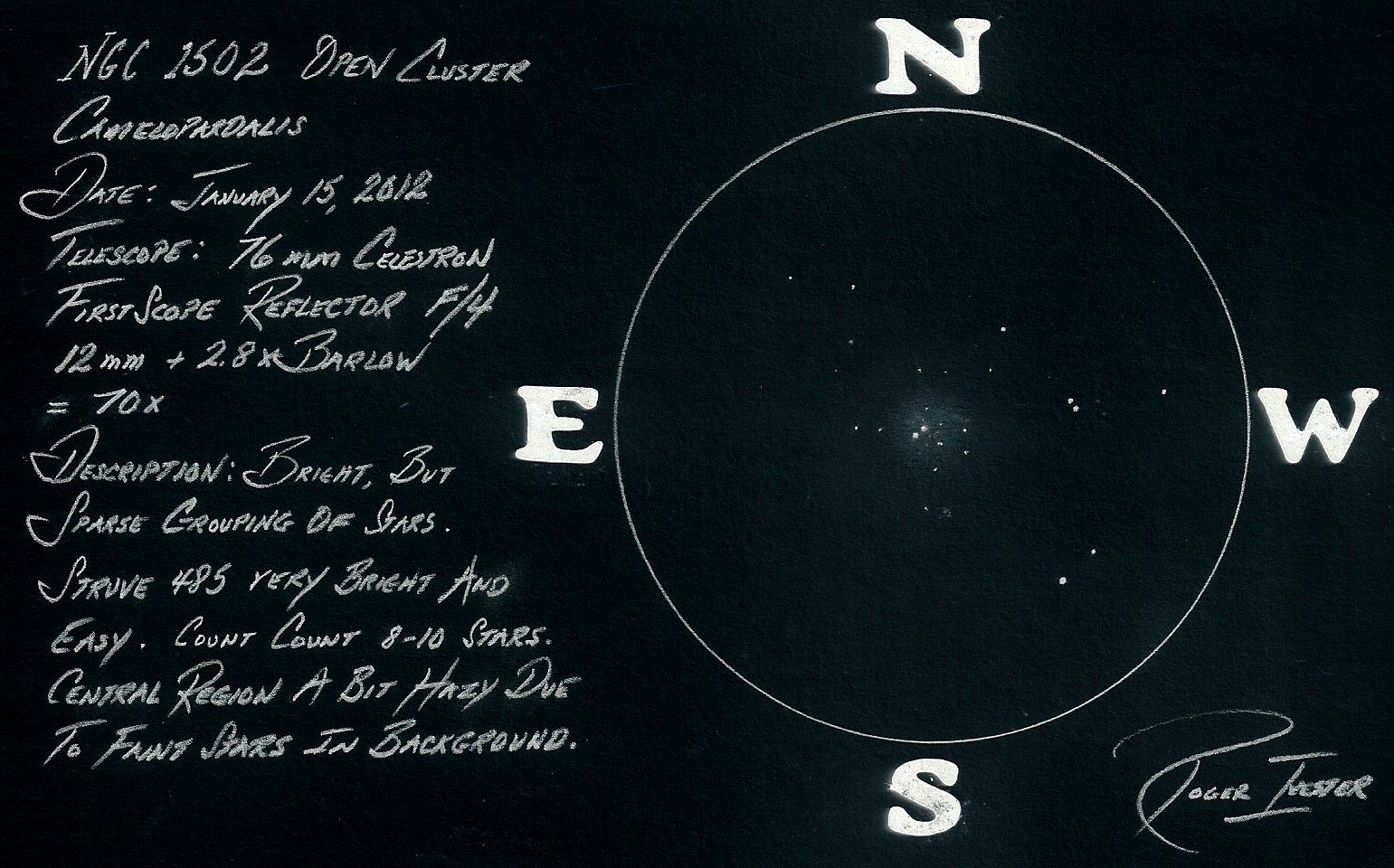
Jan. NGC 1502 Open Cluster Camelopardalis
Feb. Theta 1 – Trapezium Multiple Star Orion
Mar. NGC 2362 Open Cluster Canes Major
Apr. NGC 3115 Galaxy Serpens
May M64 Galaxy Coma Berenices
June NGC 5353 Galaxy Group CVn
July M17 Emission Nebula Sagittarius
Aug. M22 Globular Cluster Sagittarius
Sept. NGC 6826 Planetary Nebula Cygnus
Oct. NGC 7023 Cluster + Nebula Cepheus
Nov. NGC 55 Galaxy Sculptor
Dec. NGC 457 Open Cluster Cassiopeia
2011 Challenge Objects:
Jan. NGC 1333 Nebula Perseus
Feb. NGC 2261 Hubbles Variable Nebula Monoceros
Mar. NGC 2419 Globular Cluster “Intergalactic Wonderer” Lynx
Apr. NGC 3190 Compact Galaxy Cluster Leo
May M97 Planetary Nebula Ursa Major
June NGC 5866 (M102) Draco
July NGC 6645 Open Cluster Sagittarius
Aug. NGC 6819 Open Cluster (Fox Head Nebula) Cygnus
Sept. NGC 6946 Galaxy Cepheus
Oct. NGC 7380 Nebula Cepheus
Nov. NGC 281 Nebula + Cluster (Pac Man Nebula) Cassiopeia
Dec. M33 Galaxy Triangulum
2010 Challenge Objects:
Jan. NGC 2264 Cluster + Nebula (Christmas Tree Cluster + Cone Nebula) Monoceros
Feb. NGC 2903 Galaxy Leo
Mar. IC 405/410 NGC 1893 Nebula + Cluster Auriga
April NGC 4889 Galaxy Cluster Coma Berenices
May NGC 4631/27 4656/7 Galaxies Canes Venatici
June NGC 5907 Galaxy Draco
July NGC 6543 Planetary Nebula (Cat’s Eye) Draco
Aug. NGC 188 Open Cluster Cepheus
Sept. NGC 7331 Galaxy Pegasus
Oct. NGC 6888 Nebula (Crescent) Cygnus
Nov. IC 342 Galaxy Camelopardalis
Dec. M77 Galaxy Cetus
2009 Challenge Objects:
Feb. M1 SN (Crab Nebula) Taurus
Mar. NGC 2403 Galaxy Camelopardalis
April (M84-86) and Seven Other Galaxies Virgo Cluster
May M65-M66 & NGC 3628 (Leo Triplet)
June M13 and the “Propeller” Globular Cluster Hercules
July M27 Planetary Nebula Vulpecula
Aug. M2 Globular Cluster (Dark lane, as described by John Mallas) Aquarius
Sept. NGC 7293 Planetary Nebula (Helix) Aquarius
Oct. NGC 253 Galaxy Sculptor
Nov. NGC 891 Galaxy Andromeda
Dec. NGC 467/470/474 Galaxy Group Pisces















 rogerivester.com
Recent Comments