Supernova in Galaxy M82 – Magnitude Estimates

Posted January 23, 2014 by rogerivester
Categories: Roger's Articles

Over the past…almost thirty years, I’ve always enjoyed attempting to estimate the magnitude of any supernova within reach of a moderate backyard telescope.

The following are my estimates of the most recent M82 SN: 

  • Date:  January 22nd 2014:  Telescope:  10-inch f/4.5 reflector  =  11.6 M
  • Date:  January 24th 2014:  Telescope:     3-inch f/4.0 reflector  =  11.0 M
  • Date:  January 29th 2014:  Telescope:     3-inch f/4.0 reflector  =  10.6 M
  • Date:  January 30th 2014:  Telescope:    10-inch f/4.5 reflector =  10.3 M

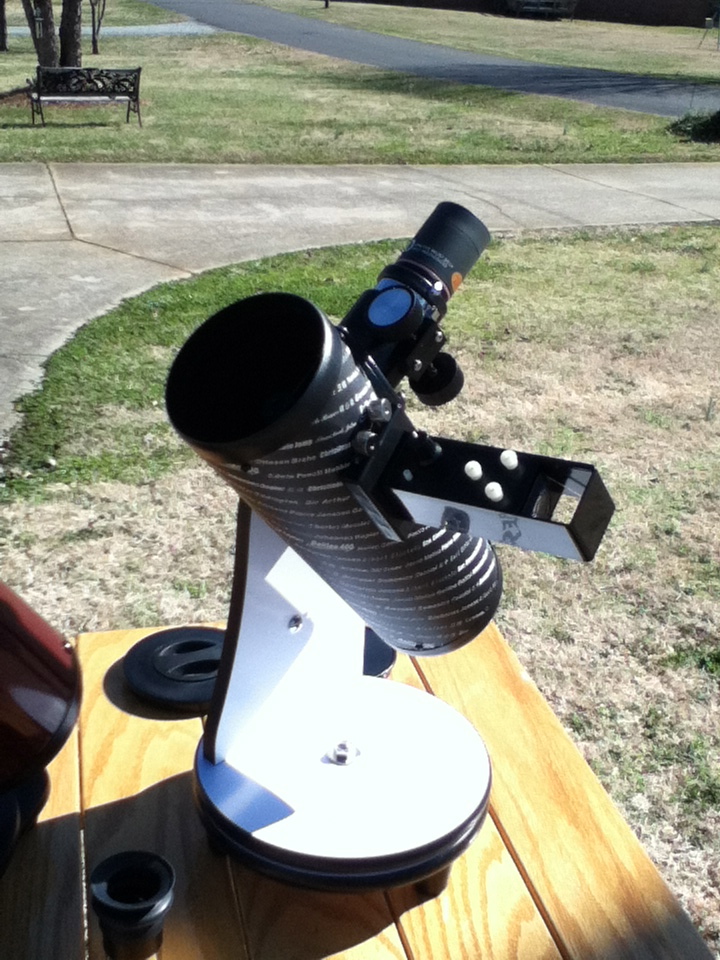
It was not the best of conditions, but I was able to easily observe the latest SN in galaxy, M82, in Ursa Major.  Telescopes used:  A vintage Meade 10-inch (model DS-10a) and an Orion 102mm Orion/Vixen f/9.8 refractor.   

The SN could easily be seen in the small refractor (102mm) even at low magnification, however, the best view came at 166x.  

I made the following pencil sketch, using the 10-inch reflector at 190x.  Both seeing and transparency were a bit lacking, however, I was very surprised to see so much mottling in galaxy, M82.  

The following pencil sketch was made using a 10-inch reflector, on a blank 5 x 8 note card, with the colors inverted using a scanner.  

Date:  January 22nd 2014

SN in M82 Revised -1 

NGC 3893 Galaxy in Ursa Major and Faint Companion NGC 3896

Posted November 30, 2013 by rogerivester
Categories: Roger's Articles

A good reason to document your observations:

I wanted to share an article concerning an observation I made on April 20, 1993.  It’s a testament that documenting and taking good notes is indeed a good thing!    

Forward to February 1994: 

While reviewing my logbook, I discovered that I’d not followed up on an object viewed on 20 April 1993.  The primary object was NGC 3893, an 11th magnitude galaxy in Ursa Major.  While making my sketch of this galaxy, I had noticed a smaller much fainter object SE of NGC  3893.  

I noted this in my logbook to check later, however, it would be ten months later (February 1994) before going back.  So, while browsing through my logbook, I saw my notes that said:  follow up on this observation. 

I checked Burnham’s Celestial Handbook, Tom Lorenzen’s 1000+, and the Tirion Sky Atlas 2000.0 only to find that none of these sources listed a companion galaxy.  I then went to the NGC-2000.0 Catalog by Roger Sinnott, and found the companion listed as NGC 3896, a very faint and small 14th magnitude galaxy.  

So, If I had not sketched NGC 3893, most likely I would have missed NGC 3896.  And, if I had not logged the companion, I probably would never have checked any reference material.  

This might be a good story for documenting, taking good nights of your observations, and periodically review that logbook.  You never know what you may find? 

The following sketches:  

The first being my most recent sketch of the galaxy pair, which was made in April 2014, and the second is my original from April 1993.  It was on this night that I questioned if I was actually seeing another galaxy, ESE of NGC 3893.  

Roger Ivester 

2014-04-08- 001

NGC 3893 and 3896 - Ursa Major -1

The Cocoon Nebula Notes and Sketch – IC 5146 – Cygnus

Posted November 15, 2013 by rogerivester
Categories: Work File Only - Observer's Challenge Reports

The Cocoon Nebula has been a difficult object for me.  I’ve tried many times over the years, but without success.  My location has always been from my moderately light polluted backyard, using a 10-inch reflector.  On the night of November 8th 2013, I was finally able to see the nebula and make the following sketch.   I used a magnification of 114x, however, the nebulosity would catch my eye a bit easier when using 57x.  A UHC filter was essential to see this faint and difficult object.  

To read the entire Observers Challenge, please click on the following link: OCTOBER 2013 OBSERVERS CHALLENGE – IC-5146

IC 5146 - Cocoon Nebula

NGC 281 “The Pacman Nebula” – Orion Telescope and Binoculars Article

Posted October 4, 2013 by rogerivester
Categories: Roger's Articles

Emission nebula, NGC 281, located in Cassiopeia is an early to late fall object that you don’t want to miss.  It can be glimpsed through an 8 x 50 finder, however, an 8-inch with an O-III filter is required to see the unique shape.  When you see this nebula for the first time…you’ll know why it’s called the “Pacman Nebula.”  

Click on the Orion Telescope and Binoculars link below for the full article.  

http://www.telescope.com/October-Deep-Sky-Challenge-NGC-281-The-Pacman-Nebula/p/103501.uts

Pencil sketch using a No. 2 pencil and a blank 5 x 8 notecard

Pacman Nebula - NGC 281

Image by Dr. James Dire using an Orion 190 mm Maksutov-Newtonian Telescope.

NGC281_LR

To read what others say about this most interesting object, click on the Las Vegas Astronomical Society link:

NOVEMBER 2011 OBSERVERS CHALLENGE – NGC-281

How to Clean a Telescope Mirror That Will Exceed Your Expectations and Will “Do No Harm”

Posted March 18, 2013 by rogerivester
Categories: How to Clean a Telescope Mirror

fullsizerender

     The following is the method I’ve used many times over many years to “successfully” clean telescope mirrors.  

     I reviewed a variety of sources to get my ideas. 

Materials:

Cotton balls  (100% cotton)  – Be sure to store the cotton balls in a sealed zip-lock bag

Blower bulb from a photo supply shop

100% Camel hair brush – Do not touch the bristles with your fingers or hands, and be sure to keep the brush or brushes in a sealed bag. 

Three gallons of distilled water

One teaspoon of liquid “Ivory” dishwashing detergent

Two clean folded bath towels  (not to have been washed using fabric softener) 

     First, wash your hands and remove all rings.   (You may  use surgical gloves if you so desire)

     Now its time to remove the mirror cell (with mirror) from the telescope.  Using a permanent marker, mark two lines on the side of the mirror and also on the cell.  This will allow the same mirror/cell orientation after the cleaning process.  Carefully remove the mirror from the cell.  Tilt the mirror on its side and blow any loose particles from the surface with the blower bulb.  Now, take the camel hair brush, and using care, very lightly “whisk” the surface, removing any loose debris or particles that might have remained.  

     Typically the mirror cleaning process is carried out in the kitchen sink.  It’s best to wash the sink thoroughly using dishwashing detergent and rinsing with water from the faucet.  After this, wipe the sink with alcohol to remove any oil or grease residue.  Place one of the folded towels in the sink and carefully lay the mirror on the towel.  Turn on the water and flood the mirror surface for a couple of minutes.  

      Next, plug the sink, pour one teaspoon of liquid dishwashing detergent while filling with water.  The water level should be about 1/2 to one-inch above the mirror, and let soak for about five minutes.  

     Secure a cotton ball by the corner to insure that finger oil is not deposited onto the mirror.  Now saturate a cotton ball with water and pull across the mirror…using only the weight of the saturated cotton ball. 

Use common sense to determine, as to how many cotton balls are needed.  At one time, I used one cotton ball per crossing, but this might be a bit excessive.  I now make multiple strokes with a saturated cotton ball.  Use as many cotton balls as you think necessary….cotton balls are very inexpensive.  It’s very important the mirror be totally submerged during this step!         

      If the mirror is really dirty, I’ve found it necessary to use the same procedure, but pulling the cotton balls crossways.  Since the mirror is already in the water, I think this is a necessary step to insure that the mirror is throughly cleaned.  

      The rinse process:  Turn on the faucet and flood the mirror, and then gently put one hand under the mirror and lift out of the water.  However, if you have very hard water, it would be best to use distilled water rather than from the facet.  Caution!  Be careful not to hit the faucet with the mirror.

      Rinse the mirror for at least two minutes, turn off the faucet, and immediately begin pouring one gallon of distilled water over the mirror for the final rinse.  Now…pour an entire bottle of 91% isopropyl alcohol over the mirror as the final rinse.  

      Carefully position the mirror onto the second folded towel at an angle to allow the remaining 91% isopropyl to drain from the surface.  You can use the blower bulb to chase remaining drops of alcohol over the edge.  Do not use any other means to dry the mirror.  

      You’re almost through:  Now, carefully install the mirror back into the cell using the alignment marks.   You are now ready to tighten the mirror clips.  I use a sheet of notebook paper as a gauge.  I leave just enough space between the clips and the mirror to be able to slide a corner of  the notebook paper between the two.  This will leave a very tiny amount of space.  The clips should not be tightened down against the mirror, as their only purpose is to keep the mirror secure, but not tight.  This will insure that the mirror is not stressed, especially during temperature changes. They should, however, be tight enough to keep the mirror from moving or “flopping around” in the cell.  The clips should have cork pads glued onto the area that touches the mirror. 

      Disclaimer:  This method has allowed me to clean telescope mirrors with excellent results.  It should, however, be noted that your results may vary.  Mirrors coatings are very delicate…be very careful and use good common sense and care.   

Roger Ivester 

The Ted Komorowski Story: North Carolina Amateur Astronomer 1940-1969

Posted January 11, 2013 by rogerivester
Categories: Uncategorized

     As you become absorbed in amateur astronomy, you may stop to wonder how others developed an interest in this hobby.  Amateur astronomy is truly nothing new.  The technology has changed, the number of people involved has changed, however, the same basic desire has remained the same.  A curiosity of what’s up in the night sky.  While you may use a sophisticated computerized telescope with the finest of eyepieces, the earlier amateurs used both crude lenses and telescopes, sometimes made by themselves.  Some did it for science, while others did it simply for pleasure and “for the love of.”  Within our own American history of amateur astronomy is an unusual, but sad story of one amateur; not unlike many of us in one way, however, far different in others.  He left a legacy almost despite himself.  This is the story of that amateur which has been told to me by some of his acquaintances of days past.  

     In 1992, I read the following from “1000+ The Amateur Astronomer’s Field Guide to Deep-Sky Observing” P-81, by North Carolina amateur and author, Tom Lorenzin.  I became very interested in the story and wanted to learn more.    

“In the case of Andromeda’s NGC 404 “Comet Komorowski” commemorates highly eccentric Ted Komorowski, Charlotte, N.C., amateur who “discovered” the object and who found nothing plotted that near beta AND on Becvar’s Atlas Coeli.  Convinced of his claim to fame and immortality, he wired his discovery to the proper authorities and hopped from one foot to the other for days until the big needle returned by mail to puncture his dream.  Ted was an amateur astrophotographer long before it was fashionable to be-so (mid-60’s) .  Impulsive by nature, he was known to “assassinate” photos he thought less-than-perfect by shining a flashlight down the tube of his Newtonian while the camera shutter was still open.  Alas, Ted Komorowski is reported to have died a violent death by gunshot at the hands of his self-defending girlfriend.”  Tom Lorenzin   

     I would later become personal friends with Tom Lorenzin, receiving advice and encouragement, regarding deep-sky observing notes and pencil sketching.     

    Vernal Equinox 1994: I met Tom and several local amateurs in an open field, just a few miles from my house, with the goal of observing all 110 Messier Objects in one night.  Unfortunately, clouds foiled our attempt. However, we went back to the William’s Observatory and had a great time, talking and laughing until the wee hours of the morning. 

Now back to the story of Ted Komorowski, and his mistake as related to galaxy NGC 404.  

     Elliptical galaxy NGC 404 could easily be mistaken for a comet, especially if it was unknown to the observer, prior to an observation.  This magnitude 8 galaxy is nestled in the glow of the much brighter star, BETA Andromeda.  I have observed this galaxy many times over the years and have found it to be fairly easy to see with telescopes as small as an 80 mm refractor.  When observing NGC 404 on those cooler nights of fall, I always think about the excitement Ted Komorowski must have felt when thinking he had discovered a new comet.  

     Gayle Riggsbee of Charlotte had known Ted for many years and talked with him only days before his untimely death in 1969.  Gayle was a mechanical engineer and helped Ted with his many astronomy projects.  On many afternoons, when returning home from work, Gayle would find Ted sitting on his steps…he might need some penny’s converted into copper washers, or any number of things.  Ted didn’t have a job, and had very little money, so he was forced to improvise on his projects.  

     Ken Dwight of Houston, lived in the same Charlotte neighborhood as Komorowski from the early 50’s until 1968.  Ken knew Ted very well and was impressed with his skills and abilities as an amateur astronomer.  Robert White became acquainted with Komorowski when he was only twelve years old, and had many discussions with him concerning astronomy and telescopes.  Ted really liked to share his knowledge of amateur astronomy with others.  He was a member of the Charlotte Amateur Astronomers Club for several years.   

     The Charlotte Amateur Astronomers Club has really grown since the days of Ted Komorowski, with a current membership of a hundred or more, and a club observatory.  They also sponsor the nationally renowned and celebrated Southern Star Astronomy Convention in the mountains of North Carolina, near Little Switzerland.  Gayle Riggsbee and Robert White are still members of the club.

     Ted Komorowski could be considered an advanced amateur for many reasons.  During the early sixties, most amateurs were using small telescopes and fortunate indeed was one who had a 6-inch reflector.  Ted’s 12.5-inch f/6.5 Criterion reflector was the largest telescope in the Charlotte area during the early 60’s.  He was one of the first astrophotographers in the region and also documented his observations.  He built his own drive corrector based on an article he had read in Sky & Telescope Magazine.  His photo efforts at times were very frustrating, but he still fantasized about selling his slides to planetariums throughout the country. 

     Ted apparently corresponded regularly with Walter Scott Houston who was a contributor to Sky & Telescope Magazine for more than 47 years, writing the Deep-Sky Wonders column.  Ted took amateur astronomy very seriously.  

     In the book “Deep-Sky Wonders” Walter Scott Houston, selections and commentary by Stephen James O’Meara, adapted from his columns in “Sky & Telescope” Magazine.  Ted is mentioned twice: 

Page 7:  “IC 434, but no Horsehead, was seen with a 2.4-inch refractor by Larry Krumenaker in New Jersey, with a 12-inch f/6.5 reflector by Ted Komorowski in North Carolina, and with 6-inch f/8 telescopes by Stephen Barnhart in Ohio and Mark Grunwald in Indiana.  However, other observers were more successful.”  

Page 231:  The Helix Nebula:  “Ted Komorowski told of a gray disk easily visible in his 8-inch f/7.5 at 56x.” 

He also wrote quite a few letters to the editors of Sky & Telescope Magazine, concerning everything from meteor showers to a review and comparison of planetary nebulae.

The following letters and writings are from the Sky & Telescope DVD collection.  

Sky & Telescope, Letters – April 1965,  p.215

Sir:

     On page 85 of the February issue, C.R. O’Dell points out the desirability of special amateur observations of central stars in planetary nebula, to check on possible brightness changes.  He gives a list of the five planetaries having the brightest central stars.  I feel that NGC 2392 in Gemini and NGC 3132 in Antlia should be added, since visually I find that their central stars seem at least as bright as that in NGC 6826, which Dr. O’Dell lists.  

Ted R. Komorowski                                                                                                                                                                                                                                                            

Sky & Telescope, Observer’s Page – January 1966, p.58-59:   S&T DVD collection  (Abbreviated) 

Many Leonids Observed

On the morning of November 16, 1965, observers in Hawaii and Australia saw what may have been the richest shower of Leonid meters since 1932.  At Charlotte, North Carolina, Ted R. Komorowski logged 115 Leonids…

Sky & telescope, February 1962, p. 4-5 “Leonids Meteors Give Unexpected Display”  This was a very lengthy letter  and the following is only the first paragraph. 

On November 17th, Ted R. Komorowski wrote to Sky and Telescope:  S&T DVD collection

    “This morning between moonset and sunrise, I observed a very rich display of Leonids.  They were literally dropped everywhere and in large numbers, sometimes three, four, or even five in rapid succession.  Almost every other one was 1st or zero magnitude and streak-leaving.  Eight were of magnitude -1 or brighter, and three others rivaled the quarter moon!”   

Some personal information about Ted Komorowski:

     Komorowski lived with his parents, except for a brief period when he went away to college.  He did not have a drivers license until a year or possibly two, prior to his death, and he never owned a car.  His mode of transportation was a bicycle.  On occasion he would ask others for a ride, however, Ted had very few friends.  From all accounts, it would appear that Ted had some social skill issues, at times having difficulty relating to others.  

     Ted earned a scholarship to Carnegie Institute of Technology in Pittsburgh, Pennsylvania.  He studied nuclear physics, but attended for only a year, possibly two.  He then returned back home where he felt the most comfortable.  Ted had a desire and ambition of becoming a planetarium lecturer.

     A year or two before his death, Ted did get a job, delivering milk, going door to door, during the very early morning hours.  This might have been the perfect job for Ted, as he worked mostly by himself, and it allowed him the opportunity to observe every clear night, if he so desired.  

Ted Komorowski, as reported earlier, died an untimely death in 1969:    

     After his passing, Ted’s father asked fellow club member, Gayle Riggsbee if he would select some of his best slides and give to the Charlotte Nature Museum as a memorial. The Criterion 12.5-inch f/6.5 reflector telescope, and equipment:  

     The telescope was ordered from Criterion as an optical tube assembly only, but without the mirrors.  Ted, however, ordered the mirrors from the Optical Craftsman, who guaranteed his criteria for a 1/20 wave accuracy.  From all who have had the opportunity to observe through this scope, it has been reported to be an excellent mirror indeed.  The mirror is dated 12-2-60, which might indicate that the telescope was possibly received in 1961. 

     He replaced the standard four-vane spider with a custom made circular spider to eliminate spikes during astrophotography. This was an advanced feature in the early 60’s.  

     Ted’s favorite eyepiece was the Criterion 16.3 mm Erfle eyepiece with a wide 75º apparent field.  He also had a 4 and 6 mm eyepieces, being of Orthoscopic design.  They were manufactured by Criterion also.

      The focal length of the 12.5-inch f/6.5 scope is 2064, which would have given a magnification of 126x when using the 16.3 mm eyepiece.  The 16.3 mm Erfle would most likely have been his eyepiece of choice when observing deep-sky objects.  Could this have been the eyepiece that he employed when he saw the smudge in the glare of Beta Andromeda?  

     The 12.5-inch Criterion telescope is really big, with the tube being slightly over 6 1/2 feet in length.  Unfortunately, Ted could not afford to purchase the proper mount, but instead used the mount from his previous 8-inch Criterion scope, which was a bit too small.  The Komorowski telescope is now owned by the Cleveland County Astronomical Society.  It is maintained and stored in the Williams Observatory, on campus of Gardner-Webb University in Boiling Springs, North Carolina.  

     The telescope has been completely restored by Steve Davis and another member of the Cleveland County Astronomical Society.  This is a beautiful scope in now in beautiful condition. The original Criterion mount has now been replaced by a much more heavy duty mount, manufactured by Meade Instruments Corporation, and designed for a 16-inch, model DS-16A reflector. 

      For a size reference, I’ve included a photo of myself with the famous telescope.  It’s a big scope for sure!  The finder was replaced shortly after this photo was made.  Photo by Debbie Ivester

IMG_1504

     Ted observed from his backyard in Charlotte.  The mount was “at times” left outside and covered when not in use.  The OTA was stored in Ted’s living room, sitting on the mirror end in a corner.  However, Ken Dwight remembers seeing the scope on many occasions mounted in the side yard, covered with a tarp.   

M42 – Date: 1968 – Telescope: 12.5-inch f/6.5 reflector using high speed 160 ektachrome slide film – Photo by Ted Komorowski  (Courtesy of Gayle Riggsbee and Tommy Forney)

07-KomorowskiSlideM42

      The following is from Sky & Telescope, October 1969 – Letters, p.239   (S&T DVD collection) 

 Why Study The Stars?

     To a casual spectator, the heavens on a clear night present a vast, featureless jumble of myriads of specks of light, with a few brighter beacons.  But to someone who has taken the time to become acquainted with his heavenly friends, the sky is made up of orderly patterns and shapes, while bright or important stars and all the planets become celestial landmarks leading to the more difficult objects.

     Some knowledge of the constellations gives one a 24-hour clock, a compass, and a protractor, but there are also philosophical aesthetic, and scientific reasons for stargazing.   Stars are lovely to behold, forming attractive celestial patterns, and some who even have a shade of color.  Scientists can study the stars to learn about matter under conditions unobtainable in earthly laboratories.  An even greater knowledge of our own world and its beginning and its eventual ending can be gotten from observing stars in different ways.

     Star names and their derivations indicate something of the contributions to astronomy of ancient and fallen civilizations, and celestial mythology is a storehouse of early folklore.  The legends of Perseus, Andromeda, and Orion are well established in the sky for ages to come.  The planets, too, have their store of myths.  Mars, named after the Roman god of war because of its angry red countenance, is really not as harsh as its name implies, for it is the least hostile to life of all the other planets.  

     Men who spend their lives trying to figure out the scheme of things and find the meaning in the universe, men who are seeking answers to very difficult questions, are greatly aided and guided by knowing what is happening above.  Reverent people may feel closer to the Creator after they have acquired a knowledge of his creations.  Others may gain their first religious awareness from experiencing the wonder, awe, and mystery of the firmament.

      Even ordinary laymen like ourselves, with no other aim than appreciating nature, can find immense enjoyment and well-spent hours in getting acquainted with other worlds above and beyond our own.  Here is treasure for all kinds of people, regardless of their purposes, if only they will look and learn.  Ted R. Komorowski   

     This is the last composition of a young amateur astronomer of Charlotte, North Carolina, who died suddenly early this year.  He frequently reported his observations of celestial phenomena to this magazine.   ED  (Sky & Telescope Magazine)

      I would like to thank Gayle Riggsbee of Charlotte, and Ken Dwight of Houston, without them and their memories, this story would have gone untold. 

      Thanks to Tom English for his research using the S&T magazine DVD collection to gather all of the magazine quotes and letters.  

      A special thanks to Sky & Telescope Magazine for giving me permission to use the information and letters provided to the editors by Ted Komorowski, also quotes by Walter Scott Houston from Deep-Sky Wonders.    

Skyuka Mountain – Sharing My Pain With Good Friends

Posted October 27, 2012 by rogerivester
Categories: Roger's Articles


Yesterday, October 26th 2012, good friends, Mike Ribadeneyra (L) myself (C) and Mike Keeley (R) rode from Boiling Springs, (NC) to Columbus, North Carolina to climb Skyuka Mountain.  

My wife, Debbie took good care of us by being our support, driving the van, and picking us up at the top.  The total ride was 50 miles, however, the final four miles, climbing up Skyuka Mountain was really tough.  

This mountain presented us with some beautiful sights, including colorful leaves floating down from the trees, waterfalls, and an incredible panoramic view of distant communities from the summit.

Veteran Tour de France rider, George Hincapie would be having his 2012 Gran Fondo ride with over 1000 riders the following day (Saturday October 27th 2012) and would also be riding up Skyuka Mountain.

 Signs had already been posted along the way up the mountain, including that famous KOM (King of the mountain) sign at the summit.   

Hincapie rode along side of Lance Armstrong in all of his seven Tour de France wins.  

Former Tour de France winner, Cadel Evans would be riding in the Gran Fondo, as well as many other riders of the BMC Team. 

It was well worth all the pain of climbing Skyuka Mountain to be able to enjoy pizza at “The Brick Pizzeria” in downtown Columbus.   

Debbie volunteered to be our support and was essential to the success of the day.  It was a fun day for sure…. 


Roger Ivester

Monday October 8th 2012 – A Memorable Day With My Family

Posted October 10, 2012 by rogerivester
Categories: Roger's Articles

Budding new amateur astronomer’s?  

Grandkids:  They don’t get to be with each other very often. It was wonderful to just watch them interact, talk and have fun.  

It was truly a “moment in time” that I will not soon forget… 

My two sons:  Rev. Roger Chadwick (Chad) South Carolina is on the left, and Bradley Jason (Brad) from Nevada.  

Anna-Grace on the left with her cousin Zoe.  This picture makes me smile and I was indeed a happy PawPaw (as they call me) on this memorable day.  

When we all sat down to eat lunch, Zoe said “this is the best day of my life.”  I must agree with Zoe… it was the best day of my life also.   

Roger Ivester

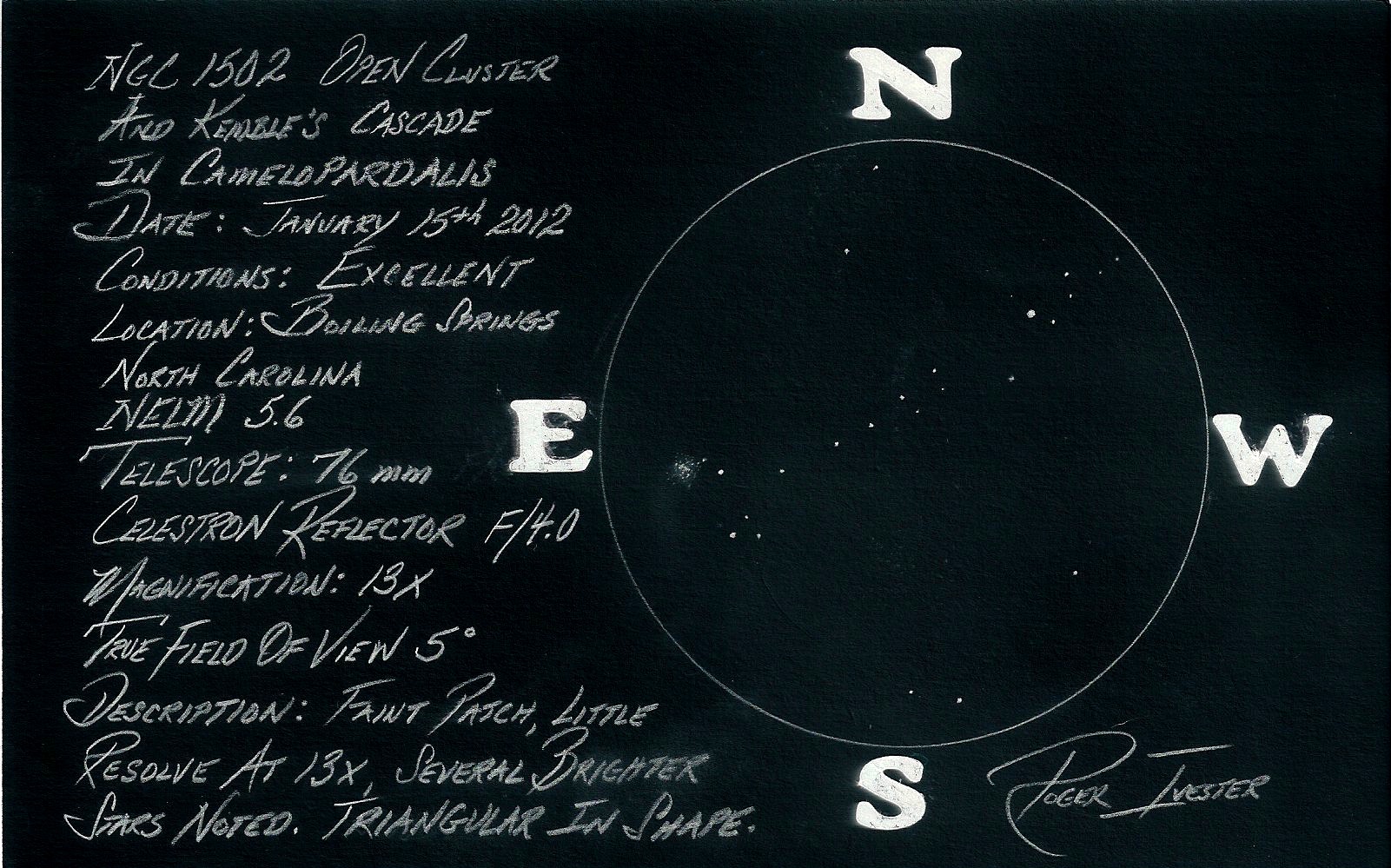
NGC 1502 – Open Cluster – And Kemble’s Cascade 3º Star Chain – Camelopardalis – Observer’s Challenge – January 2012 – Posted August 18th 2012

Posted August 18, 2012 by rogerivester
Categories: Work File Only - Observer's Challenge Reports

Using a 76mm (3-inch reflector) at 13x with a 3º field of view:  

I could see both NGC 1502 and most of Kemble’s Cascade, a bright chain of stars cascading from the NW toward the cluster.   At this low power, NGC 1502 appears as a faint patch with several bright stars noted with a triangular shape. 

When increasing the magnification to 70x, I could count 8-10 stars, and double star Struve 485 was very easy.  The central region of the cluster appears a bit hazy due to faint stars in the background, too faint to be resolved with the small scope.   Roger 

NGC 1502 & Kemble's Cascade-1


JANUARY 2012 OBSERVERS CHALLENGE – NGC-1502  

Globular Cluster M13 And The Elusive Propeller

Posted June 23, 2012 by rogerivester
Categories: Work File Only - Observer's Challenge Reports

The great globular cluster, M13 is located high overhead for observers in the northern hemisphere during the summer months, allowing for excellent viewing.  When observing this cluster back in 1977 with my 4 1/4-inch f/10 reflector, the most I could see was a moderately bright ball of unresolved stars.    

While observing M13 with the small reflector, I was unaware of the three dark lanes cutting into the SE edge of the cluster, known as the propeller.  I had never heard of the propeller at that time, but this scope was far too small to see this very faint feature.  However, thirty two years later in May of 2009 using a much larger telescope, I was finally able to see the three dark-lanes.     

A 10-inch telescope “might be considered the minimum aperture” required to see this most unique feature.  If you have plans to observe the “elusive propeller” a magnification of around 200x seems to be the optimum.  

The propeller challenge seemingly became popular due to Walter Scott Houston, columnist and writer of “Deep-Sky Wonders” suggesting that observers look for it.  

Houston first wrote about the propeller in the July 1953 edition of “Sky & Telescope magazine.”  He brought it up several more times through the years, however,  it has been only in recent times that the propeller has gained much attention in the amateur astronomy community. 

Lord Rosse mentioned three dark rifts in the 1850’s, and T.W. Webb in “Celestial Objects for Common Telescopes” noted that the lanes were seen by Buffham, using a 9-inch reflector. 

John Bortle saw the lanes in 1980 using a 12.5-inch reflector, and Dennis di Cicco saw them easily with the 12-inch f/17 Porter telescope during Stellafane in 1981.  (Source: “Deep-Sky Wonder’s” By Walter Scott Houston, selections and commentary by Stephan James O’Meara.  Sky Publishing Corporation, Cambridge Massachusetts)  

In May of 2009, I was able to observe the propeller with both 10 and 12-inch Newtonian’s.  My first sighting of the propeller came when using a friends 12-inch from the southern rim of the South Mountains in North Carolina.  I would rate this site as very good with a NELM of 6.0 (at the zenith) and maybe even better on an excellent night.  

The propeller was fairly easy to see with the 12-inch f/5 reflector from this location.  However, seeing the propeller from my suburban backyard and 10-inch f/4.5 Newtonian, was possibly seem only using my imagination.  🙂

The following sketch was made using Steve Davis’ Meade 12-inch f/5 reflector at 190x, just off Moore Mountain Road in Rutherford, County.  

The sketch was made with a No. 2 pencil and a blank 5 x 8 note card.  The colors were inverted using a scanner.     

M13 And The Elusive Propeller