My interest in amateur astronomy began in the mid-70s’ with the purchase of an Edmund 4.25-inch f/10 EQ reflector. From that time on, I’ve never known anything other than visual observing. I became a very serious student of amateur astronomy with the purchase of 10-inch f/4.5 Newtonian in 1992. At that time, I began making detailed pencil sketches, but only drawing what I see in the eyepiece. I don’t embellish my drawings or use any computer enhancements.
Finding deep-sky objects manually from my suburban backyard, with a 6.5 Bortle sky can be difficult. So, how do I find objects that are not readily seen in the eyepiece?
My favorite finder has a 6 degree field-of-view. So, using a ring with a diameter that matches 6 degrees on the atlas, I center the deep-sky object. I then move my telescope to the location. This can be fairly easy when looking for brighter objects, but when looking for very faint objects it may require careful observing.
A nice description of averted vision from AI as following:I
Averted vision is an observational technique used in visual astronomy that involves looking slightly away from a faint object. By shifting your gaze off-center, you allow the light to fall onto the highly light-sensitive rod cells in the periphery of your retina rather than the less sensitive, color-detecting cones in the center.
To locate my selected deep-sky objects, I just match up my finder view with an atlas and attempt to point the scope at the exact spot. Note: The difficult galaxy NGC 6118 is in the center of the field. The stars Yed Prior and Yed Posterior, and would seem easy enough to find the galaxy, but not. I had to find “or see” the two faint stars to the north of the galaxy, and with difficulty, the galaxy was seen, but not constant. Many or most amateurs say that NGC 6118 is the most difficult object in the entire Herschel-400 list.
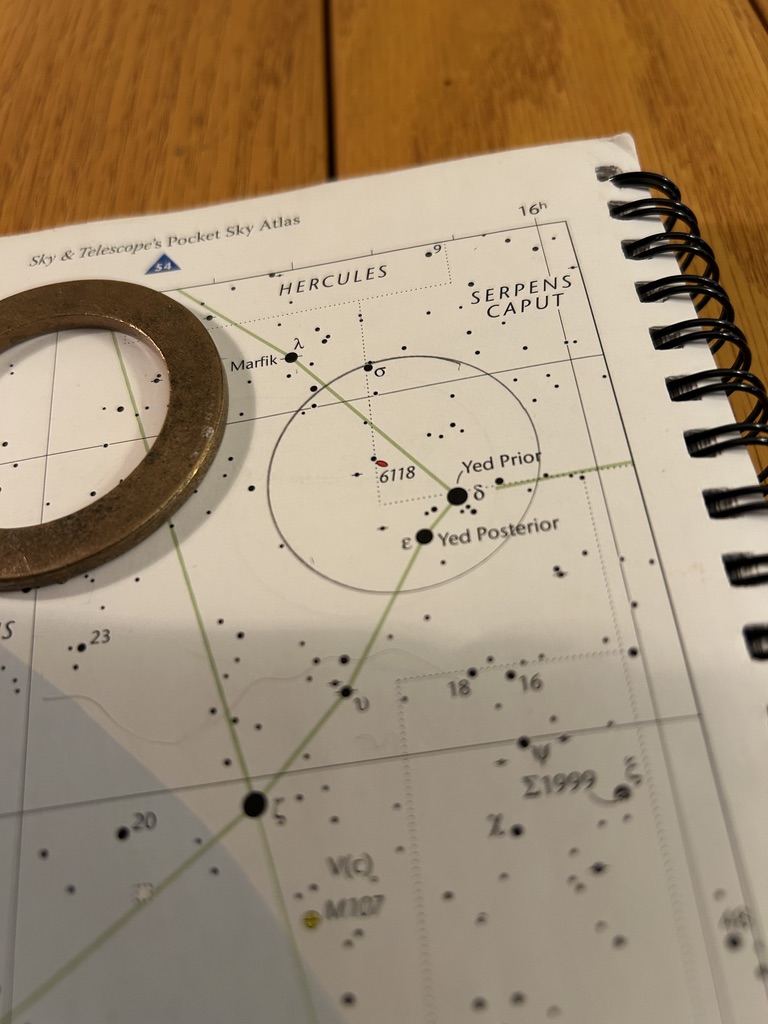
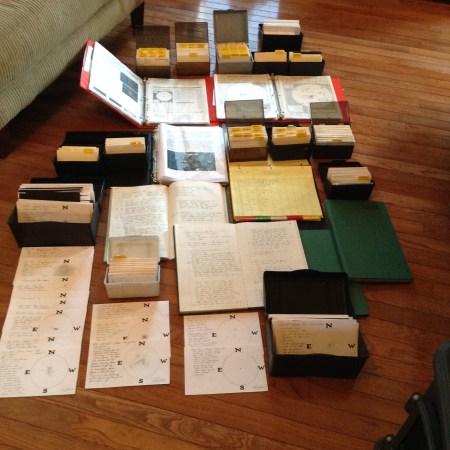
I use different sizes of brass and steel rings to match my finder(s) field of view. My choice for the last 15 years plus have been the “S&T Pocket Sky Atlas” which are compact and easy to use in the field. The black stars are so much easier to use as compared to atlas’ with white stars on black backgrounds. Plus, I like the larger format pages of the Pocket Sky Atlas’.
If you will notice, I draw circles (on the atlas pages) are for my “selected” objects. I don’t mind all of the drawn circles, soaked pages from dew, which shows the atlas’ have been well used.
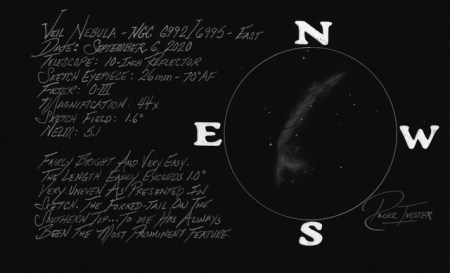
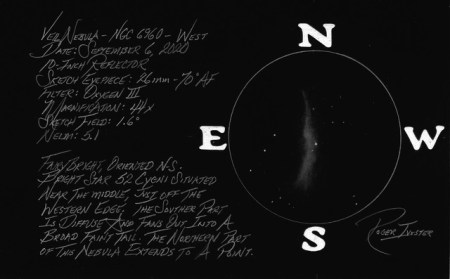
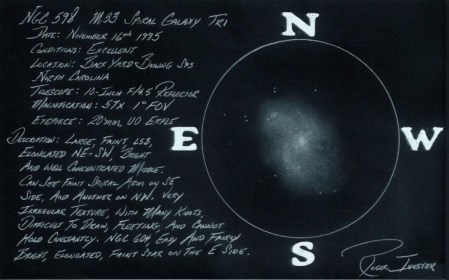
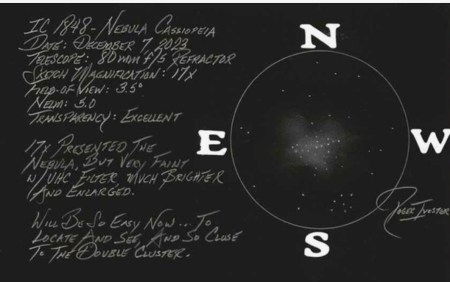
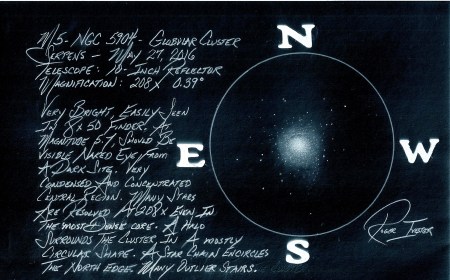
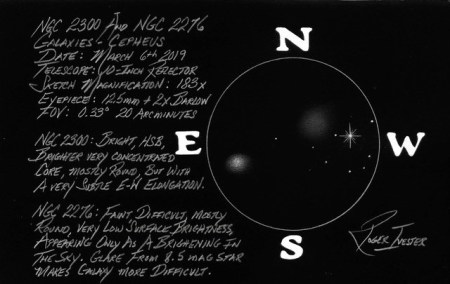
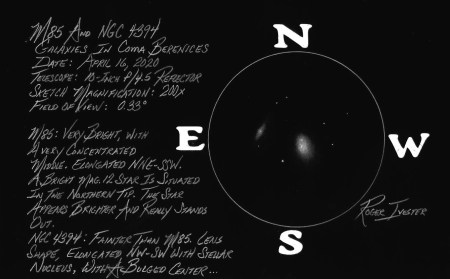
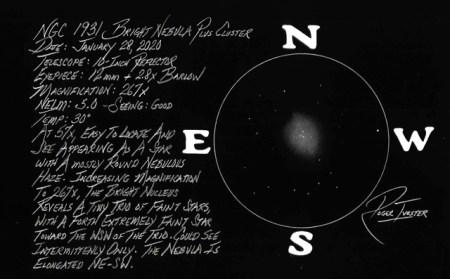
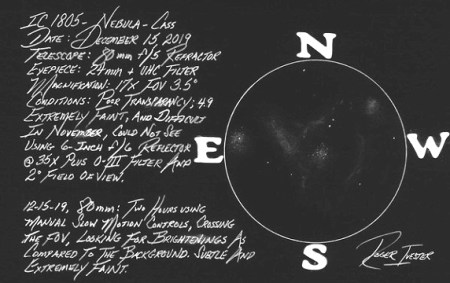
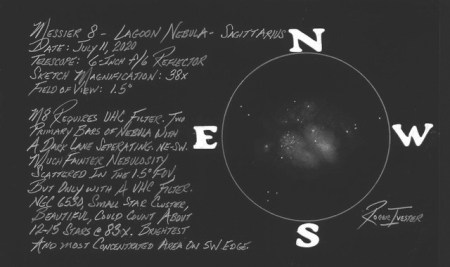
A few examples of my pencil sketches. I have more than 200 sketches using this format (5 x 8) and about 1,500 using much smaller 3 x 5 cards.


Recent Comments