In the southeast, galaxy NGC 404 is sometimes called “Komorowski’s Comet” but in most other areas it’s known as “Mirach’s Ghost.” From Skiff & Luginbuhl; “Observing Handbook and Catalog of Deep-Sky Objects” “This galaxy lies 6′ NW of B Andromeda (V = 2.1) which interferes with viewing especially in larger apertures. The object is just visible in 6 cm…”
I’ve really been enjoying observing with smaller telescopes more and more lately. My largest scope at the moment is a 6-inch f/6 Newtonian. On the first clear, moonless night, I’m hoping to see if I can spot NGC 404 using my 80mm f/5 achromatic refractor from my Bortle 6.5 suburban backyard.
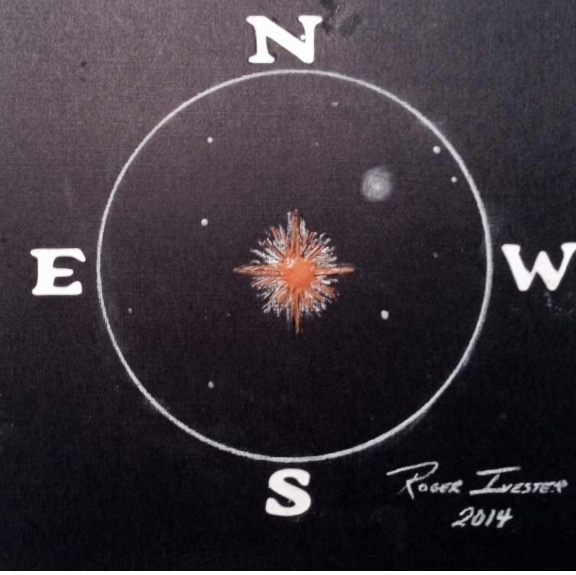
My exaggerated sketch from years past using a 10-inch reflector, to highlight the brilliance of beta Andromedae, versus the very close dim galaxy.
Why not consider more visual observing with a 3-inch or even smaller telescope. You just might be surprised just how convenient, easy and enjoyable small telescope observing can be. The cooler skies of October and beyond can be the perfect time to begin your visual quest.
I read the following from “1000+ The Amateur Astronomer’s Field Guide to Deep-Sky Observing” P-81, by North Carolina amateur and author, Tom Lorenzin. I became very interested in the story and wanted to learn more:
“In the case of Andromeda’s NGC 404, “Comet Komorowski” commemorates highly eccentric Ted Komorowski, the Charlotte, N.C., amateur who ‘discovered’ the object and found nothing plotted that near beta Andromedae on Becvar’s Atlas Coeli. Convinced of his claim to fame and immortality, he wired his discovery to the proper authorities and hopped from one foot to the other for days until the big needle returned by mail to puncture his dream. Tom Lorenzin
Tom would later coin the name “The Deerlick Galaxy Group, which was named after an extraordinary night of observing from the “Deer Lick Gap” overlook on the Blue Ridge Parkway.
I would become friends with Tom, who gave me advice on visual observing and pencil sketching. Tom passed away on August 23rd 2014 at 67 years of age.
Elliptical galaxy NGC 404 could easily be mistaken for a comet, especially if it was unknown to the observer, prior to the observation. This mag. 8 galaxy is nestled in the glow of the much brighter star, Beta Andromedae. I’ve observed it many times over the years and have found it to be fairly easy to see with telescopes as small as an 80 mm refractor. When observing it on those cooler fall nights, I always think about the excitement Ted must’ve felt when thinking he had discovered a new comet.
Ted’s 12.5-inch f/6.5 Criterion reflector was the largest telescope in the Charlotte area during the early 60’s. He corresponded regularly with Walter Scott Houston who was a contributor to “Sky & Telescope” magazine for more than 47 years, writing the Deep-Sky Wonders column. Sue French would assume this column for another 20 years.
In the book Deep-Sky Wonders, Walter Scott Houston, selections and commentary by Stephen James O’Meara, adapted from his columns in Sky & Telescope Magazine, Ted is mentioned twice:
Page 7: “IC-434, but no Horsehead, was seen with a 2.4-inch refractor by Larry Krumenaker in New Jersey, with a 12-inch f/6.5 reflector by Ted Komorowski in North Carolina. However, other observers were more successful.” Page 231: The Helix Nebula: “Ted Komorowski told of a gray disk easily visible in his 8-inch f/7.5 at 56x.” He also wrote many letters to the editors of Sky & Telescope Magazine, concerning everything from meteor showers to a review and comparison of planetary nebulae.
Roger Ivester


Recent Comments