Archive for the ‘Work File Only – Observer’s Challenge Reports’ category

NGC 55 – Galaxy In Sculptor – Recent Studies Indicate that this Galaxy Is A Part of The Local Group Of Galaxies – Observers Challenge Object For November 2012

December 21, 2012

November 9th 2012

When looking at my deep-sky list of objects observed, I was surprised that NGC 55 was not included.  My backyard has a very poor southern view, due to light pollution, so I loaded up my 10-inch in search of a better location.  I had been spying a grassy field which appeared to be a pretty good site for quite a few years and only a couple miles from my house.  

I could easily see (naked eye) my starting location star, Alpha Phoenix, just above the tree line.  After a quick polar alignment, I centered my scope on the location of NGC 55, but couldn’t see anything.  I tried low power to start, but to no avail, then moved up to medium, but again, no galaxy.  I did this for almost two hours and never once saw NGC 55, apparently due to the sky glow of Boiling Springs.  I don’t think that the conditions were that bad, however, this would suggest that a very dark sky is needed.  If you are planning to observe this galaxy, make sure that you have a good southern sky, devoid of any light pollution. 

Second attempt:  December 13th 2012

My wife Debbie agreed to go with me to a better site.  We started to drive to a true dark site, however, we got a late start and decided to stay a bit closer home. I picked another grassy field that had an excellent view of the southern sky.  Due to being sore from a recent bicycle accident, I decided to take a 4-inch refractor, which is much easier to set up than a 10-inch equatorial reflector.  

The sky and conditions were excellent, with a NELM of 6.0 or maybe a bit better.  We started out with low power, and then medium…still no galaxy.  Everything seemed to be perfect, but there was a faint light glow, just above the tree tops that seemed to obscure the view.  We attempted a variety of eyepieces, but after more than an hour of searching, we decided to give up.  

I’ll try to find a better location this year (2016) and attempt a sketch and some decent notes.  An excellent southern horizon without any light glow is a must!  

The following image of NGC 55 provided by Dr. James Dire of  Hawaii:  

M55 

Click on the following link for the complete Observers Challenge report.
NOVEMBER 2012 OBSERVERS CHALLENGE – NGC-55

NGC 7023 – Reflection Nebula In Cepheus

November 5, 2012

OCTOBER 2012 OBSERVERS CHALLENGE – NGC-7023 

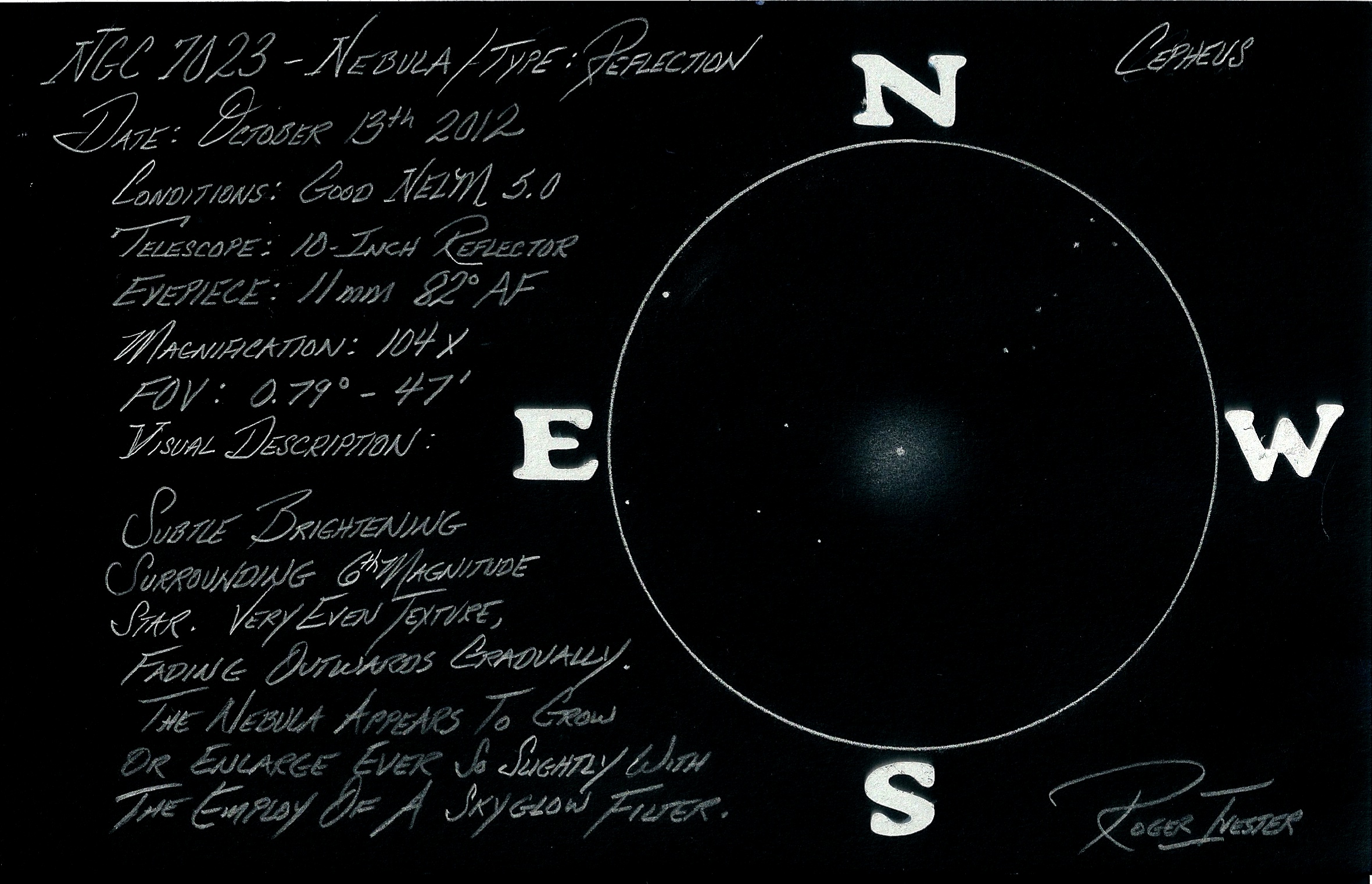
An excellent, but challenging late summer or early fall reflection nebula would have to be NGC 7023, located in Cepheus.  This faint nebula surrounding a magnitude 7 star can be found about 3 degrees SW of double star, Beta Cephei.  

This object seems to go mostly neglected by most amateurs.  It can be quite difficult to observe, due to it’s fairly large size and diffuse texture. When using my 10-inch reflector, and observing from my moderately light polluted backyard this nebula appears as a very subtle glow around the illuminating star.  The shape is mostly round, and the edges fade very gradually outwards.  The nebula is much improved and is enlarged when adding an Orion Skyglow filter.  

James Dire of Hawaii reports seeing only the mag. 7 central star when using a small refractor.  

Sue French of New York with a 130 mm refractor “At 23x there was a bright glow around a fairly bright star.  At 63x, the southern part showed nicely, and there was a faint star in it.  A UHC or O-lll filter was not helpful.  At 102x, the southern part was curved concave so the whole thing looked like a fat comma in my mirror-reversed view.”  

Brad Ivester of Nevada, using a 10-inch reflector “at a magnification of of 57x, the nebula appeared little more than a faint haze around a fairly bright star.”

Fred Rayworth of Nevada using a 16-inch reflector at a magnification of 102x could see a faint haze around a mag. 7 star, and also said that the use of a UHC or an O-lll did not help at all.  

As with all deep-sky objects, this object is greatly enhanced and the view improved with a very dark sky. The following is a pencil sketch that I made on a blank 5 x 8 note card with the colors inverted with the use of my scanner.

Roger Ivester


NGC 6826 – The Famous Blinking Planetary – Observers Challenge – Including the Complete Las Vegas Astronomical Observer’s Challenge – Posted: October 20th 2012

September 28, 2012

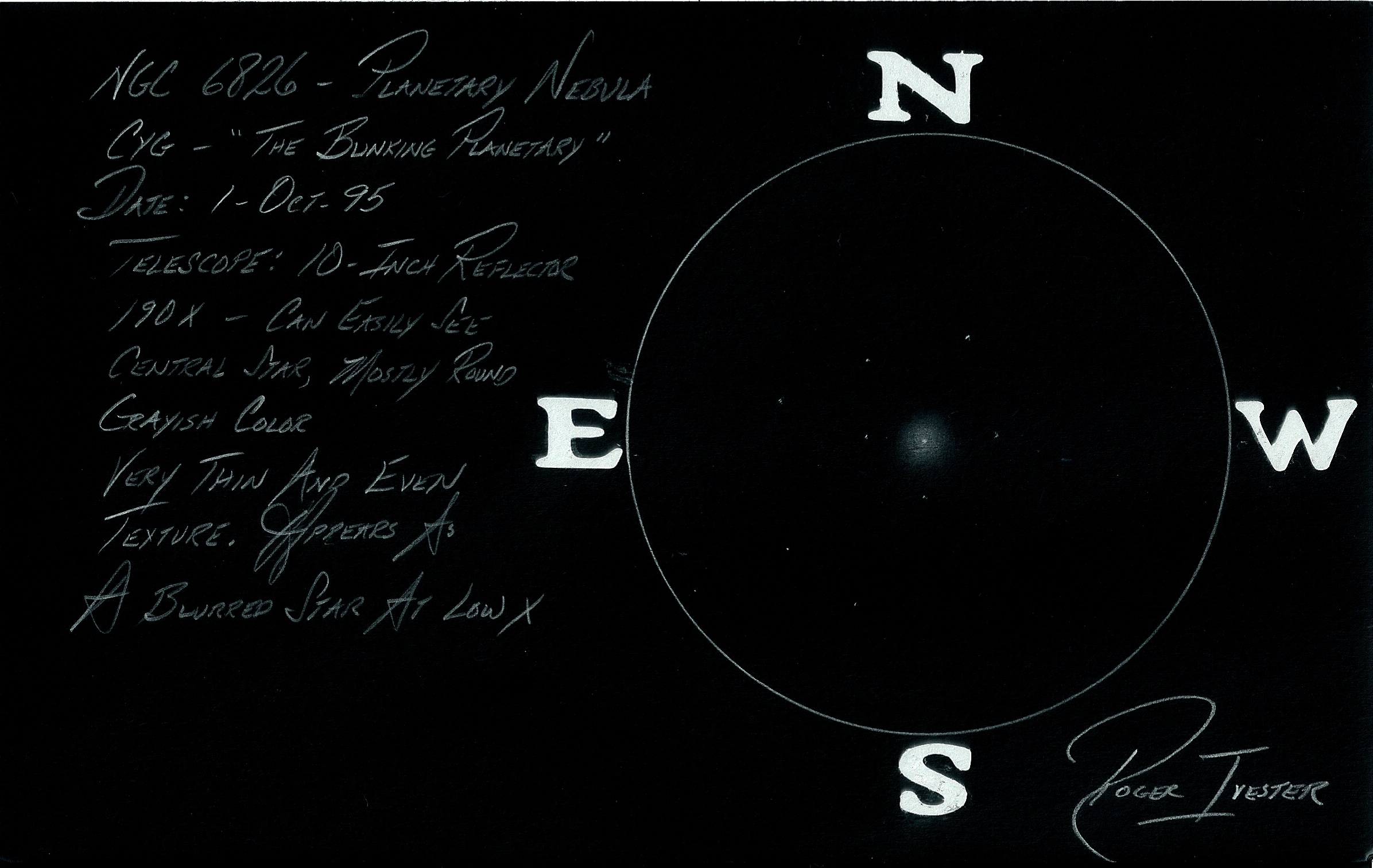
NGC 6826, also known as the “Blinking Planetary” so called because when observed with direct vision the outer nebula appears to vanish, leaving only the central star.  When using averted vision, the nebula reappears.  This phenomenon can be seen in scopes as small as a 60 mm refractor.  When observed with a 10-inch reflector at 190x this planetary appears mostly round, grayish in color, and fairly bright.  The outer nebula is fairly thin with a translucent appearance, and uneven edges.  The 11th magnitude central star appears very bright, with either a 4-inch refractor or 10-inch reflector.  The following sketch was made using a No. 2 pencil, and the color was inverted using a scanner.    

Roger Ivester 

On Saturday night, October 13th, my husband, Roger asked if I would be a part of an experiment.  He was telling me about a planetary nebula that was named “The Blinking Planetary.”  He said that when looking directly at the object, the nebula surrounding the central star would disappear.  I am not a skilled observer, so he was interested in my perception of the planetary, so I agreed, however, dubious of the blinking effect.  The 10-inch reflector was already set up in the backyard and I used a magnification of 114x.

I looked into the eyepiece and could immediately see an object that was different from the other stars in the field.  It looked like a bloated star, and it had a subtle bluish tint.  I noticed the color difference  immediately.  Roger asked me to look from left to right and then look directly in the center.  Wow!  I was surprised to see the outer part of the star disappear, and then when I looked toward the edge, it would reappear.  The central star was pretty easy to see with both direct and averted vision.  I must admit this was a lot of fun, and I was pleasantly impressed with “The Blinking Planetary.”

Debbie C. Ivester  10/14/12

To read the entire Las Vegas Astronomical Observers Challenge Report…just click on the following link…

SEPTEMBER 2012 OBSERVERS CHALLENGE – NGC-6826

M22 – Globular Cluster In Sagittarius – Observer’s Challenge – Updated: September 21st 2012

August 29, 2012

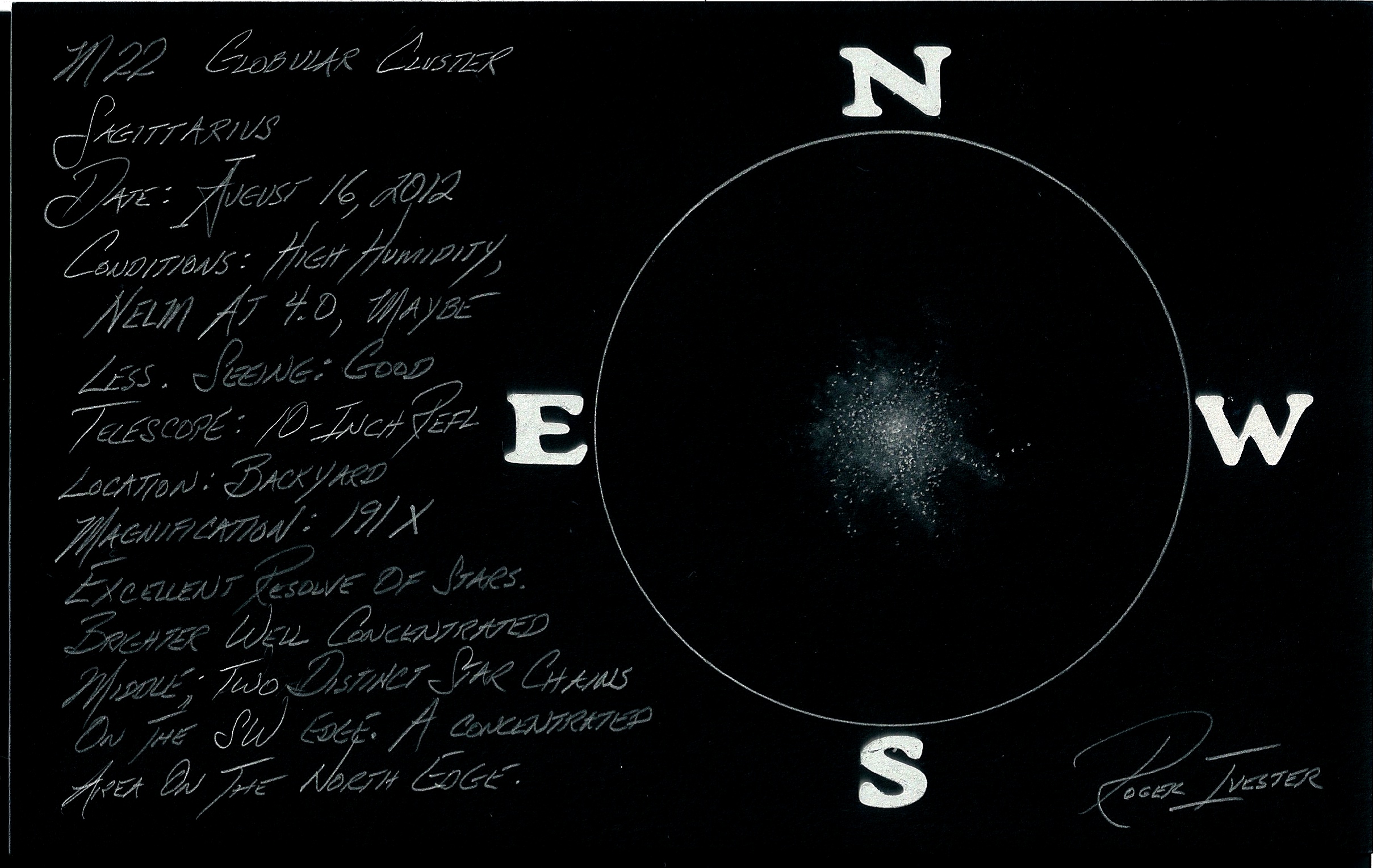
One of the most observed objects in Sagattarius by amateurs would have to be globular cluster, M22.  When viewed at 191x with my 10-inch reflector the cluster comes alive with many resolved stars.  The cluster has a brighter middle with two strings of stars leading off the SW edge.  A small concentrated patch could be seen on the northern tip, and another, however, smaller was noted toward the east. 

The following pencil sketch was made using a 10-inch f/4.5 reflector at 191x from my moderately light polluted backyard in the foothills of  North Carolina.  


After careful observing for the longest time, I would suggest that this cluster appears looking like a strange alien creature.  The star chains in the SW edge would be the legs, and the concentrated spots in the N and E would be the eyes.  It is very interesting to note that after many observing sessions over the years, I have never noticed this most interesting comparison.  

Please check out this globular for yourself and see if you too can see the alien. 

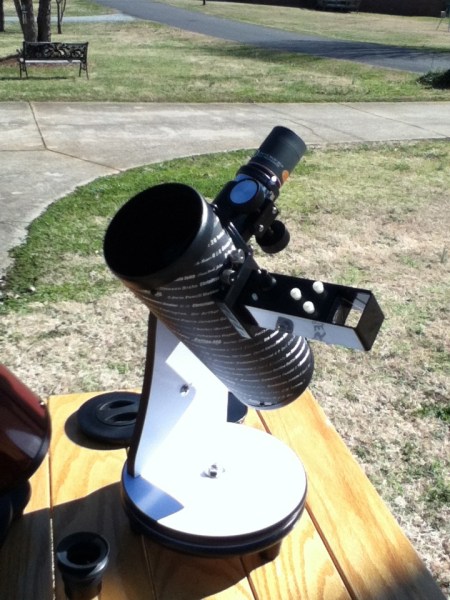
My small 76 mm f/4 reflector at 25x presents M22 as a fairly dim ball of unresolved stars.    Roger Ivester

Read the full Las Vegas Astronomical Society report, please click on the following link.

AUGUST 2012 OBSERVERS CHALLENGE – M-22

NGC 2419 – Globular Cluster – Lynx – “The Intergalactic Wonderer” Observer’s Challenge For March 2011 – Posted: August 24th 2012

August 24, 2012

See the full report:  click on the following link. 

MARCH 2011 OBSERVERS CHALLENGE – NGC-2419

NGC 2903, M105, NGC 3384 and NGC 3389 – Galaxies in Leo – Observer’s Challenge – February 2010 – Posted: August 24th 2012

August 24, 2012

Click on the following link for the full report…

FEBRUARY 2010 OBSERVERS CHALLENGE – NGC-2903 and SUPPLEMENTAL

NGC 2264 – Christmas Tree Cluster/Cone Nebula – Observer’s Challenge – January 2010 – Posted August 19th 2012

August 19, 2012

10-inch reflector:

Open cluster NGC 2264 appeared mostly sparse and course with a triangular shape.  The associated and irregular faint nebula was fairly easy to see at low magnification.  It is this observers opinion that the Cone Nebula is best seen with a much larger telescope under darker skies than my backyard.  R. Ivester

To see the the entire report, please click on the following link:

JANUARY 2010 OBSERVERS CHALLENGE – NGC-2264

NGC 2261 – “Hubble’s Variable Nebula” – Monoceros – Observer’s Challenge – January 2011 – Posted August 18th 2012

August 18, 2012

Telescope:  10-inch reflector

The illuminating star, R Monocerotis is at the southern tip of the nebula.  The comet shape or fan-tail extends toward the N-W.  Some structure was noted in the nebula when increasing the magnification to 267x.   RI

To read the entire report, click on the following link:

FEBRUARY 2011 OBSERVERS CHALLENGE – NGC-2261

NGC 1502 – Open Cluster – And Kemble’s Cascade 3º Star Chain – Camelopardalis – Observer’s Challenge – January 2012 – Posted August 18th 2012

August 18, 2012

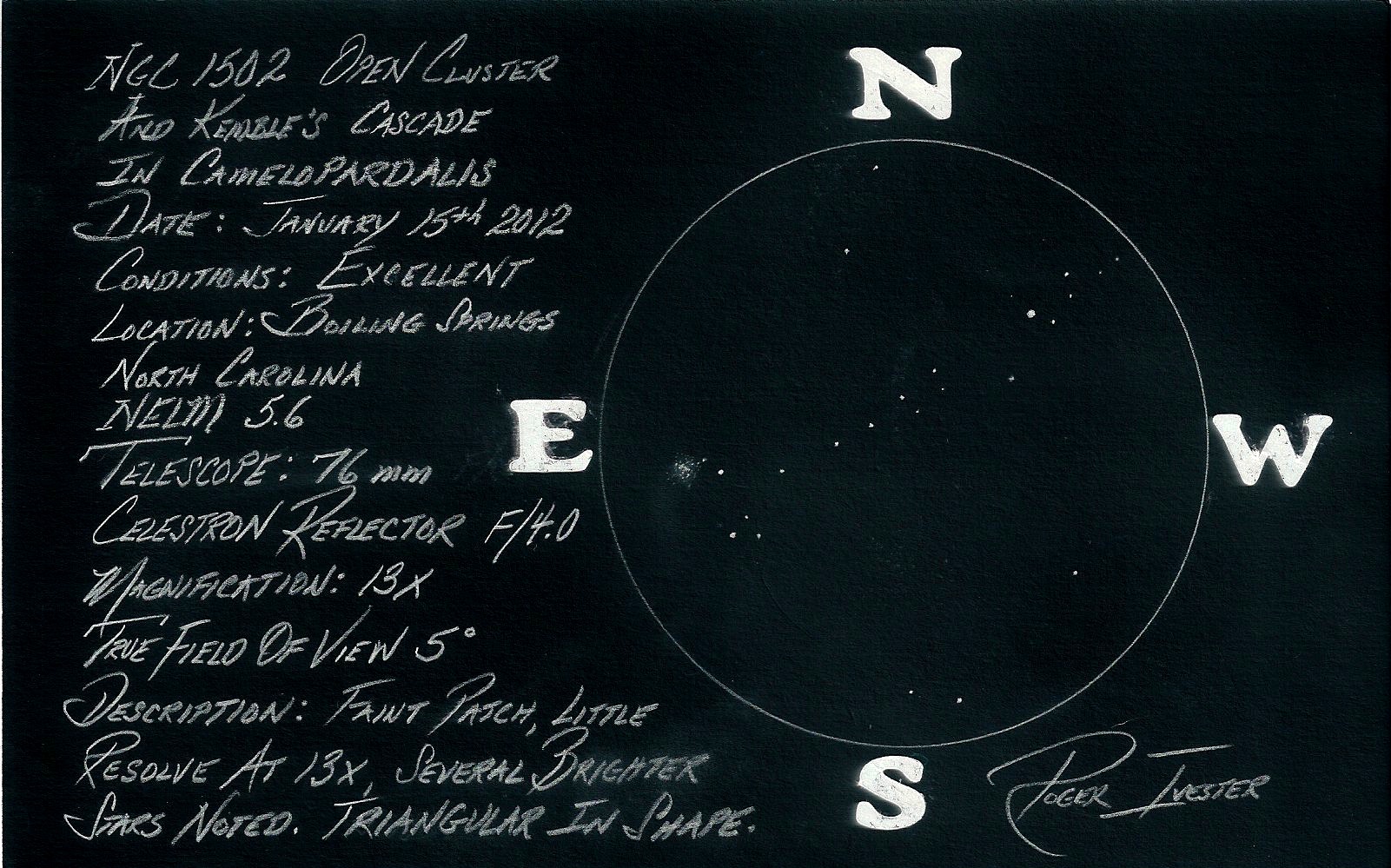
Using a 76mm (3-inch reflector) at 13x with a 3º field of view:  

I could see both NGC 1502 and most of Kemble’s Cascade, a bright chain of stars cascading from the NW toward the cluster.   At this low power, NGC 1502 appears as a faint patch with several bright stars noted with a triangular shape. 

When increasing the magnification to 70x, I could count 8-10 stars, and double star Struve 485 was very easy.  The central region of the cluster appears a bit hazy due to faint stars in the background, too faint to be resolved with the small scope.   Roger 

NGC 1502 & Kemble's Cascade-1


JANUARY 2012 OBSERVERS CHALLENGE – NGC-1502  

NGC 1333 – Reflection Nebula – Perseus – Observer’s Challenge – January 2011 – Posted August 14th 2012

August 14, 2012

NGC 1333, a reflection nebula in the constellation Perseus.  This object is very faint and associated with a 10.5 magnitude star.  At first glance, using a 10-inch reflector it appears mostly round, but with averted vision and careful viewing it becomes elongated with a NE-SW orientation.  The brightest part of the nebula is SW of the 10.5 mag. star with the NE section being much more faint with some mottling or unevenness being noted.  The overall surface brightness is fairly low, so this object is best observed using low to medium magnification.    RI

JANUARY 2011 OBSERVERS CHALLENGE – NGC-1333