Archive for May 2010

A 4-Inch (102mm) Refractor Can Be An Excellent Deep-Sky Telescope And Finally Sirius B

May 23, 2010

      Walter Scott Houston, most often used a 4-inch Clark refractor for his observations of deep-sky objects while writing the monthly “Deep-Sky Wonder’s” column in “Sky & Telescope” magazine for 46 years until his death in December, 1993.    

      When Sue French picked up DSW’s, she mostly used a 105mm refractor for her deep-sky observations over her twenty years writing the column.    

        In 1992, I purchased a copy of “The Messier Album” by John Mallas and Evered Kreimer.  This book continues to be one of my favorite references concerning the Messier objects.   

       I would later purchase a copy of the “The Messier Objects” (first edition) by Stephen O’Meara, also using a 4-inch f/5 (500 mm) Genesis Televue refractor.   

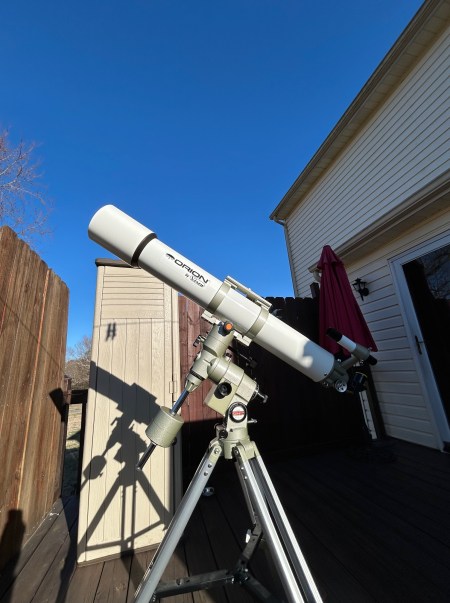
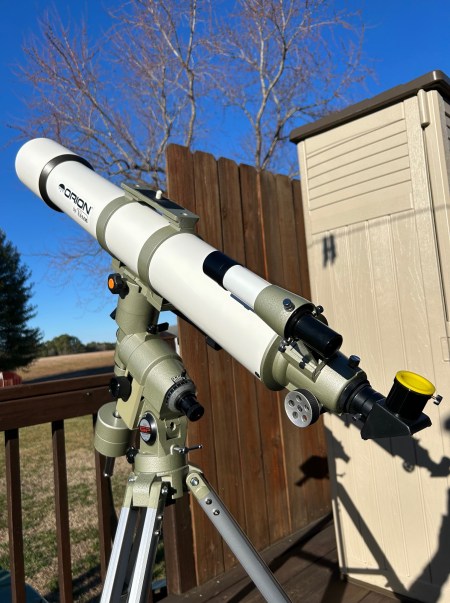
      October 1997, I would purchase the 4-inch (102 mm f/9.8) refractor as following. The telescope was made in Japan by Vixen with excellent quality.  I have used the scope for double-star work, also planetary, however, it would be used mostly for galaxies, nebula and star clusters. The telescope provides for a nice velvety background with excellent contrast of faint deep-sky objects, and on nights of good seeing it will easily perform at Dawes Limit. 

photo     

An example of my pencil sketches as following, and seeing the beautiful triple star, Iota Cassiopeia.   
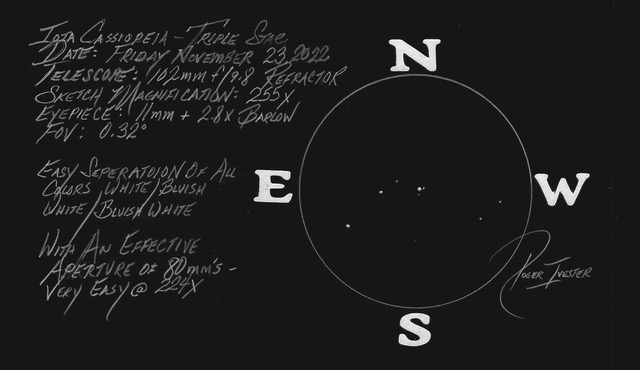
Iota Cas Roger inv 

      “Finally, after more than 40 years, I was able to see Sirius B, better known as the “Pup.”  Date of observation:  March 14th 2012     

      When Sirius B was at a relatively wide separation during the 70’s, I was using a spherical mirror, 4 1/4-inch f/10 Edmund reflector.   

March 14th 2012, and using the 102mm refractor: 

      After letting the telescope cool down for at least an hour and making a few visual test…the seeing appeared very good. An attempt to see Sirius B requires being seated, at least for me.

      I adjusted my astro-chair and removed the diagonal, and started with a magnification of 83x, but to no avail.  I increased the magnification to 232x, keeping my eye perfectly still, and looking very carefully for more than an hour.  Then suddenly, a very faint speck appeared so very close to Sirius, but winking in-and-out.   

      Knowing the position-angle really helped.  However, I could not hold the companion, or Sirius B constantly.  It was extremely difficult, but after 40 years, I had finally seen the companion to Sirius.                 

      I have always been interested in observing with a good quality refractor.  The superior contrast of a refractor can often times allow views of deep-sky objects to rival or even exceed larger telescopes of more complex designs.  

Seeing the companion to Polaris with an effective aperture of 45 mm’s. 

IMG_0023 .


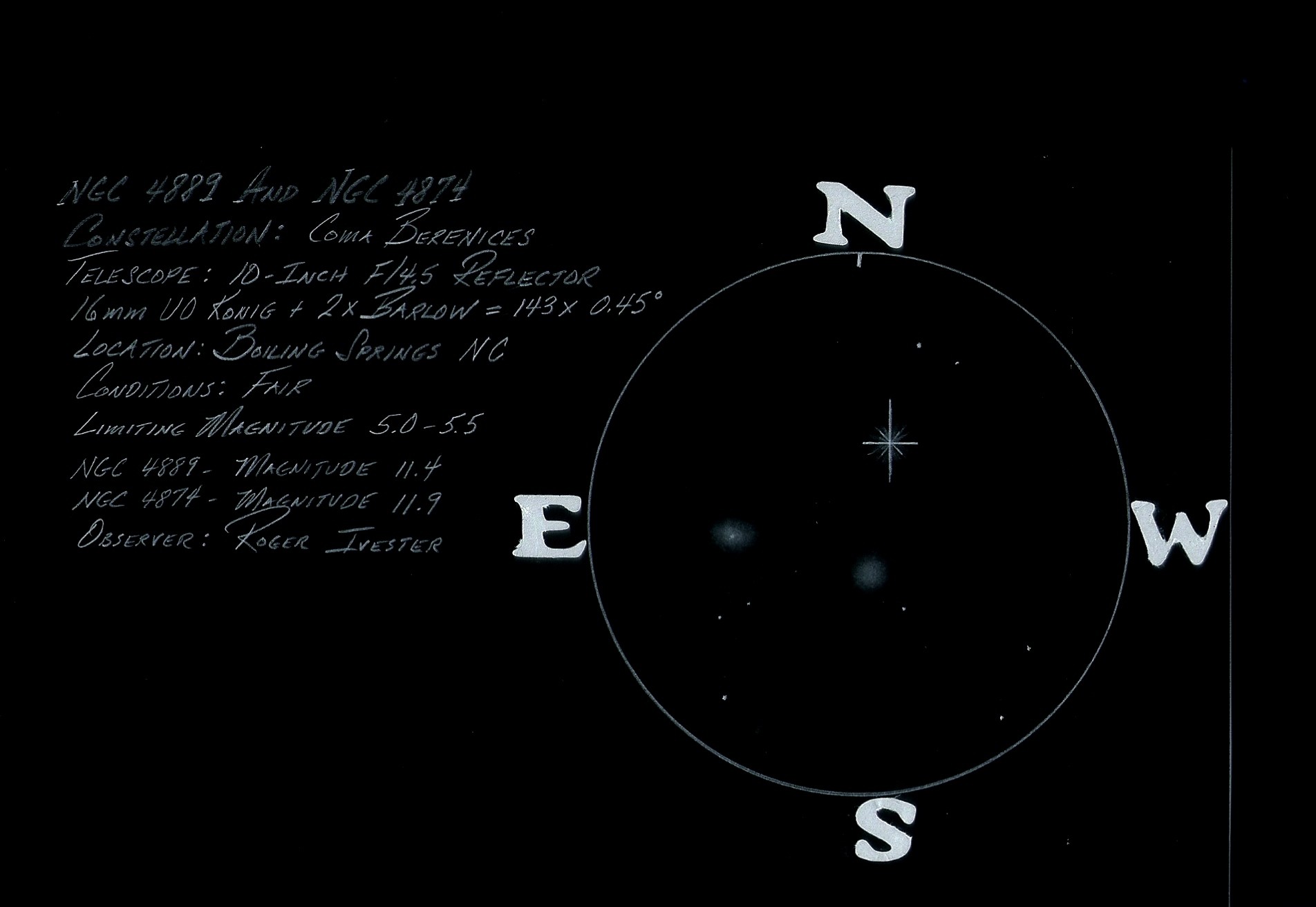
NGC 4889 and NGC 4874 – Galaxies in Coma Berenices – 10-inch reflector @ 143x

May 23, 2010

Faint galaxies in Coma

NGC 4889 and NGC 4874 10-inch reflector @ 143x

My Hand-Made “Brown Betty” Teapots From England Since 1695: By Debbie Ivester

May 23, 2010

A few years ago Roger went to see our son, Brad Ivester in Las Vegas and I was not able to go. When he came home he had me a surprise…it was a Brown Betty Teapot. I fell in love with it, as I have always had a love for teapots. But this one is so special because I neither picked it out nor asked for it…and was a total surprise.

This past January, I began to have problems with my stomach. After awhile, I noticed it was mostly in the mornings and after I had drank my coffee. So, one day I decided I was going to have to change something in my diet so I gave up coffee and dairy products and it really helped. However, I sure missed my morning coffee so I decided to try hot tea.

And after several months, I learned to love hot tea and my stomach has really improved. I drink Arbonne Clean Tox tea with local honey and it’s delicious. Now I drink lots of different teas. On some mornings I drink tea with caffeine. But at night, Roger and I drink “Camomile, Honey and Vanilla Tea” or “Celestrial Seasonings Sleepytime” and add honey.

Camomile tea has been used for thousands of years throughout the world for relaxation, sleep, upset stomach and so many other heath benefits.

I hope those of you who read my story and looked at the photos and information as following…will consider hot tea, and maybe even a “Brown Betty” teapot. Debbie Ivester

Brown Betty Facts:

Made from a special red clay found only in Staffordshire, and made exclusively in Staffordshire.

The teapot is made in a globe shape for excellent infusing of loose tea leaves.

The Rockingham glaze is lead-free.

A “Real Brown Betty Teapot” will say “Made in England” on the base. However, my newest one has it imprinted on the side also.

A few photos of the manufacturing process. Credit to “Victoria and Albert Museum”.

Mining the special red clay in Staffordshire, England.

Pouring in molds:

Molds are removed and left to dry, before firing:

Firing the teapots:

Hand dipped in Rockingham Glaze:

Stock Photo: Traditional Hand-Made Brown Betty Tea Pot by Cauldon Ceramics of Staffordshire, England. Exactly like my newest teapot!

Debbie Ivester

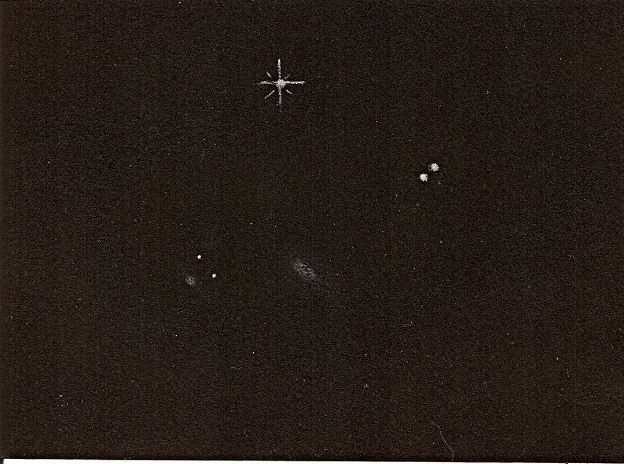
M40 Double Star, and Galaxies NGC 4290 (M11.8) NCG 4284 (M13.5) Telescope: 10-inch reflector @ 142x

May 22, 2010

M-40 Plus NGC4290 And NGC4284

The above sketch was made using a white charcoal pencil on black card stock.   Please note the very faint galaxy, NGC 4284 to the left, making a triangle with two faint stars.   Double Star, M40 makes for an excellent starting point to assist in locating the two galaxies.   roger

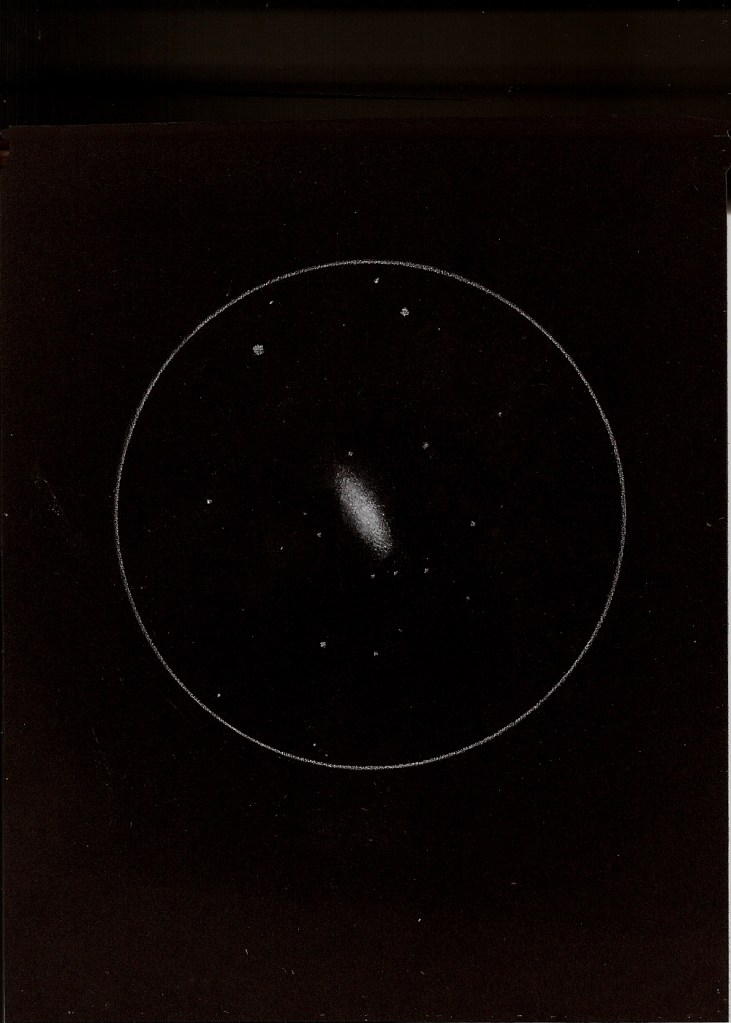
NGC 2903 galaxy in Leo, 10-inch reflector @ 143x

May 21, 2010

NGC-2903 10-inch jpg

NGC 2903 Galaxy in Leo, 10-inch reflector @ 142x

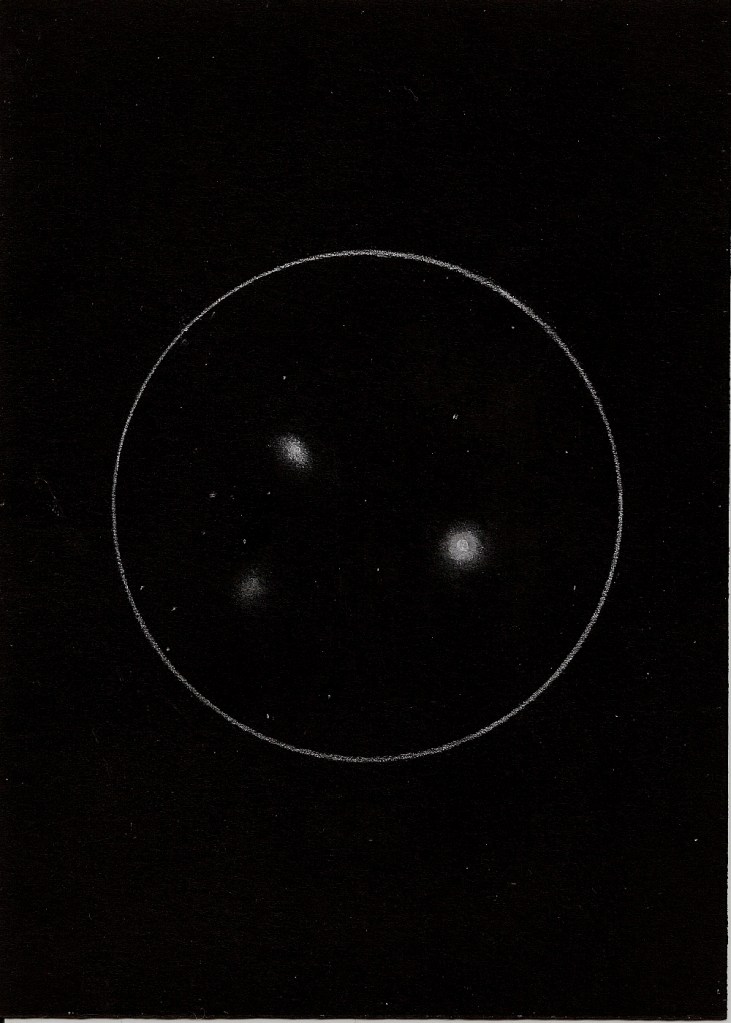
M105, NGC 3384, NGC 3389, 10-inch reflector

May 21, 2010

M105, NGC 3384, NGC 3389

M105, NGC 3384, NGC 3389

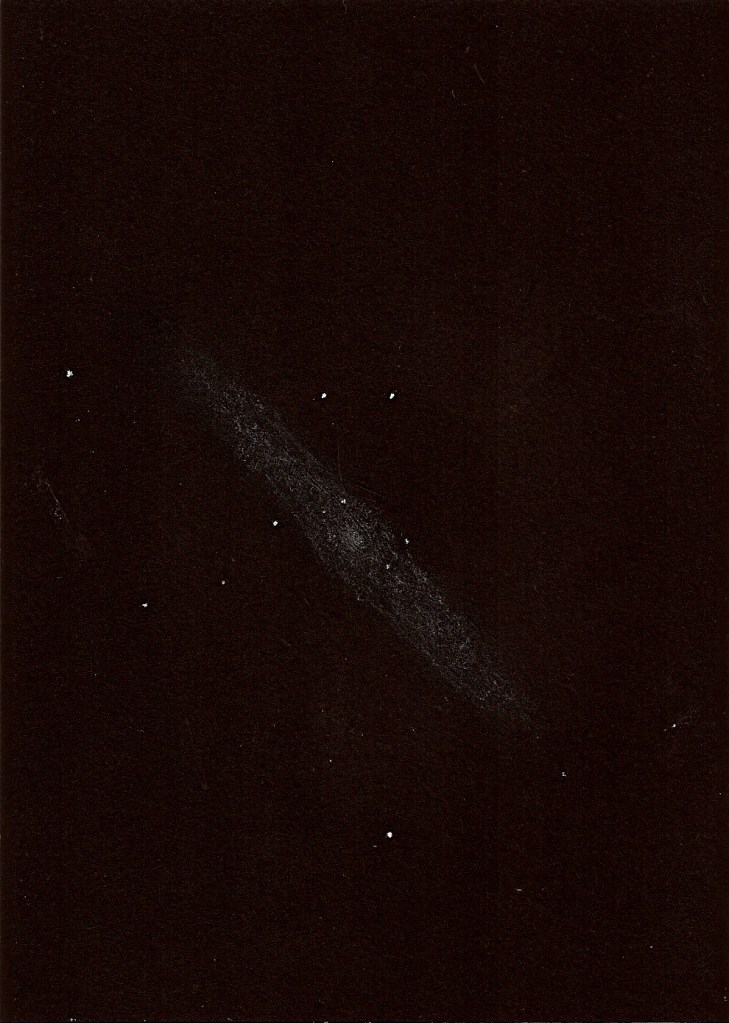
NGC 253 galaxy in Sculptor, 14.5-inch reflector

May 21, 2010

NGC 253

NGC 253, galaxy in Sculptor, 14.5-inch Reflector

“The Virgo 9” Nine Galaxies All within a 1° Field of View, When Centered on M86

May 21, 2010

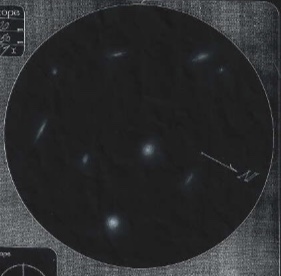
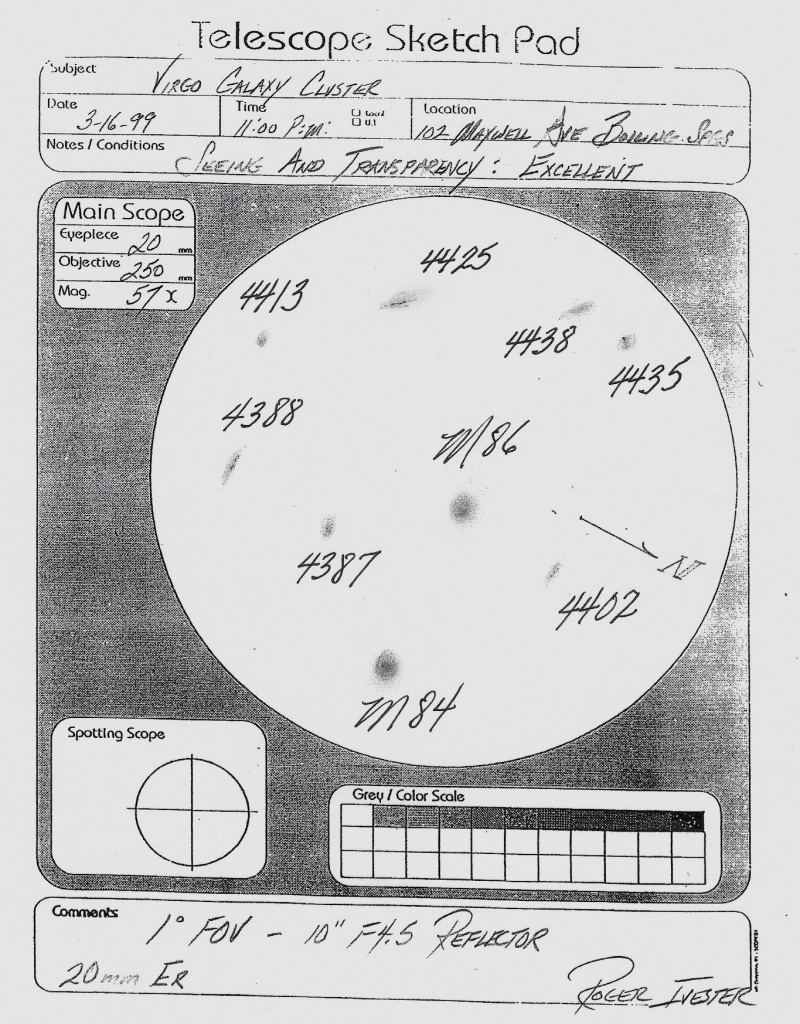
     A great galaxy group of nine galaxies when (centered on M86) however, there are a number of other galaxies in this area in very close proximity.   

     The “Virgo 9” allows anyone with an 8-inch or larger telescope, the opportunity to use a wide-field eyepiece with greater than a magnification of 100x to observe all nine.  

     I thought this unique galaxy group needed a unique name, and a modern name at that:  The “Virgo 9” sounded perfect.  

       At least three of the faintest galaxies will require a magnification of 150x or greater, or at least they did for me, using a 10-inch reflector from a suburban back yard.   I marked my sketch, changed to the higher magnification, and then sketched them in place.  Attempting to draw to scale, as close as possible. 

      I first found out about this galaxy cluster, from the late Tom Lorenzin, author of “1000+ The Amateur Astronomer’s Field Guide to Deep-Sky Observing.”   http://www.1000plus.com/#fs

     Tom asked me while waiting for darkness in a cow pasture in (March 1993) if I’d ever viewed all nine galaxies within a 1° field of view, when centered on M86.  I had not…

      However, my attempt would come a few years later on March 16, 1999.  My notes from that night are listed below, and my sketch is as following:   

fullsizeoutput_12a0

M 84:  (mag. sfc. br. 12.6)  Bright, with a brighter more concentrated middle, mostly round.

M 86:  (mag. sfc. br. 13.2)  Bright, brighter middle, round, very similar to M84, but not as well concentrated.

NGC 4387:  (mag. sfc. br. 12.9)  A very faint mostly round blur. Difficult at best, requiring averted vision.

NGC 4388:  (mag. sfc. br. 13.1)  Low surface brightness, elongated slash with an E-W orientation.

NGC 4402:  (mag. sfc. br. 13.0)  Very faint slash, low surface brightness.

NGC 4413:  (mag. sfc. br. 14.3)  Small, very faint and dim, diffuse with little concentration, mostly round.

NGC 4425:  (mag. sfc br. 13.2)  Very faint, elongated, axis N-S, small and dim.

NGC 4435:  (mag. sfc. br. 12.6)  Fairly bright, mostly round, stellar nucleus, smaller than NGC 4438.

NGC 4438: (mag. sfc.br. 13.8)  Bright, elongated with a brighter middle.

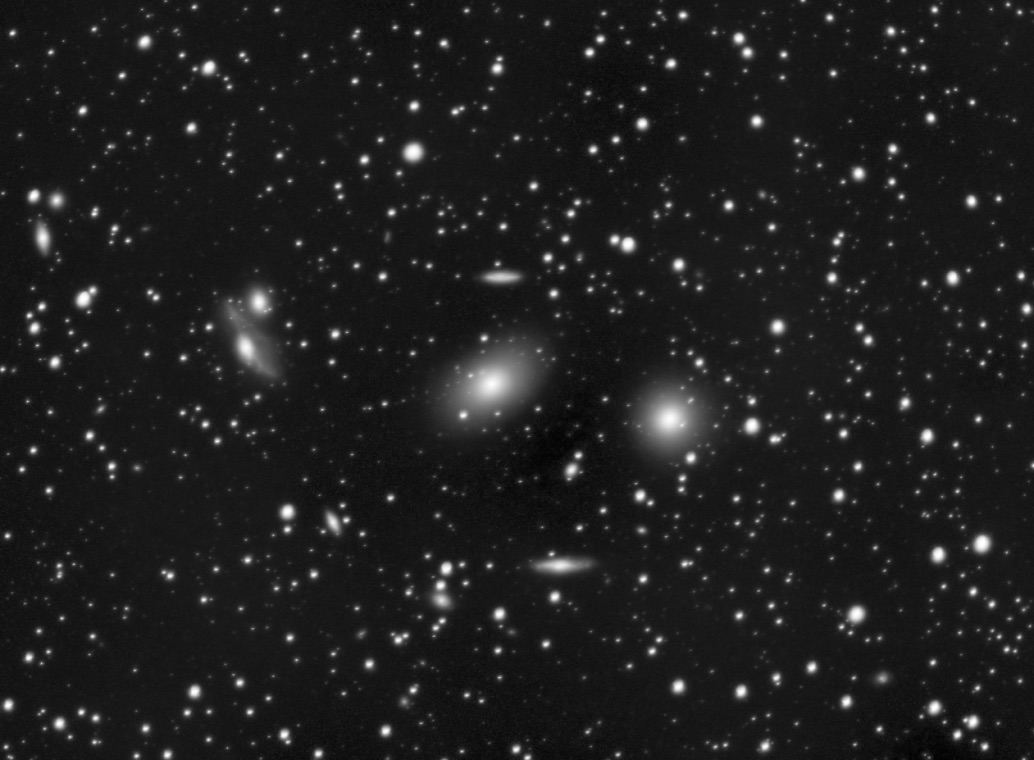
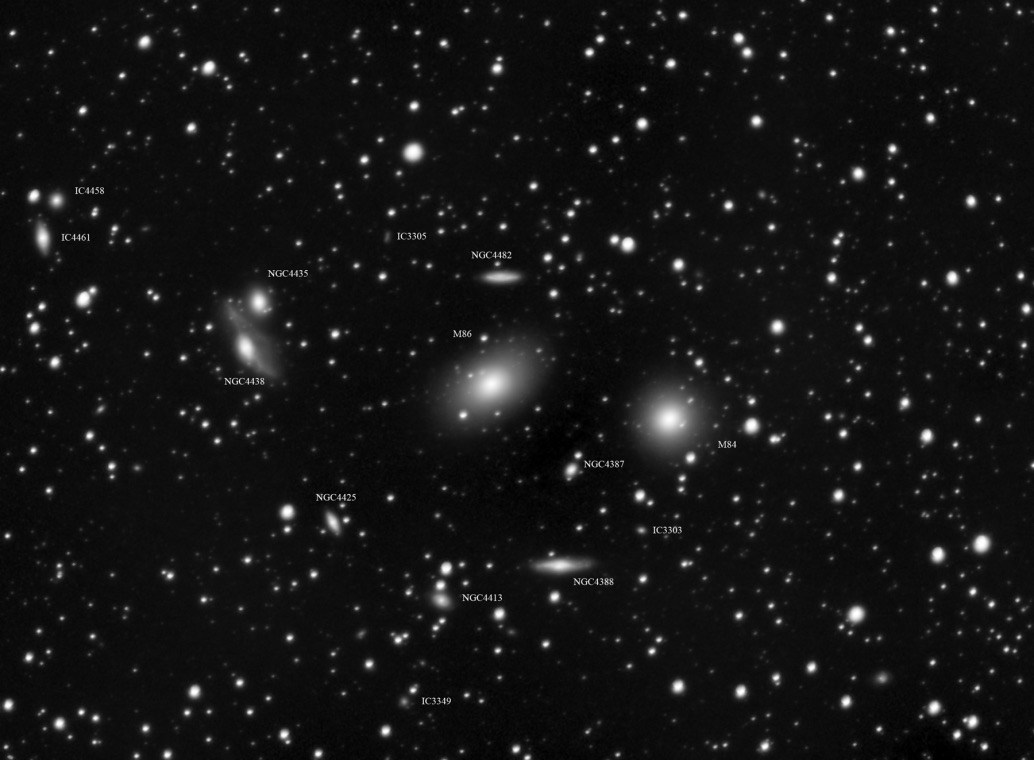
Fabulous image and a great supplemental to this post: An image of the Virgo galaxy group as following by Mario Motta using a 90 mm refractor from Gloucester, Massachusetts.

Galaxies with identification:

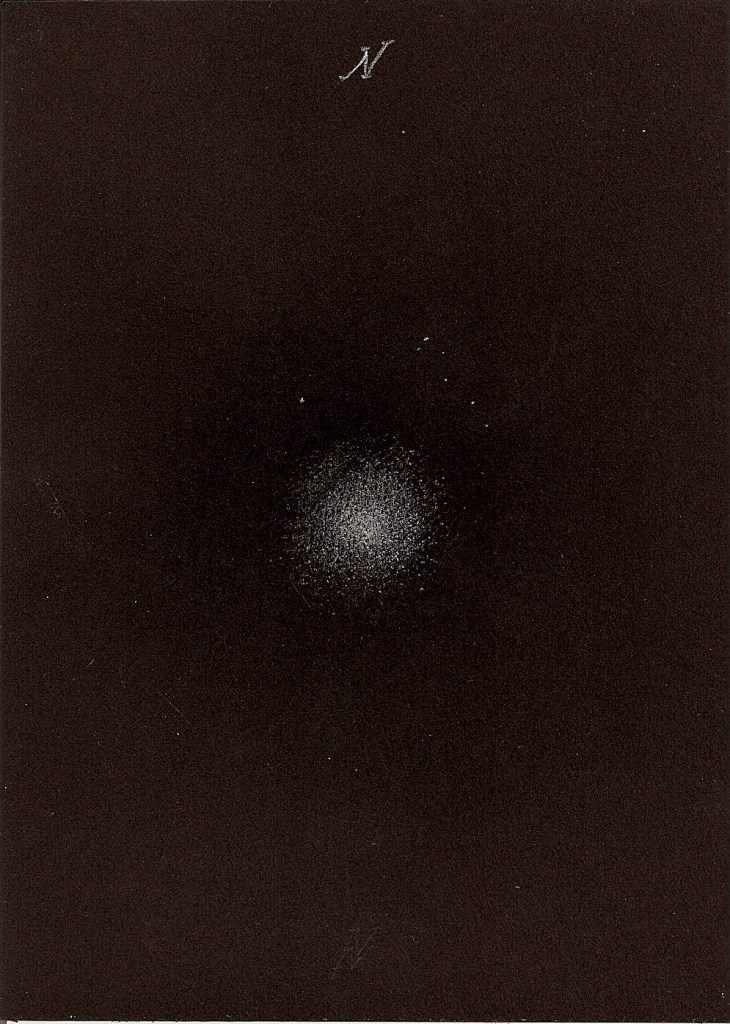
M2 and dark lane, 4-inch refractor

May 21, 2010

M2 Globular Cluster, Aquarius

M2 and Dark Lane, Scope: 4-inch refractor @ 175x

Helix Nebula – 12-inch reflector @ 60x

May 21, 2010

Helix Nebula 12-inch @ 60x

Helix Nebula 12-inch Reflector @ 60x