Polaris has never gained much attention as a double star. However, If you’ve had an interest in double stars, but never seemed to get started, Polaris would be a great double to start with, especially with a smaller telescope.
For this project, lets call a small telescope, anything 80mm’s or less.
Information from the “Cambridge Double Star Atlas” by James Mullaney and Wil Tirion, as a reference:
Polaris has a magnitude of 2.1 and the secondary or companion at a much fainter 9.0 magnitude with a wide separation of 19 arc seconds. The extreme difference in magnitudes can make this double more difficult to separate than you might think, especially if seeing is less than good.
Sometimes I check this star frequently, when setting up, to gauge seeing. I have some notes and sketches from years past, and current using some small telescopes.
September 1996: 4-inch Meade Schmidt-Cassegrain f/10, model 2045d: Seeing very good, could easily see the companion at 50x. RI
September 1996: 5-inch C5 Schmidt-Cassegrain, white-tube with the single arm fork. Made in USA. Easy, beautiful and clean. RI
February 1997: 4-inch Meade Schmidt-Cassegrain f/10, model 2045d: Seeing only fair. The companion was visible only intermittently. RI
October 1997: 90mm Meade ETX Astro-Scope, Maksutov-Cassegrain: Seeing was good and the companion was very easy at 52x. RI
December 1998: 102mm Vixen/Orion f/9.8 achromatic refractor: Very easy to see the companion at all magnifications. Roger Ivester
I was unsuccessful during the week of April 8th 2018, using my latest small economy Orion CT80 f/5 refractor. Seeing was only fair, so I’ll try it again in the next night or so. Roger Ivester
April 17th 2018: 102mm Vixen/Orion f/9.8 achromatic refractor: Seeing was very poor, could still see the companion, but only intermittently, using full 102mm aperture. Did not even attempt with an effective aperture of 60mm’s. Roger Ivester
Mike McCabe of Massachusetts was able to see the companion last summer on a night of excellent seeing, using a vintage and classic Sears 60mm f/15 refractor.
Observing notes by Mike McCabe as following, for the night of April 18th 2018: It’s been great getting to know Mike, who is an experienced and skilled observer.
Notes from Mike McCabe:
Well, you really got my interest with your lobbying everyone to try and go see the secondary to Polaris with a small scope. I got lucky here last night – totally unexpected it was – with a clear and stable sky sometime around 9pm local time.
At first I turned my interest to the 10% waxing crescent moon, and I brought out my SV80ED to have a quick look. It was spectacular, with incredible earthshine on the moon and a dark, clear sky around it. There were nearly as many stars in the view as you’d see during an eclipse! I watched the moon occult a star (don’t know which one) and then toured the Haydes, the Pleiades and then Polaris. The 80mm brought out the secondary with no trouble.
I decided to bring out the Sears 60mm f/15. That was a good decision! I put Polaris in the eyepiece and ramped the power up to 112x. In short order I had the secondary in view at an ~5:00 position in the field of view.
I have another 60mm f/15 OTA (a 1980’s era Celestron FirstScope) which I am currently setting up. I’m wanting to complete the Astronomical League’s Double Star list to receive my certificate which I started working on quite a few years ago, but have never finished. Mike McCabe – Massachusetts
Luna Brannon, North Carolina:
March 2022: Using a 100mm f/5 achromat with an ES 11mm 82º eyepiece with the employ of a 2.5x Barlow (magnification 113x), I was able to view Polaris and its companion. Applying the 50mm sub-aperture mask allowed me to watch it continuously as the image dimmed, so that I would not lose the companion star. Having committed the star’s position to memory, I was then able to see it again without transitioning directly from the 4-inch aperture. The companion star is easily split in terms of spatial resolution, it’s really just the dimness that’s the problem. From a dark site I imagine it’d be easy to get down to 40mm or less and still see the companion.
Roger Ivester, April 19th 2018:
102mm Orion/Vixen f/9.8 achromatic refractor with an effective aperture of 60mm’s. Seeing excellent: 12.5mm eyepiece plus a 2.8x Barlow for a magnification of 224x. The companion was visible as a tiny bluish dot.
Roger Ivester, April 19th 2018: Orion 80 mm (CT80) f/5 achromatic refractor.
Seeing excellent: 12.5mm eyepiece plus 2.8x University Optics Klee Barlow for a magnification of 90x. The companion was visible as a tiny bluish dot. Very similar to the view using the 102mm reduced to 60mm’s. A beautiful sight in both telescopes.
April 20th 2018: Orion 80mm (CT80) f/5 achromatic refractor. Similar conditions to my observation on the 19th. Using the same eyepiece combinations (90x) and was able to easily see the companion as a tiny bluish dot.
“Celestial Objects For Common Telescopes” By Rev. T.W. Webb – 1859
“Spec. Bin., and slightly var. D., 9 blsh. as I see it. Common test, but only suited for small apertures, being easy with anything much exceeding 2 in. D. has proposed it as a general standard, finding that 80 on 2-in. will show it if the eye and telescope are good; he has glimpsed it with 1 3/10-in. achr. Dawson has glimpsed it with 1-inch. T. T. Smith sees it with 1 1/4-in. refl. In Dorpat achr. it has been perceived by day. De. gives it 8.4 m.”
1 3/10-inch = 33 mm’s
1 1/4-inch = 32 mm’s
1-inch = 25.4 mm’s
The following is a photo of my 102mm refractor with a stop-down mask for an effective aperture of 60mm’s.

Orion (CT80) 80mm f/5 refractor, photo following: I could see the companion to Polaris with this small short focal length achromatic refractor! And when stopped-down to 60mm’s.
My son surprised me with this telescope for my birthday, and it will always be a prized possession of mine. He lives on the west coast, so it was a real surprise for a UPS truck to show up, and not knowing what the delivery was. 🙂

102mm f/10 refractor, stopped down to 35mm f/29 refractor telescope: (See the following photo)
Unfortunately, I’ve never been able to see the companion with the 35mm effective aperture, to-date. (Date: March 20th 2024)
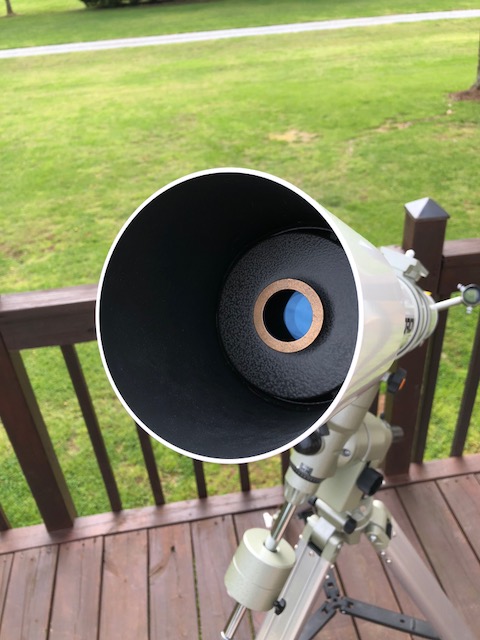
May 2, 2018: This was the third night in my attempt to see the companion using an effective 35 mm aperture. Seeing was only fair, and could not see the companion, nor with a larger 45mm effective aperture.
April 2nd 2018: Report by Richard Nugent as following:
Roger, thanks for inspiring me to observe Polaris and it’s faint companion star, Polaris B. As I mentioned I’ve observed the pair more these past few weeks than in total over the last five decades! I’m glad I did. Here’s my report to date…
Polaris B is about 19” away from Polaris so separation is not the issue. Seeing the B star only requires an aperture with a faint enough limiting magnitude. Of course, on any given night, a telescope’s limiting magnitude is dependent on many factors that are difficult to quantify. Limiting magnitude tables seem, to me, to be overly optimistic!
…..I was finally able to see the companion with a 10-inch Newtonian with a 40 mm effective aperture. Richard Nugent
May 6th 2018: The following report by Roger Ivester
Last night, seeing was excellent, and a 6-inch f/6 reflector, with an off-axis 45 mm effective aperture, could glimpse the companion, but with extreme difficulty. This required over more than an hour, using good breathing techniques, as it’s easy to “involuntarily” hold your breath when attempting a close or faint companion, such as Polaris B. I also used an eyepatch over my non-observing eye, to relax my face.
It’s my opinion, it’s “next to impossible” to observe a difficult double, or any deep-sky object while standing. I always use my astro-chair while observing, and making a pencil sketch. Roger Ivester
Richard Nugent would seem to have the have the modern day record, or at least the only amateur I know personally, who has seen the companion to Polaris with a 40 mm effective aperture. This was using a 10-inch Newtonian with a 40mm off-axis stop-down mask.
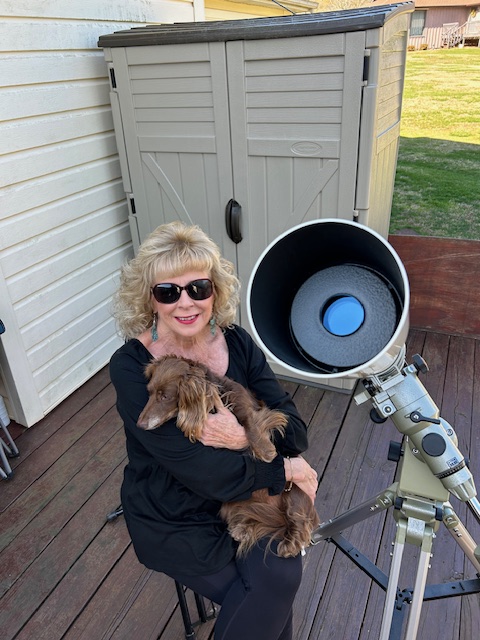
Roger Ivester, March 21st 2024 @ 5:30 AM EDT, with an effective aperture of 45 mm’s.
I could see the companion, with an effective aperture of 45 mm’s using a magnification of 233x. However, it was very difficult, and could only see during moments of steady viewing.
Photo of my 45 mm effective aperture…as following.
 rogerivester.com
Recent Comments