Archive for March 2021

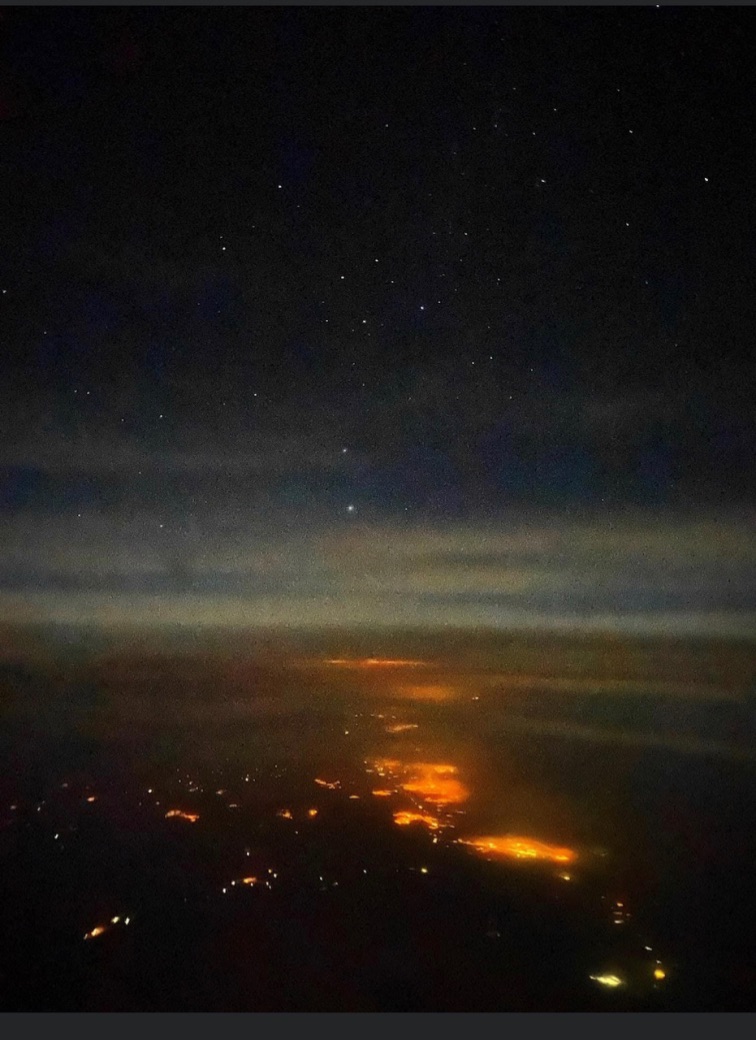
The Southern Cross by Commercial Airlines Pilot: James Yeager

March 29, 2021

Jim Yeager has always allowed me to use any of his aerial photos, which over the years have included, a beautiful photo of the Barringer Crater in New Mexico, covered with snow, and the Mount Potosi Observing Complex in SW Nevada. Both of which I’ve used in previous blog articles and other.

I really like the following image, as I’ve never seen the Southern Cross.

Jim’s notes and photo:

Here is somewhat of clear picture taken with an iPhone using a 3 second exposure on a descent out of 41,000 feet about 100 miles north of Lima, Peru.

You can see Alpha and Beta Centauri pointing to the Southern Cross.

The residual cockpit lights, moonlight behind us, and the haze of high altitude cirrus kept us from seeing the Magellanic Clouds.
Other aerial photos by Jim Yeager:

https://rogerivester.com/category/mount-potosi-observing-complex-in-southern-nevada/

https://rogerivester.com/2016/12/06/aerial-view-of-meteor-crater-compliments-of-james-yeager-pilot-american-airlines/

NGC 2685 – Galaxy In Ursa Major – March 2021- Observer’s Challenge Report # 146

March 18, 2021

MONTHLY OBSERVER’S CHALLENGE

Compiled by:

Roger Ivester, North Carolina

&

Sue French, New York

March 2021

Report #146

NGC 2685, Galaxy In Ursa Major

Sharing Observations and Bringing Amateur Astronomers Together

march-2021-observers-challenge-_ngc-2685-2

Introduction

This month’s target

German astronomer Wilhelm Tempel discovered NGC 2685 in 1882 with an 11-inch refractor. Loosely translated, his discovery description reads: Good II-III; round; with a small star in the middle; stands 4′ south of a 10th-magnitude star. 

In the Hubble Atlas of the Galaxies, Allan Sandage states, “NGC 2685 is perhaps the most unusual galaxy in the Shapley-Ames catalogue.” While most astronomers would agree with this, there remain various opinions as to why. NGC 2685 is generally regarded as a polar ring galaxy wrapped in exterior hoops of gas and dust aligned nearly perpendicular to the plane of the galaxy’s lenticular disk. The rings may have been birthed by a merger and/or accretion event. A less touted viewpoint is that this galaxy is strongly warped, and the semblance of rings is merely the result of projection effects.

This perplexing galaxy lies roughly 50 million light-years away from us. As seen photographically, the unusual array of gas, dust, and resultant stars entwining the Helix gives rise to its name. The galaxy may also house a supermassive black hole. Sue French

How to Choose Your Telescope Magnification – Sky and Telescope Magazine: By Al Nagler

March 9, 2021

One of the best articles I’ve ever read concerning the calculation of “everything” involving telescope eyepieces….as following:

https://skyandtelescope.org/astronomy-equipment/choosing-your-telescopes-magnification/

I was fortunate to meet Al Nagler a few years ago at the Southern Star Astronomy Convention in Little Switzerland, North Carolina.

Al gave a great presentation concerning eyepiece designs and calculations, based in-part on the above link.

The story:

There was a cancellation by a scheduled Southern Star participant, the last minute. I knew Sue French and Alan were at NEAF. So I called Sue via telephone, asking if Al Nagler was there, and if so would he be interested in giving a presentation for the convention.

Sue called back and said Al was “indeed” interested. I got things worked out with the Charlotte Amateurs and plane tickets for both Al and his wife…and the rest is history.