This is a very difficult object visually, very faint surface brightness, due in-part to its large size and attenuation from outer spiral arms.The following image was made using my 32-inch f/6.5 telescope, with ASI 6200 camera. Total of 40 subs 5 minutes each,of Lum, R,G,B filters, and then 50 minutes of H alpha as well to bring out the surprisingly large number of H alpha regions you can see. Processing in Pixinsight, used especially modern processing techniques of Starnet 2, that allows “removing” foreground stars to enable processing the faint background, then adding the stars back in. (without this, nearly impossible to process properly).
Roger Ivester: Observer from North Carolina
IC 342, is a faint galaxy in Camelopardalis, and can be very difficult for the visual observer, due in-part to the low surface brightness and large size, requiring a dark sky with excellent transparency.
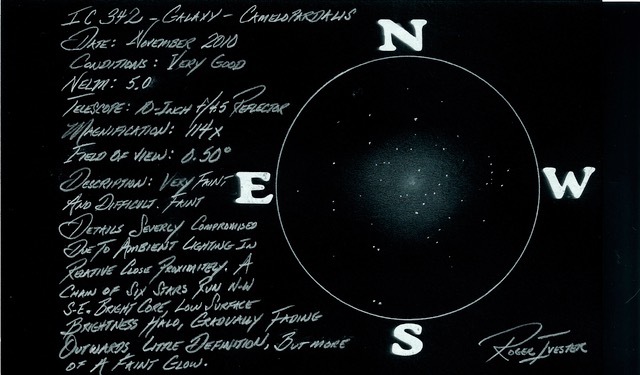
I made all observations with a 10-inch reflector from my moderately light-polluted suburban backyard. On a 5.0 NELM night, I located and observed this galaxy rather easily. A chain of six stars, with an orientation of NW-SE, lies a few minutes SW of the faint core.
This galaxy is best observed with low to medium magnification. I used 114x for the following pencil sketch. The 10-inch presented IC 342 as little more than a large faint glow without structure. A faint and small core could be seen with averted vision, with the absence of visible detail being attributed to the lack of a dark site, which reduced the contrast significantly.
On a night of lesser seeing and transparency, I was unable to see this galaxy with my 102mm refractor.
James Dire: Observer from Illinois
IC 342 is one of the most unique galaxies in the heavens due to its orientation, size and brightness. It’s a face-on spiral galaxy approximately 20 arc-minutes in diameter and glows at mag 9.67. Because of its size, brightness and orientation, it’s very hard to see visually. It spans only 1/3 the distance across as the face-on spiral M33 in the constellation Triangulum, which is 35 times brighter.So M33 is easier to see in a telescope.
IC 342 has about the same total luminosity as M100, a face-on spiral galaxy residing in Coma Berenices, however, since it spans three times the diameter as M100, but M100 is much easier to see visually.
The only face-on spiral galaxy with the same angular size that comes to mind is M101 in Ursa Major. However, M101 is 5 times brighter, so big light buckets reveal M101’s spiral arms with much greater ease.
IC 342 lies in the northerly constellation Camelopardalis. It is slightly southwest of the midpoint between two mag. 4.5 stars, Gamma Camelopardalis and BE Camelopardalis. The two stars are 5.75° apart.
To see IC 342 in its splendor requires a long exposure with an astronomical camera. The galaxy is classified as a weakly barred and loosely wound spiral galaxy.
The Hubble classification SABc. (S means spiral, AB means weekly barred, and c means loosely wound spiral arms). In barred spiral galaxies, the spiral arms usually originate at the ends of the bar. On IC 342, there appear to be two spiral arms originating from each end of the galactic bar. The arms tend to fan out as one traces them away from the bar. My image of IC 342 as following, was taken January 6, 2010 at the Wildwood Pines Observatory in Earl, NC.
I used an SBIG ST-2000XCM CCD camera, operating at -20°C, attached to a 190mm (7.5-inch) f/5.3 Maksutov-Newtonian telescope. The exposure was 60 minutes.
Sue French: Observer from New York
“Deep-Sky Wonders” P-15.
“….105mm scope at 28x, this pretty galaxy is a vaporous phantom spangled with faint stars. It appears oval, its long dimension running north and south with a 12′. From a dark-sky site with his 105mm refractor, noted observer Stephen O’Meara has been able to trace out IC 342’s three main spiral arms.”
The following pencil sketch was made using a 10-inch reflector at 88x.
Christian Luginbuhl and Brian Skiff: “Observing Handbook and Catalog of Deep-Sky Objects”
“….Large galaxy is relatively easy to see in small apertures at low powers. In 6 cm it is a faint blob north of a loose clustering of stars.”
“…25 cm a string of six stars runs SE-NW through where the object is seen in 6 cm.”
Warren D. Ivester: (1913-1986) Ruby Whisnant Ivester (1919-2006)
My Daddy loved sports cars. The following blue convertible is a Fiat 124 and the orange one (second photo) is a very rare Datsun Fairlady.He also had a couple more European cars, which was another Fiat and a French Peugeot.
Warren Ivester: “Circa 1976” driving his 1965 Datsun Fairlady1500 Roadster. A very rare car with a high-performance 4-cylinder (1,488cc engine) twin-carburetors and a four-speed transmission.
My Dad had an engineering mind with an ability to improvise a mechanical fix when he didn’t have the necessary parts. This was especially true as related to cars which were always his passion. In the early days, I remember him cutting copper-shims and placing underneath engine bearings rather than using new bearings. However, this was a common practice during the early years and even into the 60’s.
Helping my Dad at our home garage:
The garage was a very humble building with a dirt floor and comprised of a conglomerate of salvaged materials with a small coal burning stove.
While my Dad was rebuilding an engine or doing some serious engine work, I would try to help. And one of my jobs was to grind valves and valve seats in head blocks, when necessary. I would use a tool with a suction stopper on one end, attached to a wooden handle, using a variety of abrasives.
Born in 1913, my Dad grew up on a farm in the foothills of North Carolina when most roads in the area were dirt and things were far different than today. Those were the days of Ford T’s and later A-Models.
When my Dad was born it was only 10 years after the Wright Brothers made their first flight in December 1903, lasting only 12 seconds. And one year after the Titanic sank on April 12th 1912.
Working on the family cotton farm:
He would later begin working as an auto-mechanic, and would work for himself at times and then at many different garages over the coming years.
The story of the Savannah River Nuclear Facility:
My Mom told me on numerous occasions….Dad had an offer to work at the Savannah River Nuclear Facility, but decided against it. This facility was being built in the early 50’s to produce and fabricate nuclear weapons, primarily tritium and plutonian-239. Some “seriously dangerous materials” for sure! I can’t remember or be sure as to why he didn’t take the job, but was not due to the plutonian-239.
However, if my Dad had taken this job, it would have for certain changed the trajectory of my family, and It could have been beneficial to the family finances for sure.
It could have been really good for me also: As I needed my own bicycle, a serious astronomical telescope, a Lionel electric train, and other essentials that kids needed in those days. 🙂
Moving the Cape Hatteras Lighthouse:
When engineers were trying to figure out how to move the Cape Hatteras Lighthouse further inland, away from the ocean, I remember my dad having his own thoughts. The Outer Banks of North Carolina are very unstable land masses and constantly changing. His thoughts were as following, and I remember hearing him say the following, on a number of occasions.
“……it needs to be lifted up using the same principle as moving a house, then installing a massive rail-system underneath. The rails would extend the entire distance to be moved, or to its new and final resting location. The lighthouse would have to be moved very slowly, maybe only inches a day, which would allow very close monitoring of the process.”
Well…this was pretty much the exact way the famous lighthouse was moved.
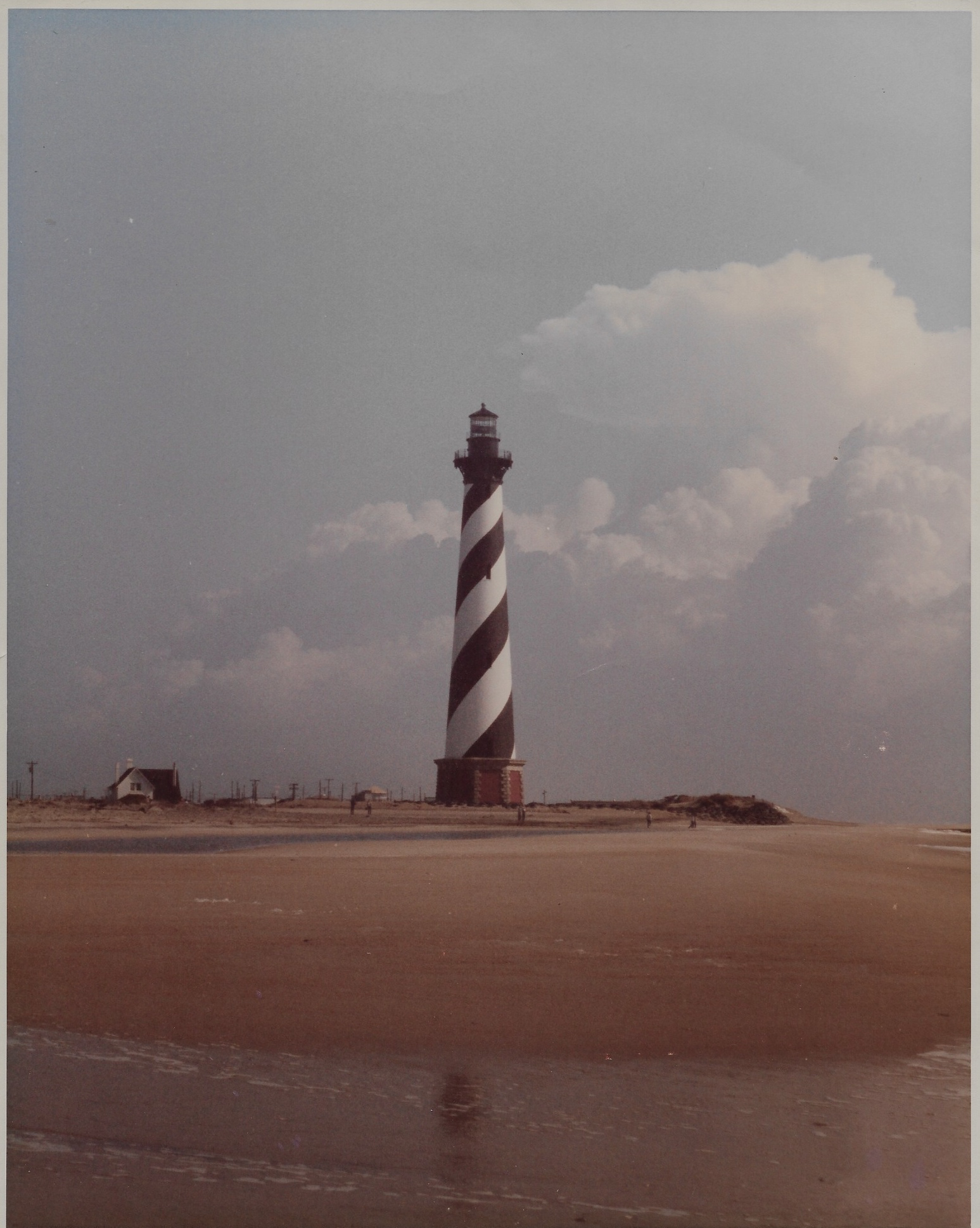
I made the following photo in April 1982 of the lighthouse in its original location, before being moved. Note how close the lighthouse was to the beach and ocean. Moving this massive structure was definitely an engineering marvel.
My Mom was the mother to six-boys and a wonderful mother she was.
She was very intelligent, excellent in math, very artistic, beautiful handwriting and well read in so many subjects. And this was many years before the internet. She would purchase one encyclopedia every month from the Shelby Winn-Dixie. We would get our groceries at Winn-Dixie, on either Friday nights or Saturday afternoons and most of the time I’d go. Our house was about 15 miles from Shelby, and we called this…going to town.
We received the National Geographic magazine, for about ten years, from about 1960 to 1968. With the addition of our grocery store encyclopedia’s, what more could we possibly need to learn about everything? My Uncle Boyd and Aunt Shelley who lived in Virginia gave the National Geographic magazines, to me and my brothers, in those early years. I remember being excited when the magazine came to our FFA (Future Farmers of America) concrete pedestal mailbox, each and every month. One of my brothers made the mailbox at Polkville School, and brought it home on the school bus.
How my Mom saved me from going to prison when I was 9 years old!
I sent off for a free stamp coin collection, or maybe it was all for a dime I’d sent them. Then I started receiving more and more (worthless) international stamps and more and more books.The company was located in Garden City, New Jersey. I then received a bill for $35. But, what to do? I just ignored the letter, but a month or so later they sent me a serious legal letter.
They advised me to seek legal counsel, as they would be sending their attorney to meet with me and my attorney in Shelby, NC, within the month. But my stamps/coins and books were suppose to be free…or covered by the dime I’d included in the envelope!
I showed the letter to my mom, and it scared her to death!
She quickly looked in our “savings” drawer and counted out $35 and put in an envelope. I’ll never forget the both of us cramming the stamps and books into a box with the money. Yes…cash in an envelope and sending to a bunch of shysters in New Jersey!
Relief! My life was saved!My Mom just couldn’t let her her youngest son go to prison for $35. The real criminals were the folks at the stamp and coin mail order company. (Note: Many years later, a law was passed by Congress, that allowed people to keep anything they didn’t order.) And I didn’t order boxes of books stamps, cheap aluminum coints and worthless books! Considering inflation, the $35 would be equivalent of $366 as of 2025. And my family needed this money!
When I was in about the 1st-4th grades (~1960-1963) she would work at a sewing company in Cherryville, and would ride with some of her friends in the area, who also worked there. My Mom would never have a drivers license. During periods when she was not working, she loved to watch soap operas, which she called “the stories.” She would talk with a few of her local friends on the telephone about the stories as if they were real. One thing for certain….she loved her family.
My mom also taught me so much about the Bible when I was really young, which inspired me to read the Bible, and my belief in Jesus Christ. I would begin to read the Bible on a regular basis, and had a couple that were given to me by my church. However, my favorite was a small Bible given to me at Polkville School, by the Gideons. Somehow at 11 or 12 years old, I managed to memorize the entire 34th Psalm. This is an amazing Psalm that says so much.
I remember so well, my Mom reading to me: Luke 16:19-31 KJV: She talked with me about Hell and eternity and said: “Can you imagine, constant torment that never ends?” Even at a very young age, this for sure caught my attention!
My Dad standing in the backyard during the summer of 1984:
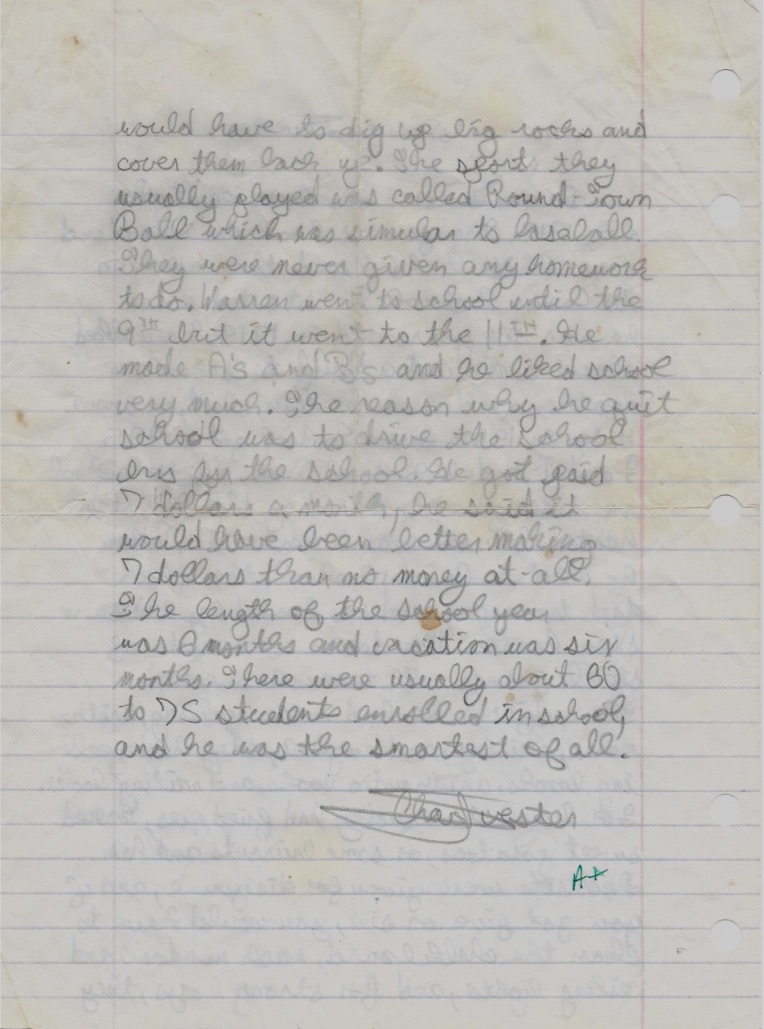
An interview and documentation as following by Chadwick Ivester: His elementary school assignment (4th grade, nine-years old in 1981) was to interview an older person that was significant in their life. Chad chose his grandfather.
Page 2:
The following is the story for easier reading. Only a few spelling changes were made and paragraphs for easier reading.
I would consider this an historical document: Roger
Warren Ivester was born on Feb. 4th, 1913. The first school he attended was White School and then went on to Casar School. He started when he was six years old in 1919. He walked about a mile and a half to school in weather conditions as rain, sleet, or snow.
Later in 1926 Casar School got a 1925 Ford T-Model Bus. White School was a single room building that was stem heated. It used coal to heat. Then when he went to Casar School, the school had two rooms and was heated by the same stem heater. The desk were made of steel frames with tarnished wood.
The subjects he had were spelling, arithmetic, writing, and english, they had spelling books, arithmetic books, and writing books. For lunch he usually had fried pies, baked sweet potatoes, or some biscuits and ham.
Demerits were given for disipline, and if you got five or six, you would have to clean the chalkboard, wash windows and ceiling lights, and for strong boys, they would have to dig up big rocks and cover them back up.
The sports they played usually played was called Round-Town Ball which was simular to baseball. They were never given any homework to do. Warren went to school until the 9th but it went to the 11th. He made A’s and B’s and he liked school very much. The reason why he quit school was to drive the school bus for the school. He got paid 7 dollars a month, he said it would have been better making 7 dollars than no money at all.
The length of the school year was 6 months and vacation was six months. There were usually about 60 to 75 students enrolled in school and he was the smartest of all.





 rogerivester.com
Recent Comments