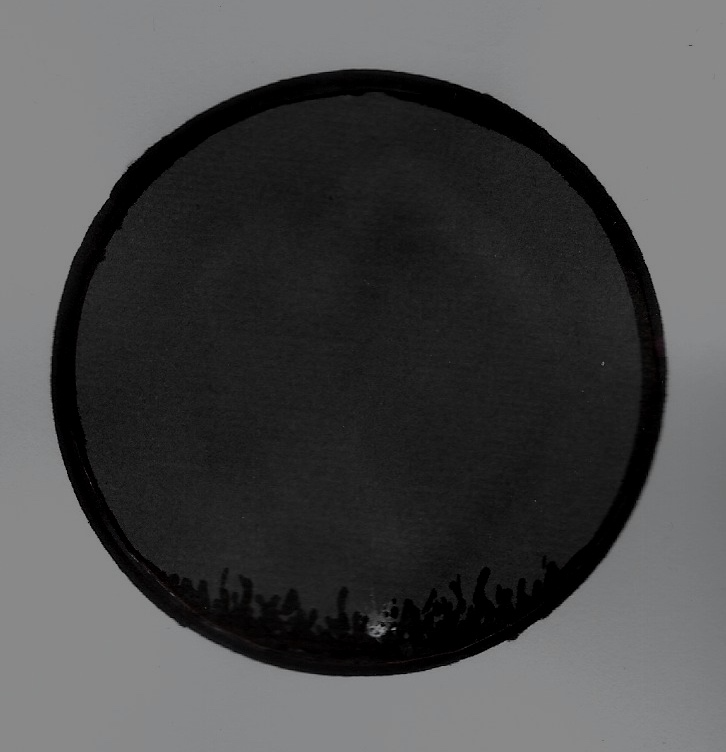
The following is a rough field sketch using chalk on “gray” cardstock, rather than “black” to better illustrate light pollution. Canopus is just visible in a distant tree line.
Canopus is located in the constellation Carina, and is the second brightest star in the sky. It has an absolute magnitude of -5.71 and with the following coordinates:
Right ascension: 06h 23min declination -52º 41
In the early 90’s, amateur astronomer Tom English, promoted an event called “The Great Canopus Chase” in our local astronomy club. It was unknown at that time if Canopus could be seen from the area, and amateurs went far and wide looking for the perfect southern view.
Many observers saw the star, but most from different locations, within the local area. It was a fun event. When I first saw it, I was surprised, but have seen it many times since. It has actually become an annual event, so it will be again this year. (2025) Roger Ivester
From my (+35º 18′ ) in North Carolina, my theoretical south latitude 90º (-) 35º = ~ -55º.
Of course the terrain and light pollution can most often be the limiting factor for many in their limiting theoretical southern latitude.
I can see the star Canopus at the south declination of (-52º 42′) but in a distant tree-line, however, it shines brightly! It’s easy to see without optical aid, but I normally take my 7 x 21 mini-binoculars to assist, but once located, it’s very easy naked eye.
So, from my location, Canopus @ -52º 42′ is only ~ 2.5º above the horizon.
The following is my rough chalk sketch, on charcoal “colored” card stock. I made this “rough sketch” as viewed from the north end of Stadium Drive, at the stop sign (junction to the Boiling Springs/Cliffside highway)
Notes and image as following by Mario Motta:
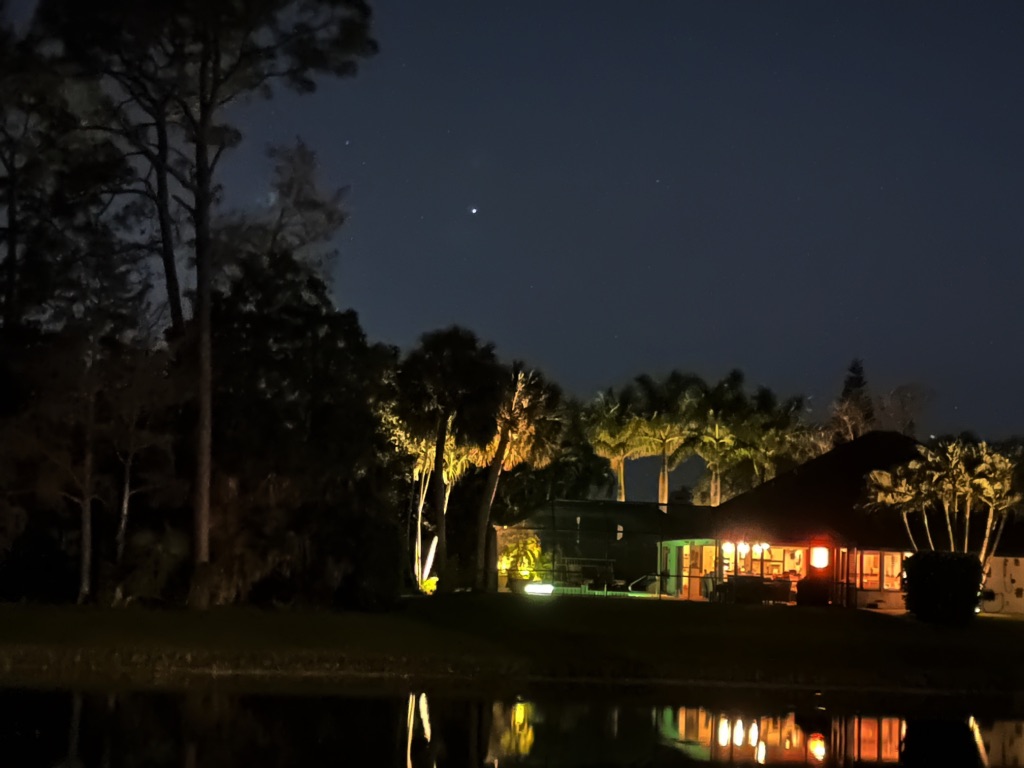
Canopus near its peak which is 11º, here at about 10º above the horizon in Naples, Florida.
I received this note from Richard Shuford, this morning: March 2nd 2023
“Back in 1976, when I was an undergraduate physics major at Lenoir-Rhyne College in Hickory, NC, catching a glimpse of Canopus was celebrated by some of my friends who observed it from a high hilltop in Burke County.” Richard Shuford
(Note: Hickory is about one hour north from my location of seeing Canopus. I was very surprised when reading the above notes from Richard Shuford. I thought our group in Boiling Springs, in the early 90’s was the first time anyone in this area (+ 35º) NC was able to see Canopus.
Chuck Vaughn: Observer from California
Now what is the likelihood of me finding and seeing this in a 30 year old magazine? Especially since I just completed a Canopus post on my site?
I was casually thumbing through a December 1992 Sky & Telescope, and the word “Canopus” seemingly jumped out of page-712 and hit me, right in the eye! His (Chuck Vaughn’s) latitude is +37º 49′ which puts Canopus on the ~horizon, and being able to see it without optical aid!
The following is a brief of that article:
“Canopus, too! Chuck Vaughn of Fremont, California…..claims to have caught sight of the star without optical in November 1991, and three years earlier in December. Has anyone else seen it from such a northerly location?” CV
Note for reference: Richmond, Virginia has a latitude of +37º 53′ just about the same as Fremont, California.
I’m hoping someone reading, with a clear southern horizon, with a latitude of ~40º’s will attempt to see Canopus. This would put the star below the horizon! Is this even possible?


 rogerivester.com
Recent Comments