Discovered by E.E. Barnard using a 5-inch refractor in 1884.
Hubble found it “fairly conspicuous” in a short focus 4-inch finder with a low-power ocular, but “barely discernible” at the primary focus of the 100-inch. Source: “Burnham’s Celestial Handbook”
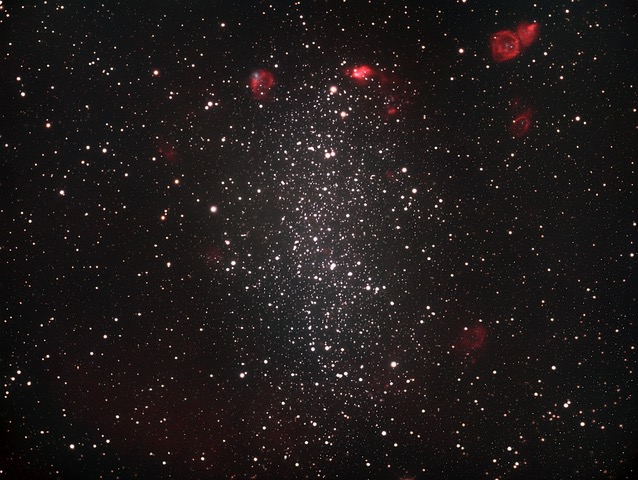
The following image by Mario Motta using a 32-inch f/6 “relay” telescope:
I took images in RGB, Lum and finally Ha filters, and stretched the Histogram to enhance the stars, then adding the Ha overlay. Total imaging time about three hours, then processed in PixInsight.
Jaakko Saloranto: Observer from Finland
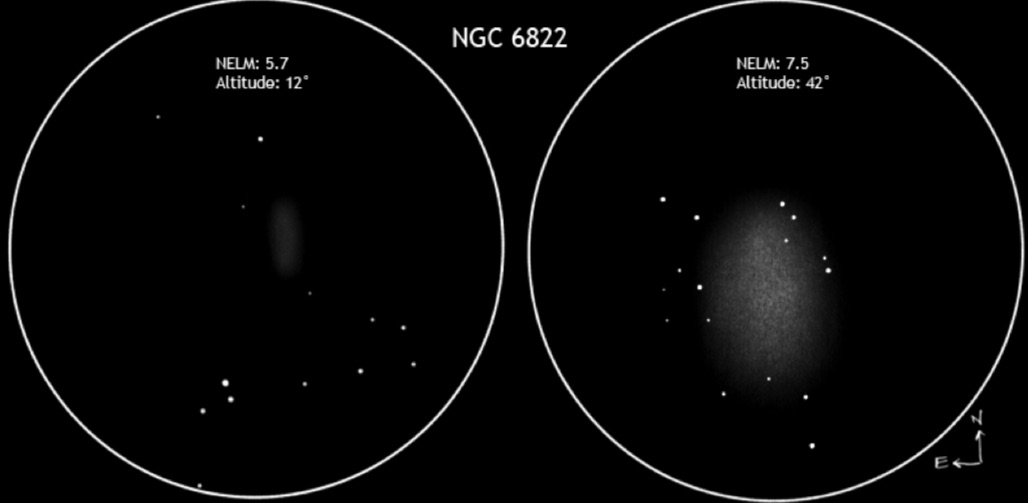
I was able to glimpse NGC 6822 on the night of August 23, 2014. During the day, it was mostly cloudy with constant showers. Eventually, it cleared up enough for me to head to my spot at around 23.30. I noticed right away that sky conditions weren’t as good as the night before, and conditions would be deteriorating fast as humidity was on the rise (~95%). I was also somewhat worried about aurora activity (didn’t notice any, but some were noted on the night before) as well as approaching clouds (which eventually came only in the morning).
After about 20 minutes in the general field of NGC 6822, I was ready to give up, but then suddenly, I got a few glimpses of an elongated, extremely faint patch of nebulosity at the NE edge of the field @ 46x (64′). I could only repeat this observation a few times afterward, but managed to sketch the object nonetheless.
I looked at the drawing immediately after I got back home at around 2:30 AM, and despite initially being quite skeptical of having actually drawn the object at the right place, it was obvious: I had sketched the galaxy perfectly at the right position! I took a SQM-L measurement from NGC-6822 and it showed 19.80 (20.50 at zenith) at an altitude of 12º. Without a doubt, it would’ve been quite a lot easier to see the galaxy if it was higher in the sky, but it doesn’t get much better than this up here in Finland.
The second drawing was made back in 2011 from GMARS, in Landers, California. Back then, I described the galaxy as follows: “Low surface brightness galaxy, but weakly visible even with direct vision. N-S elongated with a faint bar running in the middle and overall a slightly mottled structure. Several faint stars visible in the periphery, H-II regions not looked for. Both drawings were made using a 4.5-inch reflector.”
Observation notes and pencil sketch by Roger Ivester:
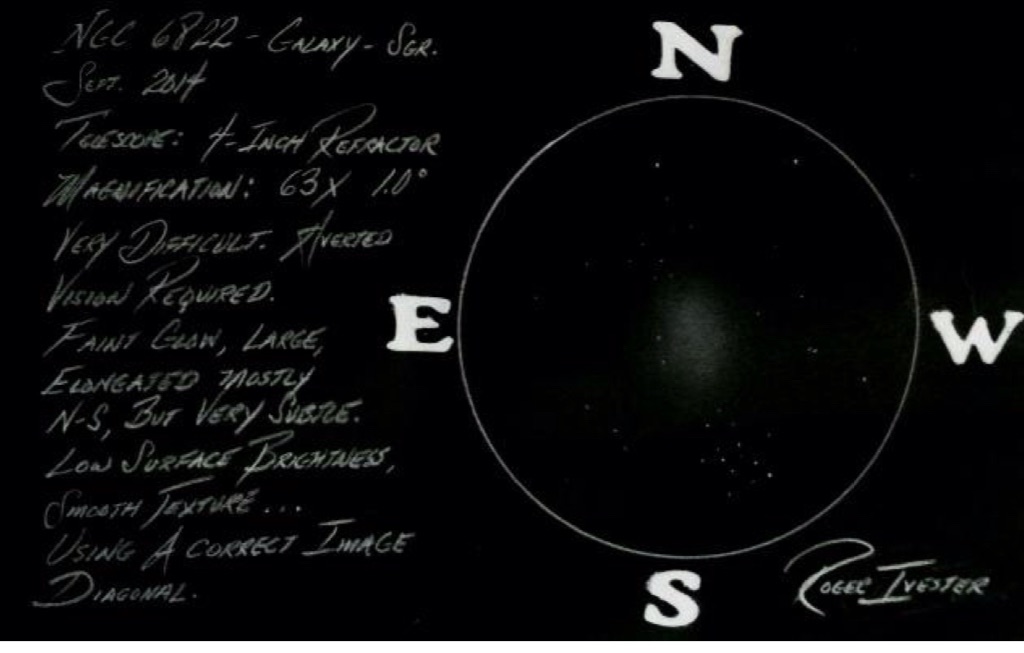
I have attempted to observe galaxy, NGC 6822 from my backyard since the early 90’s. My problem has been due in-part to a pesky unshielded street light in relative close proximity to my house. On the night of about September 14, 2014, using a utility building for a light block, I was surprised and elated to finally see this galaxy. I used a 102mm (4-inch) refractor with a magnification of 63x, and used a dark cloth to cover my head to reduce ambient lighting.
It was very difficult, and I would continue to check my atlas. After more than an hour, and using a variety of eyepieces…still no luck. I began to wonder if this was going to be another year of not seeing this illusive galaxy.
After another check of my atlas, taking a deep breath, and using a small amount of field motion, I could see a faint brightening…I knew this was it. Moving the telescope slightly back and forth ever so slightly, the faint glow or brightening became obvious. Once I had seen this brightening, I could move it out of the field of view and then find the glow again fairly easily.
I was finally able to make that long awaited sketch and some notes. I noticed a subtle N-S elongation. The size was fairly large with very low surface brightness. The night was Saturday, September 20th 2014:
Another observation of galaxy, NGC 6822:
Our local astronomy club met at Lost Arrow Ranch, nestled in the South Mountains for an observing session. This is a really good site and on occasion I’ve estimated the NELM (naked eye limiting magnitude) at mag. 6.5. However, on this occasion, the transparency was not good due to high moisture content in the air. The NELM was reduced to about mag. 5.3, which is not good when attempting to see a faint, low-surface brightness galaxy.
During the event, and using a friend’s 9.25-inch SCT telescope, I was able to see the galaxy, but with difficulty. Quite a few of the group observed it through this scope, but all, having difficulty.
Maybe one night I might attempt using my 6-inch f/6 Newtonian @ 29x, and from my backyard. However, this is contingent on having a clear and good night.
My rough field sketch using a 102 mm refractor from September 2014: This might even be a bit of exaggeration of what I saw.
Observing notes by Sue French:
Barnard’s Galaxy is a member of the Local Group, a small cluster of about 40 galaxies including our own. It was discovered by Edward Emerson Barnard in 1884, but not recognized as an extragalactic object until the 1920s.
Barnard described his discovery as “an excessively faint nebula” … very diffuse and even in its light. With 6-inch it is very difficult to see, and a 5-inch with a power of 30± with a field of about 1 1/4º it is quite distinct. This should be borne in mind in looking for it.”
Barnard’s advice is worth heeding. It is often easier to spot NGC 6822 in a small scope that allows a wide field than in a large scope with a more restricted field. While Barnard’s Galaxy has been seen in 7 x 35 binoculars, I recommend 2.4-inch (60-millimeter) or larger scopes under moderately dark skies. I can see the galaxy with my 4.1-inch refractor at 17x from my semi-rural home where the southern sky is awash with the glow from a nearby city. It is elusive and appears very faint and oblong. The long dimension measures about 11′ and runs north-south. Sue French
 rogerivester.com
Recent Comments