Archive for March 2025

Galaxies NGC 4290 And NGC 4284 Which Can Be A Real Challenge For The Backyard Observer

March 25, 2025

Sue French: Observer from New York

M40 is a double star near Megrez (Delta Ursae Majoris). Oddly, M40 was once considered a non-existent Messier object. In his 1784 catalogue, Charles Messier described his 40th object as: “Two stars very close to one another and very small, placed at the root of the great Bear’s tail.” Precessing Messier’s coordinates to equinox 2000 takes us right to such a star pair. Messier noted this double while searching for a “nebulous star” reported by Johannes Hevelius. Messier assumed that Hevelius mistook these two stars for a nebula, but the latter was actually referring to a different pair of stars – also without nebulosity.

To locate M40, start at Megrez and hop 1.1º northeast to mag. 5.5 70 Ursae Majoris. Continue that line for 1/4º to arrive at M40. My 4.1-inch scope at 28x reveals an east-west pair of mag. 10 stars, with the western one slightly brighter. Through my 10-inch scope, I see the primary as yellow-orange and its companion as yellow-white. 

Two galaxies share the field at 118x. NGC 4290 is a small northeast-southwest oval, and NGC 4284 is a tiny faint spot forming a 1½’ triangle with two mag. 13 stars. 

The galaxies are about 140 and 190 million light- years away. Although the distances to its stars are poorly known, M40 is probably an optical (unrelated) pair.  Independently discovered in 1863 by the German astronomer Friedrich August Theodor Winnecke, M40 carries the double-star designation Winnecke 4. Winnecke is also the original discoverer of eight NGC objects, and ten comets that bear his name.

Roger Ivester: Observer from North Carolina 

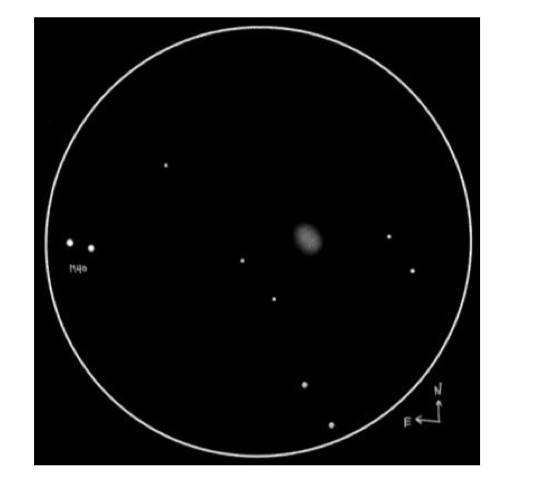
Due to our recent bad skies, I was unable to make a new observation of M40, and galaxies NGC 4284 and NGC 4290. I was forced to use a sketch and notes from an earlymorning observation on February 25, 2000. 

On that night, I was using a 10-inch reflector from my moderately light-polluted backyard with a 5.8 NELM. It was an especially good night with excellent transparency.

M40, a pair of mag. 10 stars, also known as Winnecke 4, was very easy with a wide separation of about 50 seconds of arc. The pair was oriented mostly east-west and both appeared as whitish-yellow in color.

Two faint galaxies were located very close to M40. All three objects were located within a 1/2º field-of-view.  Just to the west of M40, lay faint galaxy NGC 4290 at mag. 12.0, elongated NNE-WSW. I saw a very subtle brightness in the central region. Very close and to the west of it was a very faint mag. 14 galaxy, NGC 4284, which was extremely difficult, appearing as a faint, mostly round blur. And during a previous observation from the same location with a friend, and in a side-by-side comparison with the 10-inch reflector and an 8-inch Celestron Schmidt-Cassegrain.  We couldn’t see NGC 4284 with the 8-inch SC telescope, but could in the 10-inch Newtonian.  

The following pencil sketch was made using various graphite pencils and a blank 5 x 8 notecard with the colors inverted using a scanner. 

Jaakko Saloranta: Observer from Finland

Here’s all I’ve got: With a 4.5-inch reflector @ 152x (20′), the galaxy appeared as a fairly faint, NE-SW elongated galaxy, without detail, close to double star M40. NGC 4284 was invisible. Altitude of the object was 74°.
Galaxies NGC 3893 And NGC 3896 In Ursa Major Always Be Sure To Document Your Observations…

March 23, 2025

Mario Motta: Observer from Massachusetts 

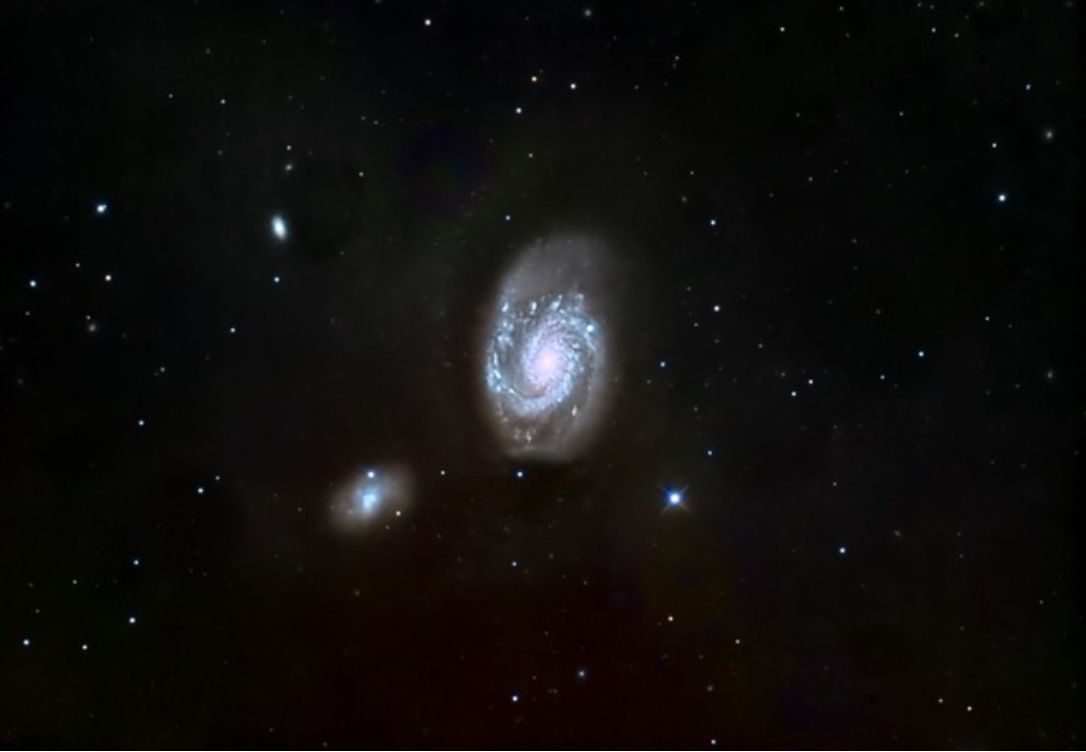
This image took some effort. I captured the galaxy in Lum with my 32-inch this past December from Gloucester, but did not have enough night to get it in color.  

I tried in Florida, but it lacks the detail of the 32-inch as it is only 4.5 by 2,4 arc minutes, thus needs the larger telescope for detail.  However, I then used a process in pixinsight to combine images from 2 different optical systems, and it worked. So…lum from the 32-inch scope with about 75 minutes lum ZWO 6200 camera.  

Then RGB from C14 scope in Florida again ZWO 6200, (about 70 min total), processed then combined with dynamic alignment tool in Pixinsight. Note NGC 3896 close by to the immediate east.This worked, I may try for more such galaxies in color only to add to my 32 inch collection of galaxies in Lum only. Spring is so short a season for all the galaxies available.  

Jaakko Saloranta: Observer from Finland

Back in March, the galaxy duo was visible in a good, high (77°) spot in the sky. Using high magnification (304x) with a 4.5-inch reflector, I described the view as follows: Fairly bright, N-S elongated galaxy with a brighter nucleus. Faint mag. 13 star touched the halo in NW. 

NGC 3896 appeared as a tiny, fairly faint and slightly SE-NW elongated galaxy just south of a mag. 13 star. Observing conditions were average: NELM around 6.0 with SQM-L readings of 20.20 near the object. Temperatures still dropped well below zero Celsius on the night of 26 March.

Roger Ivester: Observer from North Carolina 

I wanted to share an article concerning an observation I made on April 20, 1993. It’s a testament that documenting and taking good notes is indeed a good thing! During some recent cloudy weather, while reviewing past logbook entries, I discovered that I had not followed up on an object viewed on 20 April, 1993. The main object was NGC 3893, a mag. 11 galaxy in Ursa Major. While making my sketch of this excellent galaxy, I noticed a smaller, very faint object, SE and very close. I noted this in my logbook as one to look up later. It was almost ten months later, while browsing through the logbook, that I remembered to follow up on this observation.

I checked Burnham’s Celestial Handbook, Tom Lorenzen’s 1000+, and the Tirion Sky Atlas 2000.0, only to find that none of these sources listed a companion galaxy. I then went to the NGC 2000.0 Catalog by Roger Sinnott, and found the companion listed as NGC 3896, a 14th magnitude galaxy. I was elated to find out this was a faint galaxy. It should also be noted that my observation was made from my back deck, with several unshielded streetlights nearby.

If I had not sketched NGC 3893, it’s possible that I would have missed NGC 3896. If I had not logged the mysterious companion, I probably would never have checked any reference material on a future date. 

So, the moral of this story is: Keep a logbook, sketch your observations, and periodically review your notes. You never know what you might find.  I was very excited about going back to NGC 3893 and NGC 3896 after twenty one years, and surprised that they appeared exactly as I remembered them. 

It’s truly amazing how the brain can remember a faint galaxy pair after all this time.Using a 10-inch Newtonian reflector, I could easily see NGC 3893 at 57x, appearing as a faint oval, oriented NNW-SSE. When I increased the magnification to 200x, the halo became enlarged and I saw a faint stellar nucleus. I also spotted a mag. 13 star on the NW tip.

The faint companion galaxy, NGC 3896, at mag. 14.0 was very difficult, especially when observed from my moderately light polluted backyard. Using 200x and averted vision, it appeared mostly round with low surface brightness. I noted little to no detail. With patience and careful viewing, I saw two very faint stars on the NW tip.

Revised: Seeing Uranus Without Optical Aid? Is It Possible From A Suburban Back Yard, With A 5.5 NELM At The Zenith?

March 8, 2025

I received an email Saturday morning (March 7th 2025) from expert visual observer, Jaakko Saloranta from Finland. He asked me if I’d ever seen Uranus without optical aid. Seems that Jaakko had a “lively” discussion with some reporters concerning the visibility of seeing Uranus naked eyes.

March 18th 2025: My observation to see Uranus was unsuccessful, as transparency was poor and my NELM was less than 4.8 at the zenith, and the planet has a magnitude of ~ 5.75. And unfortunately, Uranus was already getting into the light dome of Boiling Springs, North Carolina.

After more than an hour of careful observing with a small 6 x 30 finder (by design) then looking over the finder, I could not see the planet naked-eye. I’d suggest this technique is an advantage as opposed to attempting to find Uranus in a mostly blank area of the sky. I used a 4.5-inch f/8 Newtonian on a GoTo mount to locate Uranus. A planet…unlike a deep-sky object does not have a permanent sky address.

My observational attempts are now over until November 2025. The trees and plants (March 22nd) are showing new life and pollen is beginning to fill the sky and reduce the sky transpacy considerably. I’d suggest pollen is similar to snow covering reflection.

I made the following wide-field sky photos last night (March 18th) at 9:30 PM using my iPhone. Can you see Uranus?

March 8th 2025 Observation:

Despite a bright moon, I wanted to use a 4.5-inch Newtonian from my suburban backyard, just to observe the planet telescopically. I’ll then try the small 6 x 30 finder, and then my 7 x 21 Pentax mini-binoculars. I was successful in seeing the planet with all three, but never attempted naked eyes for obvious reasons. Roger

Reports as following

Alan French (New York)

Long ago, it was the late 1980s or early 1990s, Sue and I made a point of catching Uranus by eye from the Texas Star Party. If I recall correctly, the folks at TSP suggested it because the planet was in a sparser star field than usual.  It’s not something I could probably do today. 

Observer 2: March 8th 2025 @ 8:30 PM EST

Roger Ivester (North Carolina)

March 8th 2025: 71% illuminated Moon, excellent seeing @ 50º

First let me say, I was using a Goto mount when attempting to see the planet Uranus. A GoTo system would give anyone an advantage. And a faint planet can be difficult to locate…unlike a deep-sky object that has a permanent sky address.

Yes, I know that the objective is to see Uranus without optical aid, but I just had to first see it with a 4.5-inch f/8 Newtonian. It was easy, appearing as a mostly white star using a magnification of 35x. When increasing the magnification to 128x, it still appeared as a star, but now with a greenish tint.

I could easily see with a small 6 x 30 finder scope, but a bit fainter through a pair of 7 x 21 Pentax binoculars. Then when looking over the finder, then alternately looking through the finder, I could not see Uranus without optical aid.

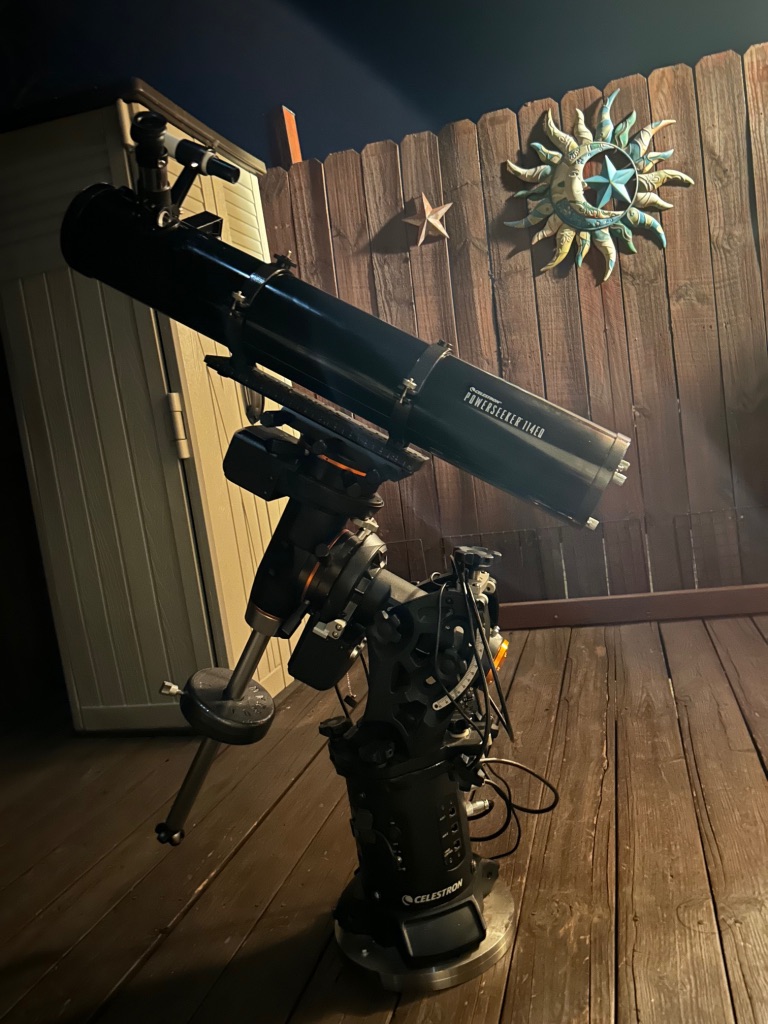
I wanted to document all things on this night, even with a photo of the telescope and mount used. This was a telescope given to me recently by a friend, and I’ve been spending a little time this week tuning it up. I was interested in seeing Uranus with the tiny 6 x 30 finder.

Observer Three: March 9th 2025

Mario Motta (Massachusetts)

Hi Roger,

As it turns out I have such an image, taken five years ago with my 32-inch telescope. The small planet size at such a great distance, does indeed has a slight greenish color, just like you mentioned in your post.

Taken with my 32-inch f/6 telescope, with ZWO asi 071 OSC camera, video the stacked and processed

The second image presents five of the planets moons…and very nicely!

Mario

Supplemental: Successful observation without optical aid by Mario Motta:

I once saw it naked eye from my place in New Hampshire, about 20 years ago with a mag. 6.5 sky.

Observer 4: Jaako Saloranta from Finland:

Hey Roger,

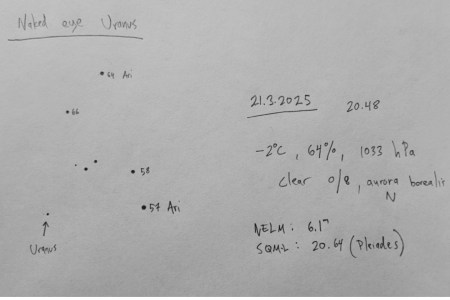
Here’s my sketch of Uranus – this is the original one I made at the site and as I no longer have a working scanner… this is all I could muster with my phone.

I rode my bicycle roughly 10 kilometers west from my house and found a decent, dark spot for myself. Temperature was roughly 27°F so it didn’t take too long for me to get cold after some sweaty cycling! While waiting for full night vision I could see M34, M35 and maybe M36 with the naked eye. Winter Milky Way was faintly visible from Perseus to Monoceros. 

But Uranus itself… seeing it was quite difficult because of the low altitude (~30 degrees). I could see roughly down to magnitude 6.5 from the west/zenith but at the general region of the Pleiades I could barely make out 6 magnitude (I managed to saw 65 Arietis only a few times during the 30 minutes I was observing Uranus) stars. I could see Uranus only… maybe 30% of the time with optimal averted vision. See Uranus back in 2011 was a lot easier from Canary Islands (high altitude, higher object altitude, darker skies and younger observer).

After I was done observing, I noticed that green aurora borealis arc in the northern sky. When I eventually got back home, I could see faint aurora glow even at the zenith.

/Jaakko

Observer 5: Steve O’Meara (Tucson)

Hi Roger,

Sometime in the 1980’s, I was outside David Levy’s Tucson home, casually stargazing by eye with Steve O’Meara, when Steve noticed Uranus in the sky.

Clear skies, Kelly Beatty