NGC 55 coordinates: RA: 00h 14m 54 Dec. -39º 12m
Roger Ivester from North Carolina: Observing notes from +35º 18′ latitude as following:
Galaxy NGC 55 is the only deep-sky object that I was not able to locate and see of the entire 185 Observer’s Challenge reports. This was due to the low southerly sky position, and not being able to find an observing location without light glow.
I’m hopeful that I can again attempt to see this galaxy, but from another dark-site, which I’ve already selected. For convenience, light weight and ease of handling, I’m planning to use a 4.5-inch f/8 Newtonian. Update: Wednesday, November 12th: Too much sky glow overlooking a small town about five miles away. I spent about an hour…but no luck. Another disappointment.
November 14th 2025: I attempted from my backyard, and with a lightblock curtain, using my 10-inch, but unfortunately the galaxy was in the trees. It seems that I’m just not suppose to see this galaxy. I’ve just got to find that “perfect site” and I’m not giving up yet, as there is still time this month!
My notes from November and December 2012 as following:
Sue French observing from the Little Caymen Island:
November 30, 2005, Little Cayman Island. 10:10 PM EST. 113/450mm (4 ½-inch f/4)
reflector. Seeing: good, transparency good, sky, very dark. Scope not collimated.
At 14X, easily visible, highly elongated, bright galaxy with brighter elongated core.
Runs ESE-WNW. At 34X, very pretty. Large mottled core. Faint star south edge, west side.
Galaxy extends farther east than west of core. About 28’ X 2 1/2’. Star mentioned above plus
three others cradled south side. At 64X, mottling much more evident. Many faint field stars
visible. Skinny brighter triangle southwest.
October 2, 2010, 9:15 pm EDT, with a 130/819mm (5.1-inch f/6.3) apochromat. The
seeing and transparency were fair. At 23X there was a bright glow around a fairly bright star.
At 37X, the star was in the southern part of a 1¾ arcminute glow. A fainter, 1-arcminute glow
continued south from the brighter one. UHC or O-III filter not helpful. At 63X, the southern
part showed nicely, and there was a faint star in it. At 102X, the southern part was curved
concave west so the whole thing looked like a fat comma in my mirror-reversed view.
October 6, 2010, PSSG. 10:30 PM EDT. 130/819mm (5.1-inch f/6.3) APO. Seeing fairpoor, transparency good. At 37X, although the sky was milky down there, this large galaxy was
visible as ~26”ESE – WNW elongated galaxy. The western half was generally brighter. Mag.
10 star ~5’ SE of eastern tip and mag. 12 star S X E of western tip. ~ 4’ wide. At 63X, showed
up nicely and was quite uneven in brightness. The bright western area broadly brighter toward
the long axis. Eastern had a weaker brightening toward the east end. Three faint stars along
south flank: The brightest one mentioned above, the second brightest was south of the middle of
the western bright patch, the faintest star was on the galaxy’s edge between the two bright
patches. Another star hugged the south side of the west tip.
November 10, 2007, 8:15 pm EST with a 254/1494mm (10-inch f/5.9) Newtonian. The
seeing and transparency were fair. At 43X, this bright nebula spanned about ¼º and was
brightest around a mag. 7½ star in the center. At 68X, the bright central region of the nebula was
elongated north-south, 3 arcminutes tall, with pinched sides and a faint star off the southeastern
edge. At 213X, the pinch was prominent south of the mag. 7½ star, and the nebula section south
of the pinch was fainter than the northern part.
November 2, 2010. 9:30 pm EDT
I’m afraid my description of that observation was just the sketch. The only details were:
254/1494mm (10-inch f/5.9) Newtonian, 67X. Seeing and transparency, fair.

Jaakko Saloranta from Finland: Observing notes for NGC 55, are from the Canary Islands:
As can be suspected of the low declination, this object never rises above the horizon here
in Finland. My latest observation of NGC 55 was made in November last year from the Canary
Islands and specifically from the biggest island, Tenerife. I was observing within the Las
Cañadas caldera at an altitude of 6,670 feet (2,034 meters) with fairly good observing conditions:
naked eye limiting magnitude (NELM) near zenith of 7.1 with SQM-L measurements in the high
21.20s. What makes this observing site pretty good is the high altitude (above the clouds), low
humidity and excellent seeing. They don’t have observatories in here for nothing! My notes
with the 4.7-inch refractor using several different magnifications read as follows:
A gorgeous sight. Huge, WNW-ESE elongated galaxy with a mottled appearance. NW
part of the galaxy contained a bright, elongated nucleus with somewhat mottled appearance.
Two brightenings visible within the halo. Larger and brighter knot appeared as slightly NW-SE
elongated. The smaller and fainter knot appeared as a nearly stellar, roundish spot in the E side
of the galaxy’s halo with a faint mag. 14 star just W of it. A darker void seemed to separate these
two possible H-II regions from each other. Several mag. 10-14 stars in vicinity, within the halo.

The following image provided by James Dire from Hawaii:
My image as following was taken with a 102mm (4-inch) apochromatic refractor at f/6.4 with a SBIG ST2000XCM CCD camera. Note the dark “eye” in the galactic core, with the dark lane angled 60º to the disk superimposed over this.

The following image by Mario Motta at (+42º 36′) from Massachusetts with the galaxy being only 6º’s above the horizon!
This one is really tough being so low in the southern sky, but last night (October 18th 2025) I was able to make the following image. The galaxy was 6º above the horizon when I started and ended. It peaked at 8º at the transit of the meridian. The imagine required two hours of 5 minute subs with my 32-inch f/6.5 reflector telescope, and ZWO6200 camera, processed in Pix.
I did not attempt color, as it was so low in the sky and have limited time between rising and setting. NGC 55 is actually close at 6.5 MLY in the constellation of Sculptor.
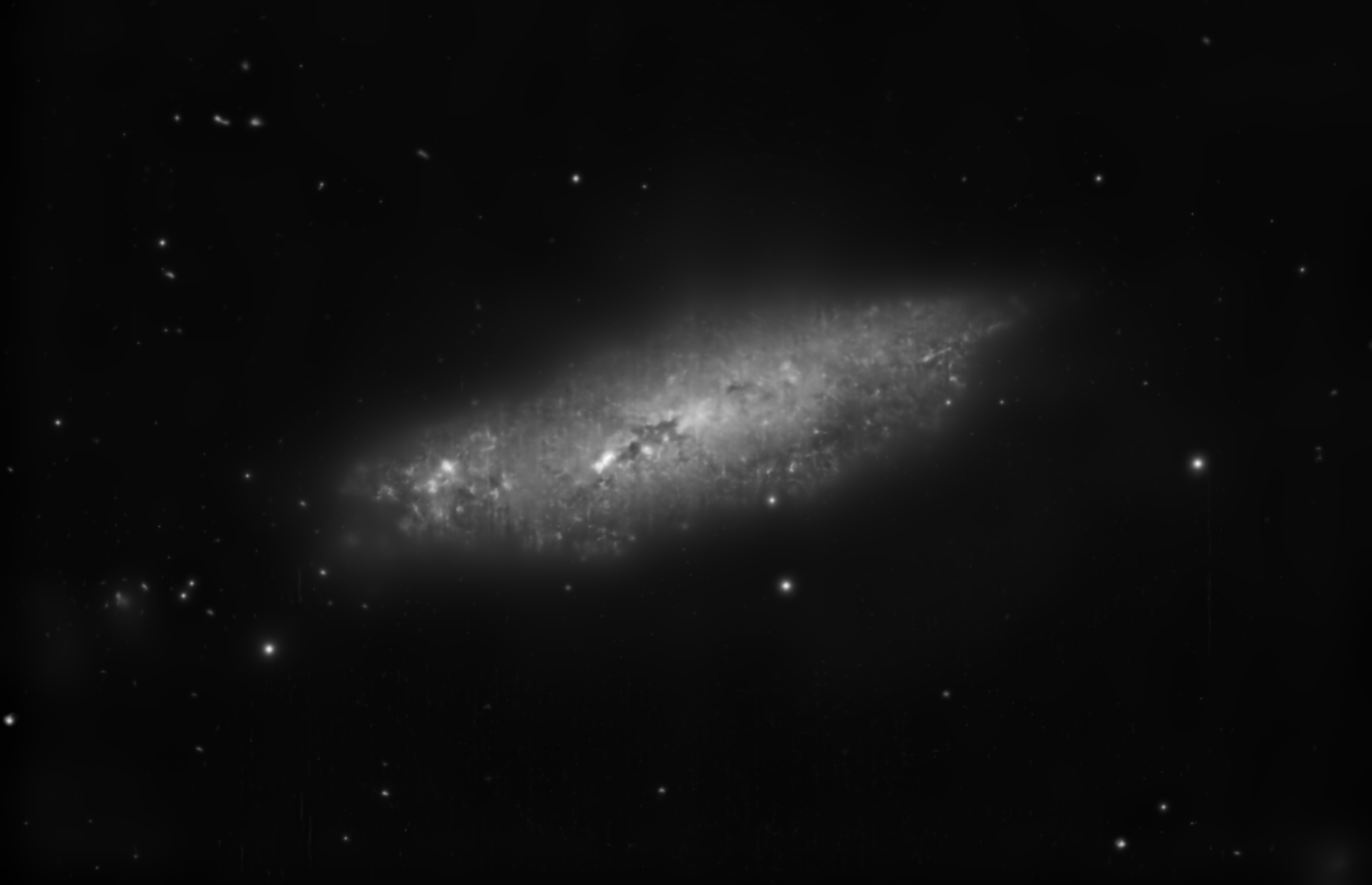
Now I have never tried this before, but decided to experiment, and somehow it worked out.
My 32-inch scope image of NGC 55 was only 6º above the horizon, so I got the brighter central region with detail, but the fainter outer region, especially lower left, was lost in the background glow. I’d made an image from Florida two years ago, and got the entire galaxy, but lacked detail, and did not capture the fainter region (C14)
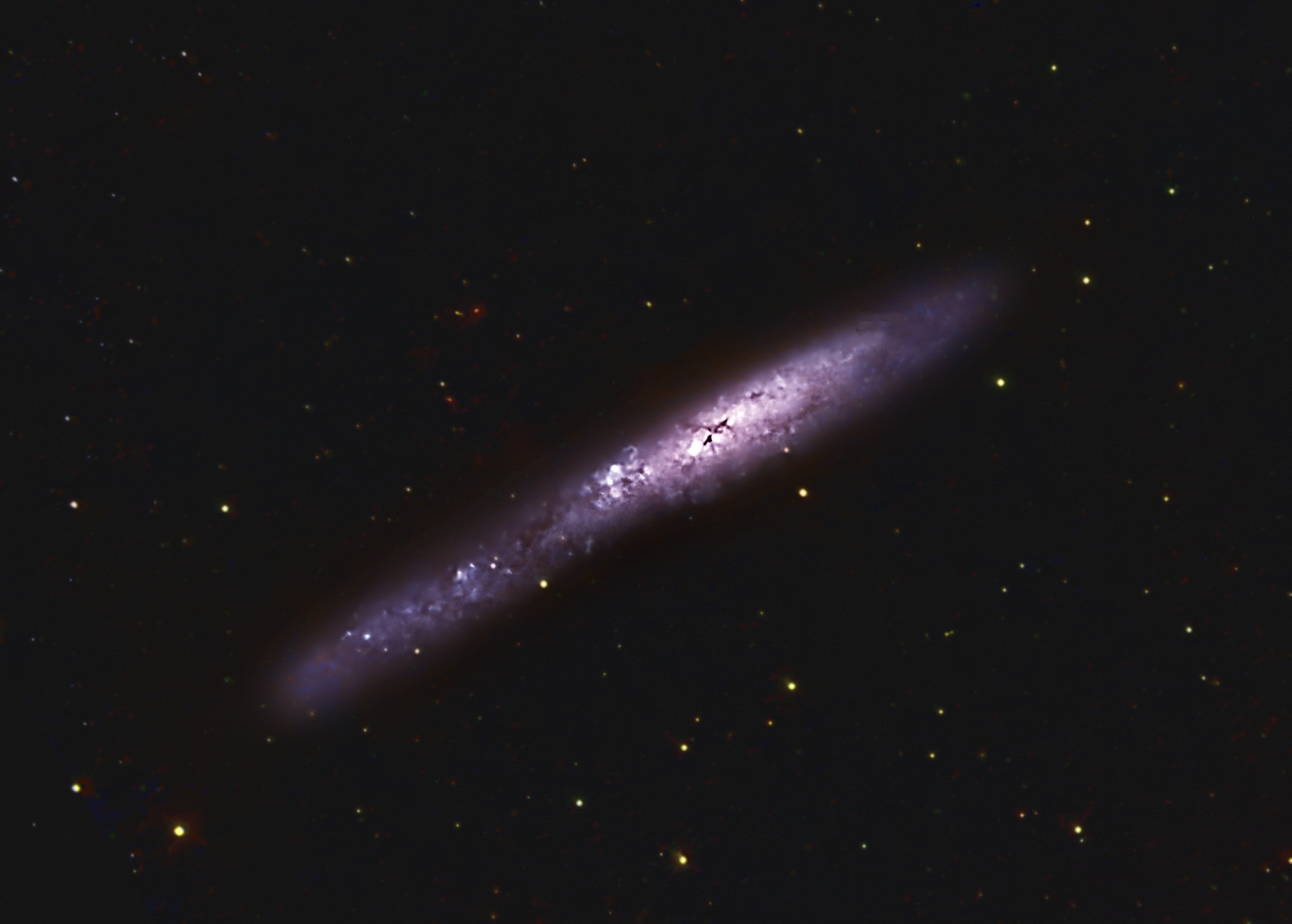
Adrien Barrajon’s image (which I processed) from New Zealand had color but missing detail, and was taken with an 8-inch telescope.
So, I attempted to combine all images…taking some time, but took the detail of the center, overlapped that on the full image from my C14 from Florida, and then overlaid the color from the New Zealand color data.
The result is the combined data of three different telescopes, of vastly different sizes, and got this combined image. There are many hidden tricks in pixinsight, and I used up quite a few of them to get the following image. 🙂
Mario Motta
 rogerivester.com
Recent Comments