I first found out about the Virgo cluster (nine-galaxies all in a 1º FoV) from Tom Lorenzin, author of “1000+ The Amateur Astronomer’s Field Guide to Deep-Sky Observing” on the evening of the Vernal Equinox 1994.
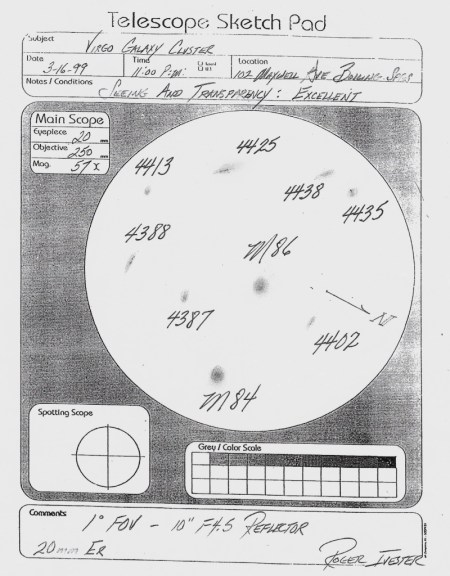
Tom asked me if I’d ever viewed all nine galaxies within a 1° field of view, when centered on M86. I had not, but was most anxious to give it a try. However, It would be years later, on the night of March 16th 1999, before I was able to observe the galaxy group.
With my 10-inch f/4.5 reflector using a 20mm UO Erfle eyepiece for a magnification of 57x and a 1.1º true field. However, I could not see three of the fainter galaxies at this magnification.
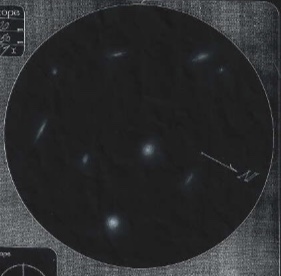
So, I was able to sketch six of the galaxies, then increased to 160x using the 20mm EP and a 2.8x Barlow and spotted the fainter ones. I then sketched the three faint galaxies in theirappropriate positions and tried my best to draw them to scale. Very faint galaxies “most often” require greater magnification, especially if they have a brighter surface brightness and well concentrated.
My notes are as follows from March 16th 1999
M84: Bright, with a brighter more concentrated middle, and a mostly round shape.
M86: Bright, brighter middle, round, very similar to M84 but not as well concentrated.
NGC 4387: A very faint mostly round blur. Difficult at best requiring averted vision.
NGC 4388: Low surface brightness, elongated slash with an E-W orientation.
NGC 4402: Very faint slash, low surface brightness.
NGC 4413: Very faint and dim, small, very diffuse with little concentration, mostly round.
NGC 4425: Very faint, elongated, axis NS, small and dim.
NGC 4435: Fairly bright, mostly round, stellar nucleus, smaller than NGC 4438.
NGC 4438: Bright, elongated, with a brighter middle.
For the past year or more, my Celestron CGE-Pro mount was seemingly having a difficult time centering selected deep-sky objects. The motors also did not sound good at times when moving to the selected objects. I also had to perform a factory reset on the settings every few months.
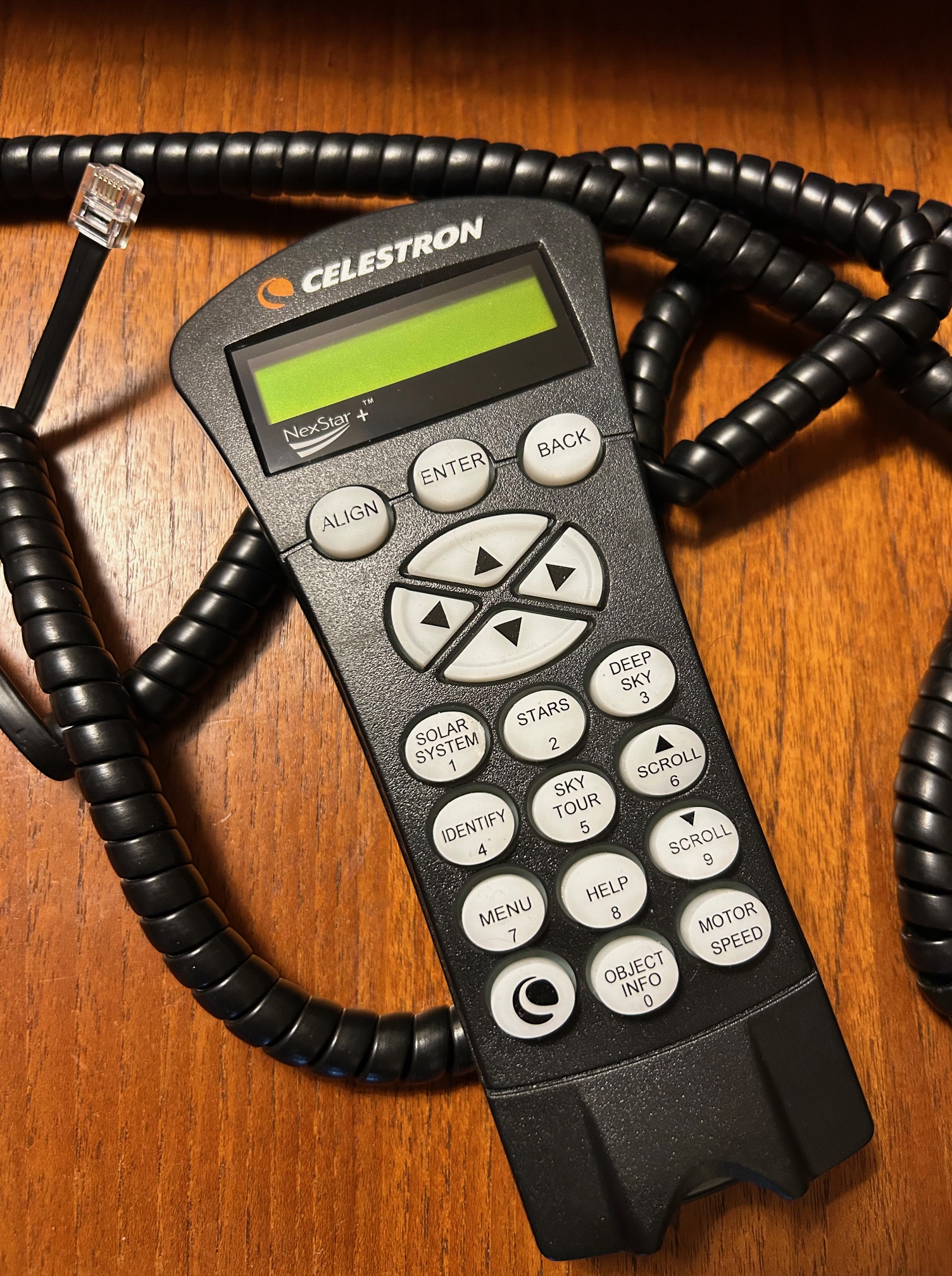
Rather than updating the firm ware for a 15 year “maybe older” hand controller, my son Brad, surprised me with a new Celestron NexStar+. However, I was concerned if it would be compatible with the older mount, but I’m happy to say…it worked perfectly!
I first updated all my site settings using the new hand controller, which is an easy task using my iPhone compass feature for the time, latitude, and longitude. There are other settings such as DST or Standard, and a few others.
Last night, and with a bright moon, I wanted to verify the mount and hand controller in all functions. I began the sequence of the mount start-up. Then the three-star alignment, which after the first star, were all centered in the telescope field-of-view.
The first thing I noticed was the two motors sounded much smoother. I was actually getting concerned the motors might be having problems. I’d read in an article a jerky motion or sound of the motors was a sign that a motor might be going bad. So, I was now feeling really good, but how would the GoTo function perform when locating deep-sky objects?
My first object was the Andromeda galaxy, and with the sound of both motors, and going in different directions, I anxiously waited for it to stop. I then looked into the eyepiece and the galaxy was perfectly centered! The next object would be planetary nebula M57, far to the west from Andromeda, which would make for a great test. The planetary…like Andromeda was “perfectly centered” in the eyepiece. I then selected about 15 other deep-sky objects, including a few double stars. Everything worked perfectly. I was excited to say the least!
I’m so appreciative to Brad for my new hand controller. Despite not ever using the mount, he always seemed to know much more than me, and all the way from the west coast. 🙂 Electronics and electrical stuff are his thing and occupation...not mine for sure.
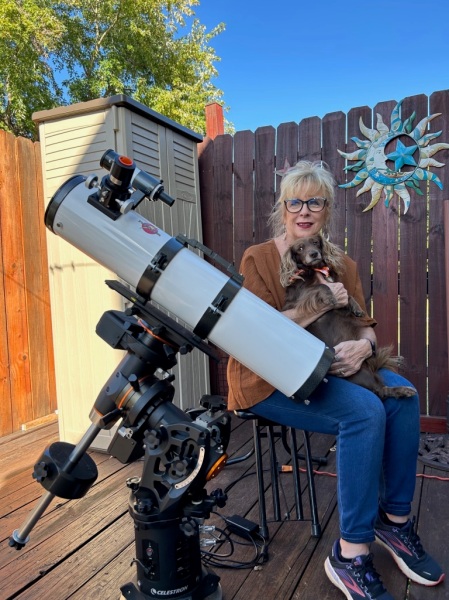
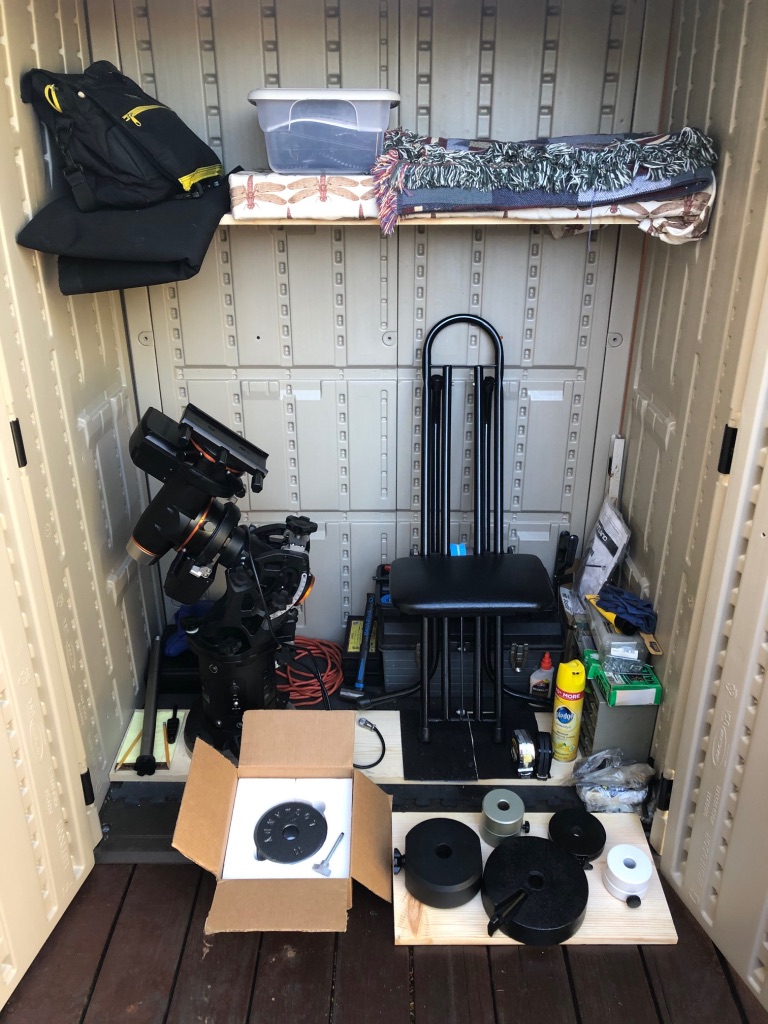
The CGE-Pro mount has bronze gears and was the most heavy-duty mount ever sold by Celestron, with a 90 pound payload.
The mount works well with a 6-inch Newtonian also as following:
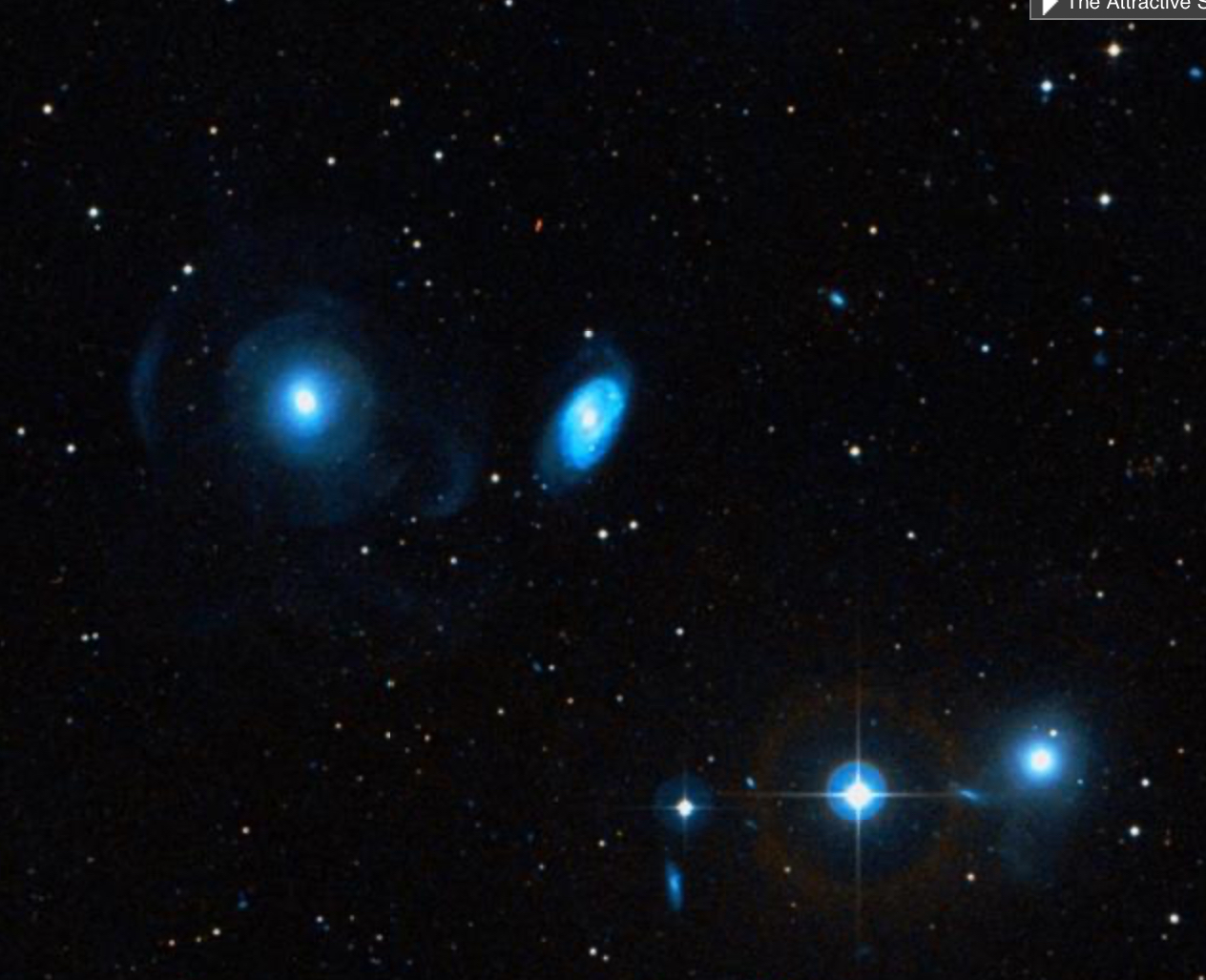
Is it possible for the very faint halo (as seen in images) of galaxy NGC 474 to be seen visually with a large telescope. I would classify a large telescope as having an aperture of 25-inches or greater? There have been reports in the past, using telescopes in the 18-20 inch range, but I can’t confirm this. I wanted an actual definitive observation of the halo and with documentation to report.
So, this was the question I posed to large telescope owner and observer, Steve Gottlieb via Cloudy Nights.
The outer halo of NGC 474 was examined closely at 375x for evidence of the outer, concentric shells and circular streams that are visible on deep images. Immediately there was a strong sense of arcs from two or more different shells. The easiest arc to confirm was the outermost on the eastern side, which curves south from a mag 13.3 star situated 3.3′ NE of center. The arc passes through a mag 16.3 star and extends 30°-40°. A second outer arc on the northeast side is half the distance (~1.6′) to the center. This arc has a stronger curvature and measures roughly 60°. Only a single outer arc (slightly more difficult to confirm) was noted on the southwest side, 2′-2.5′ from center. My rough sketch shows it also curving ~60°. Additional inner arcs or ripples were strongly sensed in the main halo of the galaxy, but were too subtle and fleeting to pinpoint locations. The center was sharply concentrated with a very prominent 1′ core. The core itself was sharply concentrated to a small, blazing nucleus.Steve Gottlieb
NGC 474 Galaxy Cluster galaxy cluster (or group) consists of three relatively bright galaxies. They are: NGC 467 (mag. 12.9), NGC 470 (mag. 12.5), and NGC 474 (mag. 12.4). This is a fascinating little trio of galaxies, especially because the catalogued largest one, NGC 474, does not visually appear as large as nearby NGC 470. The reason is that NGC 474 has an outer halo that is extremely faint. It has been seen in 18-inch instruments and larger as just a faint brightening of the black background.
My observations on Thursday, December 1, 1994, included three spiral galaxies in Pisces, NGC 467, NGC 470, and NGC 474, each separated by only a few minutes of arc. It became apparent immediately that NGC 470 was the largest and most easily seen of the group, but when I referred to the NGC 2000.0 Catalogue, it listed NGC 474 as being over twice as large as either NGC 470 or NGC 467.
At this point, I concluded that NGC 474 must have a halo that could not be seen visually, or at least not from my back yard. The next day I located a photo of this group, but it did not show a faint outer arm, nor was any halo apparent. The view appeared very similar to what I had seen through my telescope.
I decided that another observation was needed, and made a note in my log to “view at next session.” On Monday, December 16, I went to a dark site in the South Mountains about 30 minutes north of Boiling Springs, North Carolina. This would prove to be the perfect site for another observation, notes and a sketch of these three galaxies. I saw NGC 474 as round, diffuse and with a brighter nucleus. NGC 470, appeared elongated, diffuse, and twice as large as NGC 474.
Next, NGC 467 appeared round, faint halo, with a brighter nucleus, and situated a few minutes N of an 8th magnitude star. It was almost the same apparent size as NGC 474. All three galaxies were very easy to locate, relatively bright, and showed excellent contrast. Again I was bothered concerning the size listing of NGC 474. My sources indicated that it was the largest of these galaxies, but NGC 470 was clearly the largest in my telescope and in a photo that I had looked at earlier. Could there be an error in the 7.9” size I read from the NGC 2000 Catalogue, an error which was perpetuated by the other sources? A table of diameters (in arc minutes) from different sources is listed below:
Source:
NGC 2000.0: NGC 470: 3.0 NGC 474: 7.9
Burnham’s Celestial Handbook: NGC 470: 1.7 x 1.1 NGC 474: 0.4 x 0.4
Tom Lorenzin’s 1000+: NGC 470: 3.2 NGC 474: 8.0
The Observer’s Guide, Nov/Dec 1991: NGC 470: 3.0 x 2.0 NGC 474: 7.9 x 7.2
Deep Sky Field Guide to Uranometria 2000.0: NGC 470: 3.0 x 1.8 NGC 474: 10.0 x 9.2
Astronomy Magazine, January 1993: NGC 470: 3.0 x 2.0 NGC 474: 7.9 x 7.2
Luginbuhl & Skiff, Observing Handbook & Catalog: NGC 470: 3.0 x 2.0 NGC 474: 7.9 x 7.2
I expressed my concern to Tom English, Professor of Astronomy and Physics at GardnerWebb University, who promptly gathered all available reference material on NGC 474 from his extensive astronomy library at the University. Tom called me on Saturday afternoon, January 7, and invited me to research the data. While I was busy checking each source, Tom was checking the Sky & Telescope Cumulative Index to locate past issues with information on NGC 474. Tom left the lab and returned with a March 1988 issue of Sky & Telescope with a research note on the galaxy and an accompanying photo.
My quest was about to end:
On page 244, there was the photo that would resolve the problem. It showed both NGC 470 and NGC 474 overexposed, with a very faint halo surrounding the latter. A quick measurement of each galaxy in the photo showed that, with the halo considered, NGC 474 is indeed about 2 ½ times the size of NGC 470, consistent with the NGC 2000 listings. A closer look at the list of sources gives an indication that this pair has been a source of confusion to many observers.
It also reveals that cataloged information tends to propagate from one publication to the next. We all use various catalogs for background information (such as size and magnitude) as we set our observing agendas, and too often we do not follow up on this information by making actual measurements ourselves.
In the Nov/Dec issue of The Observer’s Guide, I saw my frustration mirrored in the statement that NGC 474 “is much smaller than its catalog size. Apparently, its outer halo is so faint that it is not visible.”
Image from: wikisky.org (Note the expanded very faint halo of NGC 474, which cannot be seen visually)
The following image with identifications by James Dire, from Earl, North Carolina, using an Orion 150mm Maksutov-Newtonian f/5.3 and a Parallax mount. December 2009
My pencil sketch as following using a 10-inch f/4.5 EQ Newtonian with charcoal on black card stock at the telescope eyepiece.
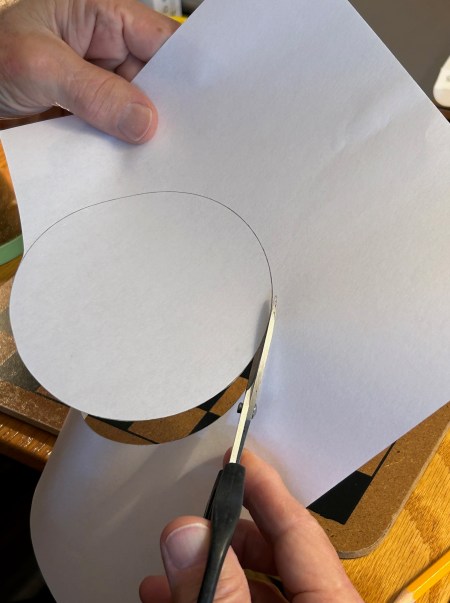
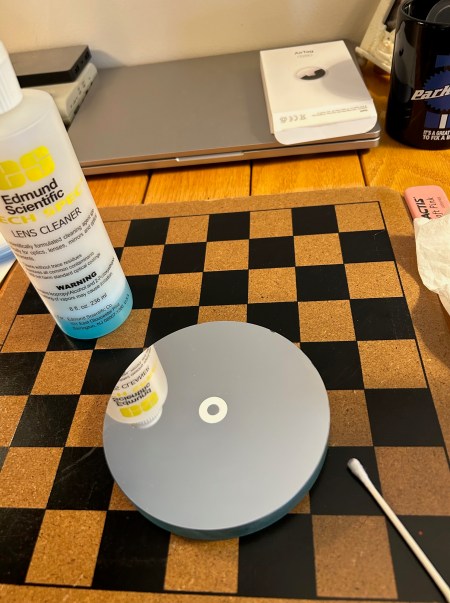
After removing the mirror, take a sheet of notebook paper, lay on the mirror and trace around the outer perimeter. The following is a 4.5-inch mirror which I center-marked earlier this year.
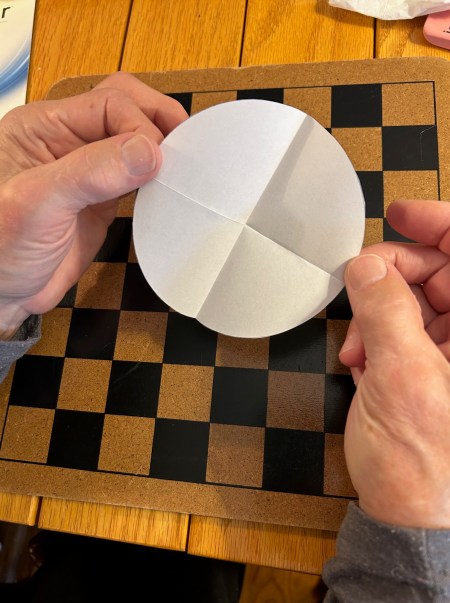
Fold the circle template in half, then quarter and then make a tiny hole in the center with any small sharp object. Now take a black Sharpie and “lightly dot” the center of the mirror, via the tiny hole. Now you are ready to replace the mirror and begin collimation. I’m not going to discuss collimation in this post, but have provided the following link from “High Point Scientific”…which is excellent.
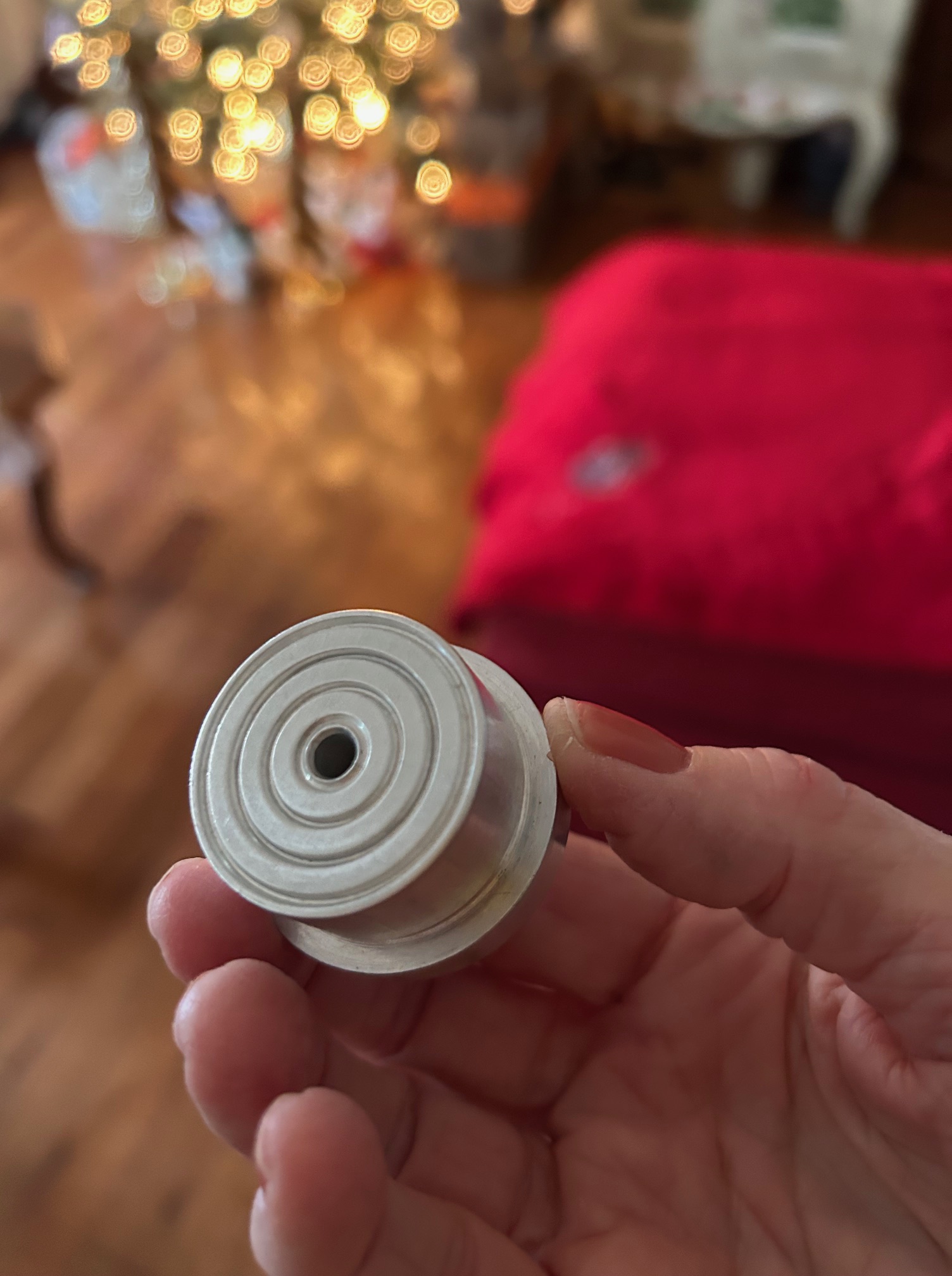
A collimation tool will be needed: I use a homemade machined collimating tool (see below) which works great. However, consider a Cheshire collimating eyepiece which is not very expensive at all. I have a Cheshire eyepiece, but most often find myself using only my homemade tool. A laser collimator is not necessary.
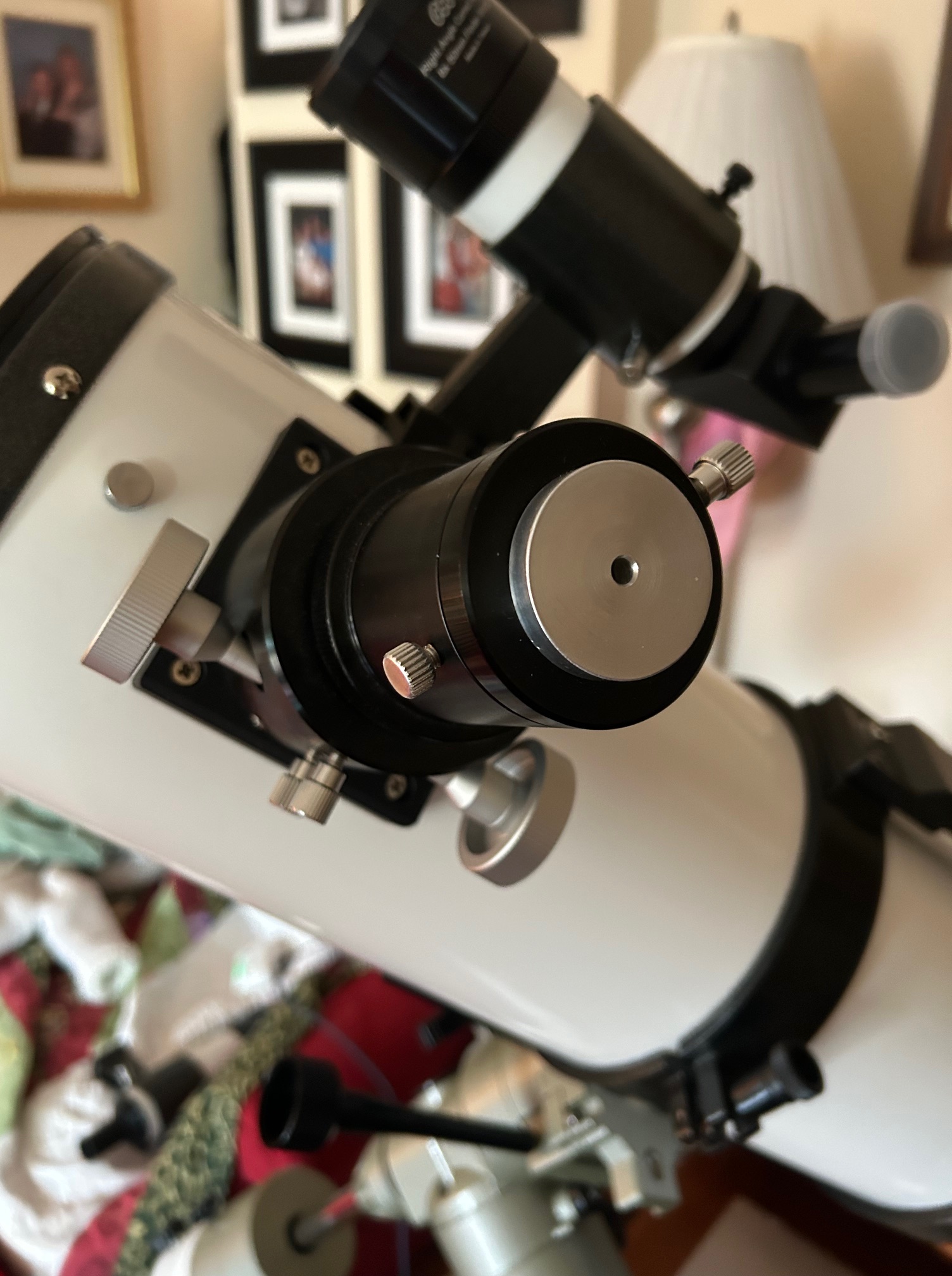
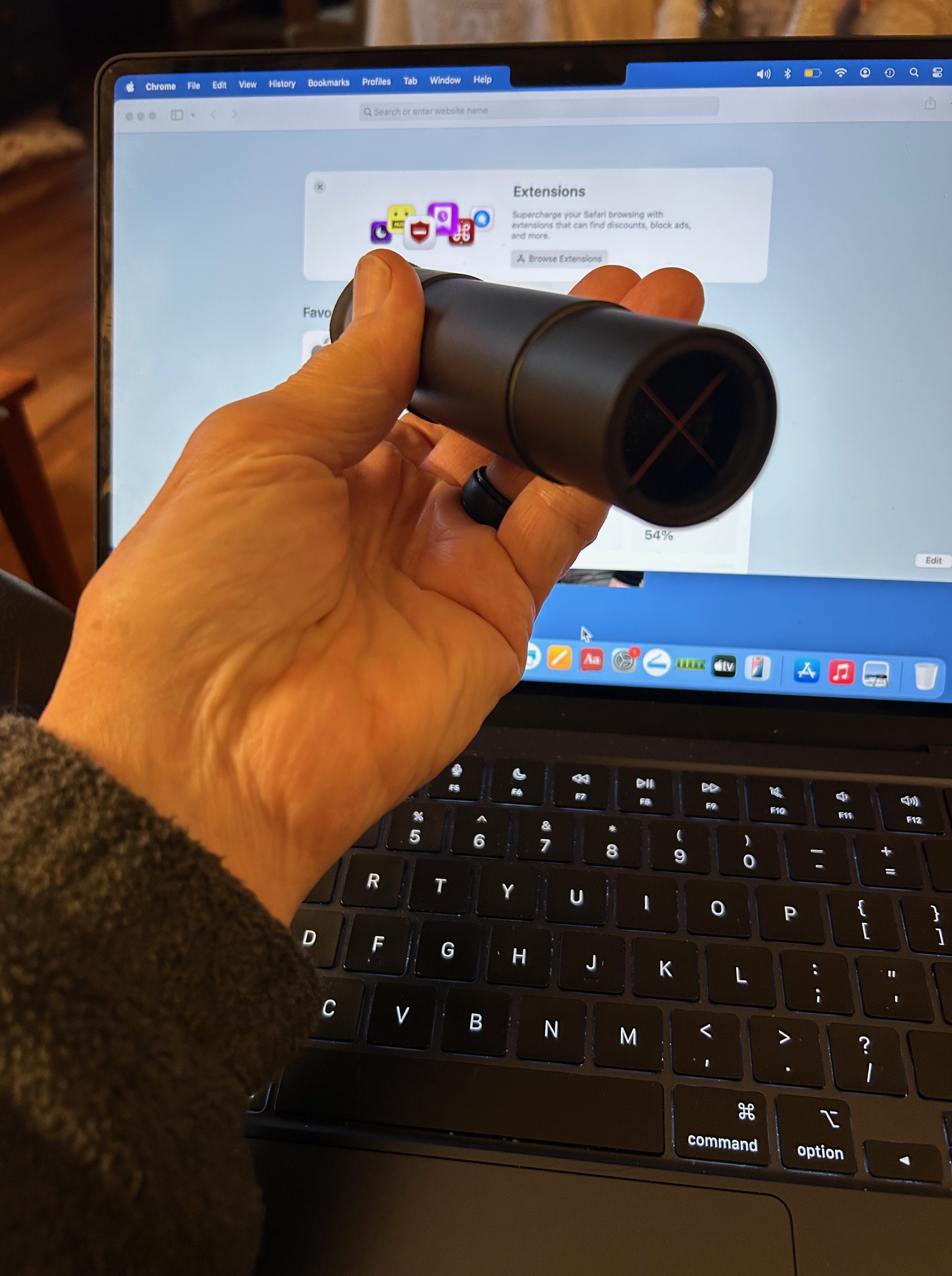
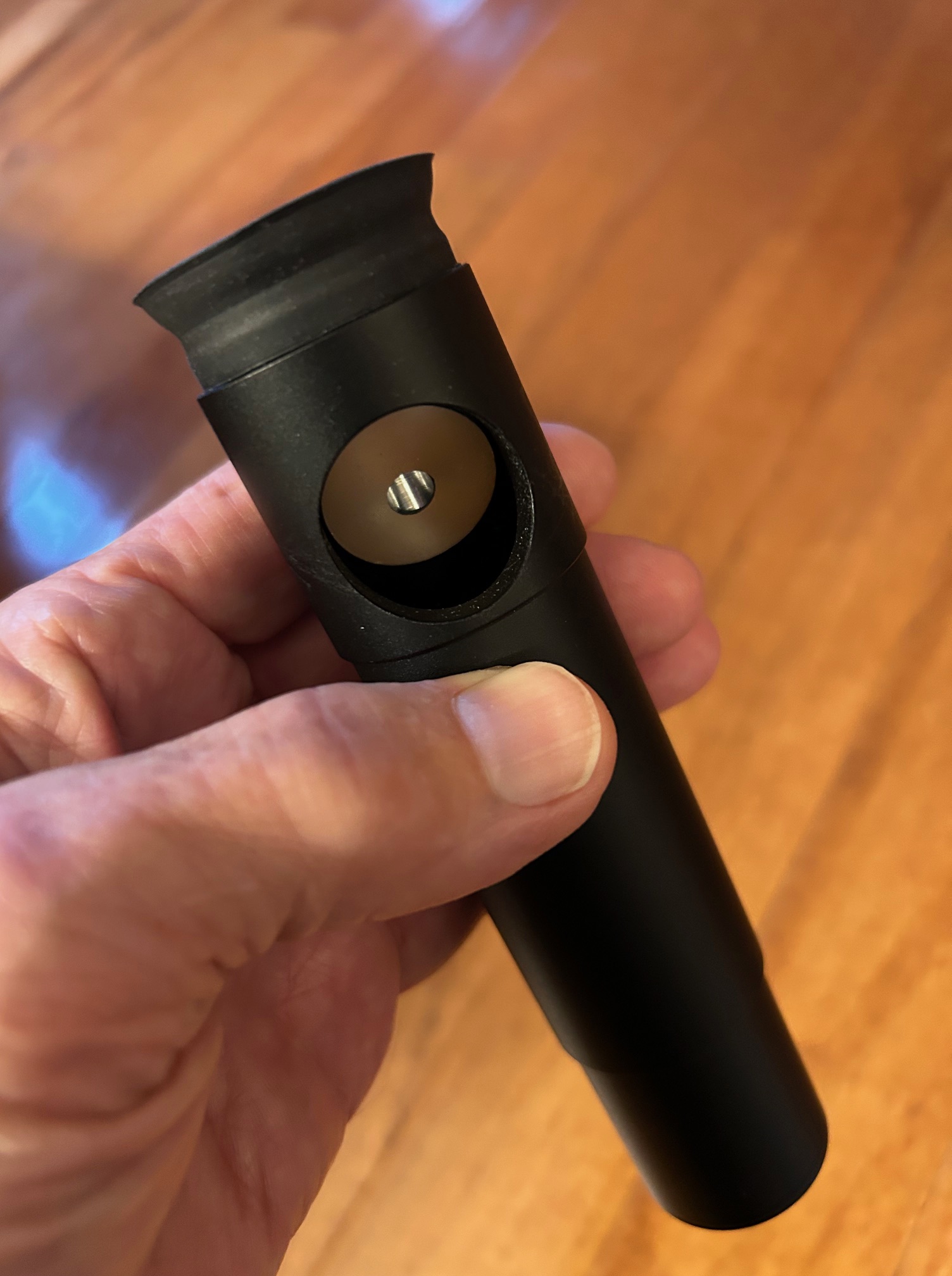
A couple photos of my Cheshire eyepiece as following which I also use on occasion:
While the mirror is out, it’s the perfect time to check if cleaning is needed.
The following procedure has allowed me to clean telescope mirrors with excellent results. It should, however, be noted that your results may vary. And mirrors coatings are very delicate, so be careful and use good common sense and care.





 rogerivester.com
Recent Comments