MONTHLY OBSERVER’S CHALLENGE
Compiled by:
Roger Ivester, North Carolina
&
Sue French, New York
February 2022
Report #157
M42 and M43, the Orion Nebula
Sharing Observations and Bringing Amateur Astronomers Together
Final Observer’s Challenge Report:
MONTHLY OBSERVER’S CHALLENGE
Compiled by:
Roger Ivester, North Carolina
&
Sue French, New York
February 2022
Report #157
M42 and M43, the Orion Nebula
Sharing Observations and Bringing Amateur Astronomers Together
Final Observer’s Challenge Report:
Roger Ivester, North Carolina
&
Sue French, New York
July 2021
Report #150
NGC 6572, Planetary Nebula in Ophiuchus
Sharing Observations and Bringing Amateur Astronomers Together
This month’s target
Our object for the 150th monthly edition of the Observer’s Challenge is the tiny, but bright, planetary nebula NGC 6572, variously nicknamed the Emerald Nebula, the Blue Racquetball, and the Turquoise Orb. These names highlight the range of hues perceived by different observers. The nebula is young, perhaps only a few thousand years old. Its diminutive size led to its inclusion in some early star catalogs. NGC 6572 has a visual magnitude of 7.3, as determined by Stephen O’Meara, while its central star dimly shines at 13th magnitude. As with many planetary nebulae, published distances vary wildly. Values in the vicinity of 5000 light-years seem most likely. This pretty little gem was discovered in1825 by Wilhelm Struve.
NGC 6572 displays bipolar outflows in deep images. There’s evidence of interaction between the collimated outflows and the nebula’s elliptical shell. The interaction has broken up the elliptical shell such that parts of the shell have been accelerated, while the outflow has been slowed down and/or deflected. This supports the idea that such outflows are common in planetary nebulae and may play an important role in shaping nebular shells. https://ui.adsabs.harvard.edu/abs/1999ApJ…520..714M/abstract
Mario Motta: Observer from Massachusetts
NGC6572 is a very tiny object (16×12 arc seconds). Got this last week, poor night with some turbulence, with an H alpha, O3 , and S2 filters. Very short exposures as it is very bright. Visually a small “blue spot”.
Image attached, about 20 minutes each filter, O3 dominated…thus very blue. No detail that I can see. Only good image on line I found is by the Hubble, but can’t match that one! However, a nice object.
Complete Observer’s Challenge Report: Click on the following link…
july-2021-observers-challenge-_ngc-6572-1

Roger Ivester: Observer from North Carolina
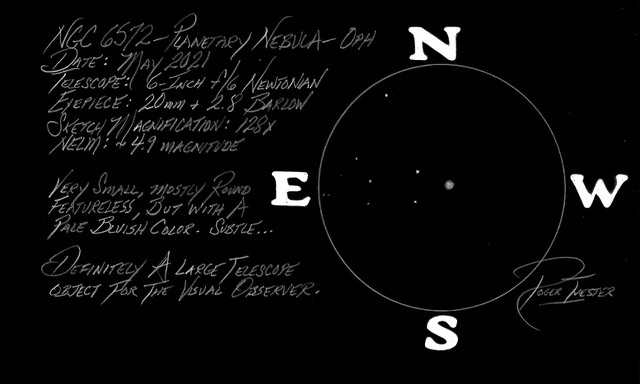
NGC 6572 – Planetary Nebula in Ophiuchus
Date: May 2021
Telescope: 6-inch f/6 Newtonian Reflector
Eyepiece: 20mm + 2.8x BarlowSketch Magnification: 128x
NELM: ~4.9 Magnitude
I knew that fine detail of this planetary would not be possible from my back yard, using a 10-inch reflector. So, I chose to use a 6-inch f/6 reflector, mostly for convenience, but not really expecting much difference from the 10-inch.
With the 6-inch, this planetary is very small, mostly round and featureless, but with a pale bluish color.
This is definitely a large telescope object for the visual observer.
Peter Vercauteren: Observer from Italy
Telescope: 18-inch f/5 Otte BinoDobsonian
Magnification: 4.5mm @ 507x

One of the best articles I’ve ever read concerning the calculation of “everything” involving telescope eyepieces….as following:
https://skyandtelescope.org/astronomy-equipment/choosing-your-telescopes-magnification/
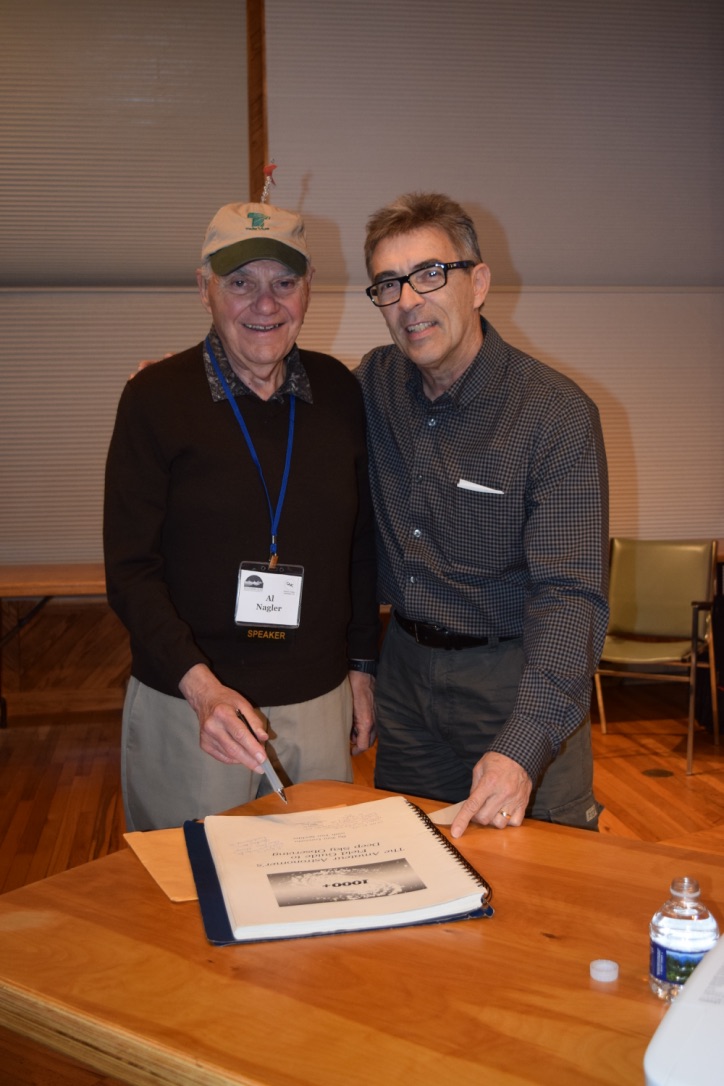
I was fortunate to meet Al Nagler a few years ago at the Southern Star Astronomy Convention in Little Switzerland, North Carolina.
Al gave a great presentation concerning eyepiece designs and calculations, based in-part on the above link.
The story:
There was a cancellation by a scheduled Southern Star participant, the last minute. I knew Sue French and Alan were at NEAF. So I called Sue via telephone, asking if Al Nagler was there, and if so would he be interested in giving a presentation for the convention.
Sue called back and said Al was “indeed” interested. I got things worked out with the Charlotte Amateurs and plane tickets for both Al and his wife…and the rest is history.
Roger, I don’t know how many of your readers have heard of the “Great Lensnapping” that happened at the original Allegheny Observatory in Pittsburgh in the late 1800s.
My beloved 13-inch Fitz-Clark had it’s objective lens stolen and held for ransom. At the time, it was the third largest in the world! (Now it’s the third largest in the current Observatory.)
Samuel Pierpont Langley was director at the time and refused to pay anything, as no telescope in the country would then be safe from theft. He finally met the thief at a hotel in a Pittsburgh suburb – the thief agreed to return it if Langley didn’t prosecute. He subsequently found it in a waste basket at that very hotel.
The lens was pretty well scratched up and Langley sent it to Alvin Clark for refinishing. Thus the dual name Fitz-Clark. As I’ve stated before, it is without question the finest visual telescope I’ve ever seen or used bar none!
To read more and see a photo of the famous 13-inch Fitz-Clark refractor, see the following link:
https://sites.pitt.edu/~aobsvtry/fitzclark.html
This is the telescope that Wally McCall and I used for our visual sky survey in the mid-60’s that resulted in the Sky & Telescope series The Finest Deep-Sky Objects and its eventual Sky Publishing reprint that went through three printings. My personal total eyepiece time logged using this amazing instrument over many years was some 10,000 hours! It clearly showed markings on several of the Galilean satellites and spiral structure within Jupiter’s Great Red Spot. One of the “discoveries” we made using the 13-inch was the “Blinking Planetary” in Cygnus (NGC 6826) which has become a favorite showpiece at star parties and public viewing sessions.
“The Finest Deep-Sky Objects by James Mullaney and Wallace McCall”
“On Public Nights at Allegheny Observatory, when the dome of the 13-inch refractor is crowded with visitors, all anxious to look at everything in the sky, a hand finding list of impressive objects is invaluable.”
These words prefaced our short list of celestial showpieces published in the December, 1962, issue of “Sky and Telescope”. We now present an expanded version, intended as a roster of the finest star clusters, nebulae, and other deep-sky objects, for the convenience of amateur astronomers with telescopes of all sizes. It is the result of our five-year visual survey of the heavens north of -40º declination….
The “Finest Deep-Sky Objects…” Cover Photo:

Since this book was my first deep-sky reference book, I wanted to document all objects, and would later put it into a soft-cover (1998 publication) of my own making. This was before I began my second quest…to see and document all of the Messier Objects.
I actually went through the list a couple times, accumulating over 500 (3×5 notecards) with observing notes and many pencil sketches of the “Finest Deep-Sky Objects”. The book was self-published (with assistance in publishing by Tom English) and actually sold at a couple local astronomy events.
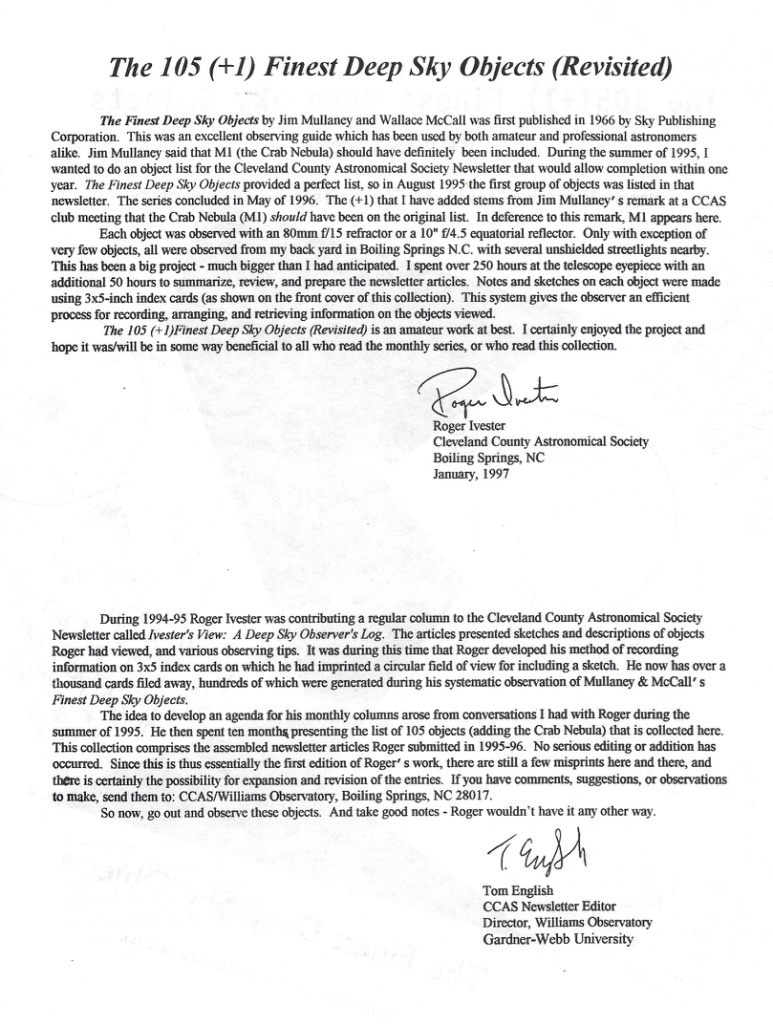
The publication was titled: “The 105 (+1) Finest Deep-Sky Objects: Revisited”
Final observing of the list: Between August 1995 and May 1996, I completed viewing all of the 105 + (1) deep-sky objects.
Each object was observed with an 80 mm f/15 refractor or a 10-inch f/4.5 EQ reflector. Only with exception of a very few objects were observed from my suburban backyard. This project was a big project…much bigger than I had anticipated. I spent over 250 hours at the telescope eyepiece with an additional 50 hours (probably many more) to summarize review and prepare for the publication.
The (+1) was an additional object to the original list, as Jim Mullaney always said, the Crab Nebula should have been included. Roger Ivester


I became acquainted with Gus Johnson in about 2009 and as time has passed, we became good friends. Shortly afterwards, he became a regular contributor to the Observer’s Challenge report.
Gus has never used a computer, so it has always been necessary for me to call him via telephone, to receive his observation notes each month. However, this has never been a problem for me, as I have always enjoyed our conversations over the years.
In 2018, Gus sent me his autobiography that he had typed himself. Yes, Gus still uses a typewriter. It was my plan to turn his “typewritten” story into a Word document, and then post on my blog site. However, I could never seem to get started. So in November 2019, I put out an email, asking if anyone would be interested in helping me tell the story of Gus Johnson “in his own words”.
A few weeks passed, and I received an email from Nina Craven of Massachusetts. Nina offered to convert the typewritten notes by Gus into a Word document. And she did a fabulous job! Both of us decided that his story should indeed be in his own words. Thank you Nina for your work!
Many of you may not know who Gus Johnson is, or his accomplishments and contribution to the world of astronomy. Roger Ivester
The following information is from wikipedia:
SN 1979C was a supernova about 50 million light-years away in Messier 100, a spiral galaxy in the constellation Coma Berenices. The Type II supernovawas discovered April 19, 1979 by Gus Johnson, a school teacher and amateur astronomer.[2] This type of supernova is known as a core collapse and is the result of the internal collapse and violent explosion of a large star. A star must have at least 9 times the mass of the Sun in order to undergo this type of collapse.[3] The star that resulted in this supernova was estimated to be in the range of 20 solar masses.[1]
On November 15, 2010 NASA announced that evidence of a black hole had been detected as a remnant of the supernova explosion. Scientists led by Dr. Dan Patnaude from the Harvard–Smithsonian Center for Astrophysics in Cambridge, MA evaluated data gathered between 1995 and 2007 from several space based observatories. NASA’s Chandra X-ray Observatory, the Swift Gamma-Ray Burst Mission, as well as the European Space Agency‘s XMM-Newton, and Germany’s ROSAT all participated in the examination.[4]
The researchers observed a steady source of X-rays and determined that it was likely that this was material being fed into the object either from the supernova or a binary companion. However, an alternative explanation would be that the X-ray emissions could be from the pulsar wind nebula from a rapidly spinning pulsar, similar to the one in the center of the Crab Nebula.[4] These two ideas account for several types of known X-ray sources. In the case of black holes the material that falls into the black hole emits the X-rays and not the black hole itself. Gas is heated by the fall into the strong gravitational field.
SN 1979C has also been studied in the radio frequency spectrum. A light curve study was performed between 1985 and 1990 using the Very Large Array radio telescope in New Mexico.[5]
More information from Chandra:
https://chandra.harvard.edu/chronicle/0410/sn1979c/
A BRIEF “ASTROBIOGRAPHY” OF GUS E. JOHNSON
In late 1938 I was born, and lived in Vanergrift, Pennsylvania, which is short, about 40 miles north-east of Pittsburgh. We lived on the bluff overlooking the Kiski River and the Pennsylvania Railroad; trains soon became a big interest of mine that continues to the present, especially steam-powered trains.
From I know not where I acquired an interest in classical music, which also is still a big interest after 68 years. I learned to play violin and organ, though not very well.
One clear starry night I recall, when living on that bluff, but to no avail, as my parents knew next to nothing about stars (or music). The news media reported a bright comet, but I didn’t see it. It scared me. I wasn’t keeping notes then so that comet’s name is gone from me.
In 8th grade, at the Lincoln School in Vandergrift, I chanced upon an article in the classroom encyclopedia, about Mars, with an artist’s version of what Mars looked like as seen from one of its moons. I think that is what sparked my interest in astronomy. I read many books on the subject, well, not really many since school libraries had few on astronomy. Somehow I learned of “Sky and Telescope” magazine. I still have my first issue , for January 1954, and nearly every issue since then. Some 1200 issues take a lot of space, and other magazines I have saved in great numbers. My house is badly a-clutter!
Around 1953 I got my first telescope, a hand-held 8 x 30 spyglass. The optics were good, but hand-held, it was of little use astronomically. About 1954 I was in high school, where I found that I knew more about astronomy than my general science teacher (9th grade). She loaned me a larger telescope, of 15x to 40x, but hand-held. Soon I bought a similar telescope and tried to mount it using a very flimsy music stand, so by the time vibrations died down the object under observation often had drifted out of the field, so I tried some other contrived mounts. I got a few observations with it like of Venus and Mizar and the moon. Saturn’s rings were visible, though tiny.
My father passed away in 1951, and then my mother in 1961. In 1954 she remarried and we then moved to Castle Shannon, a suburb of Pittsburgh. I attended a high school in Mt. Lebanon, about 2 miles away, where there was a pretty fair library and more astronomy books. The librarian acquainted me with the autobiography of John A. Brashear, which I have read numerous times, he being an excellent telescope builder and astronomer at Allegheny Observatory. His book is a joy to read. He, as a beginner who worked at a steel mill, had built himself a 5-in. refractor and a 12-in. f/10 reflector.
I was inspired to get a real astronomical telescope, and seeing an ad in “Sky and Telescope” I got a 3 ½ in. Skyscope, base priced at $30. It had ¼ wave optics, and that was adequate to give fairly good views, at 35x and 60x. A 2.4-in. f/15 Unitron refractor followed, then a Cave 6- in. f/7.8 Newtonian, which really did wonderfully on deep sky and high resolution planetary observing. Suburban skies were light polluted but sometimes I could use high powers. My stepfather had a cabin in the woods at Deep Creek Lake, in western Maryland, where skies were fairly dark. Many trees obstructed the horizons, except to the north and northeast.
My father’s name was Gus E. Johnson like myself. My mother’s was Maryon. My stepfather was Floyd Crouch; he passed away in 1957, as I wrote, my mother passed away in 1961, after which I moved from the Pittsburgh suburb to Deep Creek Lake. I now have an 8-in. f/6 Orion reflector and a very handy 4 ¼-in. f/7 reflector from Three B Optics, from Mars, PA (They advertised “Mirrors from Mars”) and their optics were very good. Alas, as with Cave, no longer in business. Three B’s head optician was Bill Herdman.
With so many surrounding trees I didn’t get very many observations. One memorable observation was made, perhaps my only sighting of M51’s spiral arms was from that home. I remember once carrying (no vehicle) my 55 lb. 6-in. at least a quarter mile so I could see into Scorpius. I’d get set up on the road then a car would come with its bright lights and I’d have to move the telescope. I think I made that ordeal only once. When I observe I like to have a writing desk beside the telescope, and along that road I couldn’t have that.
In around 1973 I got married. The house was too small so we moved around 24 miles away to Aurora, W.VA. to a sort of “farmette”, a couple acres, but with good sky access. My wife didn’t like me out observing, much discord, and a divorce came, a costly one; then I couldn’t afford a good house, so I got this rather dumpy one back near Deep Creek Lake. It has some NW sky then a fairly low horizon NE through SW. I can’t quite see Omega Centauri, but just up over the hill it can be seem dimly. Gamma Velorum can be resolved from that site too, with a 40mm Unitron finder at 12x. From my home site I can reach Theta Eridani, resolving with a 2.4-in. at 21x. Those three are my most southern objects.
More regular observing came with my joining the American Association of Variable Star Observers (the AAVSO). Besides observing long period variables, like Mira, I observed some galaxies, looking for supernovae, though probably not too seriously at first. On April 18, 1979 I invited the pastor of my church to join me observing, for he had an interest in astronomy. I took him on a “tour” of the Coma-Virgo Galaxy Cluster with my 8-in. and Leland Copeland’s “Coma-Virgo Land” chart from the Feb. 1955 “Sky & Telescope”. The pastor’s name is David Long, now a missionary in Botswana. Anyway, when we looked at M100 (NGC 4321) I noticed a little star, about mag.11 near the galaxy’s edge. I kept it in mind and later checked a Palomar photo and the star was not there so I phoned the AAVSO and they put out an alert. By the next day, April 19,1979 it was confirmed, by L. Rosino of Asiago Astrophysical Observatory and R. Kirschner, of the University of Michigan, reported that McGraw-Hill Observatory got its spectrum.
It was reported to be the third time ever that a supernova was discovered by telescope direct vision, rather than photographically. The SN was no longer visible by 1980, but I read that it was by infra-red and/or radio telescopes. I thank GOD for my noticing the SN. Between mag. 10 and 11 are around a half million stars, and I couldn’t have memorized more than a “handful”.
At the autumn meeting of the AAVSO I was awarded a handsome plaque. Some notable observers were also at that meeting: Canadian astronomers Rolf Meier, discoverer of numerous comets, and Warren Morrison, who discovered Nova Cygni with only a 2.4-in. refractor (probably a Unitron). Decades passed and I watched more galaxies just in case.
One interesting observation was made on Feb. 19, 1983. I was looking for Omicron 2 Eridani (40 ERI) and where I expected to find what normally looks like a wide unequal pair, I saw a nearly equal double aligned apx. E-W, puzzling me. I didn’t become aware of what I had until too late. The dim star is a pair of white and red dwarf stars, the latter occasionally erupting; it was flaring! And I didn’t make any timings!
In autumn of 2010 the Harvard-Smithsonian Astrophysical Observatory scientists, using NASA’s Chandra X-ray Observatory satellite discovered x-rays coming from the site of my supernova, which suggested that the SN had left a black hole behind.
All of a sudden I was getting calls from newspapers and the HSAO scientists, and a television interview was made. The “Washington Post” newspaper wrote “…Gus Johnson talks about his black hole discovery 31 years ago.” NOT quite correct; I found the supernova but NOT the black hole. Dated Nov. 29, 2010.
I have done little observing lately, due to my observing eye having a cataract, which I hope to have fixed this spring 2018.
Like most amateurs I had “aperture fever” but am getting over it. For over 60 years I wanted a 12-in. telescope, but feel now that it would be too heavy to lug around as long as I live here, where light pollution is increasing. A good small telescope on a steady mount can give many wonderful evenings. Just to get a rare clear night is a blessing. My 4¼-in. at 38x can see mag. 12 stars and even my short 2.4-in. at 25x can see mag. 11.3 (and once reached mag. 13.0 at 86x). And there are about 1,000 galaxies in range of my 8-in.
Big automated observatories are putting visual observers “out of business”, yet I feel there are small opportunities for us to find a new nova or maybe even a comet. Don’t give up. It is fun trying.
Gus Johnson
March 7, 2018
As you become absorbed in amateur astronomy, you may stop to wonder how others developed an interest in this hobby. Amateur astronomy is truly nothing new. The technology has changed, the number of people involved has changed, however, the same basic desire has remained the same. A curiosity of what’s up in the night sky. While you may use a sophisticated computerized telescope with the finest of eyepieces, the earlier amateurs used both crude lenses and telescopes, sometimes made by themselves. Some did it for science, while others did it simply for pleasure and “for the love of.” Within our own American history of amateur astronomy is an unusual, but sad story of one amateur; not unlike many of us in one way, however, far different in others. He left a legacy almost despite himself. This is the story of that amateur which has been told to me by some of his acquaintances of days past.
In 1992, I read the following from “1000+ The Amateur Astronomer’s Field Guide to Deep-Sky Observing” P-81, by North Carolina amateur and author, Tom Lorenzin. I became very interested in the story and wanted to learn more.
“In the case of Andromeda’s NGC 404 “Comet Komorowski” commemorates highly eccentric Ted Komorowski, Charlotte, N.C., amateur who “discovered” the object and who found nothing plotted that near beta AND on Becvar’s Atlas Coeli. Convinced of his claim to fame and immortality, he wired his discovery to the proper authorities and hopped from one foot to the other for days until the big needle returned by mail to puncture his dream. Ted was an amateur astrophotographer long before it was fashionable to be-so (mid-60’s) . Impulsive by nature, he was known to “assassinate” photos he thought less-than-perfect by shining a flashlight down the tube of his Newtonian while the camera shutter was still open. Alas, Ted Komorowski is reported to have died a violent death by gunshot at the hands of his self-defending girlfriend.” Tom Lorenzin
I would later become personal friends with Tom Lorenzin, receiving advice and encouragement, regarding deep-sky observing notes and pencil sketching.
Vernal Equinox 1994: I met Tom and several local amateurs in an open field, just a few miles from my house, with the goal of observing all 110 Messier Objects in one night. Unfortunately, clouds foiled our attempt. However, we went back to the William’s Observatory and had a great time, talking and laughing until the wee hours of the morning.
Now back to the story of Ted Komorowski, and his mistake as related to galaxy NGC 404.
Elliptical galaxy NGC 404 could easily be mistaken for a comet, especially if it was unknown to the observer, prior to an observation. This magnitude 8 galaxy is nestled in the glow of the much brighter star, BETA Andromeda. I have observed this galaxy many times over the years and have found it to be fairly easy to see with telescopes as small as an 80 mm refractor. When observing NGC 404 on those cooler nights of fall, I always think about the excitement Ted Komorowski must have felt when thinking he had discovered a new comet.
Gayle Riggsbee of Charlotte had known Ted for many years and talked with him only days before his untimely death in 1969. Gayle was a mechanical engineer and helped Ted with his many astronomy projects. On many afternoons, when returning home from work, Gayle would find Ted sitting on his steps…he might need some penny’s converted into copper washers, or any number of things. Ted didn’t have a job, and had very little money, so he was forced to improvise on his projects.
Ken Dwight of Houston, lived in the same Charlotte neighborhood as Komorowski from the early 50’s until 1968. Ken knew Ted very well and was impressed with his skills and abilities as an amateur astronomer. Robert White became acquainted with Komorowski when he was only twelve years old, and had many discussions with him concerning astronomy and telescopes. Ted really liked to share his knowledge of amateur astronomy with others. He was a member of the Charlotte Amateur Astronomers Club for several years.
The Charlotte Amateur Astronomers Club has really grown since the days of Ted Komorowski, with a current membership of a hundred or more, and a club observatory. They also sponsor the nationally renowned and celebrated Southern Star Astronomy Convention in the mountains of North Carolina, near Little Switzerland. Gayle Riggsbee and Robert White are still members of the club.
Ted Komorowski could be considered an advanced amateur for many reasons. During the early sixties, most amateurs were using small telescopes and fortunate indeed was one who had a 6-inch reflector. Ted’s 12.5-inch f/6.5 Criterion reflector was the largest telescope in the Charlotte area during the early 60’s. He was one of the first astrophotographers in the region and also documented his observations. He built his own drive corrector based on an article he had read in Sky & Telescope Magazine. His photo efforts at times were very frustrating, but he still fantasized about selling his slides to planetariums throughout the country.
Ted apparently corresponded regularly with Walter Scott Houston who was a contributor to Sky & Telescope Magazine for more than 47 years, writing the Deep-Sky Wonders column. Ted took amateur astronomy very seriously.
In the book “Deep-Sky Wonders” Walter Scott Houston, selections and commentary by Stephen James O’Meara, adapted from his columns in “Sky & Telescope” Magazine. Ted is mentioned twice:
Page 7: “IC 434, but no Horsehead, was seen with a 2.4-inch refractor by Larry Krumenaker in New Jersey, with a 12-inch f/6.5 reflector by Ted Komorowski in North Carolina, and with 6-inch f/8 telescopes by Stephen Barnhart in Ohio and Mark Grunwald in Indiana. However, other observers were more successful.”
Page 231: The Helix Nebula: “Ted Komorowski told of a gray disk easily visible in his 8-inch f/7.5 at 56x.”
He also wrote quite a few letters to the editors of Sky & Telescope Magazine, concerning everything from meteor showers to a review and comparison of planetary nebulae.
The following letters and writings are from the Sky & Telescope DVD collection.
Sky & Telescope, Letters – April 1965, p.215
Sir:
On page 85 of the February issue, C.R. O’Dell points out the desirability of special amateur observations of central stars in planetary nebula, to check on possible brightness changes. He gives a list of the five planetaries having the brightest central stars. I feel that NGC 2392 in Gemini and NGC 3132 in Antlia should be added, since visually I find that their central stars seem at least as bright as that in NGC 6826, which Dr. O’Dell lists.
Ted R. Komorowski
Sky & Telescope, Observer’s Page – January 1966, p.58-59: S&T DVD collection (Abbreviated)
Many Leonids Observed
On the morning of November 16, 1965, observers in Hawaii and Australia saw what may have been the richest shower of Leonid meters since 1932. At Charlotte, North Carolina, Ted R. Komorowski logged 115 Leonids…
Sky & telescope, February 1962, p. 4-5 “Leonids Meteors Give Unexpected Display” This was a very lengthy letter and the following is only the first paragraph.
On November 17th, Ted R. Komorowski wrote to Sky and Telescope: S&T DVD collection
“This morning between moonset and sunrise, I observed a very rich display of Leonids. They were literally dropped everywhere and in large numbers, sometimes three, four, or even five in rapid succession. Almost every other one was 1st or zero magnitude and streak-leaving. Eight were of magnitude -1 or brighter, and three others rivaled the quarter moon!”
Some personal information about Ted Komorowski:
Komorowski lived with his parents, except for a brief period when he went away to college. He did not have a drivers license until a year or possibly two, prior to his death, and he never owned a car. His mode of transportation was a bicycle. On occasion he would ask others for a ride, however, Ted had very few friends. From all accounts, it would appear that Ted had some social skill issues, at times having difficulty relating to others.
Ted earned a scholarship to Carnegie Institute of Technology in Pittsburgh, Pennsylvania. He studied nuclear physics, but attended for only a year, possibly two. He then returned back home where he felt the most comfortable. Ted had a desire and ambition of becoming a planetarium lecturer.
A year or two before his death, Ted did get a job, delivering milk, going door to door, during the very early morning hours. This might have been the perfect job for Ted, as he worked mostly by himself, and it allowed him the opportunity to observe every clear night, if he so desired.
Ted Komorowski, as reported earlier, died an untimely death in 1969:
After his passing, Ted’s father asked fellow club member, Gayle Riggsbee if he would select some of his best slides and give to the Charlotte Nature Museum as a memorial. The Criterion 12.5-inch f/6.5 reflector telescope, and equipment:
The telescope was ordered from Criterion as an optical tube assembly only, but without the mirrors. Ted, however, ordered the mirrors from the Optical Craftsman, who guaranteed his criteria for a 1/20 wave accuracy. From all who have had the opportunity to observe through this scope, it has been reported to be an excellent mirror indeed. The mirror is dated 12-2-60, which might indicate that the telescope was possibly received in 1961.
He replaced the standard four-vane spider with a custom made circular spider to eliminate spikes during astrophotography. This was an advanced feature in the early 60’s.
Ted’s favorite eyepiece was the Criterion 16.3 mm Erfle eyepiece with a wide 75º apparent field. He also had a 4 and 6 mm eyepieces, being of Orthoscopic design. They were manufactured by Criterion also.
The focal length of the 12.5-inch f/6.5 scope is 2064, which would have given a magnification of 126x when using the 16.3 mm eyepiece. The 16.3 mm Erfle would most likely have been his eyepiece of choice when observing deep-sky objects. Could this have been the eyepiece that he employed when he saw the smudge in the glare of Beta Andromeda?
The 12.5-inch Criterion telescope is really big, with the tube being slightly over 6 1/2 feet in length. Unfortunately, Ted could not afford to purchase the proper mount, but instead used the mount from his previous 8-inch Criterion scope, which was a bit too small. The Komorowski telescope is now owned by the Cleveland County Astronomical Society. It is maintained and stored in the Williams Observatory, on campus of Gardner-Webb University in Boiling Springs, North Carolina.
The telescope has been completely restored by Steve Davis and another member of the Cleveland County Astronomical Society. This is a beautiful scope in now in beautiful condition. The original Criterion mount has now been replaced by a much more heavy duty mount, manufactured by Meade Instruments Corporation, and designed for a 16-inch, model DS-16A reflector.
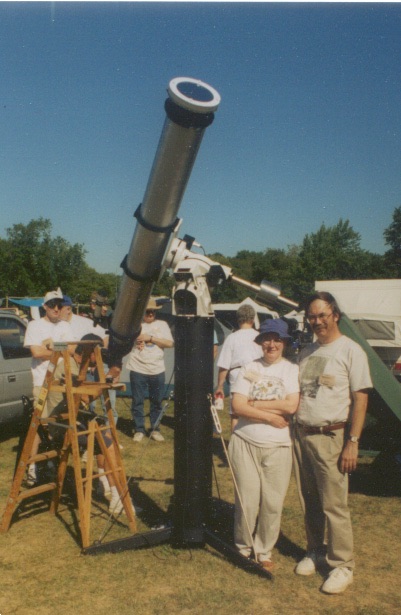
For a size reference, I’ve included a photo of myself with the famous telescope. It’s a big scope for sure! The finder was replaced shortly after this photo was made. Photo by Debbie Ivester

Ted observed from his backyard in Charlotte. The mount was “at times” left outside and covered when not in use. The OTA was stored in Ted’s living room, sitting on the mirror end in a corner. However, Ken Dwight remembers seeing the scope on many occasions mounted in the side yard, covered with a tarp.
M42 – Date: 1968 – Telescope: 12.5-inch f/6.5 reflector using high speed 160 ektachrome slide film – Photo by Ted Komorowski (Courtesy of Gayle Riggsbee and Tommy Forney)

The following is from Sky & Telescope, October 1969 – Letters, p.239 (S&T DVD collection)
Why Study The Stars?
To a casual spectator, the heavens on a clear night present a vast, featureless jumble of myriads of specks of light, with a few brighter beacons. But to someone who has taken the time to become acquainted with his heavenly friends, the sky is made up of orderly patterns and shapes, while bright or important stars and all the planets become celestial landmarks leading to the more difficult objects.
Some knowledge of the constellations gives one a 24-hour clock, a compass, and a protractor, but there are also philosophical aesthetic, and scientific reasons for stargazing. Stars are lovely to behold, forming attractive celestial patterns, and some who even have a shade of color. Scientists can study the stars to learn about matter under conditions unobtainable in earthly laboratories. An even greater knowledge of our own world and its beginning and its eventual ending can be gotten from observing stars in different ways.
Star names and their derivations indicate something of the contributions to astronomy of ancient and fallen civilizations, and celestial mythology is a storehouse of early folklore. The legends of Perseus, Andromeda, and Orion are well established in the sky for ages to come. The planets, too, have their store of myths. Mars, named after the Roman god of war because of its angry red countenance, is really not as harsh as its name implies, for it is the least hostile to life of all the other planets.
Men who spend their lives trying to figure out the scheme of things and find the meaning in the universe, men who are seeking answers to very difficult questions, are greatly aided and guided by knowing what is happening above. Reverent people may feel closer to the Creator after they have acquired a knowledge of his creations. Others may gain their first religious awareness from experiencing the wonder, awe, and mystery of the firmament.
Even ordinary laymen like ourselves, with no other aim than appreciating nature, can find immense enjoyment and well-spent hours in getting acquainted with other worlds above and beyond our own. Here is treasure for all kinds of people, regardless of their purposes, if only they will look and learn. Ted R. Komorowski
This is the last composition of a young amateur astronomer of Charlotte, North Carolina, who died suddenly early this year. He frequently reported his observations of celestial phenomena to this magazine. ED (Sky & Telescope Magazine)
I would like to thank Gayle Riggsbee of Charlotte, and Ken Dwight of Houston, without them and their memories, this story would have gone untold.
Thanks to Tom English for his research using the S&T magazine DVD collection to gather all of the magazine quotes and letters.
A special thanks to Sky & Telescope Magazine for giving me permission to use the information and letters provided to the editors by Ted Komorowski, also quotes by Walter Scott Houston from Deep-Sky Wonders.

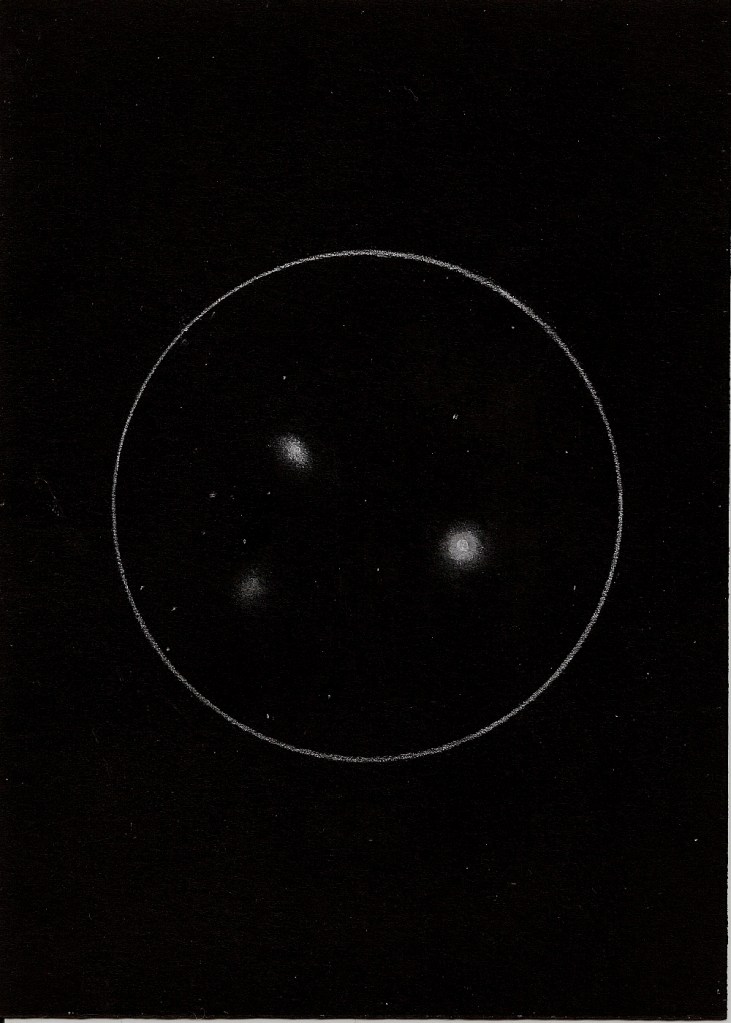
M105, NGC 3384, NGC 3389
 rogerivester.com
Recent Comments