Messier 4 – Globular Cluster in Scorpius – July 2018 Observer’s Challenge Report

Posted August 24, 2018 by rogerivester
Categories: Work File Only - Observer's Challenge Reports

Click on the following link for the complete report:  

JULY 2018 OBSERVERS CHALLENGE – M-004

Notes from my backyard:

Globular cluster, M4 is easy to see with a 60 mm refractor, appearing as a faint circular glow at low magnification.  When using a 3.5-inch Maksutov-Cassegrain at 78x, there is a resolve of some of the brighter members.  The cluster has a subtle elongated shape.  A very faint chain of stars was noted in the central region, oriented N-S.  With 102 mm refractor, there is a greater number of stars resolved within the cluster, and much greater concentration of stars, elongated and with more stars in the central chain. A prominent double star is located on the SE edge.   

10-inch reflector at 140x, excellent resolve of the cluster. The center chain of stars is very bright and with many stars counted, both in the central region and around the outer edges.  A chain of stars makes an arc, the entire length of the cluster on the NW side.  The elongation shape becomes much more apparent with the larger aperture.      Roger Ivester 

Pencil sketch with the colors inverted using a 102 mm refractor @ 140x 

Rogers M-004 Inverted

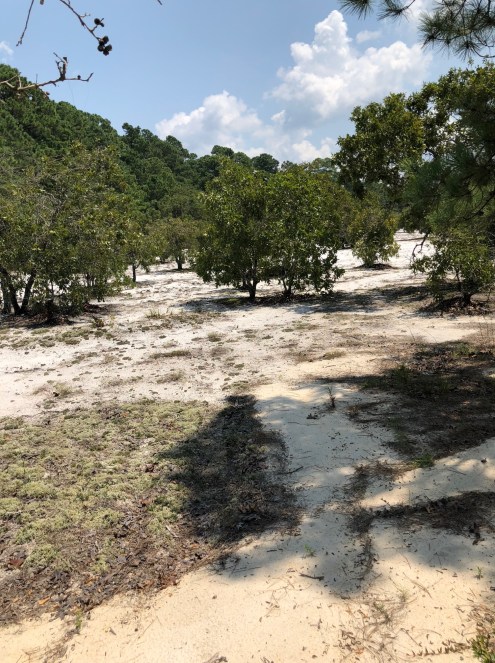
Sand Dunes In The Northeastern Corner Of South Carolina, 50 Miles From The Atlantic Ocean, Swamps, With Virtually No Light Pollution

Posted August 14, 2018 by rogerivester
Categories: Roger's Articles

While visiting our family in Mullins, South Carolina over the past few years, we have enjoyed finding some very interesting things. 

Only a few miles outside the city limits, there are country roads, agriculture fields, and no houses or lights for miles and miles, and virtually no light pollution.        

The next morning….Tuesday August 14th 2018.  

When driving in a secluded area, via unfamiliar country roads, you never know what you may find:   

While riding around with my oldest grandson, John-Winston, who just received his learners permit, and I was sharing my wisdom, on how to be a safe driver.  During our  leisure drive, we found sand dunes, in the middle of a swamp! 

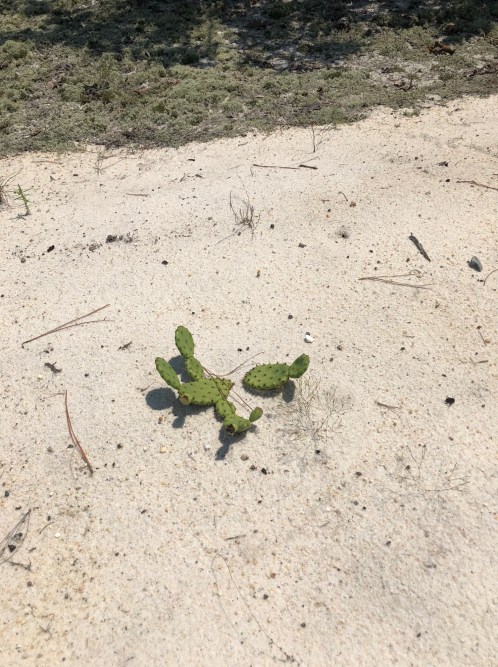
Sand dunes, and a very sandy area….at first resembling snow, all in the middle of a dense forest and surrounded by swamp land.  

There were Bald Cypress trees growing out of the black murky water, Spanish moss hanging from the trees, and who knows, maybe even an alligator or two in that dark water!

Note:  This very remote small sandy area is a protected site.  I took some pictures as following, but somehow missed the eerie swamp.   

Roger 

IMG_0420

IMG_0419

Stopped and using the car as a size reference, to a part of the protected site: 

Version 2

South Carolina Grandkids

IMG_3499

Debbie (Grammy) with granddaughter Gracie

IMG_3484

Couldn’t leave our Sophie behind!  She’s ready to go anytime we are! 

IMG_3510

M51 and Companion Galaxy NGC 5195 – June 2018 Observer’s Challenge Report

Posted July 12, 2018 by rogerivester
Categories: Work File Only - Observer's Challenge Reports

JUNE 2018 OBSERVERS CHALLENGE – M-051

Observing notes: 

Messier 51 is visible along with companion NGC 5195 in a 60mm (2.4-inch) refractor.  M51 is mostly round with a bright stellar nucleus and a very faint halo.  The small companion galaxy, NGC 5195, just to the north was very faint and small.  If sky conditions are poor, this galaxy pair can be extremely difficult to see using a telescope this small.

In a 10-inch reflector on an exceptional night at 190x, spiral structure is easily visible.  I could trace the prominent eastern arm almost in contact with companion galaxy, NGC 5195.  The nuclei of both NGC 5194 and NGC 5195 are both stellar, with the smaller companion galaxy, NGC 5195, having a brighter, more intense nucleus. 

M51 has a mag. 13.5 star a couple of minutes to the SW of the core, still within the halo, and a mag. 14 star, (requiring averted vision) just off to the east, outside of the halo.

One of my most memorable views of NGC 5194 and NGC 5195 came during an early spring night in 1993, using a 14.5-inch reflector.  The spiral arm of M51 (NGC 5194) was incredible “almost” touching the companion galaxy to the north.  This view rivaled that of many photographs.

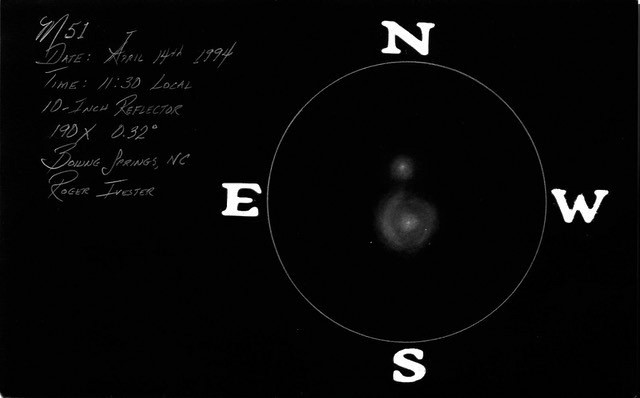
On the night of April 14, 1994, supernova 1994I was visible.  I estimated the mag. of the SN on that night at 13.8.  The following pencil sketch was made that night. 


Rogers M-051 New a Inverted
 
 
The following image by Mario Motta, observer from Massachusetts using a 32-inch telescope.
 
I imaged M51 last night (May 10th 2023) and it came out nicely, using Lum, R/G/B, and Ha filters, 5 hours total.  
 

Cline Observatory Double and Multiple Star List – Compiled By Tom English; Consisting of 25 Doubles and 5 Triples

Posted June 22, 2018 by rogerivester
Categories: Roger's Articles

Cline Observatory Double Star List – 25double-5triple 

     Tom English has put together an excellent list of twenty-five doubles and five multiple stars, which at first glance would seem to be compiled for only those new to this facet of amateur astronomy.  However, for those of us who have enjoyed double star observing for decades, we know there is no such thing as a beginners list.  

     Double star lists may be compiled of the most difficult pairs due to their close separations and sometimes with unequal magnitudes, or those with wide separations and beautiful contrasting colors.  It was the latter which coined the name: “The jewels of the night sky.”

     This list contains some beautiful and interesting doubles, all of which can be observed with a small telescope.  

     The famous double star, Epsilon Bootis is probably the most difficult double on the list, which has always required at least a 4-inch refractor for me.  Many observers have reported seeing the companion to Epsilon with a 3-inch aperture.    

     Are you stressed, too tired to take out that big telescope, but would like to enjoy an hour or so of relaxation under the night sky?  So….why not a 60 mm refractor or a 3-inch reflector?   And you don’t have to worry too much about a bright moon or ambient lights as both have little effect on “most” double or multiple stars.     

     Want to become a better double star observer?  I’ve listed a few things as following which have helped me over the years:  

     I’ve never been able to observe through a telescope eyepiece and stand at the same time, much less attempt to separate a very close pair.     

     And for those extremely close and difficult doubles, an eyepatch is necessary for the non-observing eye.  

     It’s important to relax the facial muscles and “absolutely” essential to hold the observing eye very still and on-axis….hence the need to be seated.  

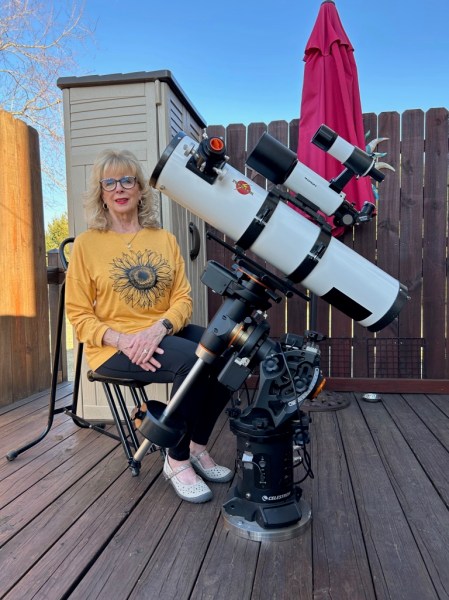
      A good quality astro-chair, as pictured below is a must when observing double stars.

Roger Ivester  


NGC 4236, Extremely Faint Galaxy In Draco – May 2018 – Observer’s Challenge Report #110

Posted June 7, 2018 by rogerivester
Categories: Work File Only - Observer's Challenge Reports

To read the complete LVAS Observer’s Challenge report, click on the link:

MAY 2018 OBSERVERS CHALLENGE – NGC-4236

Rogers NGC-4236 Inverted b

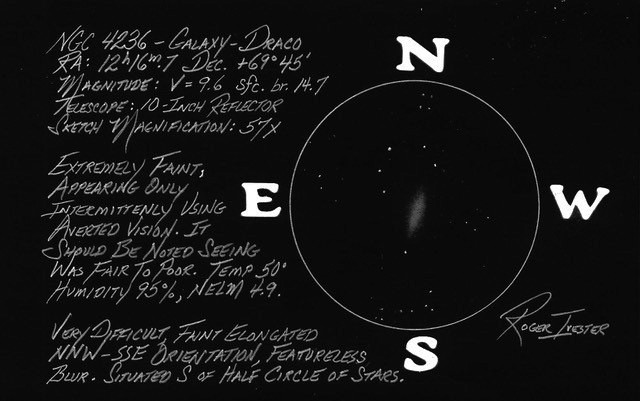
10-inch reflector, and spending four hours in my attempt to see galaxy NGC 4236, of which the first three were unsuccessful.  However, during the forth hour, at well past 1:00 AM EDT, could glimpse an extremely faint, elongated NNW-SSE oriented blur of light as shown in my sketch.  The galaxy appeared featureless due to the extreme low surface brightness, and visible only intermittently with averted vision. 

There is a distinctive half-circle of five stars, NNE of the galaxy which works well to assist in determining the exact location of this very faint galaxy, or better said, an extremely faint galaxy. 

Sky conditions were poor with a NELM of 4.9, which is about normal for springtime in the foothills of North Carolina.  

On the previous night, under the same conditions, using a 6-inch reflector, the galaxy was invisible, despite spending two hours in my search.  

Roger Ivester

Messier 81 and M82: Galaxy Pair – Ursa Major – April 2018 – Observer’s Challenge Report #110

Posted April 29, 2018 by rogerivester
Categories: Work File Only - Observer's Challenge Reports

April 2018 Observer’s Challenge Report:  APRIL 2018 OBSERVERS CHALLENGE – M-081-82-1

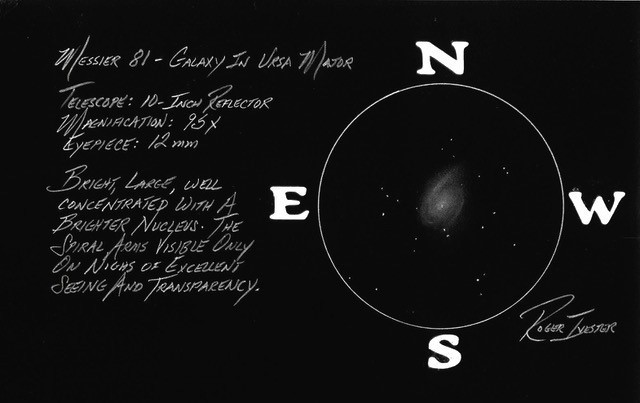
Messier 81 (NGC 3031) Galaxy in Ursa:   10-inch f/4.5 reflector.  Sketch magnification; 12 mm eyepiece 95x.  

80 mm refractor at 33x, M81 is large, bright, mostly round with a brighter nucleus, and is nicely framed with companion galaxy M82.   

10-inch reflector at 95x, M81 is bright, large, well concentrated, elongated, but subtle, NE-SW.  Very bright nucleus, almost stellar.  Only on nights of excellent seeing and transparency can the spiral arms be seen from my moderately light polluted backyard.   RI   

Rogers M-081 Inverted


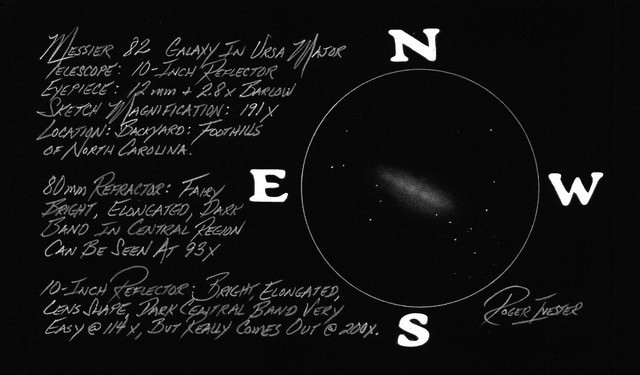
Messier 82 (NGC 3034) Galaxy in Ursa Major:  10-inch f/4.5 reflector @ 191x magnification.  Eyepiece:  12 mm plus 2.8x Barlow 

80 mm f/5 refractor:  Surprisingly bright, elongated with a lens shape, smooth texture at low magnification.  When increasing the magnification to 75x, the galaxy becomes very uneven and mottled, with two brighter knots toward the middle, and an outer elongated halo.  This galaxy is much fainter than it’s companion, Messier 81.

10-inch reflector:  Bright, very elongated, dark band in the central region is almost separating the galaxy, and is very easy at 114x, but really comes out at 200x.  At the higher magnification the galaxy becomes very mottled, and with a faint surrounding halo extending the length of the galaxy.  The NE and SW edges or tips of the halo are smooth.   RI   

Rogers M-082 Inverted

Notes from April 1978:  

It wasn’t until the mid-70’s when I acquired my very own telescope, a 4 1/4-inch Edmund Scientific reflector, a Palomar Jr. which was not my first choice, but the best my budget would allow.  

I’ll never forget one special night using this telescope. I was attempting to locate M81 and M82, two of the most beautiful galaxies in the heavens. By this time, the fabulous skies of my early years were gone. I’d moved to an area packed with houses and street lights, and the light pollution was very severe in my back yard.

Attempting to find even the brightest deep-sky objects under these conditions proved to be difficult.  I had tried on many occasions to find M81 and M82, without success.  I wanted to see this galaxy pair, which appeared so striking and beautiful in the magazines.

One night, while observing, time was running out.  It was already after 11:00 PM, and needed to get up early the next morning.  I used my hands in an attempt to block the ambient light from entering my eyepiece, and then it happened: A small, faint fuzzy object entered my telescope view.  I then nudged the scope slightly and then another…..finally M81 and M82.  What a beautiful sight!  I savored the view for the longest time and to this day and I can still feel that excitement.  RI 

Below:  Wide field image of M81/M82 and also NGC 3077, by Dr. James Dire at Wildwood Pines Observatory in Earl, North Carolina:

Image 1


Polaris: Seeing the Companion With a Very Small Telescope, Maybe Even As Small As 30mm’s?

Posted April 15, 2018 by rogerivester
Categories: Polaris and Companion With the Smallest of Telescopes

     Polaris has never gained much attention as a double star.  However, If you’ve had an interest in double stars, but never seemed to get started, Polaris would be a great double to start with, especially with a smaller telescope.    

     For this project, lets call a small telescope, anything 80mm’s or less. 

     Information from the “Cambridge Double Star Atlas” by James Mullaney and Wil Tirion, as a reference:  

     Polaris has a magnitude of 2.1 and the secondary or companion at a much fainter 9.0 magnitude with a wide separation of 19 arc seconds.  The extreme difference in magnitudes can make this double more difficult to separate than you might think, especially if seeing is less than good. 

     Sometimes I check this star frequently, when setting up, to gauge seeing.  I  have some notes and sketches from years past, and current using some small telescopes.   

     September 1996:  4-inch Meade Schmidt-Cassegrain f/10, model 2045d: Seeing very good, could easily see the companion at 50x.  RI

     September 1996:  5-inch C5 Schmidt-Cassegrain, white-tube with the single arm fork. Made in USA.  Easy, beautiful and clean.  RI

     February 1997:  4-inch Meade Schmidt-Cassegrain f/10, model 2045d: Seeing only fair.  The companion was visible only intermittently.  RI 

     October 1997:  90mm Meade ETX Astro-Scope, Maksutov-Cassegrain: Seeing was good and the companion was very easy at 52x.  RI 

     December 1998:  102mm Vixen/Orion f/9.8 achromatic refractor: Very easy to see the companion at all magnifications.  Roger Ivester 

     I was unsuccessful during the week of April 8th 2018, using my latest small economy Orion CT80 f/5 refractor.  Seeing was only fair, so I’ll try it again in the next night or so.   Roger Ivester 

     April 17th 2018:  102mm Vixen/Orion f/9.8 achromatic refractor:  Seeing was very poor, could still see the companion, but only intermittently, using full 102mm aperture.  Did not even attempt with an effective aperture of 60mm’s.  Roger Ivester

     Mike McCabe of Massachusetts was able to see the companion last summer on a night of excellent seeing, using a vintage and classic Sears 60mm f/15 refractor.   

     Observing notes by Mike McCabe as following, for the night of April 18th 2018:  It’s been great getting to know Mike, who is an experienced and skilled observer. 

Notes from Mike McCabe:  

     Well, you really got my interest with your lobbying everyone to try and go see the secondary to Polaris with a small scope.  I got lucky here last night – totally unexpected it was – with a clear and stable sky sometime around 9pm local time. 

     At first I turned my interest to the 10% waxing crescent moon, and I brought out my SV80ED to have a quick look.  It was spectacular, with incredible earthshine on the moon and a dark, clear sky around it.  There were nearly as many stars in the view as you’d see during an eclipse!  I watched the moon occult a star (don’t know which one) and then toured the Haydes, the Pleiades and then Polaris.  The 80mm brought out the secondary with no trouble.

     I decided to bring out the Sears 60mm f/15.  That was a good decision!  I put Polaris in the eyepiece and ramped the power up to 112x.  In short order I had the secondary in view at an ~5:00 position in the field of view.     

     I have another 60mm f/15 OTA (a 1980’s era Celestron FirstScope) which I am currently setting up.  I’m wanting to complete the Astronomical League’s Double Star list to receive my certificate which I started working on quite a few years ago, but have never finished.     Mike McCabe – Massachusetts 

Luna Brannon, North Carolina:

March 2022:  Using a 100mm f/5 achromat with an ES 11mm 82º eyepiece with the employ of a 2.5x Barlow (magnification 113x), I was able to view Polaris and its companion. Applying the 50mm sub-aperture mask allowed me to watch it continuously as the image dimmed, so that I would not lose the companion star. Having committed the star’s position to memory, I was then able to see it again without transitioning directly from the 4-inch aperture. The companion star is easily split in terms of spatial resolution, it’s really just the dimness that’s the problem. From a dark site I imagine it’d be easy to get down to 40mm or less and still see the companion.   

Roger Ivester, April 19th 2018:  

102mm Orion/Vixen f/9.8 achromatic refractor with an effective aperture of 60mm’s.  Seeing excellent: 12.5mm eyepiece plus a 2.8x Barlow for a magnification of 224x.  The companion was visible as a tiny bluish dot.  

Roger Ivester, April 19th 2018:  Orion 80 mm (CT80) f/5 achromatic refractor. 

Seeing excellent: 12.5mm eyepiece plus 2.8x University Optics Klee Barlow for a magnification of 90x.  The companion was visible as a tiny bluish dot.  Very similar to the view using the 102mm reduced to 60mm’s.  A beautiful sight in both telescopes.     

 April 20th 2018:  Orion 80mm (CT80) f/5 achromatic refractor.  Similar conditions to my observation on the 19th. Using the same eyepiece combinations (90x) and was able to easily see the companion as a tiny bluish dot.  

“Celestial Objects For Common Telescopes” By Rev. T.W. Webb – 1859 

“Spec. Bin., and slightly var. D., 9 blsh. as I see it.  Common test, but only suited for small apertures, being easy with anything much exceeding 2 in.  D. has proposed it as a general standard, finding that 80 on 2-in. will show it if the eye and telescope are good; he has glimpsed it with 1 3/10-in. achr.  Dawson has glimpsed it with 1-inch.  T. T. Smith sees it with 1 1/4-in. refl.  In Dorpat achr. it has been perceived by day.  De. gives it 8.4 m.”

1 3/10-inch = 33 mm’s 

1 1/4-inch = 32 mm’s 

1-inch = 25.4 mm’s  

     The following is a photo of my 102mm refractor with a stop-down mask for an effective aperture of 60mm’s.   

IMG_0023

      Orion (CT80) 80mm f/5 refractor, photo following: I could see the companion to Polaris with this small short focal length achromatic refractor!   And when stopped-down to 60mm’s. 

      My son surprised me with this telescope for my birthday, and it will always be a prized possession of mine.  He lives on the west coast, so it was a real surprise for a UPS truck to show up, and not knowing what the delivery was.  🙂 

IMG_2497

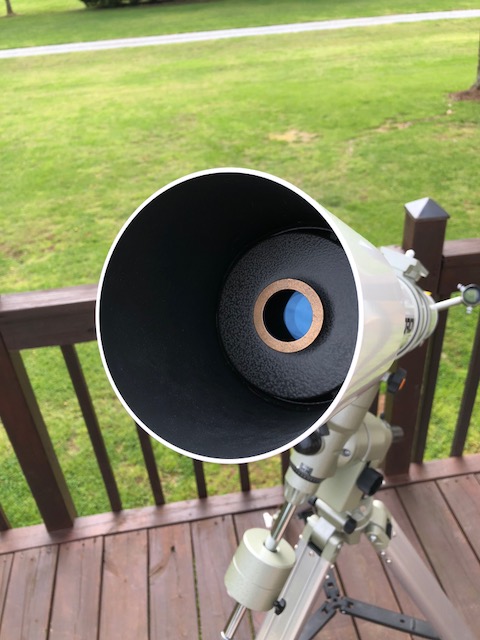
102mm f/10 refractor, stopped down to 35mm f/29 refractor telescope:  (See the following photo) 
 
 Unfortunately, I’ve never been able to see the companion with the 35mm effective aperture, to-date.  (Date: March 20th 2024)  
 

357125662_6_1

      May 2, 2018:  This was the third night in my attempt to see the companion using an effective 35 mm aperture.  Seeing was only fair, and could not see the companion, nor with a larger 45mm effective aperture.

April 2nd 2018:  Report by Richard Nugent as following: 

      Roger, thanks for inspiring me to observe Polaris and it’s faint companion star, Polaris B.  As I mentioned I’ve observed the pair more these past few weeks than in total over the last five decades! I’m glad I did.  Here’s my report to date…    

     Polaris B is about 19” away from Polaris so separation is not the issue. Seeing the B star only requires an aperture with a faint enough limiting magnitude. Of course, on any given night, a telescope’s limiting magnitude is dependent on many factors that are difficult to quantify. Limiting magnitude tables seem, to me, to be overly optimistic!  

…..I was finally able to see the companion with a 10-inch Newtonian with a 40 mm effective aperture.  Richard Nugent

May 6th 2018:  The following report by Roger Ivester

     Last night, seeing was excellent, and a 6-inch f/6 reflector, with an off-axis 45 mm effective aperture, could glimpse the companion, but with extreme difficulty.  This required over more than an hour, using good breathing techniques, as it’s easy to “involuntarily” hold your breath when attempting a close or faint companion, such as Polaris B.  I also used an eyepatch over my non-observing eye, to relax my face.  

     It’s my opinion, it’s “next to impossible” to observe a difficult double, or any deep-sky object while standing.  I always use my astro-chair while observing, and making a pencil sketch.  Roger Ivester  

     Richard Nugent would seem to have the have the modern day record, or at least the only amateur I know personally, who has seen the companion to Polaris with a 40 mm effective aperture.  This was using a 10-inch Newtonian with a 40mm off-axis stop-down mask.   

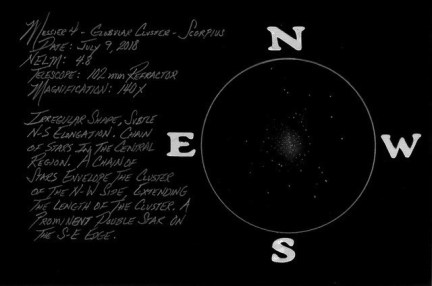
Roger Ivester, March 21st 2024 @ 5:30 AM EDT, with an effective aperture of 45 mm’s.

I could see the companion, with an effective aperture of 45 mm’s using a magnification of 233x.  However, it was very difficult, and could only see during moments of steady viewing. 

Photo of my 45 mm effective aperture…as following.
Orion 80MM f/5 Achromatic Refractor Telescope Review:

Posted April 4, 2018 by rogerivester
Categories: Roger's Articles


     This telescope is sold as an optical tube assembly, without accessories from Orion Telescopes and Binoculars.  However, no problem, as I have extra finders, an equatorial mount, a correct image amici diagonal and plenty of eyepieces. 

     This is a surprise birthday gift from my son, Brad.  I’d always wanted an 80mm f/5 refractor, since University Optics sold their 80mm refractor kit, which required painting and assembly.  However, I wasn’t too excited about the painting and assembly.  It’s hard to duplicate a factory paint job with a spray can. 🙂

     The telescope fits nicely to my Vixen GP mount and I had a three pound counterweight which allows for perfect balance. A smaller and lighter duty equatorial mount would be sufficient for the CT-80, but the Vixen GP makes for a rock steady mount for sure.  A good quality heavy duty tripod could also suffice for either astro or terrestrial viewing. The GP mount and tripod with the legs folded together, and telescope can be easily be carried all together, in one trip.   

     Before I go to my first light evaluation, I’ll share what I found in the shipping box.  It was packed very nicely in a heavy corrugated box and I was surprised at its light weight.  The optical tube and dew-shield are both made of aluminum and has a beautiful pearl-white paint job.  

      The rack and pinion gear assembly is made of steel. The focuser had a minor rough feel, but after a little petroleum jelly on the gear rack, and then with a bit of adjusting the “lock-down” thumb-knob, problem solved. 

       So, everything was good so far, but how would it perform under the night sky?   

First Light:

     My first target was the beautiful double star, Castor in Gemini.  I started with 33x, but this was not enough magnification.  I then added a 2.8x Barlow, giving a magnification of 93x and was pleased with the double being cleanly separated. 

     My next object was the Trapezium in Orion.  The four primary components were crisp and clean even at 33x.  When increasing the magnification to 93x, the four primary stars were a beautiful sight indeed. The Orion Nebula appeared very bright with excellent contrast, but what about galaxies?  

     M81 and M82, located in Ursa Major, have always been two of my favorite galaxies.  Both galaxies fit nicely within the large 1.8º field of view at a 33x magnification. A beautiful sight!  This took me back more than forty years (1977) when I first observed this galaxy pair with a 4.25-inch f/10 Edmund Newtonian.  So, I’d been outside for almost an hour which was my time allowance for this night. Never would I take out my 10-inch equatorially mounted reflector, or my 102 mm refractor or 6-inch reflector, all with EQ mounts for less than an hour.  This telescope had already proved its value and convenience as being light and compact, also providing excellent views of brighter deep-sky objects.     

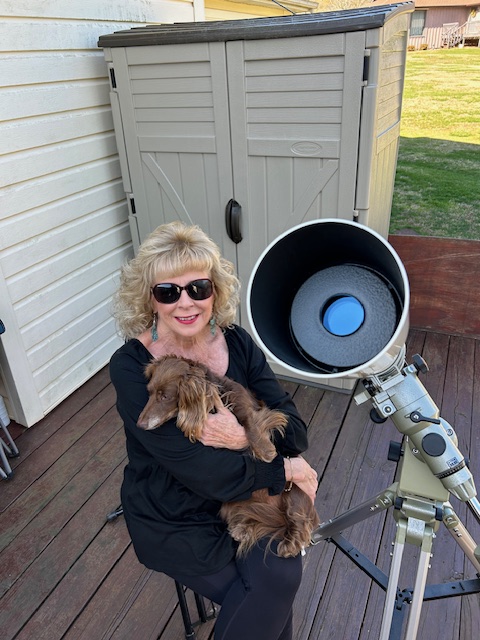
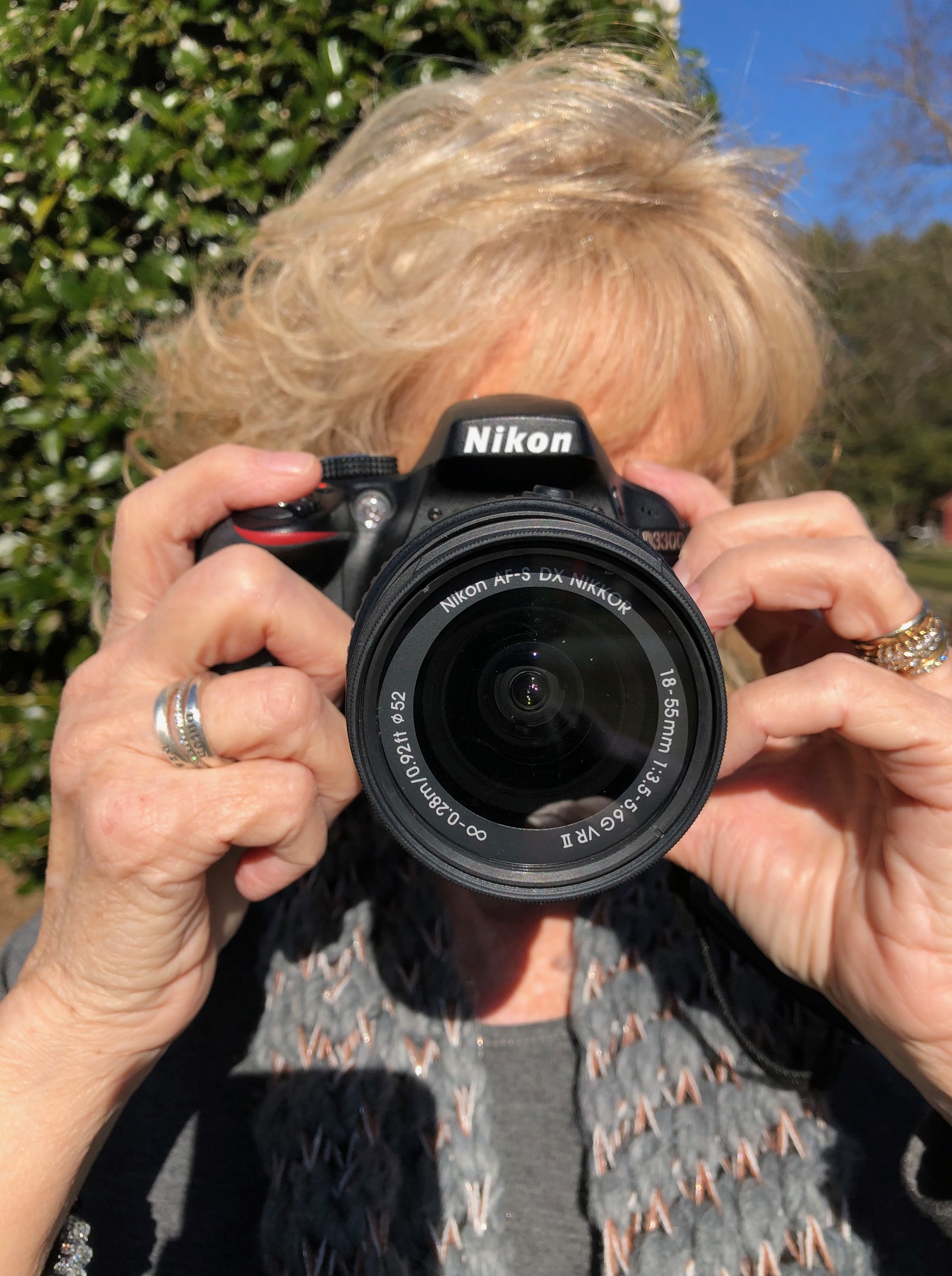
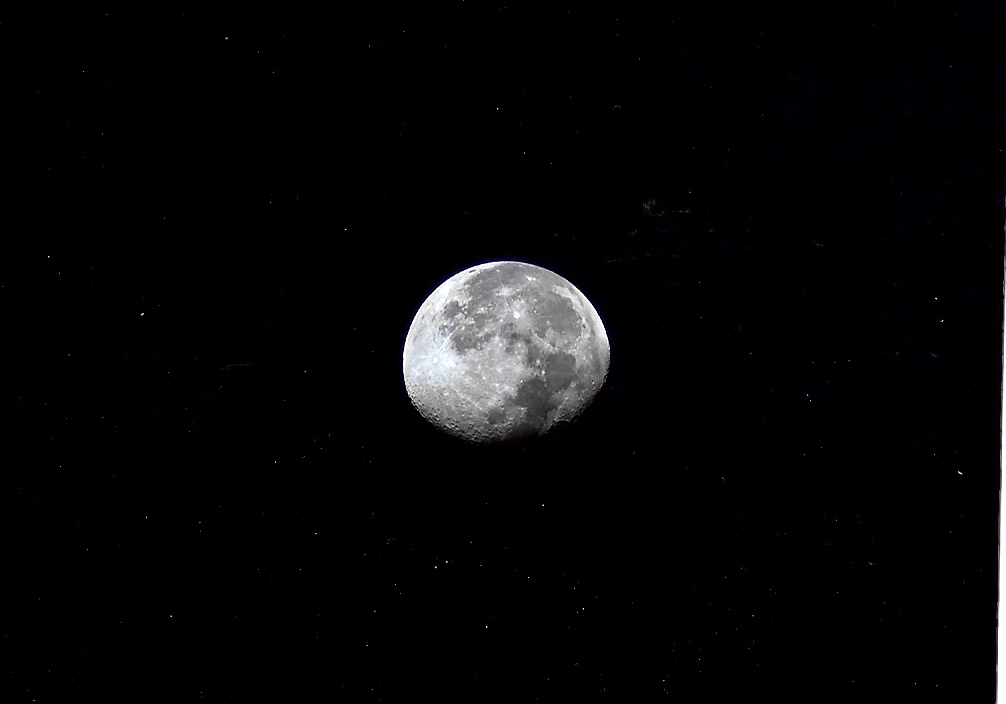
     My wife has always had an interest in making some photos of the moon.  Now for her story: By Debbie Ivester

img_0555

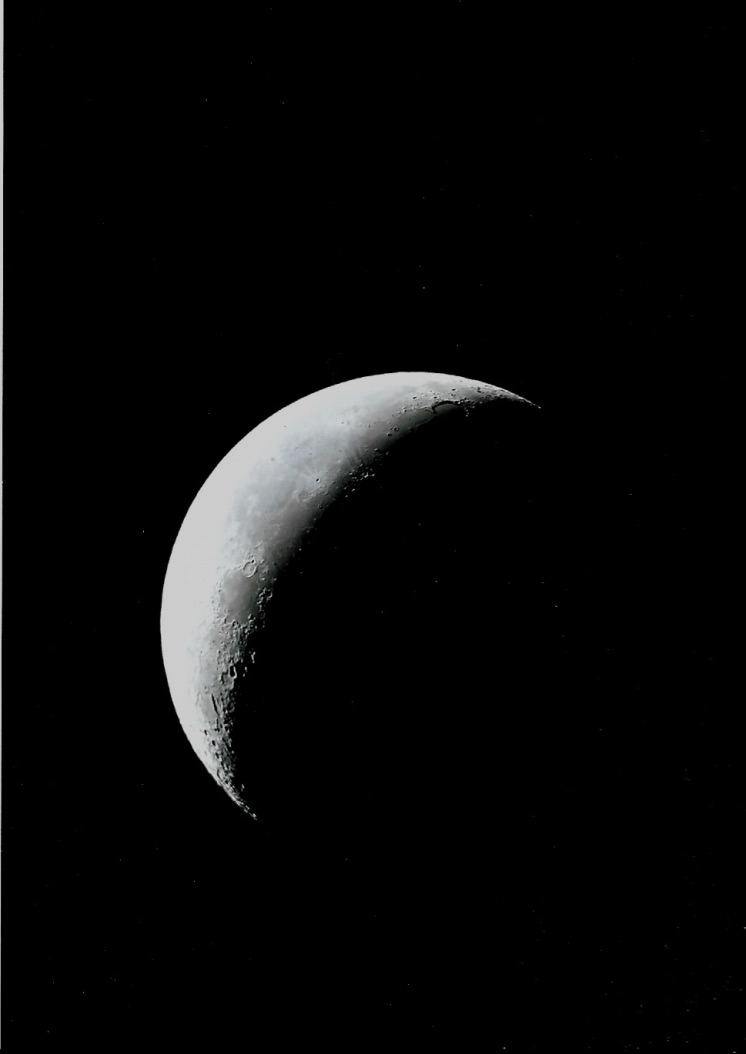
My first photo of the moon: By Debbie Ivester

Other attempts of the moon:

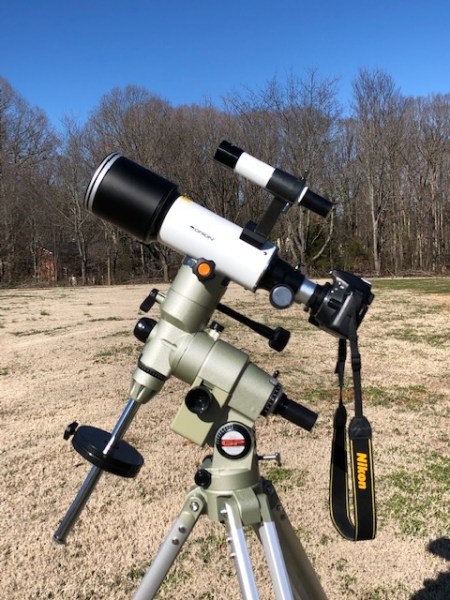
Easy enough to attach the camera to the telescope:

I changed the “single-screw” attachment ring on the back of the telescope, to a more secure “carbon-fiber” ring with two-screws to more securely hold the camera: Debbie

I wanted to include a couple examples of my pencil sketches using the CT-80: Roger

The telescope and mount (with counter-weight) can easily be taken out in one trip. This telescope is especially nice for my “very early morning” observing sessions, before drinking my first cup of coffee, or those 15-30 minute sessions before going to bed.

NGC 2371-72 Planetary Nebula in Gemini – March 2018 Observer’s Challenge Report #109

Posted March 29, 2018 by rogerivester
Categories: Work File Only - Observer's Challenge Reports

Observer’s Challenge Report #109:  

MARCH 2018 OBSERVERS CHALLENGE – NGC-2371-72

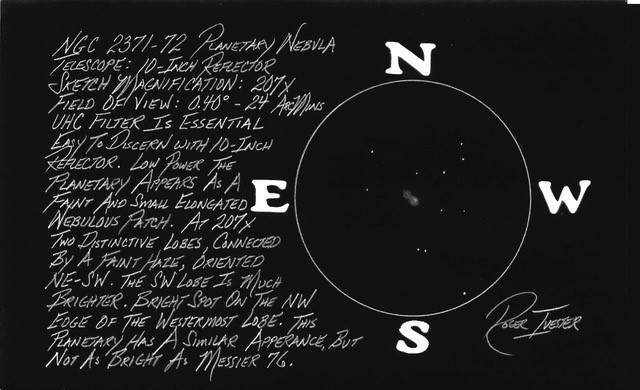
Pencil sketch using a 10-inch reflector with inverted colors.  

Rogers NGC-2371 Inverted

NGC 2371-2372, Planetary in Gemini, nebula magnitude 11.3; central star 14.8.

This planetary is easy to discern with 10-inch reflector from my moderately light polluted backyard. At low power (57x) the planetary appears as a faint and small elongated nebulous patch.

When increasing the magnification to 207x, and with a UHC narrowband nebula filter, two distinctive lobes become visible, connected by a faint haze. The nebula is oriented NE-SW, with the SW lobe being brighter and having greater concentration. The bright spot becomes visible using averted vision, located on the NW side of the westernmost lobe.

When first observing this planetary almost twenty five years ago, I mistakenly thought this bright spot to be the 14.5 magnitude central star. It was, however, during a later observing session in 1998 that I realized the bright spot was not centrally located and far too bright to be the extremely faint central star. Another observation the following year confirmed this.

NGC 2371-72 has a similar appearance, but not nearly as bright as M76 (NGC 650-1) planetary nebula in Perseus.

Roger Ivester

I

M41- Open Cluster in Canis Major-February 2018 Observer’s Challenge Report #108

Posted March 9, 2018 by rogerivester
Categories: Work File Only - Observer's Challenge Reports

FEBRUARY 2018 OBSERVERS CHALLENGE – M-041

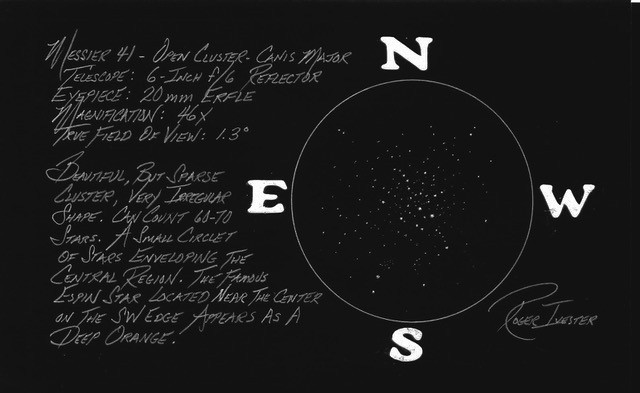
Pencil sketch:  6-inch reflector @ 46x and 1.3º field of view: 

sketch with Inverted colors

Rogers M-041 Inverted

Messier 41 (NGC 2287) at magnitude 4.5 is visible without optical aid. I often enjoy viewing this cluster with a pair of 7 x 21 mini-binoculars. It is easily located at about 4º south of Sirius, and NW of 6.0 magnitude 12 Canis Majoris.

A beautiful, but sparse cluster, very irregular shape, with several small chains of stars. The most noticeable star chains are on the SW and NE.

When using a 6-inch reflector, I can count ~60-70 stars. A small circlet of stars envelope the central region of the cluster. M41 contains the famous red star, known as the Espin star (HD 49091) magnitude of 6.9 and a K3 spectrum. The star was named after Rev. T.E. Espin (1858-1934.) I normally see this star as a deep-orange in color.    Roger Ivester