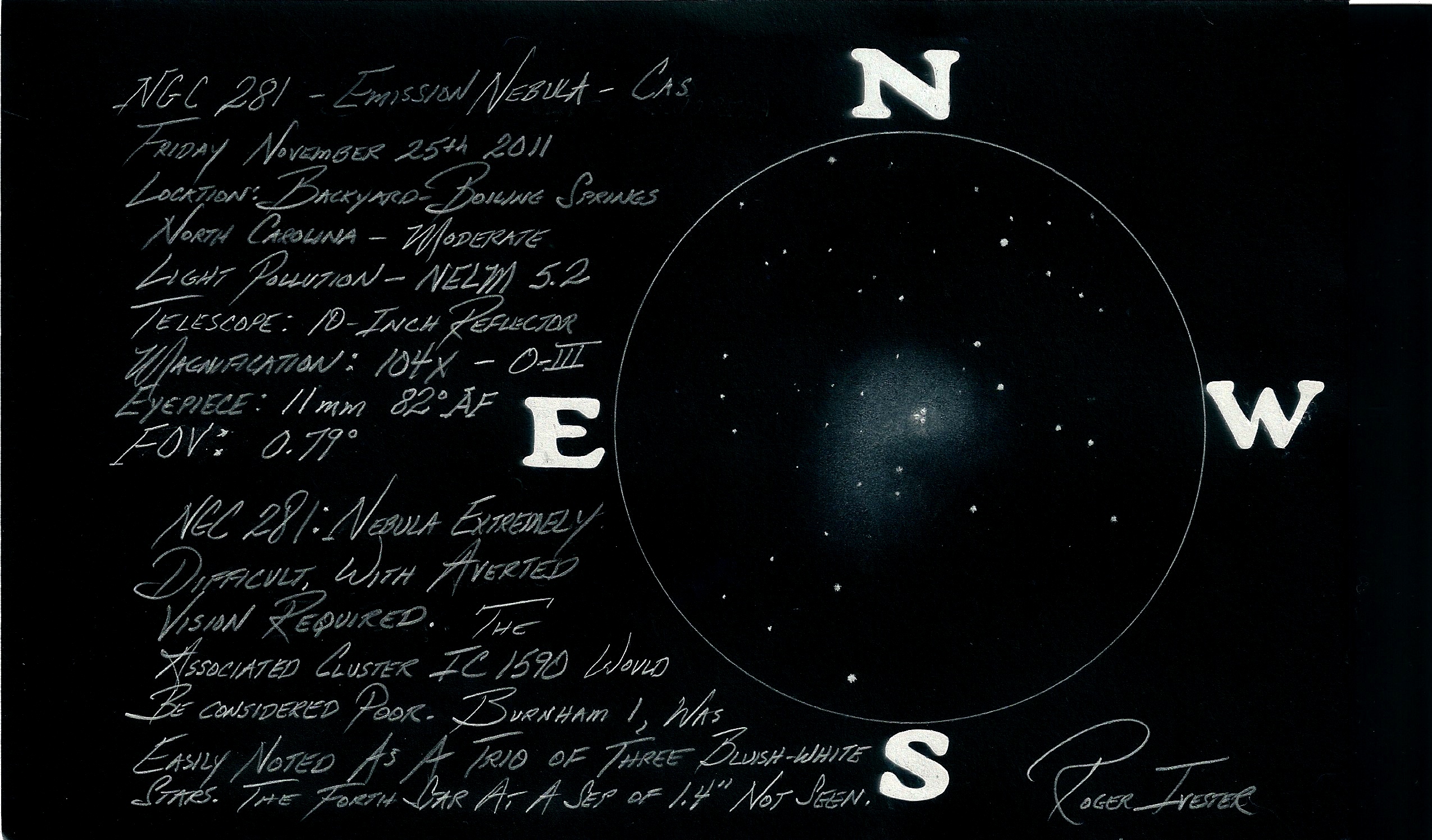
Emission nebula, NGC 281, located in Cassiopeia is an early to late fall object that you don’t want to miss. It can be glimpsed through an 8 x 50 finder, however, an 8-inch with an O-III filter is required to see the unique shape. When you see this nebula for the first time…you’ll know why it’s called the “Pacman Nebula.”
Click on the Orion Telescope and Binoculars link below for the full article.
NGC 6645 is a most interesting summer time cluster located in the constellation of Sagittarius. Upon careful examination with either my 102 mm Orion/ Vixen refractor, or my 10-inch Newtonian reflector, a small hole, devoid of stars can be seen in the middle of the cluster.
Please click on the following link and read more about this fabulous deep-sky in an article for Orion Telescope and Binoculars.
Yesterday, October 26th 2012, good friends, Mike Ribadeneyra (L) myself (C) and Mike Keeley (R) rode from Boiling Springs, (NC) to Columbus, North Carolina to climb Skyuka Mountain.
My wife, Debbie took good care of us by being our support, driving the van, and picking us up at the top. The total ride was 50 miles, however, the final four miles, climbing up Skyuka Mountain was really tough.
This mountain presented us with some beautiful sights, including colorful leaves floating down from the trees, waterfalls, and an incredible panoramic view of distant communities from the summit.
Veteran Tour de France rider, George Hincapie would be having his 2012 Gran Fondo ride with over 1000 riders the following day (Saturday October 27th 2012) and would also be riding up Skyuka Mountain.
Signs had already been posted along the way up the mountain, including that famous KOM (King of the mountain) sign at the summit.
Hincapie rode along side of Lance Armstrong in all of his seven Tour de France wins.
Former Tour de France winner, Cadel Evans would be riding in the Gran Fondo, as well as many other riders of the BMC Team.
It was well worth all the pain of climbing Skyuka Mountain to be able to enjoy pizza at “The Brick Pizzeria” in downtown Columbus.
Debbie volunteered to be our support and was essential to the success of the day. It was a fun day for sure….
Have you ever heard of the Virgo Diamond? No…I’m not talking about the large group of stars, comprised of Cor Caroli, Denobola, Spica, and Arcturus, also called the Virgo Diamond.
I’m talking about a basically unknown and very tiny asterism in Virgo which makes a beautiful diamond shape, comprised of five faint stars. If conditions are not good this asterism can be difficult, especially the faint companion of the western-most star.
When I first read about the Virgo Diamond back in 1993, I became immediately interested, and could hardly wait to see it for myself. The Virgo Diamond seems to be as unknown today (2024) as it was back in 1993. I still know of only a very few amateurs who have observed this most interesting asterism.
If you’re interested in learning more about this fascinating object, please continue reading, and you too might want to test your observing skills in an attempt to see all five stars of the “Virgo Diamond.”
Virgo Diamond: In the December 1, 1991 Monthly Notices of the Royal Astronomical Society , Noah Brosch (Tel Aviv University, Israel) discusses his investigation of a newly discovered asterism in Virgo. Five stars all appearing brighter than 13th magnitude, comprise a diamond shaped area with sides only 42 arc seconds long. The probability is small that five stars with similar brightness could be so closely aligned by chance, and Brosch suggests that the stars of the diamond are physically associated. The diamond is located at: RA: 12:32.8 Dec: -0.7
Direct Source: Sky and Telescope Magazine, May 1993, page 110
My first observation of the Virgo Diamond came on the night of April 14th 1993. I was using a 10-inch f/4.5 reflector at 190x which presented a faint grouping of four stars. I was unable to see the fifth star. The stars range in brightness from 10.9 to 13.7 in magnitude. Please don’t underestimate this very faint asterism. If conditions are not good, even the four primary stars can be difficult.
Since that night in 1993, I have observed this object many times, however, always seeing only the four primary stars. However, this changed on the night of April 12th 2012. The conditions were excellent, and using a 10-inch reflector, I saw the elusive fifth star at a magnification of 266x. I could not hold the fifth companion star constantly, and averted vision was required. Exciting to say the least….after all of my attempts over the years to see the fifth star.
It should be noted that excellent seeing and high magnification are essential for observing all components of the Virgo Diamond.
The northern most star is TYC 4948-53-1 (Magnitude 10.9) The brightest and easiest of the diamond. (RA 12h33m18.96s Dec. -00.38m32.3s)
The western star (the double) is magnitude 12.1
The southern star is magnitude 13.7
The eastern star is magnitude 13.5
Tom English of North Carolina, using a 16-inch SCT described a fabulous view of all five stars using 194x and 387x.
Fred Rayworth of Las Vegas could see the fifth star using a 16-inch Reflector at 130x, but could not hold the faint companion constantly, even from the desert southwest.
Sue French of New York could see the faint companion using both a 130-mm apochromatic refractor and a 10-inch reflector.
Jaakko Saloranta of Finland, using an 8-inch reflector, under less than ideal conditions managed to see the elusive fifth star, despite a focuser that kept freezing up under extreme cold conditions.
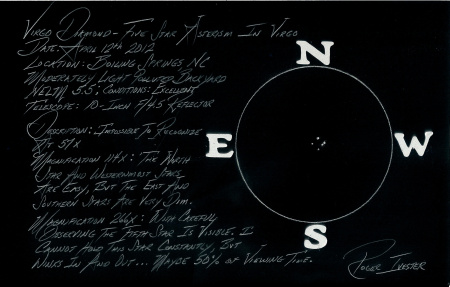
The following is a pencil sketch from that special night of April 12th 2012, using only a No. 2 pencil on a blank 5 x 8 note card. The color was inverted using a scanner.
This afternoon I went by my friend Marty’s house for a few pictures of his Questar. He lives only twenty or so minutes away.
Sharing his story:
Marty always had an interest in Questar’s and hoped that one day he would own one. During his early teens he would look at the Questar advertisement that would grace the back of the front cover of “Sky & Telescope Magazine” for so many years.
The advertisement featured a picture of this beautiful gem, and in bold letters “Questar Does It All” and then a small caption at the bottom “Questar, the world’s finest, most versatile telescope.”
Marty grew up in Queens, New York, and at the age of eighteen (1965) he visited the Questar factory, located in New Hope, Pennsylvania. A demonstration scope was set-up, trained on a coin, a quarter, which was about fifty foot away. He was very impressed with the most minute details that could be seen with this small scope.
Marty continued to look at those “Sky & Telescope Magazine” advertisements, and in 1996, only 31 years later, he was finally able to purchase his Questar.
My granddaughter Gracie, was visiting from out of town and the forecast was clear skies. I thought this might be the perfect opportunity to share the night sky with her.
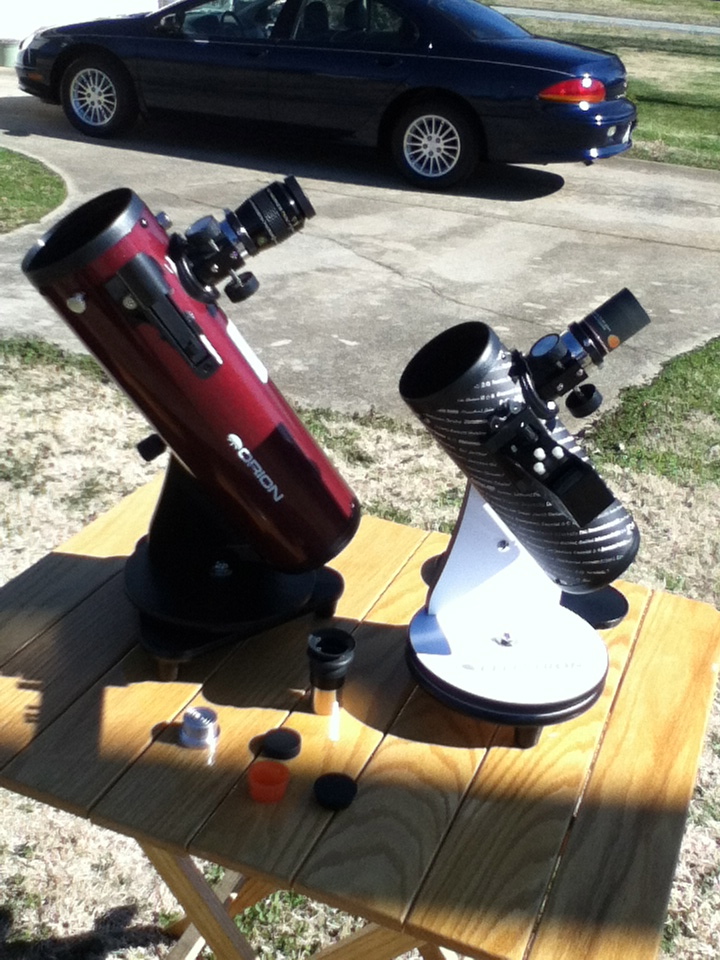
It also occurred to me that this would be a great time to see how easy it would be for an eleven year old to use two very popular beginner telescopes. A 76mm Celestron firstScope and a 100mm Orion SkyScanner.
The 76mm Celestron FirstScope (model 21024) has a 300mm focal length for an f/4.0 focal ratio. It comes with two eyepieces for magnifications of 15x and 75x.
The 100mm Orion SkyScanner has a 400 mm focal length for an f/4.0 focal ratio also. The Orion scope has a parabolic mirror, and the FirstScope has a spherical mirror. A parabolic mirror (especially at f/4) should have better performance than a spherically ground mirror. The SkyScanner eyepieces are quite a bit better in quality than the ones which come with the 76 mm FirstScope.
The 76mm Celestron sells for about $50 from a variety of vendors, and the 100mm Orion SkyScanner…at current sells for $119.00 from Orion Telescope and Binoculars.
Both scopes performed well, with the biggest difference being brighter views in the 100mm versus the 76mm, as expected, due to the larger aperture.
It should be noted that the Celestron FirstScope does not come with a finder. The 100mm Orion SkyScanner comes standard with a very good quality red-dot finder that works really well. I have a couple Rigel Quik Finders, so I use one with my FirstScope. The mounts are well constructed, and both scopes can be moved very smoothly and with precision.
Note: To effectively use the 76mm FirstScope, a finder is essential. You can purchase an optional “optical” finder kit, with a DVD for (about $20) but it’s a bit too small and dim, so I can’t recommend this finder.
The Orion SkyScanner 100 comes standard with a an excellent red dot finder, better quality eyepieces, and a parabolic mirror. The SkyScanner has almost twice the light gathering capacity, and is just as portable.
Both telescopes offer excellent value for the money, however, if you can spring for a little extra, the Orion SkyScanner offers quite a bit more in performance and capability.
Back to observing:
My granddaughter and I were able to observe quite a few deep-sky objects. We stayed out well over an hour with the temperature in the low 30’s. She learned how to use the Rigel Quickfinder, pointing the scopes, and focusing without any difficulty at all.
Gracie could see the red star (known as the Espin Star) located in the central region of open cluster M41 with the 100mm SkyScanner, and galaxies M81-82 were very easy in both telescopes. She described the two galaxies very well, “one is mostly round and the other is oval” and this was without any coaching. She became very interested in learning about red stars and even pointed out a couple without a telescope.
On Sunday morning before church, she filled out three note cards with her thoughts and descriptions from the previous night. She mentioned the Espin star in M41, her perception of open cluster M45, the moon, Jupiter, M42 and the Trapezium. Gracie said she understood the purpose and importance of using a red light when observing. She had leaned about this in a book she had read. I was very impressed!
Her last sentence in her notes:
“Then I looked at M81 & M82…it was a pretty cool night.” Gracie
Both scopes presented a nice and crisp separation of the four trapezium stars in the Orion nebula.
You can purchase larger and better telescopes, but at $50 and $110 respectively, one cannot go wrong with either of these telescopes.
If you find that amateur astronomy is not your cup of tea…well, you haven’t lost a great amount of money. However, if it is, there are plenty of telescopes to move up to, and I’ve always believed that everyone should keep their first telescope.
Final: Not only are these scopes of very good quality and perform well, they also look great sitting on a bookshelf or desk.
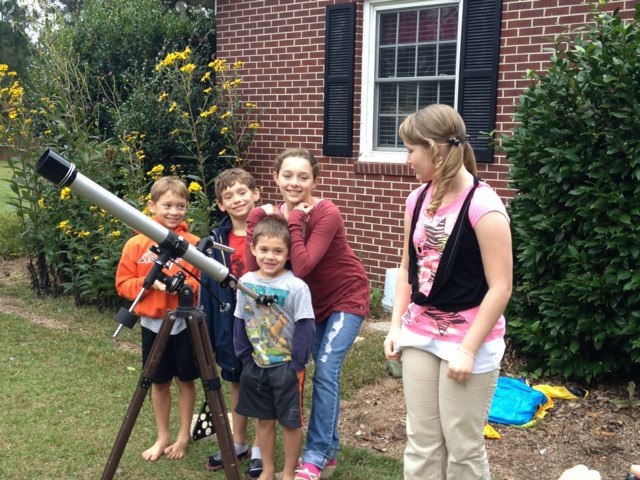
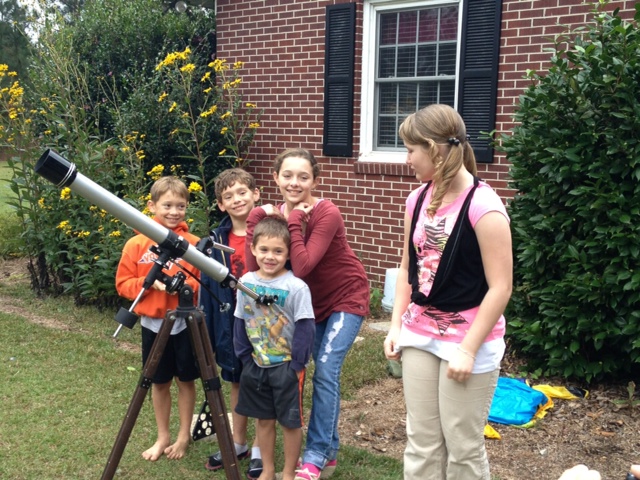
Photo as following: October 2012: All my Grandkids in one place. Location: South Carolina. This was the last time, they were all together.
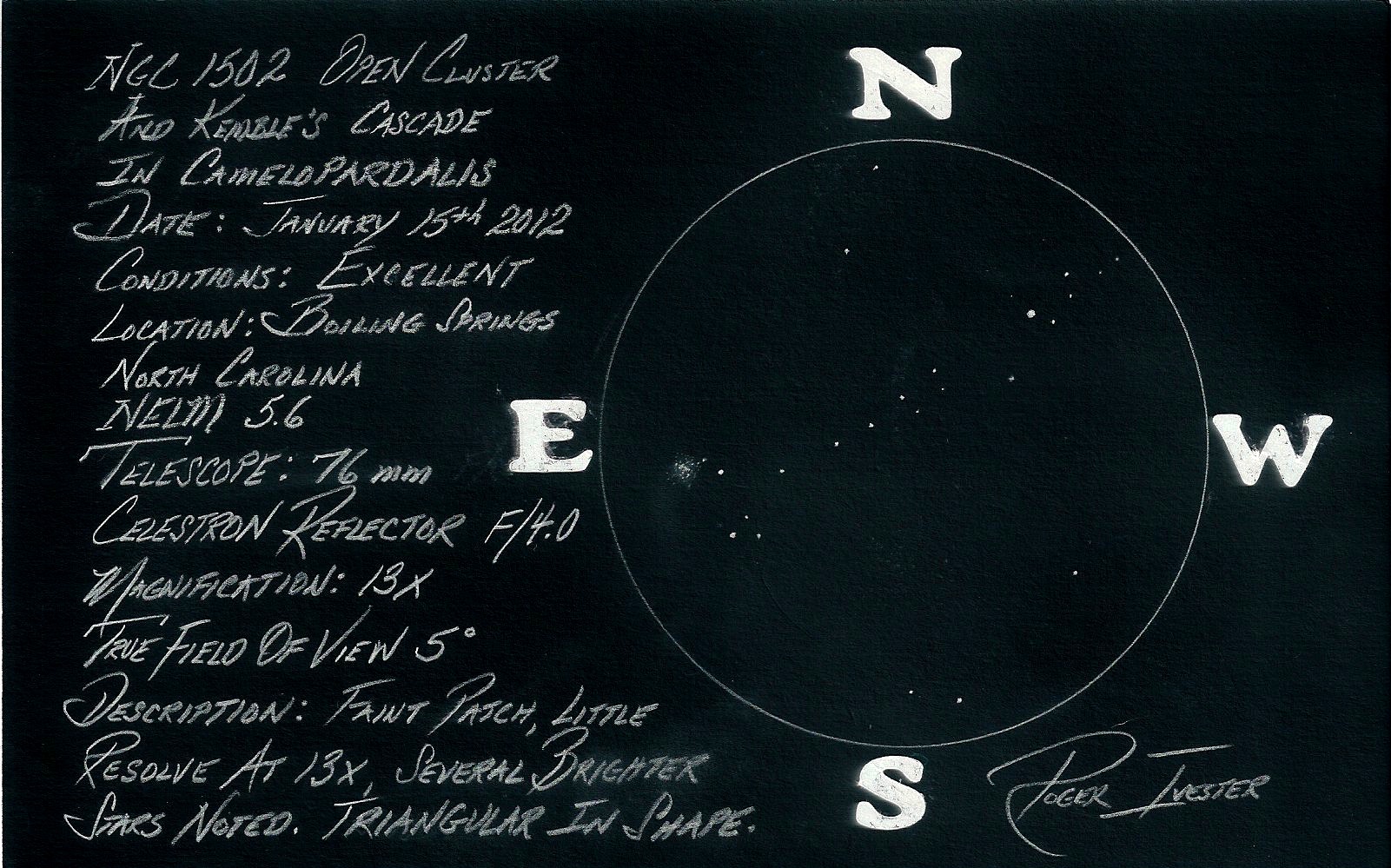
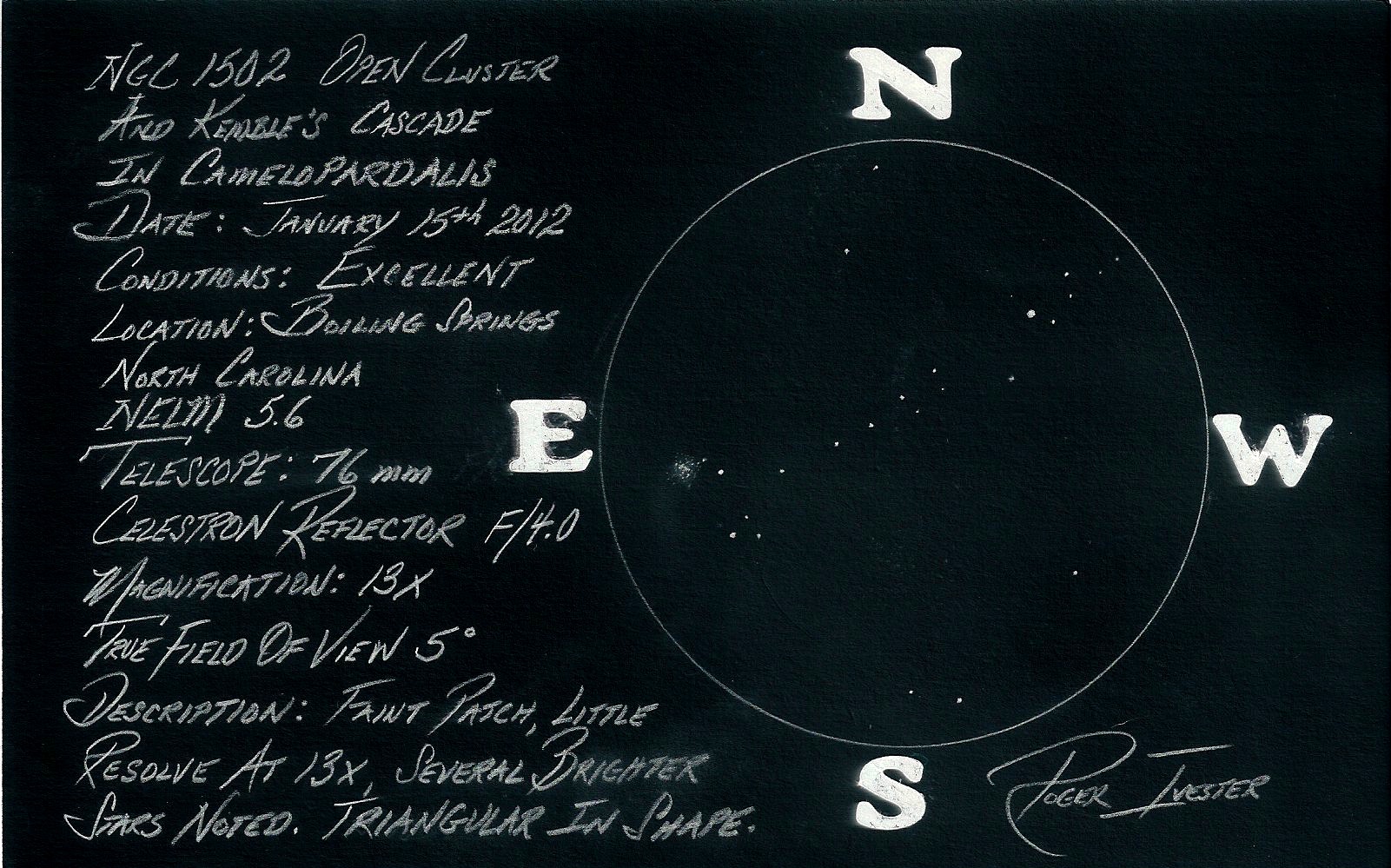
Location: Suburban backyard in western North Carolina
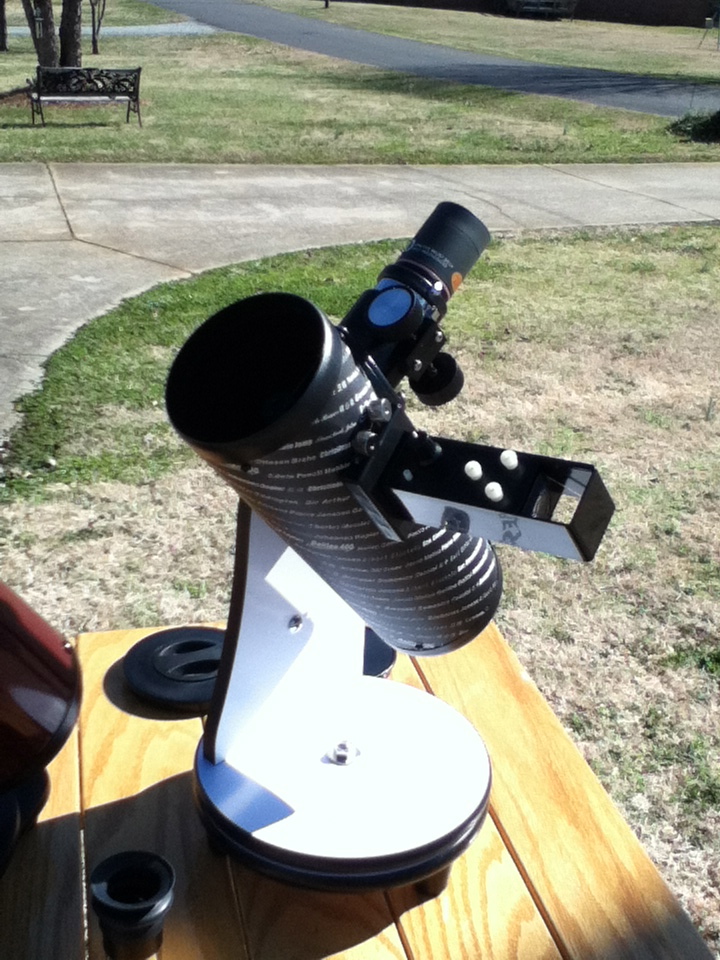
76 mm f/4 Dobsonian Reflector, using a 24 eyepiece with 60 degree apparent FOV and a 13x magnification.
Telescope: ~4.0º Field of View
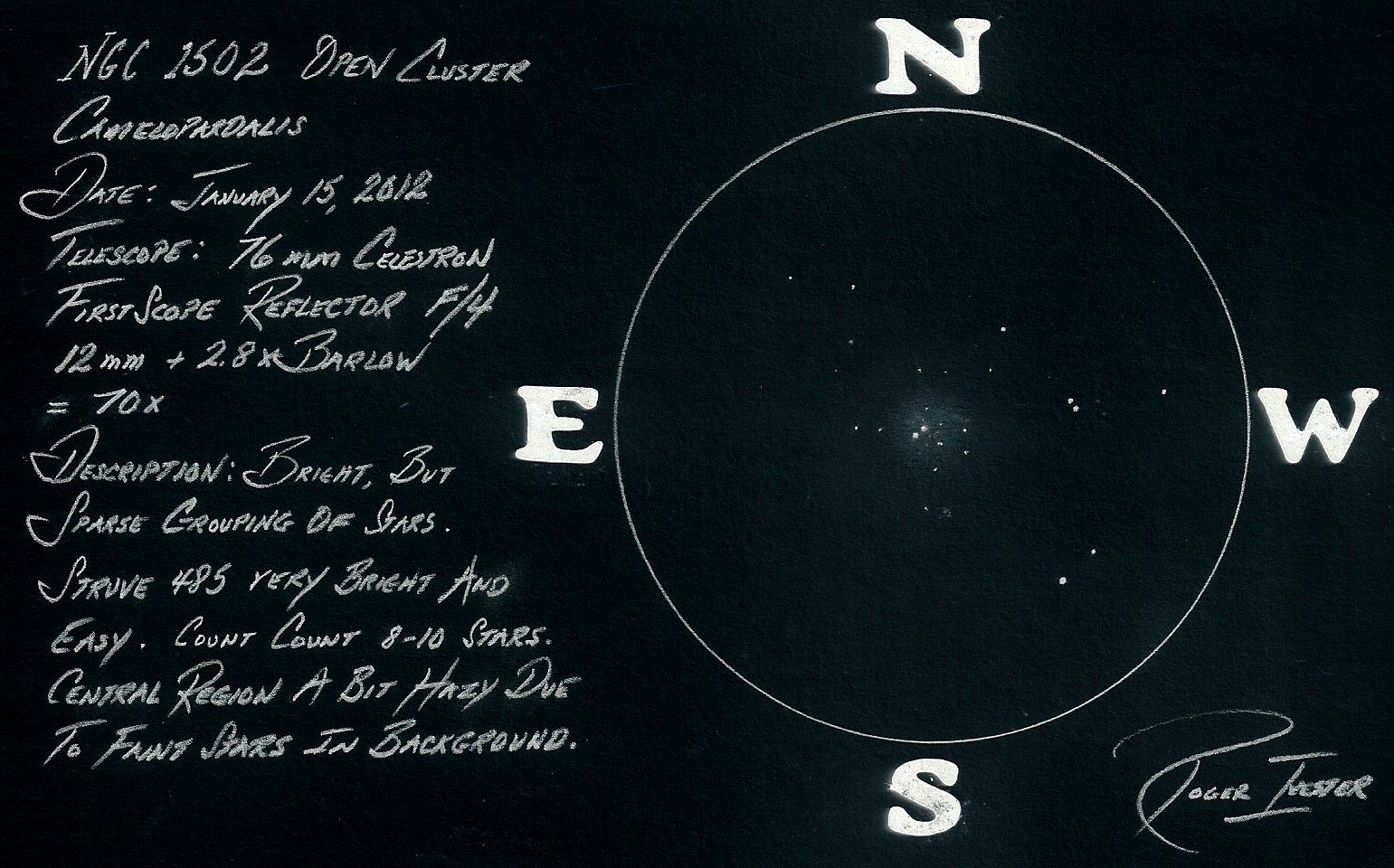
Faint patch of triangular shaped group of stars. Double star Struve 485 is in the center of the cluster and appears as a single bright star at low magnification.
This scope presents Kemble’s Cascade as a beautiful and interesting chain of about fifteen stars, with one brighter star noted in toward the middle of the line.
Galaxy M82 and the 2014 Supernova
My granddaughter was visiting from out of town and the forecast was clear skies. I thought this might be the perfect opportunity to share the night sky with her.
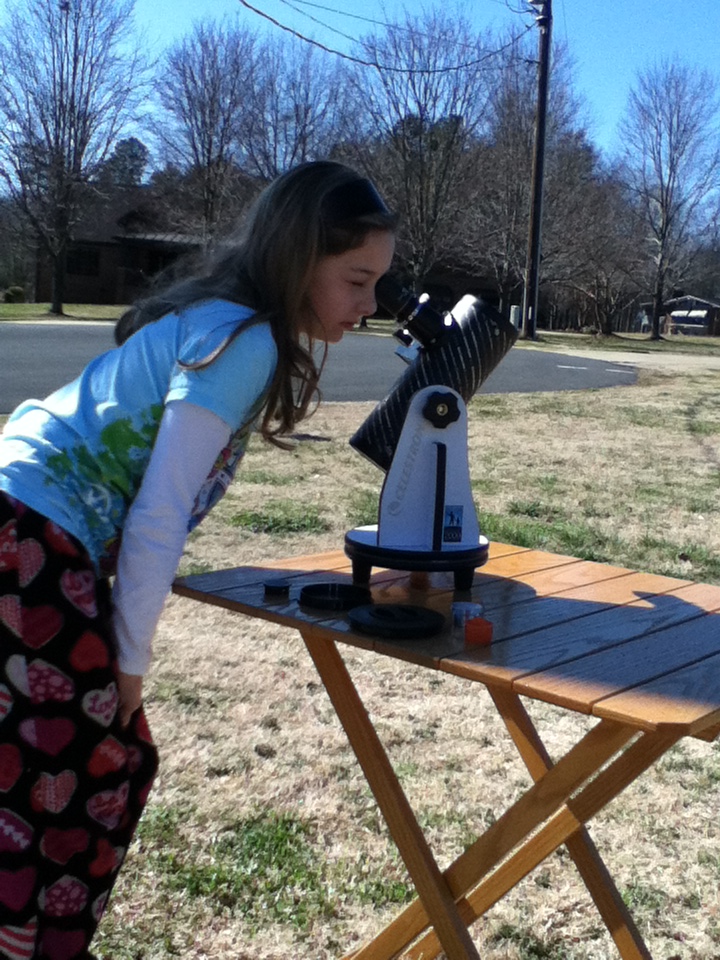
It also occurred to me that this would be a great time to see how easy it would be for an eleven year old to use a popular beginner telescope, a 76mm Celestron firstScope.
The 76mm Celestron FirstScope (model 21024) has a 300mm focal length for an f/4.0 focal ratio. It comes with two eyepieces for magnifications of 15x and 75x. This telescope sells for about $50 from a variety of vendors. I have a Pelican box full of eyepieces, so we didn’t use the ones that came with the telescope.
It should be noted that the Celestron FirstScope does not come with a finder, which is an essential item. Fortunately, I had a couple Rigel Quik Finders, so I use one with the FirstScope.
The mount is well constructed and moves very smoothly.
Back to observing:
My granddaughter and I were able to observe quite a few deep-sky objects, and we stayed out well over an hour with the temperature below 30º. She learned how to use the Rigel Quik finder to point the scope, and had no trouble using the focuser.
Gracie could see the red star (known as the Espin Star) located in the central region of open cluster M41, and galaxies M81-82 were very easy to see.
She described the two galaxies very well, “one is mostly round and the other is oval” and this was without any coaching. She became very interested in learning about red stars and even pointed out a couple in the sky without a telescope.
On Sunday morning before church, Gracie filled out three note cards with her thoughts and descriptions from the previous night.
She mentioned the Espin star in M41, her perception of open cluster M45, the moon, Jupiter, M42 and the Trapezium. Gracie said she understood the purpose and importance of using a red light when observing. She had leaned about this in a book she had read. I was very impressed!
Her last sentence in her notes: “Then I looked at galaxies M81 & M82…it was a pretty cool night.” Gracie
If you find that amateur astronomy is not your cup of tea…well, you haven’t lost a great amount of money. However, if you discover that astronomy is an interesting hobby, and you desire a larger telescope, there are plenty to select from.
Now to the west coast:
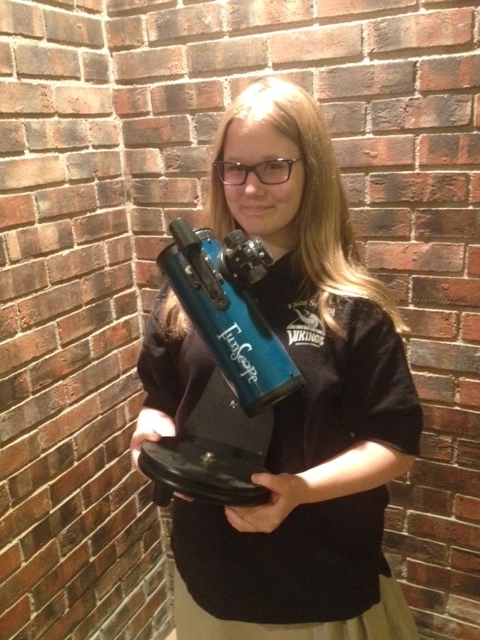
Photo below: My granddaughter from the west coast in 2012 with her Orion 76mm f/4 FunScope. This telescope is basically the same as the FirstScope, but comes with a decent magnified finder scope. The FunScope also has superior eyepieces, as compared to the Celestron FirstScope.
We actually observed from Henderson, Nevada…looking south. It was surprising, how many deep-sky objects we could see, and not very far from the Las Vegas Strip!
Following photo: East Coast granddaughter in 2012 with the 76 Celestron FirstScope
Open Cluster NGC 1502 showing double star Struve 485 at 70x.
Comments:Comments Off on Deep Sky Observing With A 76mm f/4 Celestron FirstScope: NGC 1502 Open Cluster; Kemble’s Cascade; M82 Supernova And Many Others












 rogerivester.com
Recent Comments