Archive for the ‘Work File Only – Observer’s Challenge Reports’ category

M92 Globular Cluster in Hercules and “Trouvelot’s Hook”

August 1, 2016

The Observer’s Challenge complete report:  Click on the following link:  JULY 2016 OBSERVERS CHALLENGE – M-092

The following write-up and sketch by Jaakko Saloranta of Finland, one of the most talented and gifted visual observer’s in the world today.  Roger Ivester 

Messier 92

The baby brother of Messier 13. Brightest star in the cluster is magnitude 12.1 so it is fairly easy object to resolve. However, it is a difficult naked eye object: barely visible with optimal averted vision at an altitude of 57 degrees. Easily visible with a 8×30 binoculars as a non-stellar smudge.

Forms a triangle with two 10th magnitude stars. Partial resolution is achieved – only a handful of stars visible – with a 3 inch refractor @ 133x (23′). With a 4.5 inch SkyQuest XT @ 152x (20′) M92 appears as fairly well resolved, with a few dozen stars visible. Bright core, might appear slightly elliptical but is probably just an illusion caused by unresolved stars NW of the nucleus.

Messier 92 contains a little known small feature nicknamed “Trouvelot’s Hook” (named after 19th century French astronomer Étienne Léopold Trouvelot) . It is a hook-shaped chain of stars with dark bays at both sides. The feature is visible in two separate sketches made by Trouvelot. The first one is from 1874 and the second from 1877. Both sketches of M92 are made from Harvard College Observatory.

Having seen Roger Ivester’s notes on M92, it is obvious that Roger has noted – at least a part of – “Trouvelot’s hook”. He described it as “a faint chain of four stars follows the flattened edge”. This is part of the very same chain sketched by Trouvelot! I personally could not make out the dark lane sketched by Roger. I only saw a couple of bright stars just E of the cluster’s core.

Pencil Sketch By Jaakko Saloranta of Finland:

M92_2015_LVAS_1

The following sketches by French Astronomer, Trouvel0t. The first one was made in 1874 and the second 1877, both from the Harvard College Observatory.
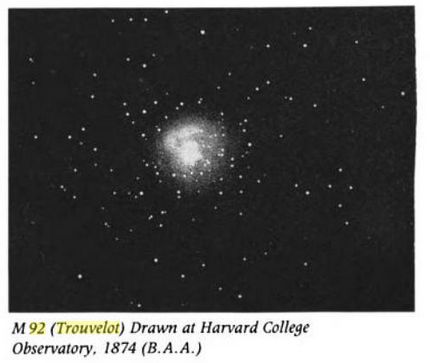
M92_Trouvelot

Below:  Sketch by Trouvelot in 1877

DSC_0659


The following information and pencil sketch by the writer.  RI 

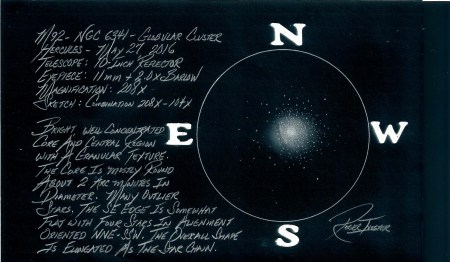
M92 – NGC 6341 – Globular Cluster in Hercules:  Date: May 27, 2016

Telescope: 10-inch f/4.5 Equatorial Reflector

Eyepiece: 11 mm – Also Other Observations With The Employ Of a 2.0x Barlow
Magnifications: 104x and 208x intermittently

Bright with an intense round core and a granular texture at 104x. When increasing the magnification to 208x, excellent resolution of stars in the outer regions and in the halo, with many outliers.

The overall shape has a subtle N-S elongation. The NNE-WSW edge is flat, which is one of the more noticeable and recognizable features of the cluster. When using averted vision a faint chain of four stars follows the flattened edge. These stars were not visible on two of the three nights of observations, and appeared intermittent or not constant.

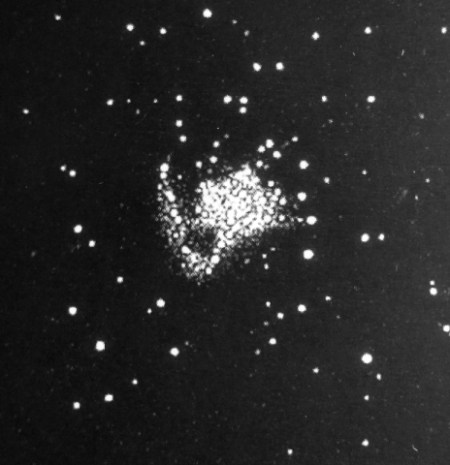
The following is a pencil sketch using a 5 x 8 blank notecard, with the colors inverted using a scanner.  Please note the faint star chain on the eastern side of the cluster, on both my sketch and Jim Dire’s image.  It was extremely difficult for me, requiring averted vision, and could only see intermittently on the third night of observations.

Roger Ivester 
Scanned Image 162110000

M92:  The following image and text by James Dire of Hawaii

M92

James Dire, Ph.D.

M92 is the middle in size and brightness of three globular cluster located in the constellation Hercules. The brightest and largest is M13 while the smallest in our sky is NGC6229. All three globular clusters can be spied with an 8-inch or larger telescope.

Globular clusters are highly compact groupings of tens of thousands to millions of stars. There are approximately 150 of these clusters forming a spherical halo around our Milky Way galaxy. Globular clusters are also known to exist in other galaxies. The Andromeda galaxy probably has 2-3 times as many as the Milky Way.

M13 is the brightest globular cluster visible in the northern hemisphere and the third brightest visible from Earth. At magnitude 5.8, has a diameter of 25 arc minutes, nearly as large as the Moon. In comparison, at magnitude 6.4 M92 is roughly half as bright. It spans 15 arc minutes. Although both appear in Charles Messier’s famous catalog, he did not discover either of them. Edmond Halley discovered M13 in the year 1715 and Johann Bode discovered M92 in 1777.

M92 is found six and one-third degrees north of Pi Herculis, the northeastern-most star in the Keystone. Like M13, M92 can easily be spied in 50mm binoculars or finder scopes. Many stars can be resolved in both clusters using telescopes. Larger apertures will reveal more individual stars. I recommend eyepieces that yield 100x, or higher if the seeing is steady.

At magnitude 9.4, NGC6229 is quite a bit more challenging to find than M92. NGC6229 is located just north of the center of Hercules’ club, or 11 degrees north of M13. The easiest way to find it is to center the 5th magnitude star 42 Herculis in the eyepiece and hop two degrees to the southeast. William Herschel discovered NGC6229 in 1787. He was also the first to resolve stars in M92 six years later.

My image of M92 was taken with a 10-inch f/6 Newtonian with a Paracorr II coma corrector yielding a 1753mm focal length. The scope was atop a Paramount ME German equatorial mount and the image was taken with an SBIG ST-2000XCM CCD camera. The exposure was 20 minutes. The brightest star in the field of view, left (east) of the cluster, is HD156821 shining at magnitude 9.76. The faint star to the left of this is a 16.1 magnitude star. The yellow orange star on the northeast side of the cluster is HD156873, magnitude 9.98. The third brightest star in the field, to the lower right of the cluster shines at magnitude 10.9. None of these stars are members of M92.   James Dire 
M5 Globular Cluster in Serpens and The Mystery of The Ruby Eyes

June 26, 2016

     Each and every spring I always try to observe the magnificent globular cluster M5, in hopes to see a long held mystery, referred to as the Ruby Eyes. 

     My hope for all reading this, you’ll give this challenge a try, especially if you have a larger aperture telescope (16-inches and larger)   

     In the early 90’s, during astronomy conventions and other in my area, there were many discussions of the “Ruby Eyes of M5” and the mystery behind them. 

     What did Bill Henson and Arlo Gardner see on that night in July 1992?  A few of us attempted to find out in May and June of 2016, using the Observer’s Challenge platform.    

Sky & Telescope, December 1993, page 108: A brief and paraphrased account from the original article:

     On July 17, 1992, North Carolina amateurs Bill Henson and Arlo Gardner were testing Gardner’s newly rebuilt 20-inch Dobsonian. While sweeping through Serpens, they picked up the mag. 6 globular cluster M5. Taking time to examine the cluster’s tight, compact core, they both noticed a pair of ruby stars south-southeast of the cluster’s center and oriented east-west.

“They impressed us because of their color,” writes Henson. “In fact, the pair actually seemed closer than the globular….suspended between us and M5.”  They estimated the stars to be around mag. 13, separated by about 30 to 40 arc seconds. 

     Tom English, spearheaded this review, and what I think was a very objective study.  James Dire also played a very significant and important role in this project with his help in imaging M5 at that time.  Sue French also contributed with her own research concerning the variability of the “two subject” stars. 

     Unfortunately one of the amateurs that reported this sighting of red stars, Bill Henson has since passed away, but not too late to learn of this review.  Bill was appreciative for all that took their time and effort to bring back to life, the “Ruby Eyes” that he and his observer friend, Arlo Gardner reported on a special night so many years earlier.    

     This causes me to feel good and with the help of others, we were possibly able to contribute to a resolve of the Ruby Eyes.   

Roger Ivester

Be sure to click on the following link for the complete report….

JUNE 2016 OBSERVERS CHALLENGE – M-005

Pencil sketch: 

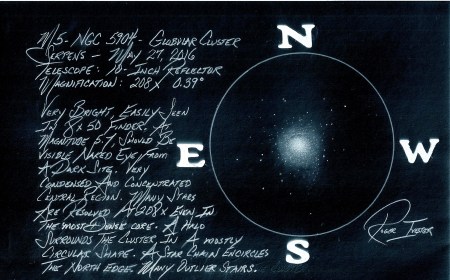
10-inch reflector @ 208x:   Pencil sketch using a blank 5 x 8 blank notecard with the colors inverted via a scanner.  Note the dark lane on the northern edge, and the chain of stars on the  leading of the SSW  edge of the cluster.  

Scanned Image 161780000

The following image was made using a 4-inch refractor by Dr. James Dire of Hawaii.  Please note the dark lane on the northern edge as shown in the previous pencil sketch.  

Roger Ivester:  Observer from North Carolina  

Date: May 27, 2016

M5 – NGC 5904 – Globular cluster in Serpens 
Telescope: 10-inch f/4.5 Reflector and 102mm refractor
Magnification: 208x
FOV: 0.39º NELM: 5.0

Very bright, easily seen through an 8 x 50 finder. At magnitude 5.7, the cluster should be visible naked eye from a dark site. Well concentrated and dense in the central region, with many stars resolved at 208x. When using averted vision, a chain of stars encompasses the northern edge, creating a subtle void between this chain and the main cluster. Also with averted vision, a very faint chain of stars lead off toward the SW. A halo surrounds the main cluster in a mostly circular shape, with many outlier stars embedded in the halo and extending well beyond.

Telescope: 102 mm f/9.8 refractor
Magnification: Eyepiece 26 mm + 2.8x Barlow = 108x

Bright with a well concentrated center and much brighter more intense core. Little to no resolution, however, many brighter outliers are visible. A chain of five stars are easily seen on the north edge of the cluster. The most prominent feature of this cluster, using the 102 mm refractor is the triangular shaped core.  


M100 – NGC 4321 – Galaxy in Coma Berenices

May 21, 2016

Observer’s Challenge Link:  

MAY 2016 OBSERVERS CHALLENGE – M-100-1

M100 – NGC 4321 – Galaxy in Coma Berenices 

Date: April 2016
NELM: 5.0
Telescope: 10-inch Newtonian Reflector
Magnification: 57x
Field of View: 1.1º

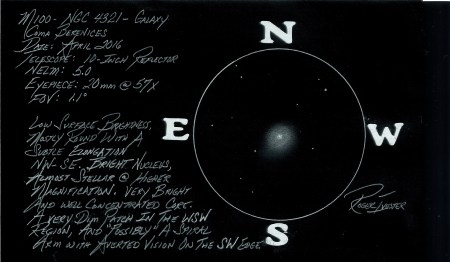
Description: Low surface brightness, mostly round with a subtle NW-SE elongated halo. Bright nucleus, almost stellar at high magnification. A very dim patch W of the core and a hint of a spiral arm on the SW edge.    Roger Ivester

The following is a pencil sketch using only a No.2 pencil, an eraser, a blank 5 x 8 notecard with the colors inverted using a scanner.  RI 

Scanned Image 161410000

The following information and image provided by Dr. James Dire from Hawaii.

M100
By James Dire, Ph.D.

M100 is located in the constellation Coma Berenices. It lies 8 degrees east and slightly north of the star Denebola (Beta Leonis). It can be found roughly 40% of the way along a line from Denebola to the star Diadem (Alpha Comae Berenices). At magnitude 9.3, M100 is one of the brightest galaxies in the Coma-Virgo Cluster. M100 was first spied by Pierre Merchain in 1781 and then confirmed by Charles Messier later that year. M100 is a face-on spiral galaxy located 56 million light years away as determined by measuring the periods of Cepheid variable stars in the galaxy.

My image of M100 was taken with a 190mm f/5.3 Maksutov-Newtonian with an SBIG ST-2000XCM CCD camera. The expose was one hour. The galaxy has two main spiral arms with numerous branches. The arms contain many massive, hot, blue giant stars with many HII giant clouds of gas. The nucleus is bright and compact.

M100

The second image has labels for several nearby galaxies and their magnitudes. All are members of the Coma-Virgo cluster.

M100_legend

The following sketch and notes compliments of Jaakko Saloranta of Finland.

M100_2016_LVAS

Rough sketch made at the eyepiece. 8 inch dobson shows a bright galaxy with a nearly stellar nucleus @ 38x –(66′). Best visible @ 152x (16′) but the spiral structure is very difficult. Flanked nicely by two 14th magnitude stars. Bright, non-stellar nucleus surrounded by a E-W elongated halo. Northern spiral arm is brighter with a brighter spot at the W end. Southern spiral arm is slightly smaller but with two brighter areas visible in the arm in both ends. It takes over an hour to discern the spiral structure properly with this aperture. NGC 4323 and NGC 4328 not looked for.    Jaakko Saloranta 

NGC 3077 – Galaxy – Ursa Major

May 3, 2016

Observer’s Challenge Link:  APRIL 2016 OBSERVERS CHALLENGE – NGC-3077

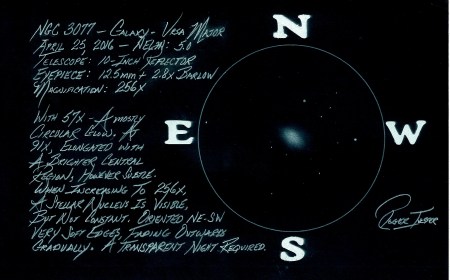
The following pencil sketch was made using a 10-inch reflector, and a  5 x 8 blank notecard with the colors inverted via scanner.  Roger Ivester

Scanned Image 161230001

NGC 3077 – Galaxy – Ursa Major
Date: April 25, 2016
NELM: 5.0
Telescope: 10-inch Newtonian reflector
Eyepiece: 12.5 mm + 2.8x Barlow
Magnification: 256x

At 57x, fairly easy to see, appearing mostly as a circular glow. At 91x, the galaxy becomes elongated with a NE-SW orientation, and a brighter central region, however, subtle. When increasing the magnification to 256x, a stellar nucleus is visible, but cannot be held constantly. The surface brightness of this galaxy is fairly low, making it difficult from my moderately light polluted backyard.

After viewing close neighboring galaxies, M81 and M82, which are much brighter and larger, NGC 3077 can be difficult, and maybe even a bit disappointing.

Roger Ivester

The following report and images are courtesy of Dr. James Dire of Hawaii.

NGC 3077
By Dr. James R. Dire

NGC3077 is a peculiar galaxy located in Ursa Major near the galaxy pair M81 and M82. The galaxy was discovered by William Herschel on November 8, 1801. Although the galaxy looks like an elliptical galaxy in the eyepiece, images of it show it has wispy edges and dark dust lanes, atypical of elliptical galaxies. Carl Seyfert included it in his list of active galaxies (now called Seyfert galaxies) in 1943. Today it is considered an irregular galaxy. Its distorted shape is probably casued by gravitational interactions with the large spiral galaxy M81, similar to Barnard’s Galaxy, NGC6822, which is equally close to the Milky Way.

Magnitude estimates for NGC3077 range from 9.9 to 10.8. The galaxy is 5.3′ x 4.4′ in size and is located 12.8 ± 0.7 Mly away. The galaxy is located three-quarters of a degree east-southeast of M81.

The first image was taken with a Stellarvue SV102 102 mm apochromatic refractor at f/6.3 using a Televue 0.8x FF/FR. The camera was a Canon 30D and the exposure was 60 minutes. In all images, north is up and east to the left. Image 1 was framed to have M81 and M82 centered. NGC3077 is labeled in the lower left-hand corner of the frame.

The second image was taken with a 10″ f/6 Newtonian with a Paracorr II coma corrector, yielding an f/6.9 optical system. A SBIG ST-2000XCM CCD camera was used. The exposure was 100 minutes. I really need 300-400 minutes of data to bring out the wispy edges and dark dust areas of the galaxy. But they can (barely) be seen in this short exposure. Unfortunately, time and weather did not allow more imaging before submitting this report.

Image 1


Image 3

NGC 2392 – Eskimo Nebula – Gemini

April 15, 2016

Please click on the following link for the Observers Challenge report: 

MARCH 2016 OBSERVERS CHALLENGE – NGC-2392

NGC 2392 – Planetary Nebula – Gemini 
Date: February 2016
Observer: Roger Ivester
Telescope: 10-inch f/4.5 reflector
Sketch magnification: 190x
FOV: 0.32º – 19 arc minutes

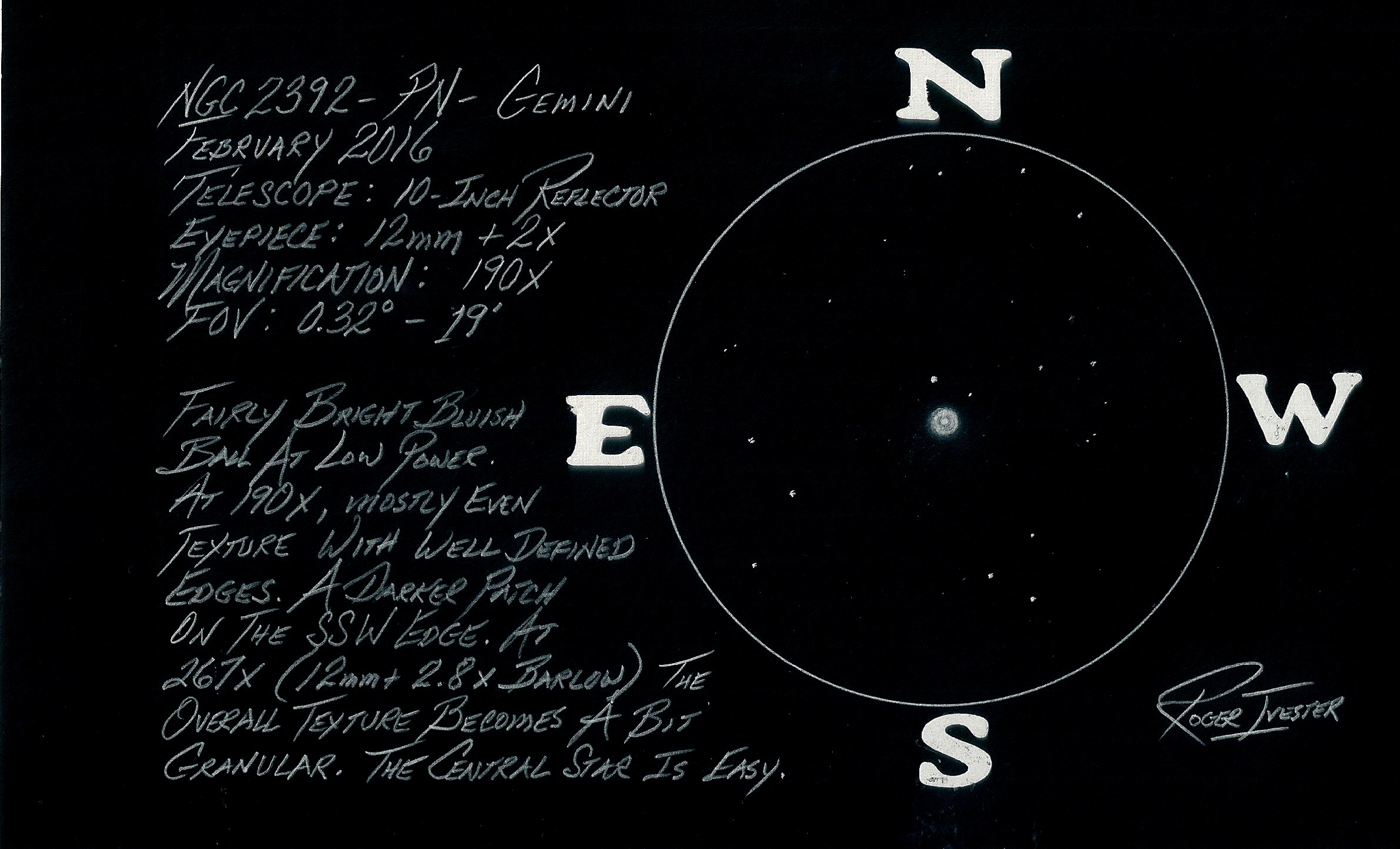
Description: Very bright, bluish ball, appearing as a blurred star at low magnification. When increasing the magnification to 190x, the central star is easily seen. The edges are well defined, with a darker patch noted on the SSW edge. When increasing the magnification to 267x, using a 12 mm plus a 2.8x Barlow, the nebula became granular.

Date: January 31, 1998
Telescope: 10-inch reflector@ 256x (12.5 mm plus 2.8x Barlow)
Very bright, round, bright central star, with well defined outer edges. Greater concentration on SW edge.

Date: February 8, 2008
Telescope: 10-inch reflector@ 190x (12 mm plus 2.0x Barlow)
Much brighter than double planetary nebula, NGC 2371-2372 also in Gemini. The nebula is very bright, round, but has a hint of N-S elongation. The central star is easily seen at all magnifications.  

The following pencil sketch was made using a 10-inch Newtonian reflector, with a blank 5 x 8 notecard and with the colors inverted via computer.   Roger Ivester  

Scanned Image 160930001

The following image was made by Jim Gianoulakis of Las Vegas.  Can you see the face of an Eskimo, or how about a clown-face, or maybe even the face of the beloved character, WC Fields?  

ESKIMO-MORE-COLOR-CROP-1

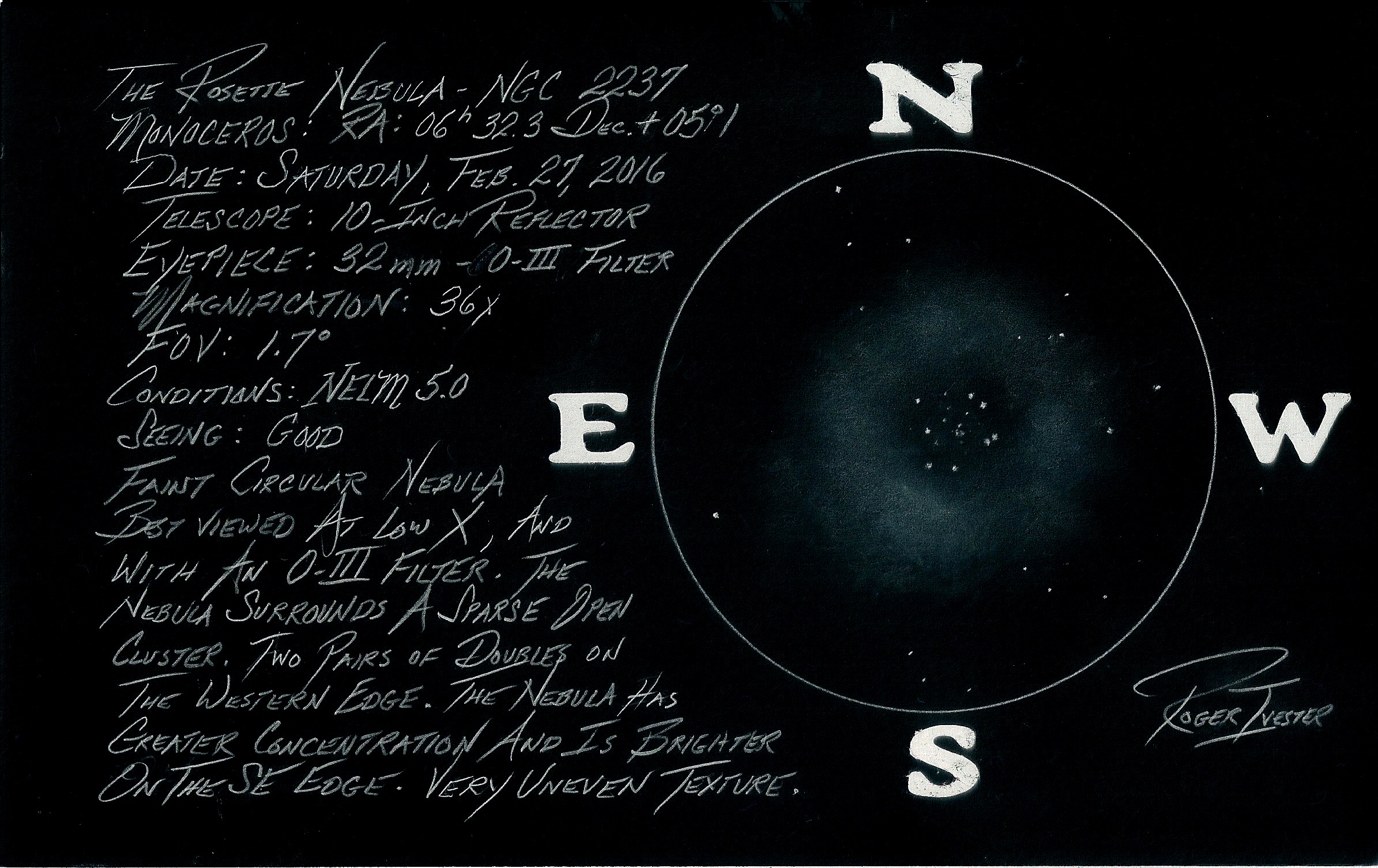
The Rosette Nebula – NGC 2237 – Monoceros

March 21, 2016

LVAS Challenge Link:

FEBRUARY 2016 OBSERVERS CHALLENGE – NGC-2237

The Rosette Nebula – NGC 2237 – Monoceros
Date: February 27, 2016
Telescope: 10-inch Newtonian 
Eyepiece: 32 mm
Magnification: 36x
Field of View: 1.7º
Naked Eye Limiting Magnitude: 5.0

Faint circular nebula over 1º in diameter, surrounding open cluster NGC 2244. The cluster contains twelve brighter members with many fainter stars. Two pairs of wide doubles are located on the NW edge of the cluster. 

Faint circular nebula over 1º in diameter, surrounding open cluster NGC 2244. The cluster contains twelve brighter members with many fainter stars. Two pairs of wide doubles are located on the NW edge of the cluster.

A low power wide field eyepiece with an O-III filter are essential in seeing the vast wealth of faint detail found in the nebula. The SE section is the brightest and most concentrated. I have found that covering my head with a cloth improves the contrast of the nebula significantly. The texture of the Rosette is very uneven, with many lighter and darker areas.

Many amateurs feel that the Rosette can only be observed successfully under a very dark sky. However, I’ve enjoyed observing it many times over the past twenty five years from my moderately light polluted backyard, using a nebula filter.

Roger Ivester

Pencil sketch using a 10-inch reflector from my moderately light polluted backyard.  

Scanned Image 160920001

M78 – Diffuse Nebula In Orion

February 16, 2016

JANUARY 2016 OBSERVERS CHALLENGE – M-078

The following is a pencil sketch I made using a 10-inch reflector @ 91x from my moderately light polluted backyard. 

M78 – Diffuse Nebula in Orion
Date: February 11th 2016
Telescope: 10-Inch f/4.5 Newtonian Reflector
Magnification of Sketch: 91x
FOV: 0.66º – 40 arc minutes
NELM: 5.0
Location: My backyard with two pesky unshielded streetlights in close proximity

Description: Faint wispy nebula involved with two mag. 10 stars. The greater concentration of nebula is ESE of the illuminating stars. The shape is mostly irregular with a slight elongation oriented E-W. The texture of the nebula is very even with diffuse edges.

About 20 arc minutes to the NNE is NGC 2071. A very faint, mostly round nebula which surrounds a mag. 10 star. 

NGC 1023 – Galaxy In Perseus

January 14, 2016

DECEMBER 2015 OBSERVERS CHALLENGE – NGC-1023

NGC 1023 – Galaxy in Perseus
Observer: Roger Ivester
Date: November 3rd 2003
Conditions: NELM ~ 5.5
Seeing: Excellent
Telescope: 10-inch f/4.5 Newtonian Reflector 
Sketch Magnification: 114x
FOV: 0.50º

Description: Small, lens shape, oriented E-W with a broad and well concentrated core, and a stellar nucleus. The halo extensions are very faint, but with well defined edges. A triangle of three stars, making a triangle, just SW of the galaxy, and a chain of three stars leading off toward the NE edge.

I made the following pencil sketch using a 10-inch reflector with the colors inverted via a computer.   Roger Ivester

Rogers NGC-1023

NGC 1579 – “The Northern Trifid” – Reflection Nebula in Perseus – February 19th 2013

December 19, 2015

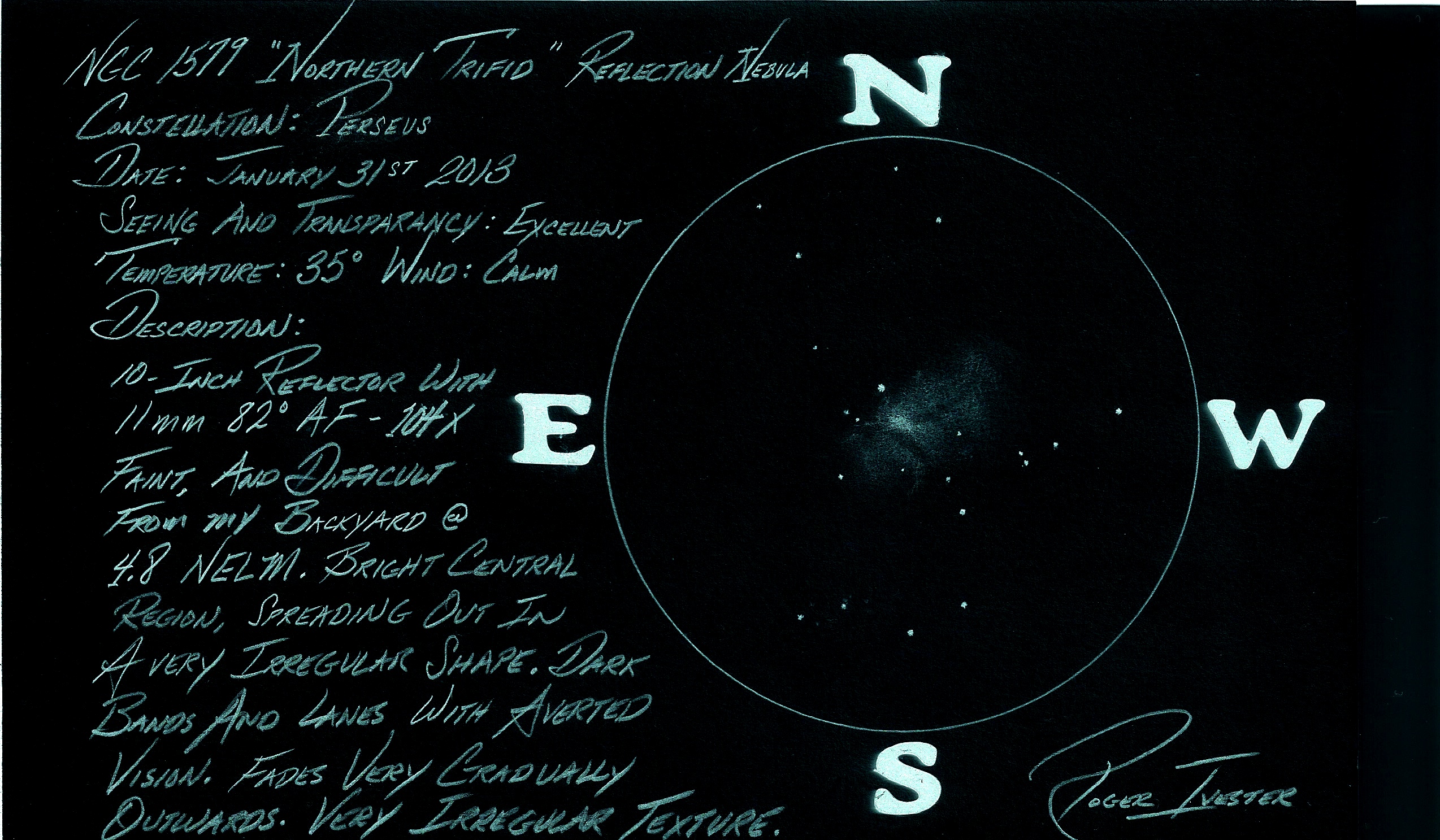
NGC 1579 – “The Northern Trifid”  Reflection Nebula in Perseus 

Date: January 31st 2013 – Telescope: 10-inch f/4.5 reflector @ 104x – Location: Moderately light polluted Backyard in western North Carolina with a NELM 4.8 

Faint and very diffuse with a brighter oval shaped middle.  The texture is somewhat mottled and uneven, and at least two dark lanes can be seen with averted vision (see sketch).  The nebula has very uneven edges which fade very gradually outwards.  A 12M star lies just to the NE, and a group of four stars to the south make the shape of a dipper.  This is a most interesting object which seems to be overlooked by many amateurs.  The following sketch was made using a 5 x 8 blank notecard, a No. 2 pencil, and an eraser.  The color was inverted using a scanner…

Roger Ivester  2-16-13

NGC 1579 - Reflection Nebulae-1

Date: January 31st 2013 – 10-inch reflector @…

View original post 165 more words

NGC 7789, Open Cluster in Cassiopeia

December 14, 2015

NOVEMBER 2015 OBSERVERS CHALLENGE – NGC-7789 

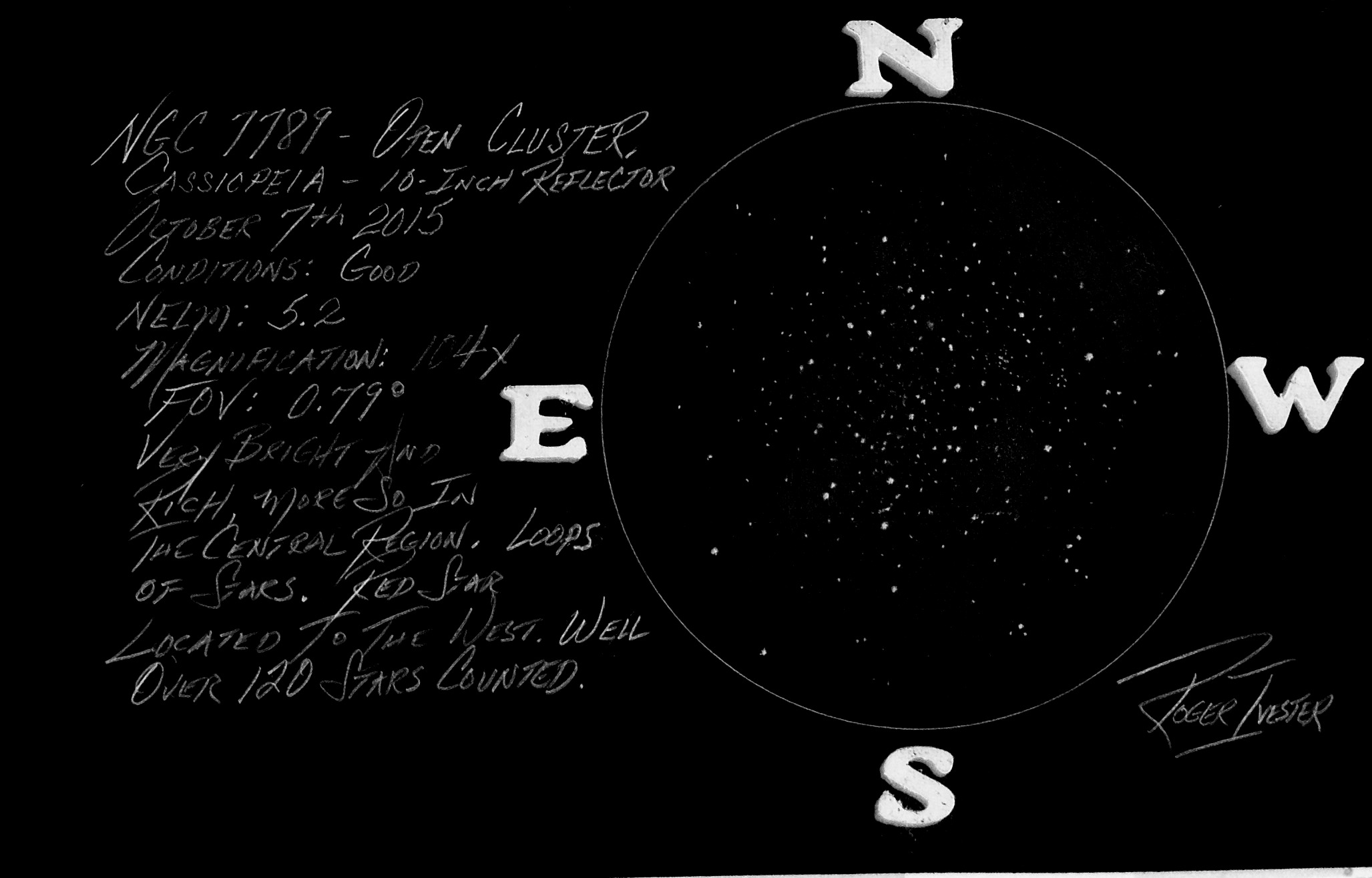
NGC 7789, Open Cluster in Cassiopeia:  Location of observation:  From my moderately light polluted backyard in Western North Carolina 

Observer:  Roger Ivester 
Date: October 7th 2015
Conditions: Good   NELM: 5.2
Telescope: 10-inch f/4.5 Newtonian Reflector
Sketch Magnification: 104x    FOV: 0.79º
Catalogued Magnitude: 6.7

Very bright and rich with well over 120 stars counted with the 10-inch. The cluster stars encompass an area of about 25 arcminutes. Loops of stars with dark lanes throughout, but mostly a random scattering of stars. A fairly bright, mag. 9 star is located just off the cluster edge toward the west.  

Pencil Sketch with inverted colors.

Rogers NGC-7789

Image by Dr. James Dire of Hawaii using a 10-inch f/4 reflector, and a SBIG ST-2000 XCM CCD camera.  Exposure time 30 minutes.

NGC7789

The following notes and pencil sketch (with inverted colors) of NGC 7789:  By Jaakko Saloranta of Finland

Despite poor observing conditions a rich and very beautiful cluster.

Strong background glow is lost at high magnification.  Several dark pathways visible within the cluster as starless regions.  

Brighter stars concentrated towards the W edge. ~80* within 9′ down to 13th magnitude.  Resembles an open rose.  

Sketch @ 101x (30′) using a 4.5 inch Orion SkyQuest.

NGC7789_LVAS