Complete Report: Click on the following link:
Archive for the ‘Work File Only – Observer’s Challenge Reports’ category
NGC 6751 Planetary Nebula In Aquila: September 2022 Observer’s Challenge Object: #164
September 23, 2022NGC 5474 – Galaxy in Ursa Major: June 2022 Observer’s Challenge Report #161
June 22, 2022Updated and revised June 2022 (galaxy NGC 5474) Observer’s Challenge Report, Final. One of the fainter deep-sky objects to-date, in the past 14 years!
The report will be heading into the fall really soon, and hopefully much better weather for most of us. As for me, I prefer those cold nights of winter, with heavy coats, neck warmers, gloves, and for those of us in the south…always wearing a toboggan.
Note: From lower Virginia, and further south, all the way to Texas, a toboggan is a hat to keep a head warm…”known as a knitted or ski hat” in the north. We had a good discussion concerning this, about ten years ago, and most everyone learned something new.
Yes…something to keep southerners heads warm, and not a sled. 🙂
My observing season really begins when the Pleiades is coming up in the east, just cresting the treetops. This was my first deep-sky object at about 11 years old (same for Leslie Peltier) and at the time, I didn’t know it was Messier 45.
Throughout my earliest years as an amateur astronomer, I always waited anxiously for October, and seeing M45 rising above the trees, and the same goes even today.
Seeing M45 for the first time in the fall, causes me to go back in time. I become eleven years old again…what a great feeling!
Roger Ivester
NGC 5474 – Galaxy in Ursa Major: June 2022 Observer’s Challenge Report #161
April 28, 2022Work-File: Used only for organization and editing. When all entries are received (July 8th) a final and a .pdf report will be issued by the 10th of July, and at that time will be posted on this page.
James Dire: Observer from Illinois
| Date/Location | March 7, 2021 Jubilee College State Park, Illinois |
| Camera and Settings | SBIG STF-8300C CCD camera -20°C |
| Telescope | Askar 72mm f.5.6 Qunituplet Apo with a 0.7x focal reducer to yield f/3.9 |
| Mount | Celesctron CGEM II |
| Exposure | 100 min (10 x10 min) |
| Processing | CCDOpts, Image Plus 6.5, Photoshop CS6 |
| Other | Spiral galaxy in constellation Coma Berenices; mag. 9.31, size 6.0 x 5.5 arcmin. Galaxies brighter than magnitude 14 labeled in the image. |

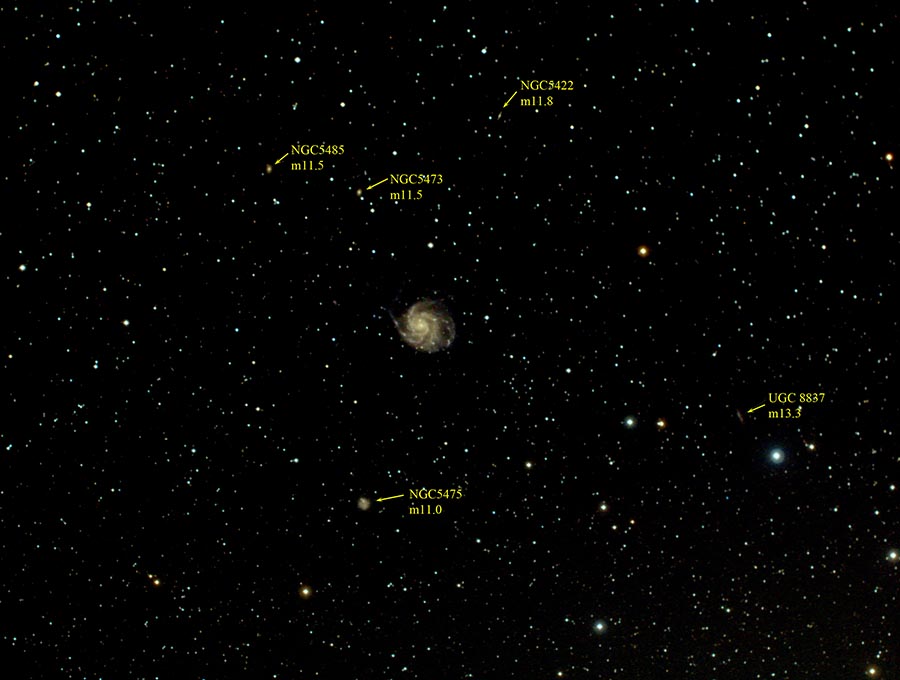
Mario Motta: Observer from Massachusetts
NGC 5474, a distorted galaxy near M101. The following image this is 90 minutes of imaging Lum filter only.
Taken with my 32-inch f/6.5 telescope, with ZWO ASI6200 camera, stacked and processed with pixinsight. This is a “dwarf spiral satellite galaxy” of M101, distorted with an off-set center, and spiral arms.

David Rust: Image Information later

NGC 1501 – Planetary Nebula in Camelopardalis: January 2022 Observer’s Challenge Report #156
January 19, 2022Work-File: Used only for organization and editing. When all entries are received, a final .pdf report will be issued by the 10th of February. And the link will be posted on this page.
MONTHLY OBSERVER’S CHALLENGE
Compiled by:
Roger Ivester, North Carolina
&
Sue French, New York
January 2022
Report #156
NGC 1501 Planetary Nebula in Camelopardalis
This month’s target:
William Herschel discovered NGC 1501 with his 18.7″ reflector on 3 November 1787. As handwritten by his sister Caroline, his description, reads: A very curious Planetary nebula near 1′ diameter. Round, pretty-well defined of a uniform light and pretty bright. Not surprisingly, the open cluster NGC 1502, sitting just 1.4° north of the nebula, was the next discovery in Herschel’s sweep.
Lawrence Parsons (the 4th Earl of Ross) and his assistant Ralph Copeland observed NGC 1501 several times with the 72-inch Leviathan… Perhaps the best description comes from Lord Rosse’s observation on 15 January 1868: A bright ring and inside it a dark annulus, very decided. A star in the centre seen very clearly and continuously with various powers; suspect variable [unequal?] brightness in the ring, perhaps a dark spot in it nearly on the preceding [western] side. The following [eastern] side of the ring appears broadest and to approach the central star nearer than the preceding side does. The north and south sides of the ring seem rather brighter than the preceding and following sides. Suspect other bright points in it, but am not at all certain. It is slightly elliptical, its major axis being preceding and following.
Complete and Finalized Report: Click on the following Link:
january-2022-observers-challenge-_ngc-1501
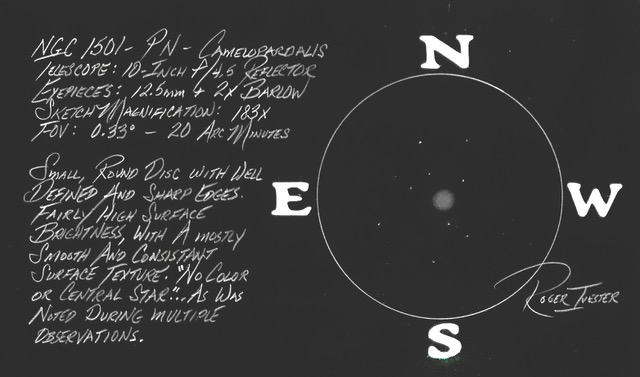
Pencil Sketch of NGC 1501 – Planetary nebula in Camelopardalis
NGC 7662 Planetary Nebula in Andromeda: November 2021 Observer’s Challenge Report #154
November 19, 2021MONTHLY OBSERVER’S CHALLENGE
Compiled by:
Roger Ivester, North Carolina
&
Sue French, New York
November 2021
Report #154
NGC 7662 Planetary Nebula in Andromeda
Sharing Observations and Bringing Amateur Astronomers Together
Final November .pdf report, click on the following link:
This is the observer’s challenge “Work-File” report: Used only for organization and editing. When all entries are received, a .pdf report will be issued by the 10th of December. And the link will be posted on this page.
Commonly called the Blue Snowball, the planetary nebula NGC 7662 dwells in the northern reaches of Andromeda. Its nickname springs from an article by Leland S. Copeland in the February 1960 issue of Sky & Telescope magazine. Copeland describes the nebula as “looking like a light blue snowball.”
William Herschel discovered this nebula on October 6, 1784, with this 18.7-inch reflector. His journal entry reads: A wonderful bright, round planetary pretty well defined disk, a little eliptical [sic]; perhaps 10 or 12″ diameter. Another entry from October 3, 1790, endearingly states: My planetary nebula. A very beautiful object, with a vS [very small] star following; giving one the idea of a large Planet with a vS satellite. In his impressive new book, William Herschel Discoverer of the Deep Sky, NGC/IC researcher Wolfgang Steinicke credits William Herschel with 10 observations of NGC 7662.
NGC 6857: Emission Nebula – Cygnus: October 2021 Observer’s Challenge Report #153
October 13, 2021MONTHLY OBSERVER’S CHALLENGE
Compiled by:
Roger Ivester, North Carolina
&
Sue French, New York
October 2021
Report #153
Click on the following link, for the complete report:
october-2021-observers-challenge-_ngc-6857-1
This month’s target:
William Herschel discovered NGC 6857 on 6 September 1784. His handwritten journal for that date reads: A patch containing some nebulosity…irregularly long.
Heinrich d’Arrest writes of this object and his observation of it in his 1867 Siderum Nebulosorum Observationes Havnienses. My very loosely paraphrased English for the Latin text: Minute, faint; it is most probably a cluster. A 12th-magnitude star precedes it. – Rechecked shortly after: it was not so small; not all of the nebula is resolved, there is at least some cloudiness. I’m not surprised that this was missed by Rosse.
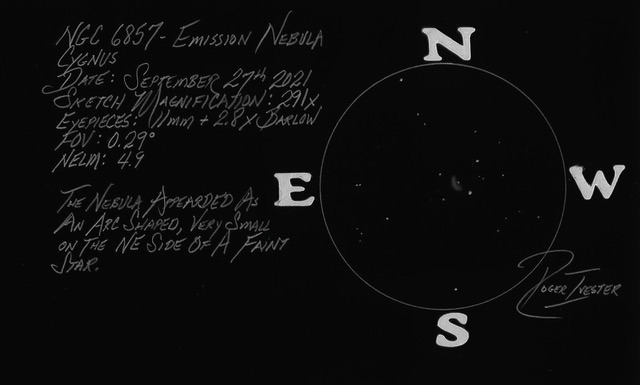
NGC 6857 is the brightest part of the larger, star-forming emission region Sharpless 2-100, which is a much more difficult visual target than NGC 6857.
A 2010 paper by Manash Samal and colleagues in the Astrophysical Journal indicates that the main ionizing source at the center of NGC 6857 is the bright, massive star at its heart. This compact nebula is estimated to be approximately 28 thousand light-years away from us, and the star is thought to have a spectral type of about OIII. The most likely age of the nebula is in the vicinity of 1 to 2 million years. (Intro and object information by Sue French)
 rogerivester.com
Recent Comments