Observer’s Challenge Report: FEBRUARY 2019 OBSERVERS CHALLENGE – NGC-2175
Archive for the ‘Work File Only – Observer’s Challenge Reports’ category
NGC 2175: Reflection Nebula in Orion – February 2019 Observer’s Challenge Object #120
January 7, 2019NGC 1514 – Planetary Nebula In Taurus – the “Crystal Ball Nebula” January 2019 Observer’s Challenge Object
December 16, 2018JANUARY 2019 OBSERVERS CHALLENGE – NGC-1514
I’ve observed NGC 1514 thrice with my 15-inch f/4.5 reflector, and it’s wonderfully complex. The sketch was made at 216× with a UHC filter. I may not have gotten all the lumps and bumps in exactly the right place, but it gives the general impression. Sue French
Inverted pencil sketch:

Pencil sketch by Roger Ivester
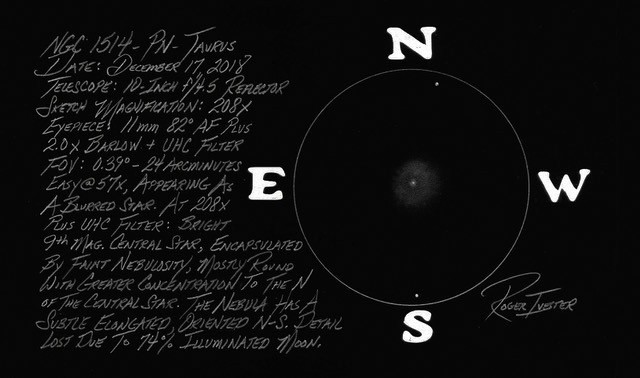
Seeing was excellent, but with a 74% illuminated moon. I set my 10-inch reflector in the backyard, using my house to shield the direct light from the moon. Having no idea what to expect under these conditions, I started out with 57x, and without a filter. It was easy to see the 9th magnitude central star, with some faint surrounding nebulosity. I then went to 208x and a UHC filter, and the nebula really came alive! The only two stars visible in the field, are two ~8th mag. stars…one to the north and the other south. The nebula has greater concentration to the north, which can seen in my sketch. The edges are irregular and uneven, and the nebula has a very subtle N-S elongation.
Roger Ivester
NGC 1514 in Taurus is sometimes called the “Crystal Ball Nebula,” But I have coined the name “Herschel’s Revelation” as being far more significant. This is the object that convinced Sir William that nebulae were real and not, as was the belief then, just masses of unresolved stars. His profound insight came at seeing the clear separation of the surrounding nebula from the obvious central star. Yet another of Herschel’s many amazing observations based solely on the visual appearance of an object in his telescopes.
Jim Mullaney
NGC 147 and NGC 185 – Galaxies in Cassiopeia – November 2018 Observer’s Challenge Report #117
October 29, 2018NOVEMBER 2018 OBSERVERS CHALLENGE – NGC-147
Calculating the surface brightness magnitudes:
Information from “Observing handbook and Catalog of Deep-Sky Objects” by Christian B. Luginbulh and Brian A. Skiff :
“The surface brightness magnitudes (sfc. br.), also from the * RC2, represent the brightness (in V or B, depending on the color of the integrated magnitude ) of a square arc minute patch averaged over the galaxy within the dimensions given for each. Since this value is an average, the central parts of the galaxy will typically have higher surface brightness and the outer parts lower.”
For complete information concerning (sfc. br.) refer to pages 10-11 “Observing Handbook and Catalog of Deep-Sky Objects.” Luginbuhl and Skiff.
* RC2 = “….nearly all data on galaxies are from the Second Reference Catalogue of Bright Galaxies (RC2) by de Vaucouleurs, de Vaucouleurs and Corwin, and the Southern Galaxy Catalog (SGC) by Corwin, de Vancouleurs, and de Vancouleurs.”
Observing notes and pencil sketches by Sue French from New York:
254/1494mm Newtonian
43×: By sweeping westward from Omicron Cassiopeiae, NGC 185 is immediately visible ensconced in a isosceles triangle of three 8th- to 10th-magnitude stars, the brightest one golden.
68×: The sketch was done at this magnification, where NGC 185 and NGC 147 just fit together in the 72 arcminute field of view. NGC 185 has a small core that grows gently brighter toward the center. NGC 147 is more slender than its companion and very faint. There’s a dim star superimposed on NGC 147, barely west of the galaxy’s center. Both galaxies lean roughly northeast by east, with plump NGC 185 have a slightly greater position angle. Most of the stars visible near the galaxies were sketched, but far too many showed in the richly populated Milky Way for me sketch all the field stars. Sue French
Pencil sketch with inverted colors: SF

Observing notes and pencil sketches by Roger Ivester
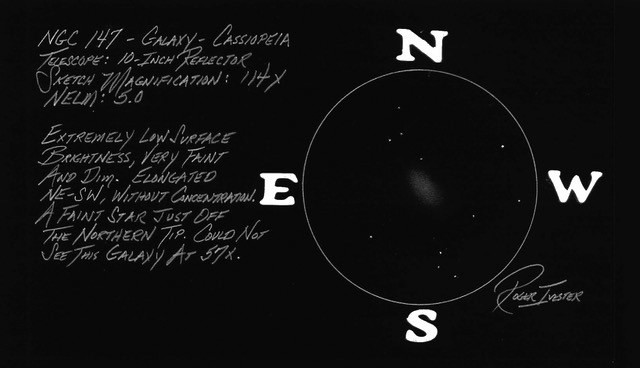
NGC 147, with a 10-inch reflector is very difficult at 57x, and best observed at magnifications of 114x and 160x from my 5.0 NELM backyard. The galaxy is very faint and difficult, due to the extremely low surface brightness. Elongated NE-SW, without concentration, with a faint star located almost in the halo to the north. On nights of fair transparency, I’ve been unable to see this galaxy. A dark sky is essential to successfully observe this object.
The first time I observed this galaxy was in on October 12th 1993. My note at that time: 10-inch reflector @ 57x, faint, and difficult with very low surface brightness. At 95x, still dim, but noted an elongation of NE-SW, low surface brightness, and mostly featureless. When first observing both NGC 147 and NGC 185 almost twenty five years ago, I used the photo’s in Burnham’s Celestial Handbook to verify my find.
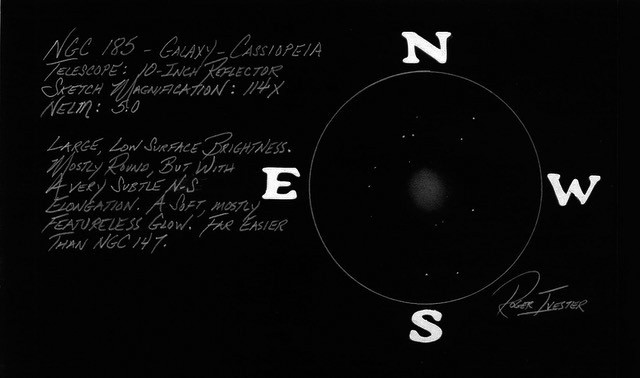
NGC 185, using a 10-inch reflector at 114x, shows this galaxy as large, mostly round and on nights of excellent transparency, a subtle center brightness. Far easier and brighter than NGC 147. Roger Ivester
Pencil sketches:
NGC 7129: Cluster + Nebula In Cepheus, October 2018 Observer’s Challenge Report #116
October 26, 2018OCTOBER 2018 OBSERVERS CHALLENGE – NGC-7129
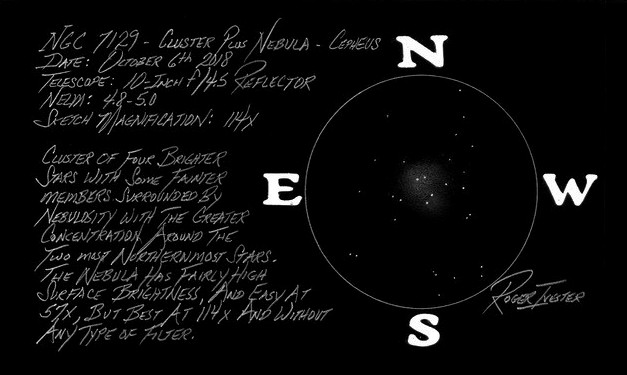
In my 10-inch reflector a cluster of four brighter stars with some fainter members, enveloped by nebulosity with greater concentration around the two northernmost stars. The nebula has fairly high surface brightness, and easy to see at 57x, but best seen at 114x, and without any type of filter. The sparse cluster and nebulosity is very easy to locate and see, and stands out prominently in the star field. Roger Ivester
Pencil sketch with inverted colors:
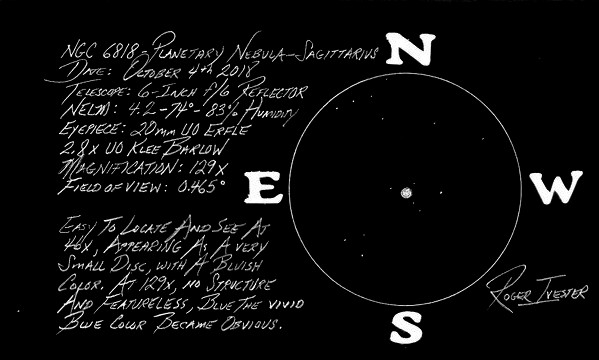
NGC 6818 – Planetary Nebula – Sagittarius – September 2018 – Observer’s Challenge Report #115
October 12, 2018SEPTEMBER 2018 OBSERVERS CHALLENGE – NGC-6818
Pencil sketch from the eyepiece using a 5 x 8 blank notecard, and 6-inch f/6 reflector @ 129x, with the colors inverted…
Planetary Nebula IC 1295 In Scutum: August 2018 Observer’s Challenge Report
September 20, 2018Messier 4 – Globular Cluster in Scorpius – July 2018 Observer’s Challenge Report
August 24, 2018Click on the following link for the complete report:
JULY 2018 OBSERVERS CHALLENGE – M-004
Notes from my backyard:
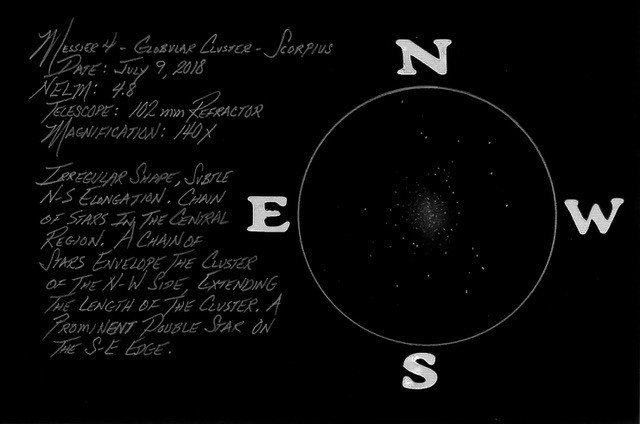
Globular cluster, M4 is easy to see with a 60 mm refractor, appearing as a faint circular glow at low magnification. When using a 3.5-inch Maksutov-Cassegrain at 78x, there is a resolve of some of the brighter members. The cluster has a subtle elongated shape. A very faint chain of stars was noted in the central region, oriented N-S. With 102 mm refractor, there is a greater number of stars resolved within the cluster, and much greater concentration of stars, elongated and with more stars in the central chain. A prominent double star is located on the SE edge.
10-inch reflector at 140x, excellent resolve of the cluster. The center chain of stars is very bright and with many stars counted, both in the central region and around the outer edges. A chain of stars makes an arc, the entire length of the cluster on the NW side. The elongation shape becomes much more apparent with the larger aperture. Roger Ivester
Pencil sketch with the colors inverted using a 102 mm refractor @ 140x
M51 and Companion Galaxy NGC 5195 – June 2018 Observer’s Challenge Report
July 12, 2018JUNE 2018 OBSERVERS CHALLENGE – M-051
Observing notes:
Messier 51 is visible along with companion NGC 5195 in a 60mm (2.4-inch) refractor. M51 is mostly round with a bright stellar nucleus and a very faint halo. The small companion galaxy, NGC 5195, just to the north was very faint and small. If sky conditions are poor, this galaxy pair can be extremely difficult to see using a telescope this small.
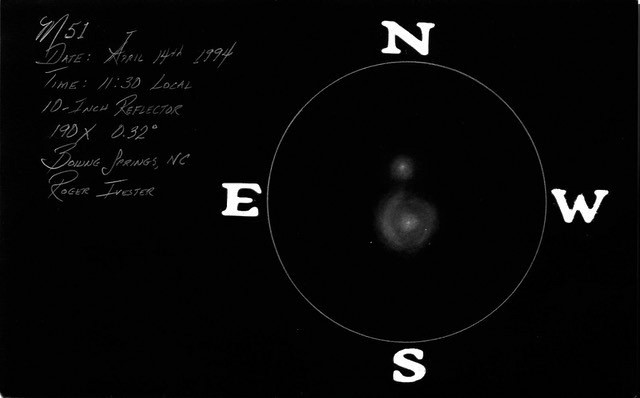
In a 10-inch reflector on an exceptional night at 190x, spiral structure is easily visible. I could trace the prominent eastern arm almost in contact with companion galaxy, NGC 5195. The nuclei of both NGC 5194 and NGC 5195 are both stellar, with the smaller companion galaxy, NGC 5195, having a brighter, more intense nucleus.
M51 has a mag. 13.5 star a couple of minutes to the SW of the core, still within the halo, and a mag. 14 star, (requiring averted vision) just off to the east, outside of the halo.
One of my most memorable views of NGC 5194 and NGC 5195 came during an early spring night in 1993, using a 14.5-inch reflector. The spiral arm of M51 (NGC 5194) was incredible “almost” touching the companion galaxy to the north. This view rivaled that of many photographs.
On the night of April 14, 1994, supernova 1994I was visible. I estimated the mag. of the SN on that night at 13.8. The following pencil sketch was made that night.
The following image by Mario Motta, observer from Massachusetts using a 32-inch telescope.
I imaged M51 last night (May 10th 2023) and it came out nicely, using Lum, R/G/B, and Ha filters, 5 hours total.

NGC 4236, Extremely Faint Galaxy In Draco – May 2018 – Observer’s Challenge Report #110
June 7, 2018To read the complete LVAS Observer’s Challenge report, click on the link:
MAY 2018 OBSERVERS CHALLENGE – NGC-4236
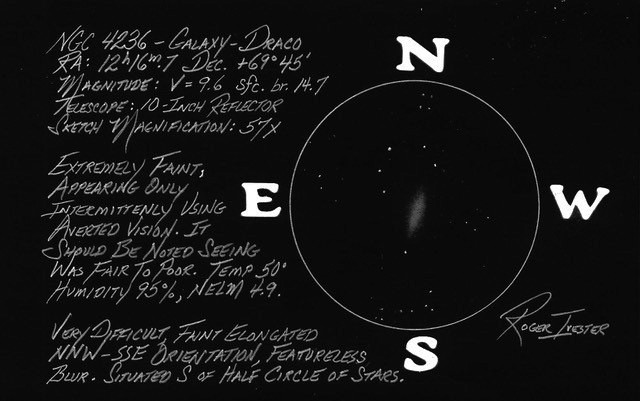
10-inch reflector, and spending four hours in my attempt to see galaxy NGC 4236, of which the first three were unsuccessful. However, during the forth hour, at well past 1:00 AM EDT, could glimpse an extremely faint, elongated NNW-SSE oriented blur of light as shown in my sketch. The galaxy appeared featureless due to the extreme low surface brightness, and visible only intermittently with averted vision.
There is a distinctive half-circle of five stars, NNE of the galaxy which works well to assist in determining the exact location of this very faint galaxy, or better said, an extremely faint galaxy.
Sky conditions were poor with a NELM of 4.9, which is about normal for springtime in the foothills of North Carolina.
On the previous night, under the same conditions, using a 6-inch reflector, the galaxy was invisible, despite spending two hours in my search.
Roger Ivester
 rogerivester.com
Recent Comments