Posted March 23, 2023 by rogerivester Categories:Roger's Articles
Beginning in (2022) my oldest grandson, needed a project to show the movement of the sun over a period of time….if possible an entire year. However, despite living more than 200 plus miles apart, we both made similar “solar devices” to measure the suns shadow, beginning on the Vernal Equinox (March 20th 2022) and beyond.
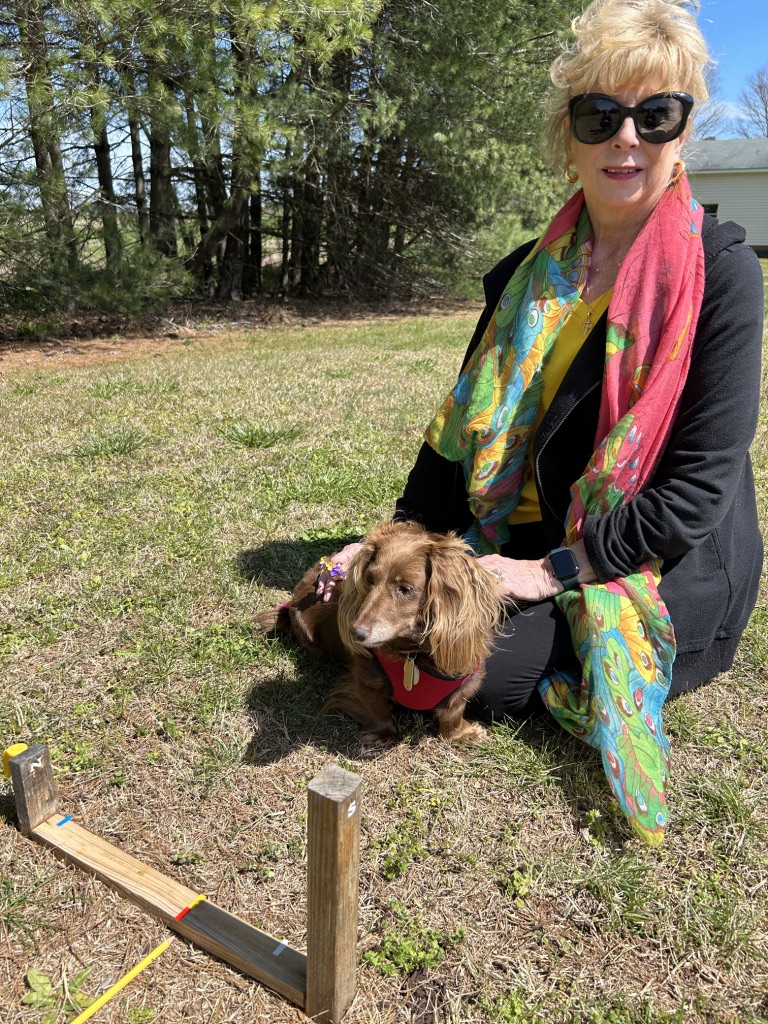
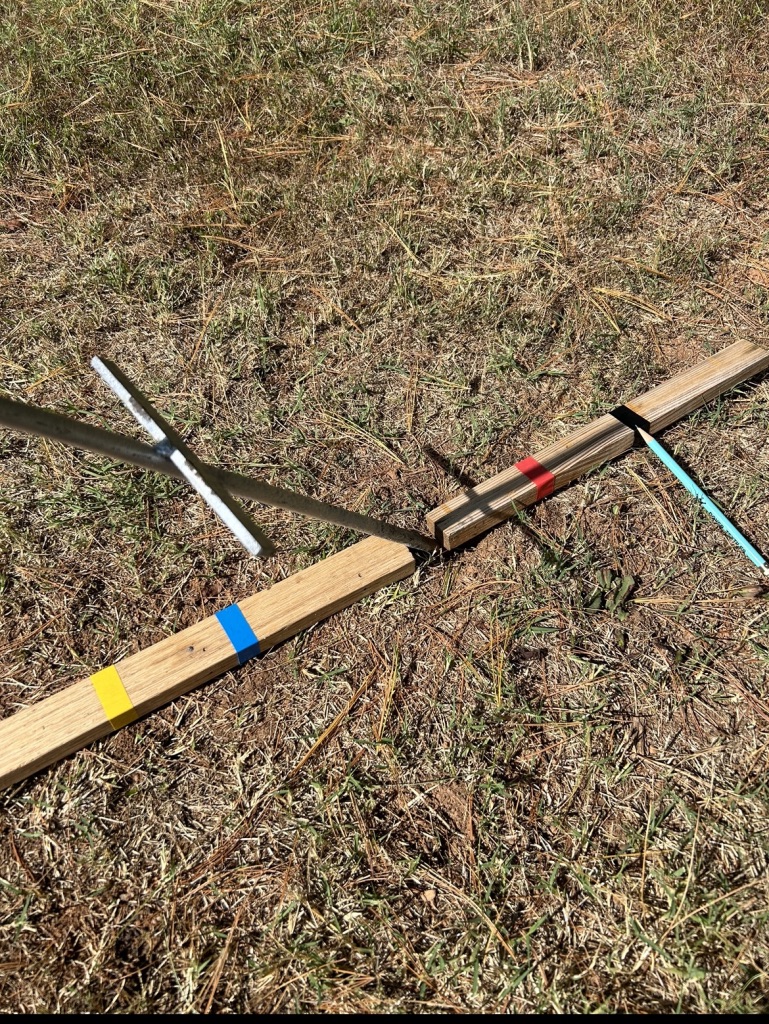
The following photo:
The yellow tape mark on the right side of the scale shows the sun shadow on the 2022 Spring Equinox. (This was my first measurement)
The white tape was placed on the first day of summer (June 20th 2022) which shows the longest day of the year. Note: the sun is not directly overhead using this method, as the shadow indicates.
The blue mark was placed on the scale, on the shortest day of the year, December 21st 2022, which is the longest shadow of the year for 2022.
A second way to measure the suns shadow, by Tom English.
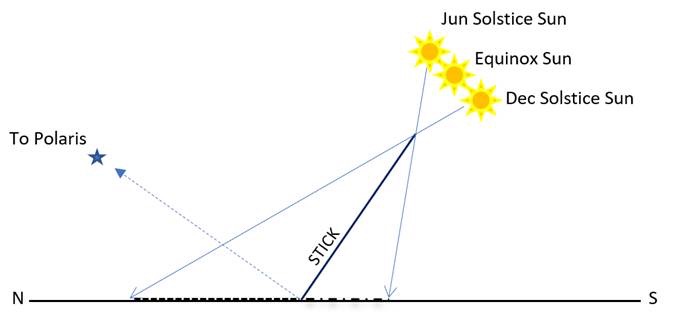
I thought of a variation that I might try someday: Put a straight pole into the ground, facing due south, and at an angle of 54 degrees (for you it would be 55 degrees)
Then on the two equinoxes it would cast no shadow at local noon.
On the June solstice the shadow will cast its greatest extent southward, and on the December solstice the shadow will cast at greatest extent northward of the stick.
Roger Ivester
My latitude is 35º 15′
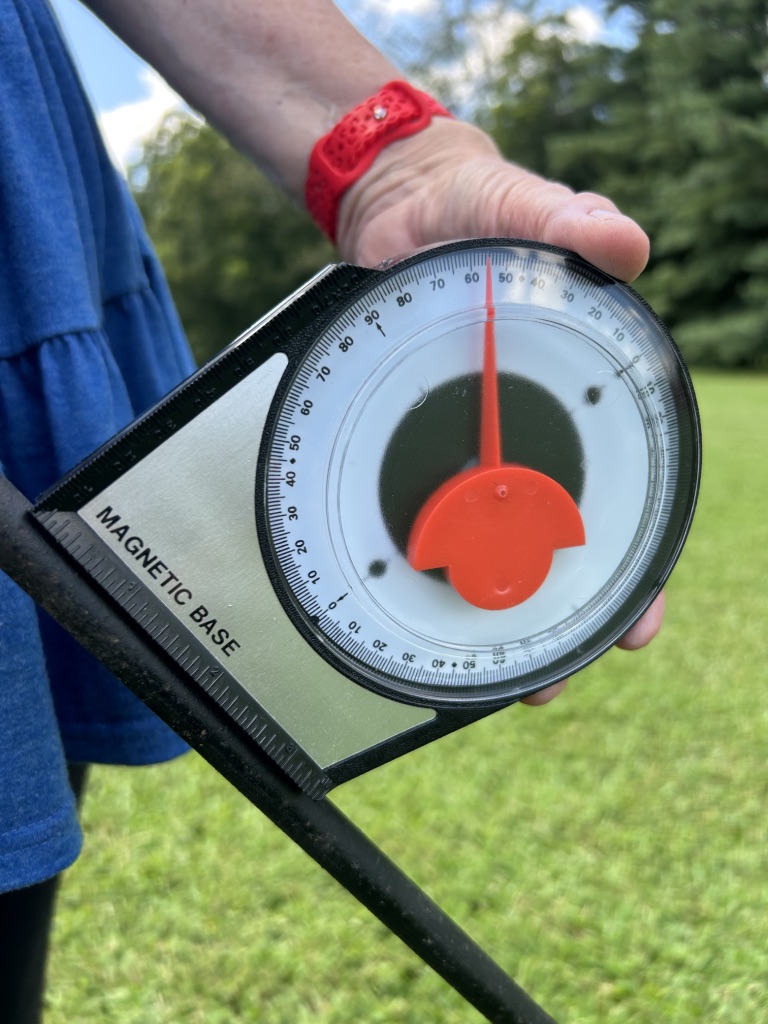
(90º – 35º) = 55º
Debbie using an angle finder to insure the proper angle is at 55º.
The angle is toward the South at 55º
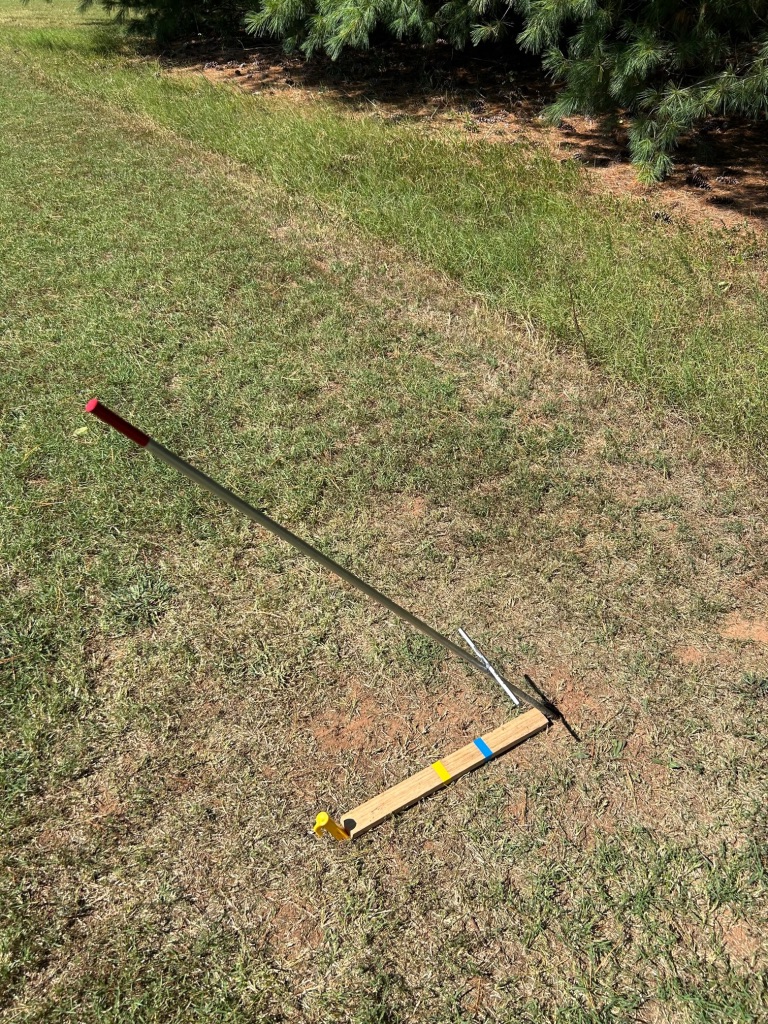
Point the steel rod toward North, but again the angle is toward the South.So draw a line, with the post, going South to North.
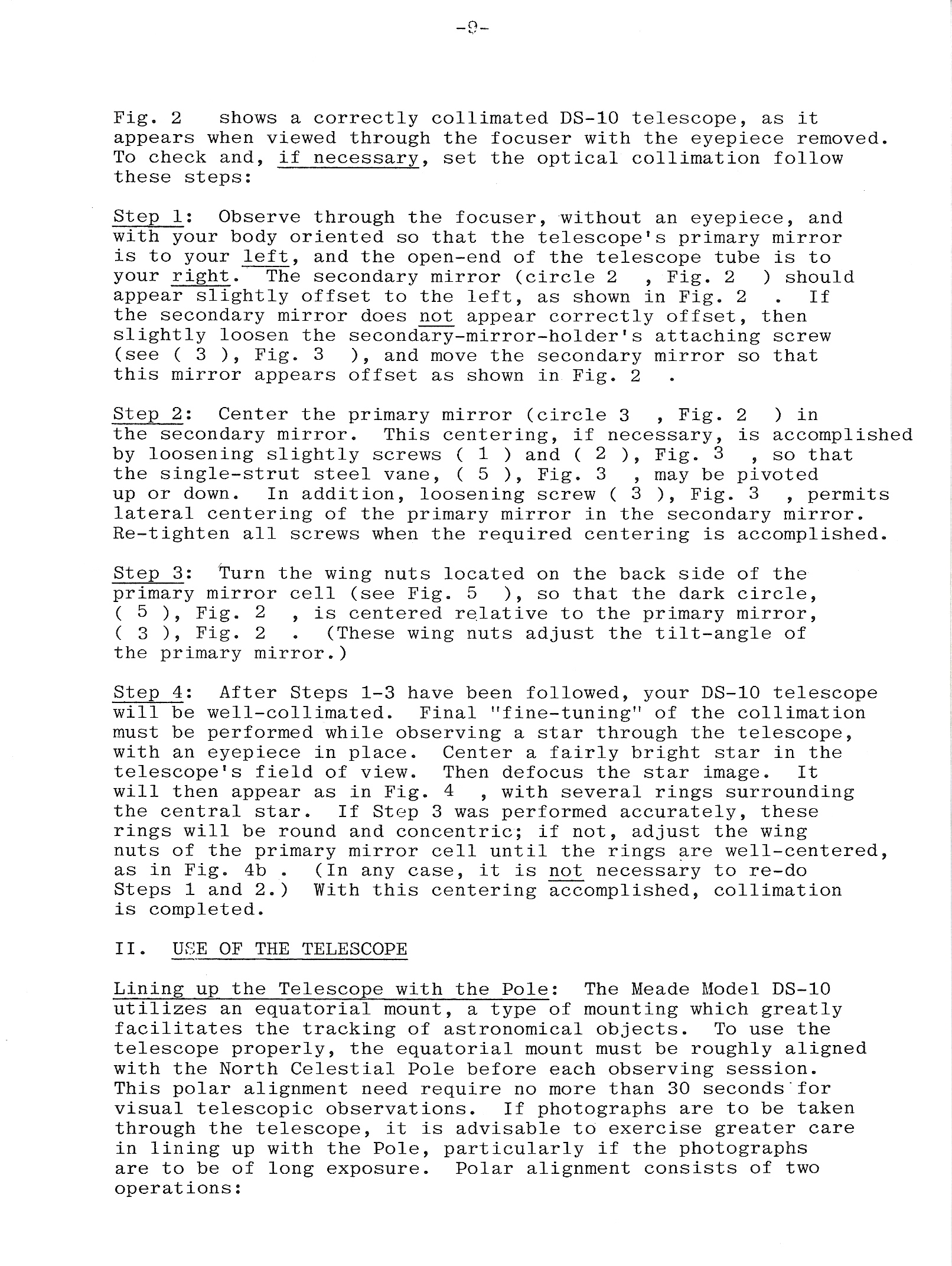
Note the shadow. It will be increasing each day to get shorter, until on September 22nd, there will be no shadow, as the sun will be “pointing down” the rod.
At 1:00 PM EDT, today (September 22nd) a photo was made, and indeed showing no shadow, as the sun was shining directly down the steel rod.
The previous marks (blue and yellow) on the scale indicate the positions of the suns shadow on different days, since August 24th.
The black mark shows the shadow on the first day of winter. The yellow mark was made on the longest day of the year….or the first day of summer.
Comments:Comments Off on Tracking The Suns Shadow For An Entire Year, Using Two Methods
Posted March 12, 2023 by rogerivester Categories:Roger's Articles
Deep-sky observing can be enjoyed with a group or solitary, however for me, I much prefer the latter. I always have a planned agenda, with the object or objects that I’m interested in observing.
Deep-Sky observing (galaxies, nebula and star clusters) are very serious business for me, with no time for idle chatter or distractions! There are pencil sketches and notes to make! 🙂
However, I did have one observing partner that was with me on a regular basis for almost 17 years, but she passed away in February 2016. Its been ten years now as of 2026, and I still miss and think about her often.
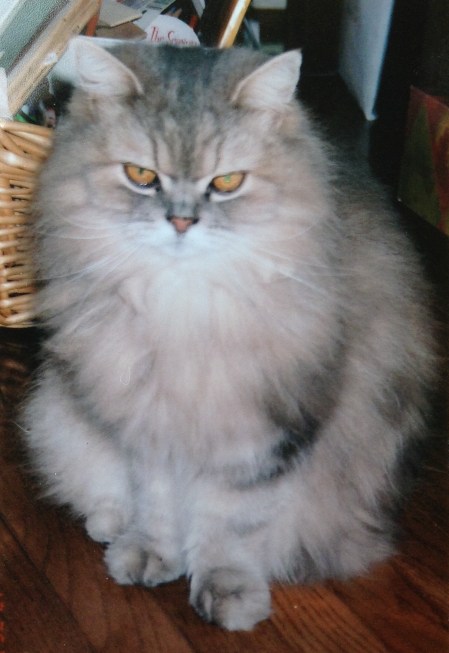
I can still see CJ, our Persian Cat, waiting anxiously at the back door, ready to go outside, while I’d be setting up my telescope on the deck or in the backyard.
When the door was finally opened, she would run out, fast as she could and so excited. She would walk around, climb the deck, play like she was catching something….pouncing and clawing the ground. However, after a short while, she’d end up on my lap, either due to being cold or to just feel safe.
CJ was going to stay with me for only a couple weeks and would then be moving to California, but that two weeks ended up being almost 17 years. I’m really glad the move didn’t work out.
Debbie and I held her in our arms from 11:30 AM till 8:15 PM. I had my hand on her chest when her little heart beat the last time, after 19 years. It was a very, very sad day.
CJ had a wonderful life. We treated her like a Princess.
Comments:Comments Off on Losing My Telescope Observing Partner After 17 Years: It Was A Sad Day.
Posted February 27, 2023 by rogerivester Categories:Roger's Articles
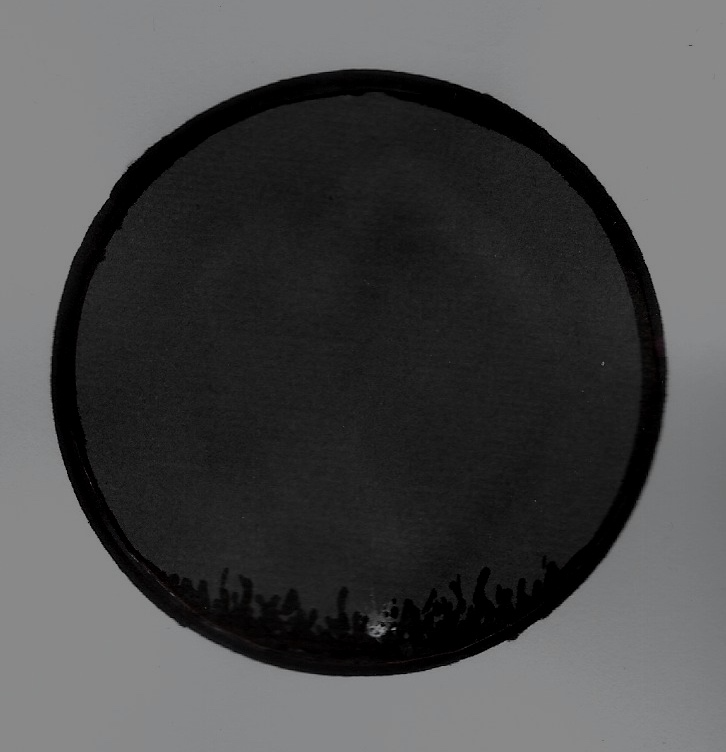
The following is a rough field sketch using chalk on “gray” cardstock, rather than “black” to better illustrate light pollution. Canopus is just visible in a distant tree line.
Canopus is located in the constellation Carina, and is the second brightest star in the sky. It has an absolute magnitude of -5.71and with the following coordinates:
Right ascension: 06h 23min declination -52º 41
In the early 90’s, amateur astronomer Tom English, promoted an event called “The Great Canopus Chase” in our local astronomy club. It was unknown at that time if Canopus could be seen from the area, and amateurs went far and wide looking for the perfect southern view.
Many observers saw the star, but most from different locations, within the local area. It was a fun event. When I first saw it, I was surprised, but have seen it many times since. It has actually become an annual event, so it will be again this year. (2025) Roger Ivester
From my (+35º 18′ ) in North Carolina, my theoretical south latitude 90º (-) 35º = ~ -55º.
Of course the terrain and light pollution can most often be the limiting factor for many in their limiting theoretical southern latitude.
I can see the star Canopus at the south declination of (-52º 42′) but in a distant tree-line, however, it shines brightly! It’s easy to see without optical aid, but I normally take my 7 x 21 mini-binoculars to assist, but once located, it’s very easy naked eye.
So, from my location, Canopus @ -52º 42′ is only ~ 2.5º above the horizon.
The following is my rough chalk sketch, on charcoal “colored” card stock. I made this “rough sketch” as viewed from the north end of Stadium Drive, at the stop sign (junction to the Boiling Springs/Cliffside highway)
Notes and image as following by Mario Motta:
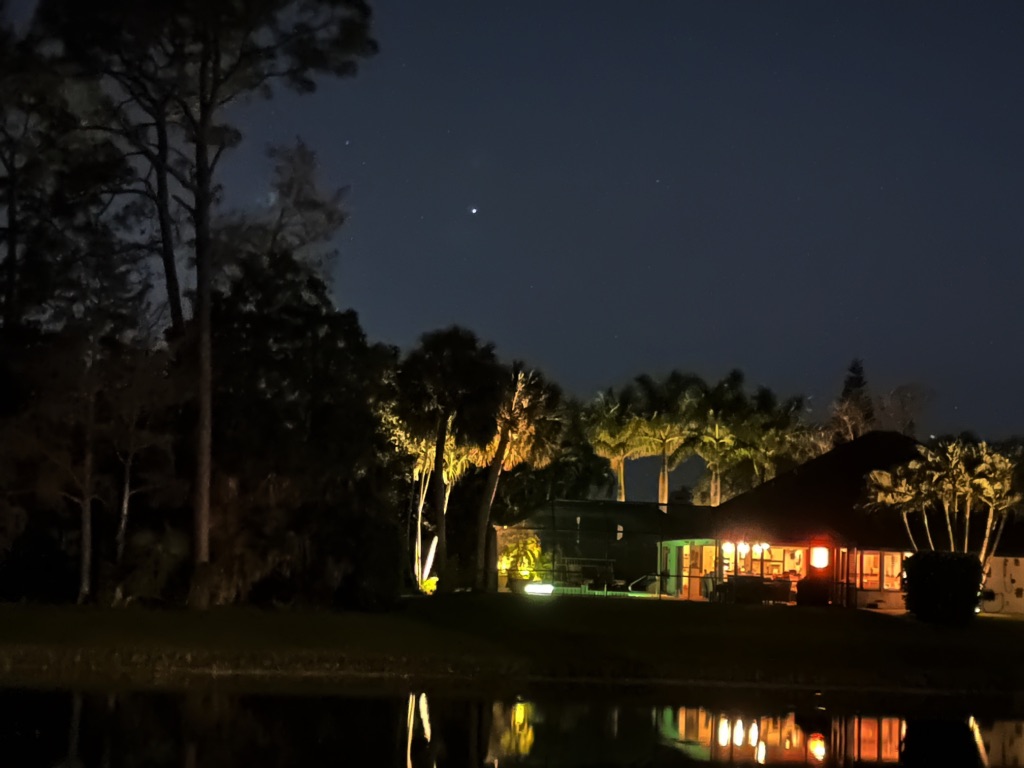
Canopus near its peak which is 11º, here at about 10º above the horizon in Naples, Florida.
I received this note from Richard Shuford, this morning: March 2nd 2023
“Back in 1976, when I was an undergraduate physics major at Lenoir-Rhyne College in Hickory, NC, catching a glimpse of Canopus was celebrated by some of my friends who observed it from a high hilltop in Burke County.” Richard Shuford
(Note: Hickory is about one hour north from my location of seeing Canopus. I was very surprised when reading the above notes from Richard Shuford. I thought our group in Boiling Springs, in the early 90’s was the first time anyone in this area (+ 35º) NC was able to see Canopus.
Chuck Vaughn: Observer from California
Now what is the likelihood of me finding and seeing this in a 30 year old magazine? Especially since I just completed a Canopus post on my site?
I was casually thumbing through a December 1992 Sky & Telescope, and the word “Canopus” seemingly jumped out of page-712 and hit me, right in the eye! His (Chuck Vaughn’s) latitude is +37º 49′ which puts Canopus on the ~horizon, and being able to see it without optical aid!
The following is a brief of that article:
“Canopus, too! Chuck Vaughn of Fremont, California…..claims to have caught sight of the star without optical in November 1991, and three years earlier in December. Has anyone else seen it from such a northerly location?” CV
Note for reference: Richmond, Virginia has a latitude of +37º 53′ just about the same as Fremont, California.
I’m hoping someone reading, with a clear southern horizon, with a latitude of ~40º’s will attempt to see Canopus. This would put the star below the horizon! Is this even possible?
Comments:Comments Off on Canopus From Western North Carolina @ +35º 18′: Also Sightings From Hickory NC, Richmond Va And Fremont California
Posted February 13, 2023 by rogerivester Categories:Roger's Articles
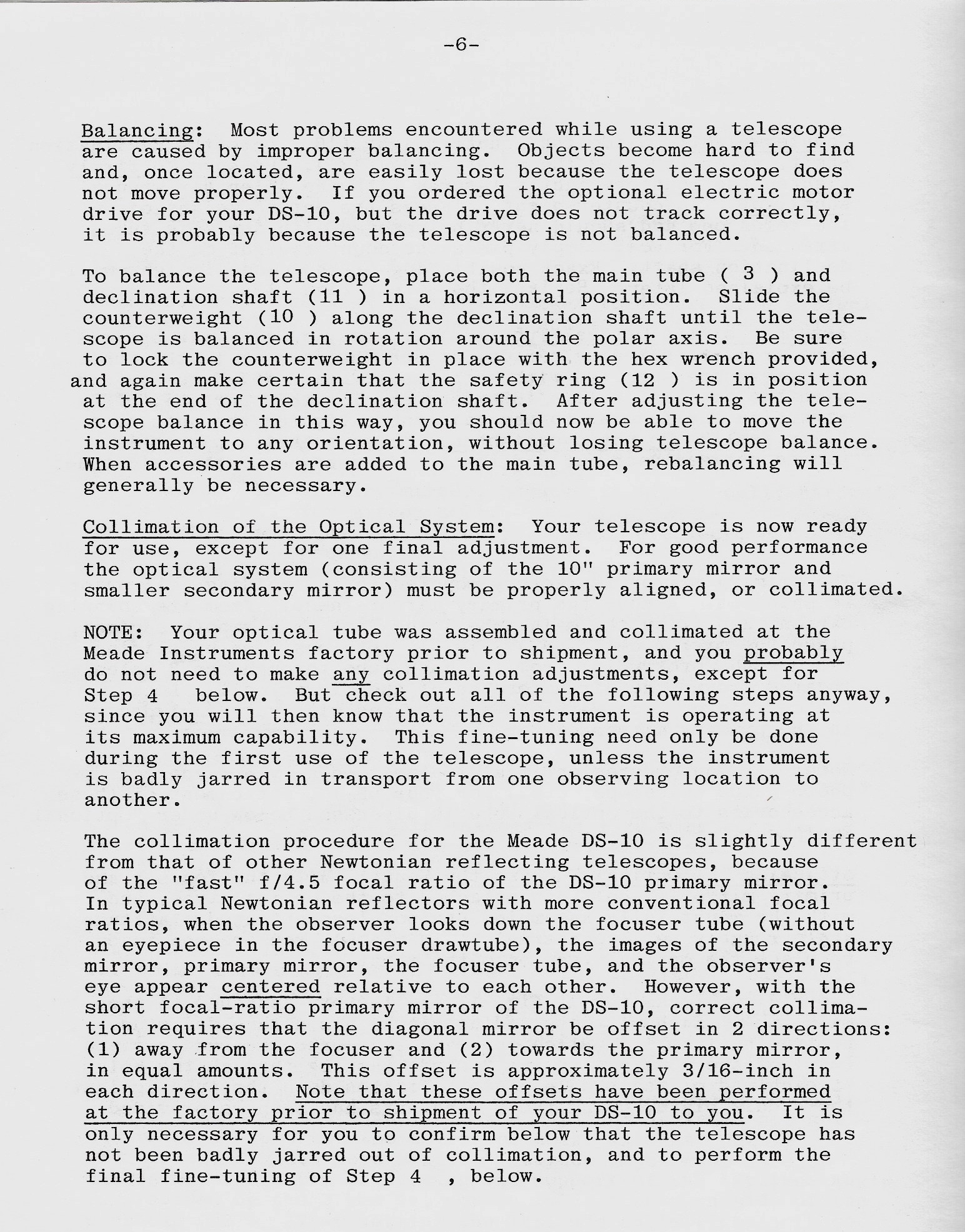
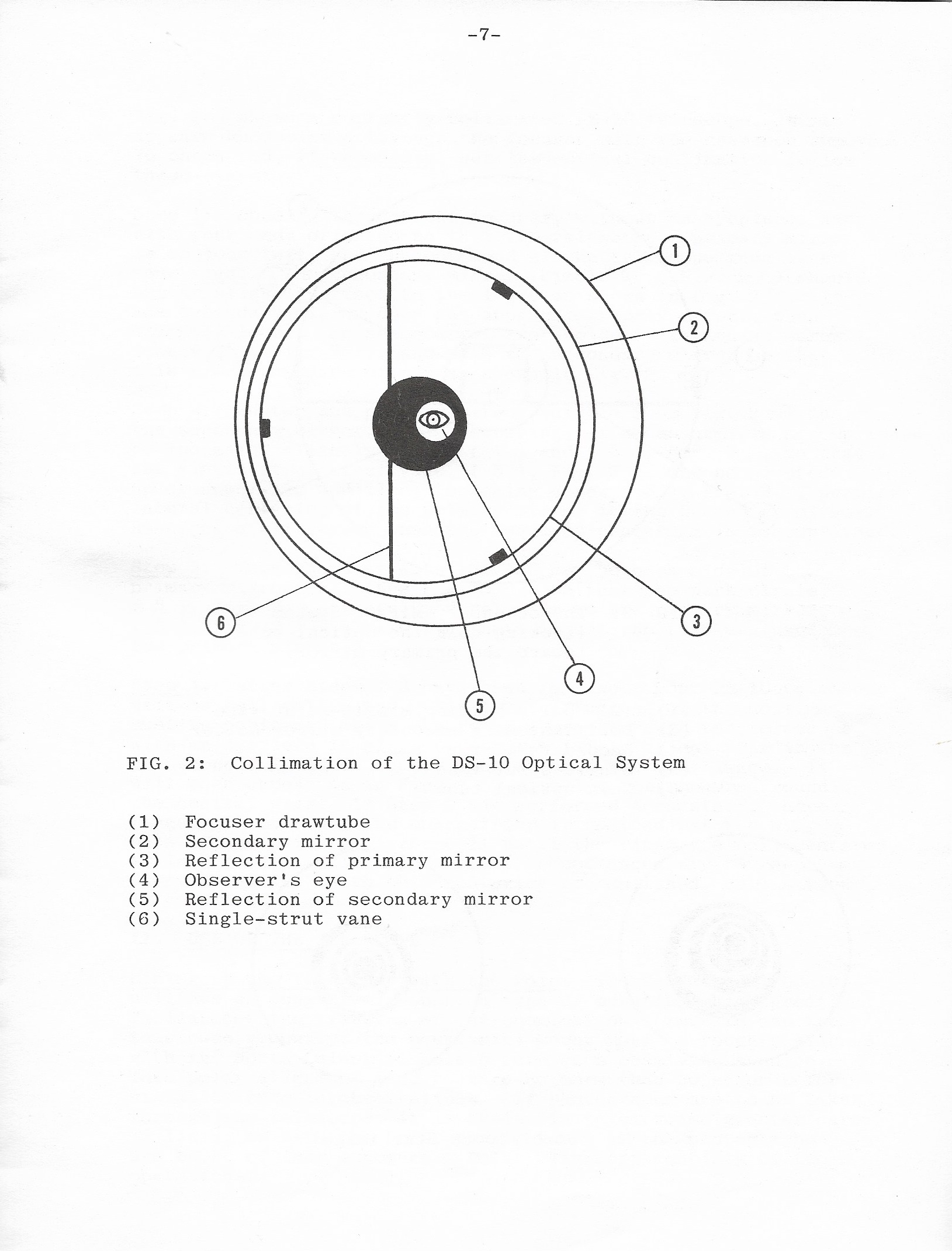
When I purchased my first f/4.5 Newtonian in February 1992, I learned about the need or reason for offsetting the diagonal. This was something totally new to me, as all my previous reflectors had focal ratios of f/8 or slower.
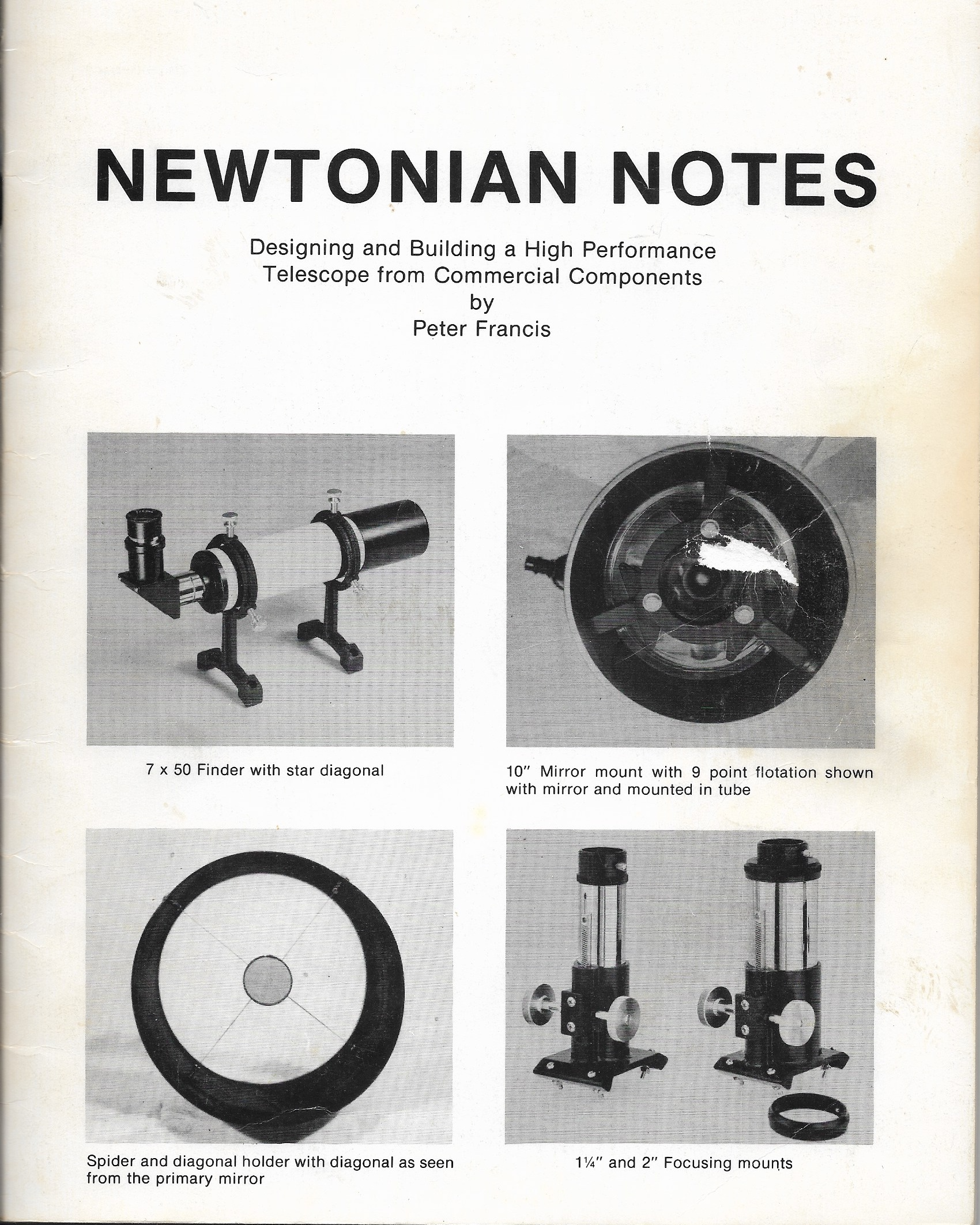
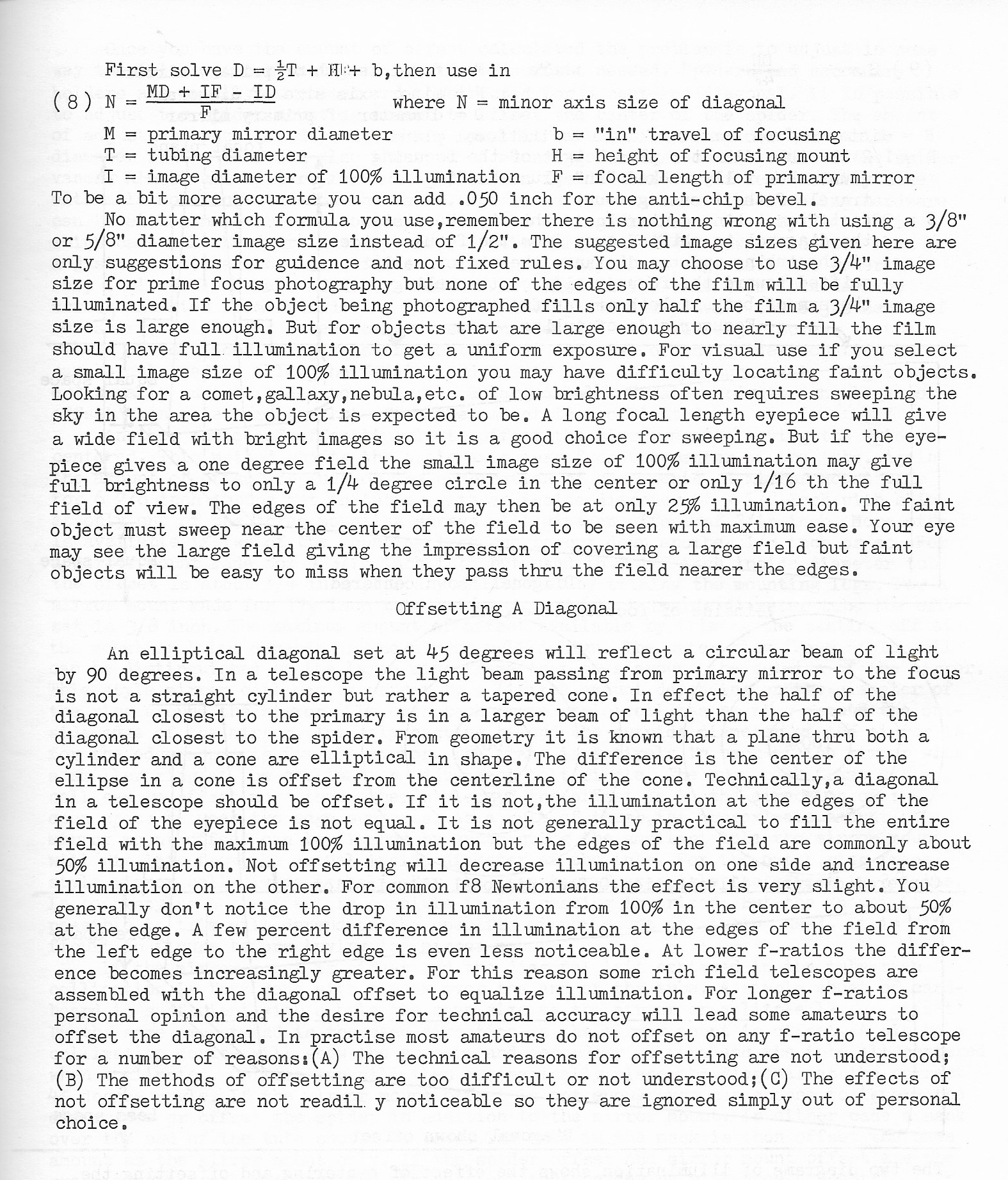
From my instruction book for the 10-inch Meade f/4.5 Newtonian which was beneficial for me at that time. I’m including a couple pages as following:
Meade Instruments Corp.
Newtonian Notes:Possibly or “arguably” one of the best books covering everything and anything someone would want to know about how to collimate a Newtonian reflector.
A page from “Newtonian Notes” as following, concerning the purpose and need for offsetting a diagonal.”
Comments:Comments Off on Collimation Of An f/4.5 Newtonian Reflector With Emphasis On “Offsetting The Diagonal” And The Purpose For This Procedure.
Posted February 6, 2023 by rogerivester Categories:Roger's Articles
Orion Telescope and Binoculars has an incredible amount of solar equipment and everything you need to know, concerning solar observing.
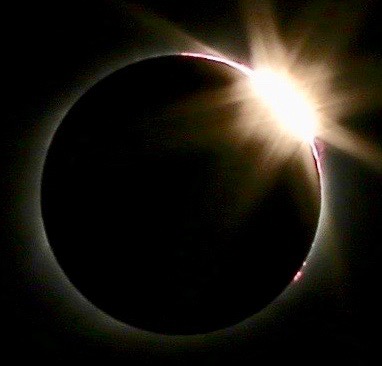
The followingimage by Barre Spencer and Patrick White, using a Canon Rebel with a 200 mm zoom lens from the 2017 total eclipse, presents the Diamond Ring and Bailey’s beads very nicely.The image was made from Columbia, South Carolina.
Unfortunately my friend of many years, Barre Spencer, passed away on June 1st 2022.
Our story of witnessing the August 2017 total solar eclipse from Laurens, South Carolina:
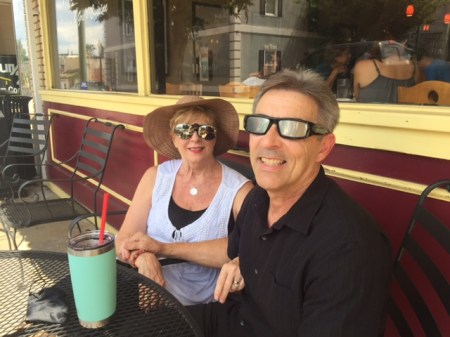
A group of folks from various places met outside of an Italian restaurant to enjoy the solar eclipse together. We were all surprised how few came to this quaint little town to observe this historic event. The totality duration was ~ 2 mins 34 seconds, and with perfect weather!
During totality the sky darkened to a surprising level, but not as dark as a clear full moon night. Venus appeared very bright in the western sky and Jupiter in the southeast. I could not see any stars naked eye.
We were amazed at the sudden flash of the diamond ring!
The temperature drop was very significant. A weather bureau report from Newberry, SC, only 30 miles away, and also in the line of totality, recorded a temperature drop of 11º Fahrenheit. So, we can assume that this temperature drop would have been similar in Laurens.
When the sun began to re-emerge, we noticed a shimmering of light waves on the pavement in front of us, known as shadow bands. A very interesting phenomenon, which I was hoping we’d see…and we did!
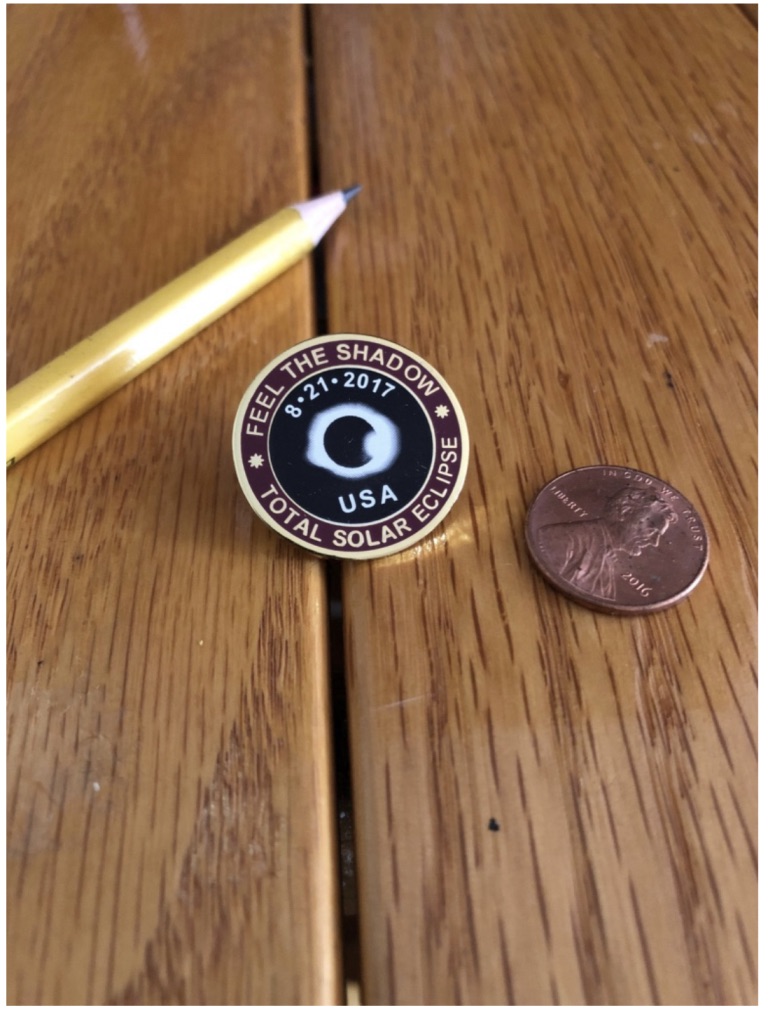
John Goss, who at that time was the President of the Astronomical League, sent both us two very nice and high-quality pins. I wear mine often to this day, with many questioning and asking what the pin is all about.
I’m really glad we have our 2017 pins, to remind us of that special day in Laurens, South Carolina. For many reasons, we’d never “witnessed” a total solar eclipse, and I’m glad I took notes, and made this post, shortly afterwards.
There is nothing like the written word, as there are always plenty of images of the event online, but there will be no duplication of your thoughts, your feelings and what you saw.
Comments:Comments Off on 2017 Total Solar Eclipse, As Viewed From Laurens, South Carolina: An Event We Will Never Forget

 rogerivester.com
Recent Comments