Archive for September 2022

The 8-Inch “Orange Tube” Schmidt-Cassegrain f/10 Telescope, Founder Tom Johnson, And Other

September 26, 2022

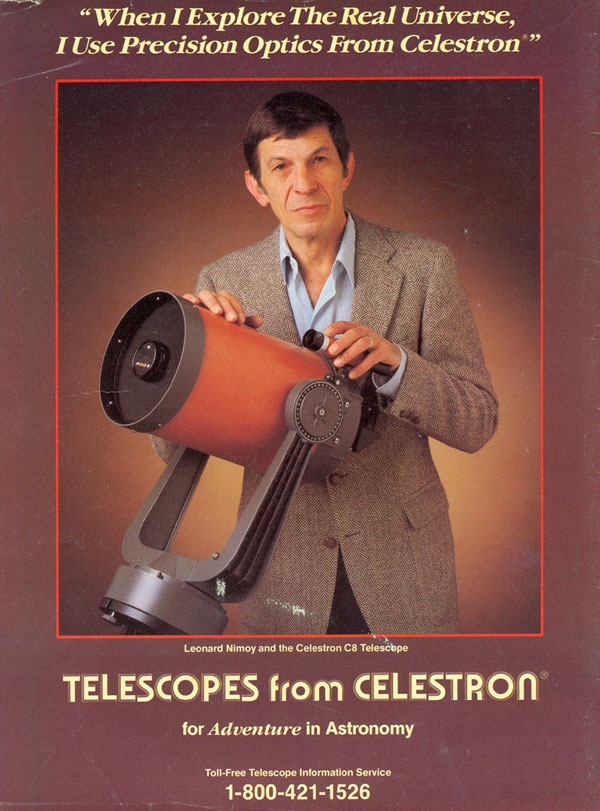
I pulled the following photo of (Leonard Nimoy) “Spock” and his “Orange-Tube” 8-inch Celestron Schmidt-Cassegrain telescope, from Phil Harrington’s vintage telescope advertisement post.

This is the telescope, that changed the world of amateur astronomy, with its introduction in 1970.    

http://www.philharrington.net/old50.htm 
Amateurs wanted a more compact and portable telescope, and the 8-inch Schmidt-Cassegrain f/10 fit the bill.  I’ve owned two SC scopes over the years, but for me, I still like the simplicity of a Newtonian Reflector, despite the bulk and weight. And should a problem present itself, there is always an “easy fix” maybe not so much so with a Schmidt-Cassegrain or Maksutov-Cassegrain.

However, the Schmidt-Cassegrain telescope is the choice of telescope for many amateurs, for their own personal reasons. I’d suggest mostly for portability, and astrophotography.

Newtonian Reflectors:

It’s my opinion, a 10-inch “equatorially mounted” (solid tube) reflector, is the largest reflector that can/could be considered portable.  And that’s a stretch, as I have a very heavy 10-inch EQ reflector (solid tube) so this is based on my experience.  

However, this is not the case for a Dobsonian design, as many take 20 to 25-inch Newtonian’s, and sometimes “even” larger to star parties on a regular basis.  But for me, I was always happy for someone else to bring such a large telescope. 🙂

My experience with a 20-inch Dobsonian: 

I’ll never forget being at a star party near Blowing Rock/Boone, North Carolina, and climbing a “really” tall ladder, to observe through a 20-inch Dobsonian.  To make things worse there was a 15 to 20 mph wind, and “of course” in total darkness.  I couldn’t wait to get back on ground, and decided my 10-inch reflector was all I needed!  I just never thought astronomy should be a hazardous hobby, even greater than road cycling!

I’ve always preferred the simplicity of both a Newtonian and refractors:  

For me, growing up looking at big Cave Newtonian’s (advertisements) and other brands, with massive German design equatorial mounts, was what an astronomical telescope should look like.

We can never escape our early years, and thoughts.

Roger Ivester 

The following is an excerpt from Wikipedia, concerning Tom Johnson and Celestron telescopes. 

…..Johnson, who had a strong interest in amateur astronomy, originally created Celestron as the “Astro-Optical” division of Valor Electronics in 1960.[2][3] Around 1960, Johnson had been looking for a telescope which could be used by his two sons, but found no such child-friendly models on the market at the time.[2] Johnson built a new telescope, a 6-inch reflector telescope, by himself, in 1960.[2] He was visiting his brother in Costa Mesa, California when he came upon his nephew, Roger, trying to grind the 6 inch diameter lens he purchased from the clearance table at a local hobby shop. Roger was tired of the project and offered the lens-grinding kit to his uncle. Thomas Jasper took the kit home and after several days of hand grinding, he invented a machine that would grind the lens for him. Thus, by accepting the lens grinding kit from his nephew, Roger L. Johnson, “TJ” (as the family called him) created that first lens of many.

On July 28, 1962, he publicly unveiled a new invention, a portable 18+34-inch Cassegrain telescope, at the party held by the Los Angeles Astronomical Society on Mount Pinos.[3] The new transportable telescope proved so groundbreaking that Johnson’s invention was featured on the cover of a 1963 issue of Sky & Telescope.[3]

Johnson’s interest in telescopes soon became a full-fledged business.[2] Johnson’s new company, Celestron, which descended from the “Astro-Optical” division of Valor Electronics, soon began selling more sophisticated Schmidt–Cassegrain telescopes in models ranging from just 4 inches to 22 inches.[2] However, the Schmidt–Cassegrain telescope proved difficult to mass-produce because the models needed Schmidt corrector plate, an advanced aspheric lens, which could be hard to manufacture.[2] To solve this production problem, Johnson and the company’s engineers invented a new type of telescope, the Celestron 8, in 1970.[2] The Celestron 8 was more compact, affordable and easier to manufacture than traditional telescopes, like the Schmidt–Cassegrain.[2] Johnson’s new telescope proved very popular in the amateur astronomy and educational industries, allowing the hobby to rapidly expand and reach more consumers.[2]

Johnson sold Celestron in 1980.[2]

NGC 6751 Planetary Nebula In Aquila: September 2022 Observer’s Challenge Object: #164

September 23, 2022

The Thorn In The Apostle Paul’s Side. But What Was That Thorn? A Question That Has Been Asked For More Than Than 2,000 Years.

September 22, 2022

2 Corinthians 12:7-11

The thorn in the flesh….

7 And lest I should be exalted above measure by the abundance of the revelations, a thorn in the flesh was given to me, a messenger of Satan to buffet me, lest I be exalted above measure. 8 Concerning this thing I pleaded with the Lord three times that it might depart from me. 9 And He said to me, “My grace is sufficient for you, for My strength is made perfect in weakness.” Therefore most gladly I will rather boast in my infirmities, that the power of Christ may rest upon me. 10 Therefore I take pleasure in infirmities, in reproaches, in needs, in persecutions, in distresses, for Christ’s sake. For when I am weak, then I am strong.

7 …..Therefore, in order to keep me from becoming conceited, I was given a thorn in my flesh, a messenger of Satan, to torment me.  NIV 

My thoughts concerning the “Thorn In The Apostle Pauls’ Side” as following: Roger Ivester

Could the “thorn in the Apostle Paul’s side” have been mental and his inability, therefore, as a human lacking the ability to forgive himself?   Could Paul’s thorn have been guilt, due to his murder and torment of Christians. Mental pain and guilt can be more punishing than physical pain. Despite the supernatural event and his conversion on the road to Damascus…the thorn in his side remained.

Was Paul continually “tormented” by Satan, saying…?  You have tortured and even murdered many followers of Jesus Christ. Who are you to profess faith in Jesus Christ, when his followers hate and fear you?

Disclaimer:  This theory and conjecture is based on my own simple understanding of the Bible, and mine alone.  Never will this humble servant pretend to understand or know “definitively” the many hidden meanings of the Bible. 

…..years ago, a sentence from a Gideon’s KJV Bible had a profound effect on my ability to share that which I do not know or understand, concerning the Bible:  “It involves the highest responsibility, will reward the greatest labor, and will condemn all who trifle with its sacred contents.”  Source:  Gideon’s International.   

Information compiled and personal thoughts by Roger Ivester 

Saul’s conversion on the road to Damascus…blinded by Jesus.

Organizing My Pencil Sketches And Notes, However, It’s Taking Much More Time Than I Thought.

September 14, 2022

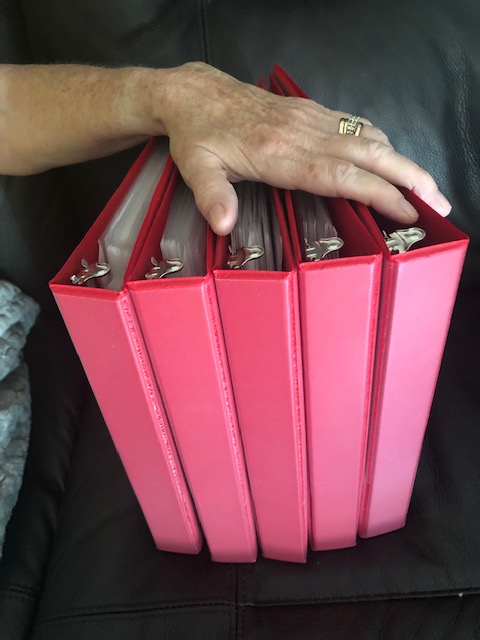
Several months ago, it occurred to me that I needed a more organized system of filing my pencil sketches and notes. I was just filing my 5 x 8 sketches in plastic boxes, without having a directory, and having to look through hundreds of sketches to find the one I might be looking for. I have spent about sixteen hours to-date, and with many more hours to go.

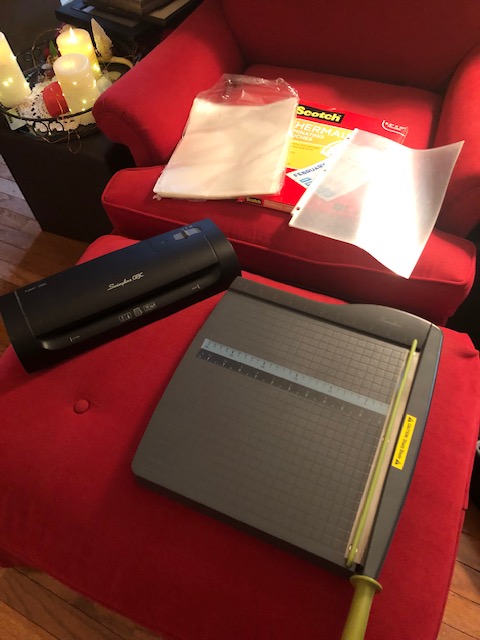
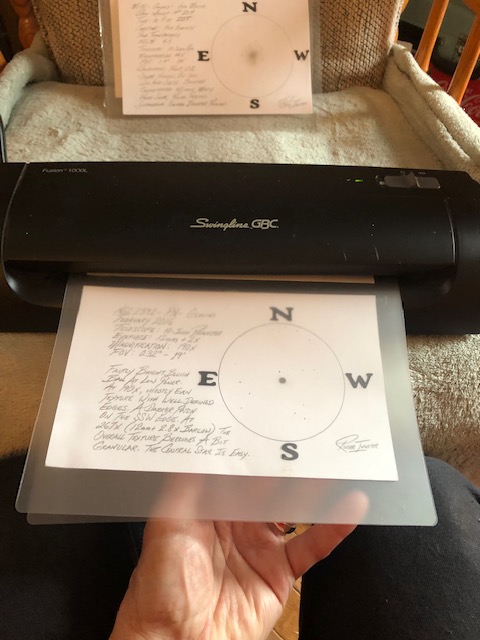
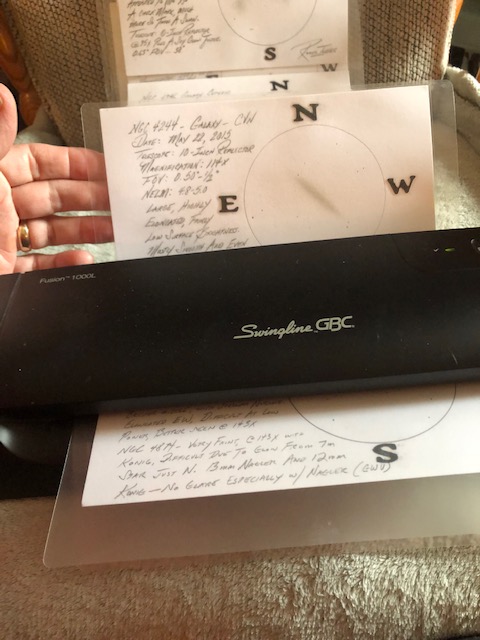
I am using a laminator, lamination plastic, a paper cutter, plastic page protectors, and plenty of 3-inch loose leaf notebooks. When finished, there will be a directory in front of each notebook, then a master list to find the notebook needed, and then the page number.

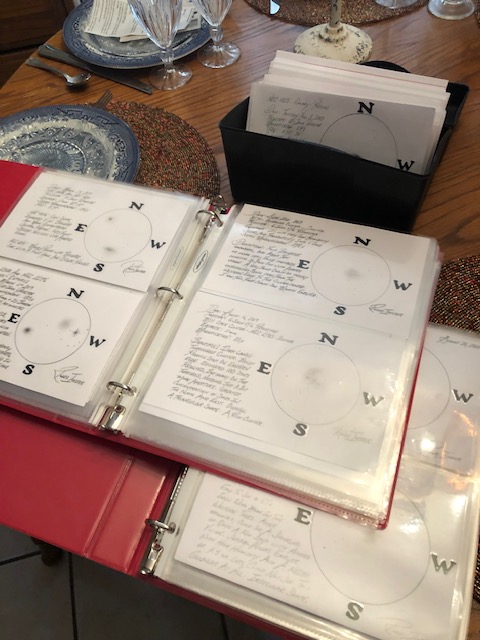
This is a preliminary post, and I will be adding more information when the task is finished. At this point, I have five complete notebooks. I have all of my sketches digitized for the past fifteen years, but nothing like a “hard-copy.”

Four books now completed, with the fifth, just beginning. There is no way, I can laminate all of my sketches, and notes, as they are in different formats, journals, and too many small 3 x 5 cards to count.

Maybe a thousand or more small note cards ( 3 x 5) filed in plastic boxes, by constellation. So they are just fine, and easy to locate…the object I might be looking for.

The following are the books to-date with Debbie’s hand holding.

NGC 253 – Galaxy In Sculptor: It’s Far South -25º South Declination Deters Many Amateurs From Observing. However, It’s Possible To Be Observed From Anywhere in The Continental US.

September 9, 2022

Richard Nugent and Bruce Berger saw the galaxy from Maine at +45º N latitude.

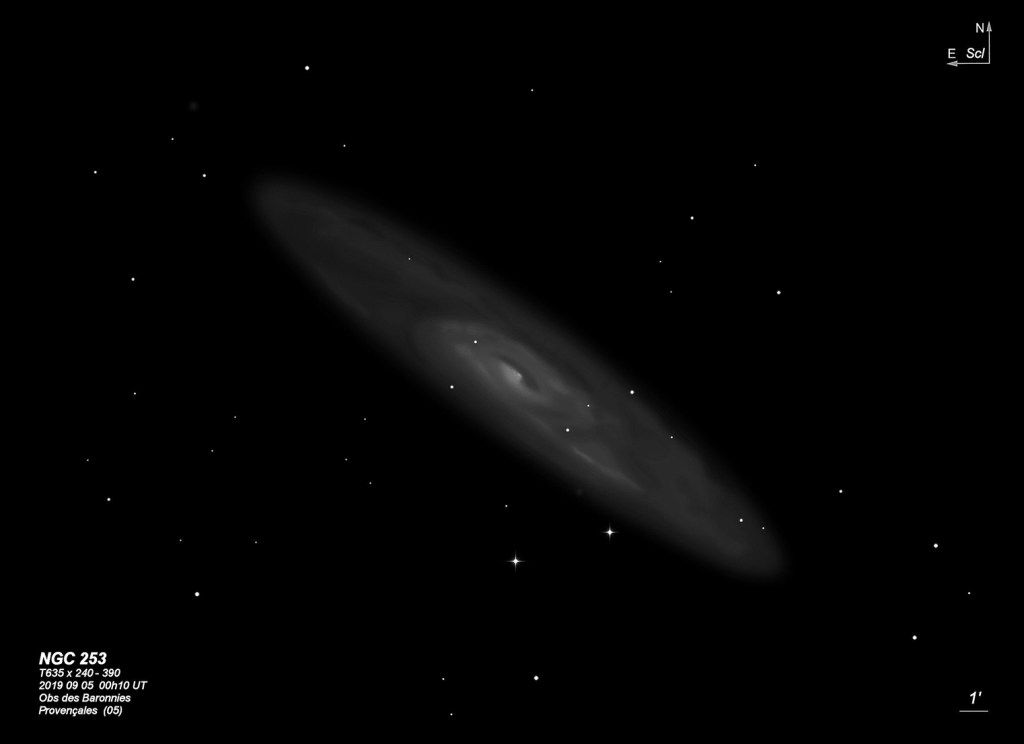
Pencil Sketch as following by Bertrand Laville from France, using a 25-inch Reflector:

Image by Mario Motta:

The data was collected in 2019, counting the number of subs, I have 70 min both Blue, and red filters, and 60 minutes Lum Filter. Green filter was only 40 minutes, likely it began to set in the west too low and could not get more.

This was taken with my 32-inch scope from Gloucester MA, with a ZWO ASI6200 camera.

Processed in Pixinsight

Image by James Dire:

Date/LocationNovember 15, 2009 Wildwood Pines Observatory, Earl, NC
Camera and SettingsSBIG ST-2000XCM CCD Camera -10°C
TelescopeOrion 190mm Maksutov-Newtonian f/5.3
MountParallax HD150
Exposure60 minutes (6 x 10 min)
ProcessingCCDOpts, Image Plus 3.0, Photoshop
OtherMag. 7.1 spiral galaxy in Sculptor. 26.9 x 4.6 arc minutes.

Pencil Sketch by Roger Ivester from North Carolina:

14.5-inch reflector at 125x, from a local dark-site in North Carolina at +35º N latitude on October 22nd 1995. I made the following sketch using a white charcoal pencil on black card stock.

South is up, and East is to the right.

Pencil Sketch by Sue French from New York at +43º N latitude:

10-inch reflector at 68x

Equatorial Mounts With Stiction, and How to Fix: What is Stiction?

September 2, 2022

Stiction: Physics = “The friction which tends to prevent stationary surfaces from being set in motion”

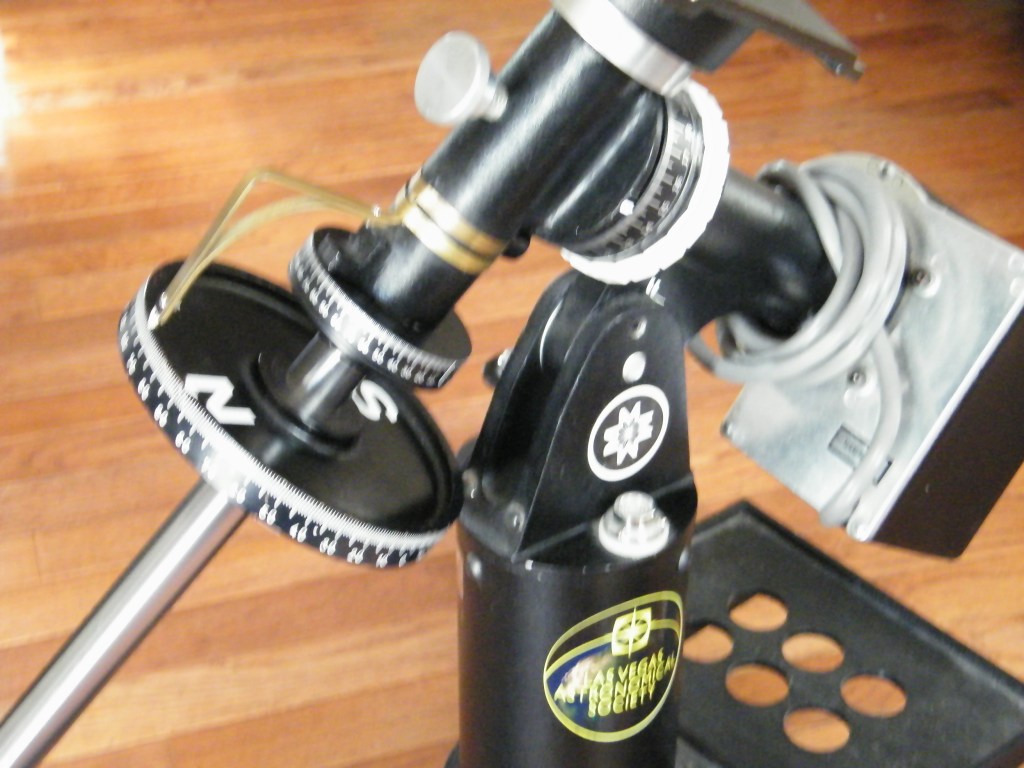
I have an older Meade “medium duty” equatorial mount.  It’s been a while since I’d last used this mount. Unfortunately, while pointing the telescope, the RA and Declination shafts were “jerky” or sticking, when attempting to hand-move the mount. This is called “stiction.”  

This mount has teflon/nylon split bearings, and over the past 30 years, knowing that a petroleum based lubricant can attack plastics, nylon and teflon, I have disassembled and used paraffin.

It occurred to me to use some Mobil 1 synthetic motor oil in a tiny plastic dropper, might just be the perfect lubrication. 

I removed the counter weights, and flipped the RA and Dec shafts in all angles, and dripped small drops of Mobil 1 synthetic into the RA and declination lock down holes, which would allow permeation of the internal surfaces. 

The Meade Medium Duty mount seems to now work beautifully.