Archive for the ‘Work File Only – Observer’s Challenge Reports’ category

NGC 6015 – Galaxy in Draco – Observer’s Challenge Report – June 2017 #100

June 9, 2017

JUNE 2017 OBSERVERS CHALLENGE – NGC-6015

Our 100th monthly anniversary edition.   

Telescope: 10-inch Reflector @ 104x 

Conditions: 59º with high humidity and 16% moon.  NELM:  4.5-4.8 

Low surface brightness, large, broad oval with a subtle brightening in the central region.  An 11 mag. star lies 2 arc minutes to the west of the galaxy.  A 14 mag. star is  visible in the extreme SW halo when using averted vision.  A pair of 13 mag. stars are visible with direct vision, located just off the SW tip of the galaxy.  

Roger Ivester  


FullSizeRender 

Observer’s Challenge: Galaxy M98 in Virgo – May 2017 – Report #99

May 24, 2017

MAY 2017 OBSERVERS CHALLENGE – M-098-1

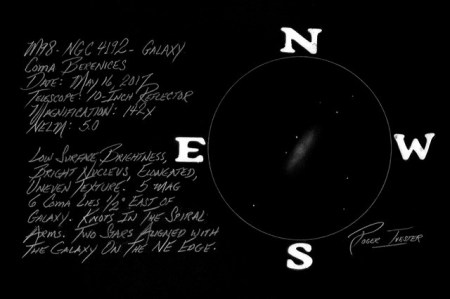
In a 10-inch reflector, M98 appears fairly bright, elongated, a bright nucleus, with unevenness in the halo, with some mottling noted in the central region. Two brighter sections can be seen in both the NW and SE arms.  The nucleus is off-set toward the SE.  

With a 102 mm refractor, and observing from my moderately light polluted backyard this galaxy appears very faint, elongated and weak without any center brightness. In a 6-inch reflector, the galaxy is slightly enlarged and overall a bit brighter when compared to the refractor.  Roger Ivester 

 Pencil sketch with the colors Inverted: 

Rogers M-098 Inverted

NGC 3395-96 – Interacting Galaxies in Leo Minor – Observer’s Challenge Report For April 2017 – Month # 98

April 8, 2017

Complete Report:  APRIL 2017 OBSERVERS CHALLENGE – NGC-3395-96

Observer:  Roger Ivester – Date: March 18, 2017  
Telescope: 10-Inch Reflector
Sketch Magnification: 135x
Eyepiece: 16 mm + 1.9x Barlow

Galaxy NGC 3395-96: Almost connecting. Both galaxies are elongated, brighter middles with NGC 3396 having a distinctive stellar nucleus when using averted vision, but could only be seen intermittently. I could glimpse the galaxies using a low magnification of 57x, but the best views came at 200x, and 135x, respectively, which would indicate that both galaxies are fairly well concentrated. Joseph Rothchild from Massachusetts, using a 10-inch reflector provided an excellent description of this beautiful interacting pair: “Easily seen, appearing most like an asymmetric butterfly….”

Another galaxy, NGC 3340, only 1/2º to the east of the NGC 3395-96 pair, has low surface brightness. Elongated NE-SW with an oval shape and a very subtle brightening or greater concentration in the central region. Despite the low surface brightness, I found that a higher magnification of 191x worked best.

Roger Ivester:  

Pencil Sketch with colors inverted:

Rogers NGC-3395-96a


Open Cluster M67 In Cancer: March 2017 Observer’s Challenge Report

March 13, 2017

March Observer’s Challenge Report:  Open cluster M67 in Cancer. 

MARCH 2017 OBSERVERS CHALLENGE – M-067 2

Telescope: 6-inch f/6 reflector
Eyepiece: 11mm 82º AF
Sketch Magnification: 83x – FOV: 1.0º

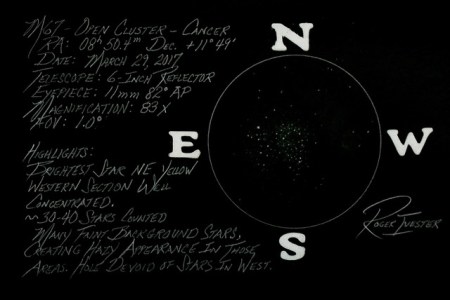
The brightest star of the cluster on the NE tip appears yellow. The cluster is very bright and large, consisting of two sections, the sparse eastern section, and the more concentrated western part. I could count ~ 30 to 40 total stars, with many faint stars being in the background, causing a hazy appearance in these areas. A lane separates the east from the west, traveling north to south, or the entire length of the cluster. With careful and patient observing, several dark lanes were noted.

An almost perfect circle, devoid of stars is obvious in the most concentrated area on the western side.

Inverted pencil sketch:  Roger Ivester 

Rogers M-067a

Winter Albireo – Double Star – Known As h3945 and 145 G Canis Majoris – February Observer’s Challenge Object

February 8, 2017

This is the 8th year anniversary edition of the Observer’s Challenge, which started out as a three month trial.  Thanks to all who have participated and made this….the 96th consecutive monthly report possible.  The following link is the anniversary report.  Enjoy!

FEBRUARY 2017 OBSERVERS CHALLENGE – WINTER ALBIREO

February Observers Challenge: h3945/The Winter Albireo

Despite the fact that thousands of double and multiple stars lie within reach of even the smallest of telescopes, and are visible on all but the worst of nights even in light-polluted skies, they are the most neglected of all deep-sky objects. (Incidentally, these tinted jewels are deep-sky objects, lying as they do beyond the solar system.) Were I to pick one object that epitomizes an overlooked and neglected wonder of the skies, it would surely be this lovely combo. Its ruddy-orange and greenish-blue components, while over a magnitude fainter than its namesake’s, seem more intensely hued to some observers including myself. Indeed, the primary even appears a fiery-red at times (apparently depending on atmospheric conditions). This pair is striking even in a 2-inch glass at 25x and is absolutely superb in a 6-inch reflector at 50x. So why the neglect? Overshadowed by radiant Sirius to its northwest may be one reason. But I suspect that the real cause is its unusual designation. Having neither a Bayer Greek-letter or Flamsteed number on atlases — nor even a Struve or other obvious double star designation — causes most observers to ignore it. The “h” prefix indicates that it’s one of the discoveries of Sir John Herschel, William’s famous son. (Sir William himself discovered some 800 double and multiple stars in addition to the more than 2,000 clusters and nebulae for which he is best known.) In any case, this Albireo clone certainly deserves to be on every showpiece list!    

 Jim Mullaney, 

Supplemental information as provided by Sue French:

“This double also carries the moniker 145 G Canis
Majoris, though the designation is often
incorrectly listed without the G, which
indicates it’s from the 1879 Uranometria
Argentina by Benjamin Apthrop Gould.”  Sue French 

The following photo of the Winter Albireo by Mario Motta of Massachusetts:

h-3945

Observing notes by Sue French from New York:

The lovely double star h3945 lies about
halfway along and 38′ west of a line connecting
NGC 2367 and Tau. (This double
also carries the moniker 145 G Canis
Majoris, though the designation is often
incorrectly listed without the G, which
indicates it’s from the 1879 Uranometria
Argentina by Benjamin Apthrop Gould.)
It’s the brightest star in the area and
sports 5.0- and 5.8-magnitude components
26″ apart. Although striking in
appearance, this is only an optical pair
whose unrelated stars lie along the same
line of sight. Astronomy author James
Mullaney dubbed this duo the Winter
Albireo for its resemblance to the famous
gold and blue double in Cygnus. In a
small scope, they seem gold and white to
me.   Sue French

Observing notes by Debbie Ivester from North Carolina: 

Date: February 25, 2017
Observer: Debbie Ivester
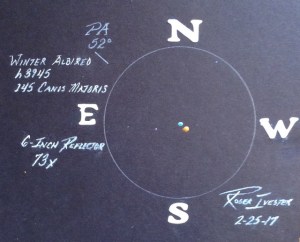
Object: Double Star h3945; Winter Albireo
Date: February 25, 2017
Seeing: Excellent
Telescope: 6-inch f/6 reflector
Magnification: 73x

A beautiful double star, and definitely the most color I’ve ever seen through a telescope. I saw the primary as yellow and the companion as a vivid blue. My color perception was not arbitrary. I looked at this double several times over a thirty minute period, and each time, I saw the same colors. It was very enjoyable to see this most colorful pair.   Debbie Ivester

Observing notes by Roger Ivester from North Carolina:

Object: h3945 Double Star in Canis Major – 145 Canis Majoris

This wide and colorful double star is known as the “Winter Albireo” a name coined by author and astronomy lecturer, James Mullaney. The component magnitudes are 5.0 and 5.8 with a wide separation of 26 arcseconds. This double is easy to observe even in the smallest of telescopes. I was able to observe this beautiful double with a 76 mm f/4 reflector, but with subdued colors, as compared to larger telescopes. The following are my notes using three different telescopes:

Date: March 2016
Telescope: 102 mm refractor
Magnification: 82x
Colors: Yellow/blue

Date: February 25, 2017
Telescope: 6-inch f/6 reflector
Magnification: 73x
Primary: Deep Yellow/Aqua

Date: February 13, 2017
Telescope: 76 mm f/4 reflector
Eyepiece: 12.5 mm + 2.8x Barlow
Magnification: 67x
Colors: Yellowish/pale blue
fullsizerender

Observing notes by Steve Clougherty from Massachusetts:

A few of us die hard observers finally got around to checking out h3945 last night using a 25 inch Dobsonian in the Ed Knight Observatory in Westford at the ATMoB clubhouse. Despite only fair seeing, the colors were striking!

Gold and pale Blue; best at low magnification using a 13 mm eyepiece for a magnification of 131x. As always, the colors are more pronounced when slightly defocusing the double.  

Observing notes by Gus Johnson from Maryland

In April, 1975 I observed h3945, a double star in Canis Major using a 6-inch reflector at 59X. It was very similar to the summer Albireo, in Cygnus. Beautiful, yellow primary and blue companion. I easily resolved it with my 10X40 finder. In October, 1980, I observed it with a 4.25-inch Newtonian at 28X. It displayed exquisite colors! Yellow and Blue

Notes from Peter Bealo from New Hampshire: 

As clouds were rolling in from the south at 7:20 PM EST on 2/26/2017 I took a few minutes to observe h3945 with my 80mm f6 apochromatic refractor.

It is indeed a pretty double. Easily split at even 20X, probably would have been no problem with 14 X 70 binoculars, but didn’t have them handy.

With a 9mm eyepiece, the primary appeared yellow with more intense color than the companion. The companion or secondary star was a bluish-aqua. When I switched to a 24mm, the companion color intensity was more blue. Possibly very subjective, but obvious to me!   Peter Bealo

Observing notes by Mike McCabe from Massachusetts:

I was first introduced to these stars a few years ago through an article in Sky and Telescope written by James Mullaney. He called the targets on his list the Top 10 Neglected Deep Sky Wonders and over the ensuing years, I’ve found most of them to be very attractive indeed.

Setting down at the scope about an hour after dinner, I was once again presented with this attractive pair in the eyepiece, and they really did look like the Albireo pair that we’re all very familiar with.

Depending on the aperture of the scope I’m using at the time, I see the colors as pale yellow and pale blue, with the saturation appearing deeper in smaller instruments. Comparatively, the color saturation might be just slightly less than that of the real Albireo, but part of that is likely due to the poor seeing down below 20° off the horizon.

Observing notes by Craig Sandler from Massachusetts: 

Telescope:  8-inch Schmidt-Cassegrain 

Eyepiece:  24 mm 

Tallahassee, FL
Date:  Jan. 24, 2017
Seeing:  Good 
Transparency:  Good
NELM:  6.0

First, some nomenclature. I first found this beautiful object tooling around with my GoTo in the hand control’s “Constellation” menu item, which will bring up notable objects (NGC, IC, Messier and 2x stars) in a given constellation. Under “Double Stars” for CanMajor, the SE8 database gave the designation “CanMaj 145,” so I’ll always think of it that way. Many prefer the Herschel designation, h3945. And Sue French points out the definitive designation is Canis Majoris G 145, “which indicates it’s from the 1879 Uranometria Argentina by Benjamin Apthrop Gould.”

In any event, I was stunned when it came into view in Petersham, MA right at the beginning of winter/end of fall. For my report, I’m using an observation in January from Florida – the first apparition was when the double star was so low it (and the Trapezium) was so low it was boiling in the atomosphere – quite beautifully, I must say. Anyhow, in January the object was high in the southern sky with a stable sky and was beautiful. I think of it as being the state colors of Massachusetts, plus some orange (for the primary) and some purple (for the secondary). I did my usual (sadly) ballpoint pen sketch, because that night I had limited time and a long agenda. Then on Cape Cod in February, I tried a color sketch just for fun. I was not too pleased with the result, but the process is interesting and pleasing. Once I have observed all the Messiers (two to go, saving M56 for Cherry Springs!) and the “Covington 200” (“Celestial Objects for Modern Telescopes”), I believe I’ll be ready to slooow dooown and give my sketches the practice they deserve. C.S. to all!    Craig Sandler 

Observing notes by Fred Rayworth from Las Vegas:

I saw one bright orange star and the other was maybe blue at first. It was hard to tell because seeing was bad. The main star, the brighter one was orange and looked much brighter than the other one, even though the mags. weren’t all that much different. Once in a while, when things settled down for a split second, the dimmer companion’s color slipped through and the color, a tint of aqua came through, reminding me just a bit of Uranus or Neptune.

Observing notes by Richard Nugent from Massachusetts:

I had never before observed h3945 so, thanks for the February challenge. What a beautiful double star! I have been observing it over the last month through telescopes ranging from my 10-inch,  Joe Henry’s 16-inch, Steve Clougherty’s 18-inch and my 20-inch scope.

I saw the stars as burnt orange and pale blue. The companion blue star’s color seemed muted through the 20-inch, but was more pronounced with the 9-inch aperture mask in place. My favorite view came last Sunday evening through the 10-inch at 50x and good seeing. The colors were quite dazzling! I’ll add this to my list of star party objects…h3945 offers the “Wow!” we always hope for. Thanks again!   Richard Nugent

Observing notes by Chris Elledge from Massachusetts: 

I was able to split h3945 with 15×70 binoculars tonight (February27th) after my difficulty yesterday with the stars low on the horizon and my not wearing contacts. With the stars higher in the sky and my astigmatism corrected, it wasn’t difficult thanks to their distinct colors. I would describe the primary to be orange and the companion pale blue.   Chris Elledge

Observing notes by Sharon Mullaney from Delaware: 

Date:  February 20, 2017
Observer:  Sharon Mullaney
Object:  Double Star h3945
Seeing:  Very Good
Telescope: 5-inch Schmidt-Cassegrain
Magnification:  50x

A stunning double star – brilliant in color. I saw the primary as bright yellow and the companion as lavender blue. The companion definitely had a purplish hue,
even after checking back in on this double a few times over the next hour. It was a great night to observe!   Sharon Mullaney

Observing notes by John Goss from Virginia:

The skies in southwest Virginia were near perfect last night. So, not wanting to waste such a rare opportunity, I tried my luck with a few objects, primarily h 3945. My equipment was an 8-inch reflector f/4 reflector and the eyepiece was a 24 mm, giving 32 x. It was easy to find as it is a straight shot from epsilon through delta Canis Majoris. The brighter component appeared orange-gold. The other one was what I would call a “Carolina Blue.” UNC fans know the shade well.

Yes, h 3945 should be on anyone’s top ten multiple star list. It is well worth any observer’s time, even if he or she doesn’t particularly fancy double stars.

John Jardine Goss
Astronomical League President
http://www.astroleague.org

Observing notes by Glenn Chaple from Massachusetts:

I just returned inside after having made a few small-scope observations of h3945. I studied this beautiful pair with a 60mm f/11 refractor and a 114mm f/8 reflector. Finding h3945 was a simple matter of pointing each scope at an area defined by a line traced from omicron-1 CMa through omicron-2 CMa and extended an equal distance beyond. Experimenting with different eyepieces, I found that h3945 was best split (not too close, not too widely separated) by magnifications between 35X and 50X. The golden yellow color of the primary was obvious in the 60mm scope; the bluish hue of the companion wasn’t as apparent. The colors were more vivid in the reflector, with the primary sporting a rich golden-yellow color, the secondary a soft blue tint. This is definitely a showpiece double!   Glenn Chaple

Observing notes by Joseph Rothchild from Massachusetts:

I observed the Winter Albireo tonight with a 6″ f/5 reflector at 53x. The primary appeared copper and the secondary a pale blue.   Joseph Rothchild 

Observing notes by Sameer S. Bharadwaj from Massachusetts: 

I used my 60mm refractor at 30x and then barlowed it to 84x.

Not difficult to find using Sirius, Adhara and Wezen. About the same distance on the other side of Wezen as Adhara. Was at about 24 degrees altitude when I saw it between 7:30 and 8 pm local EST.

Could clearly see a warm orange and cyan blue well separated. The colors are indeed pretty and the contrast is good.   Sameer S. Bharadwaj 

NGC 1545 – Open Cluster in Perseus – Beautiful and Colorful Triple Star in the Central Region

January 13, 2017

January Observers Challenge Report:  january-2017-observers-challenge-ngc-1545-1

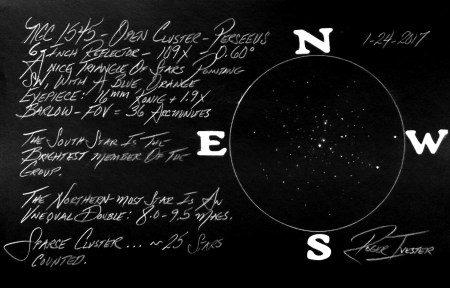
NGC 1545 – Open Cluster; Perseus; Mag. 6.2; Size 12′ – “Near the center of this cluster 6 cm shows a pretty 2′.5 triangle pointing SW, formed by blue, orange, and yellow stars (moving clockwise from the SW apex). In 30 cm about 35 stars are visible in an 18′ area.” Skiff & Luginbuhl  “Observing Handbook and Catalog of Deep-Sky Objects” 

Pencil sketch using an 5 x 8 notecard with colors inverted:

rogers-ngc-1545

Image provided by Mario Motta from Massachusetts, using an 8-inch RC telescope.  

image001

The following image by James Dire of Hawaii:

My first image here is of both NGC-1545 and NGC-1528 taken with a 70mm (2-3/4-inch) f/4.8 APO using an SBIG STF-8300C CCD camera. The field of view is approximately 1.5° from left to right. I have circled and labeled the two star clusters. The brightest star in the image is b Persei, a foreground star 318 light-years away.   James Dire 

james-ngc-1545-wide-field


M74 – NGC 628 – Galaxy in Pisces

January 10, 2017

fullsizerender

december-2016-observers-challenge-m-74

Date: December 17, 1997  

Telescope: 10-inch f/4.5 reflector 

Magnification: 143x

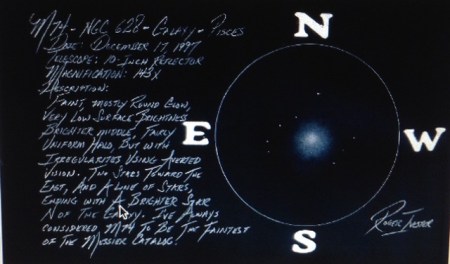
Description: Faint mostly round glow, very low surface brightness. Brighter middle, fairly uniform halo, but with irregularities using averted vision. Two stars toward the east, and a line of stars ending with a brighter star north of the galaxy. I’ve always considered M74 to be the most difficult object in the Messier catalog. (See sketch)

Date: November 10, 1999
Telescope: 102 mm refractor f/9.8
Magnification: 63x
Description: Very faint with extremely low surface brightness halo that fades very gradually outwards. A brighter center, however, not well concentrated.

Date: November 1995
Telescope: 4-inch Schmidt-Cassegrain f/10
Magnification: 63x
Description: Brighter middle with a faint diffuse halo. Mostly round well concentrated nucleus.

Roger Ivester


NGC 206, Stellar Association or Star Cloud Located In The Spiral Arm of M31 – November 2016 Observer’s Challenge Report

December 8, 2016

november-2016-observers-challenge-ngc-0206

The close-up image was taken with a 10-inch f/6.9 Newtonian with an SBIG ST-2000XCM CCD camera 18 X 10 min. The wide-field image was taken with a 71mm f5.9 APO with an SBIG STF-8300C CCD camera, 6 X 10 min.  James Dire 

ngc206_1hr_labels

Notes by Roger Ivester

NGC-206 can be visually observed with a 10-inch reflector and I feel certain it can also be seen with an 8-incher, and probably a 6-inch.

Current observations: M31 star cloud, or NGC-206, without success on two nights last week (November 2016). The cloud was a bit too low in the east, and was involved with sky glow as I had mentioned earlier. I’m going to wait till the moon is out of the way this month and allow it to be at its highest point, and hopefully with excellent transparency.

I was pleasantly pleased to find three sketches and numerous notes from years past of M31, which also included NGC-206. The following “rough” field sketch was made using my 10-inch reflector and a 32mm EP. The magnification was 36X with a 1.7º FOV.

November 3, 1996: Extra supplemental notes for this sketch describing NGC 206: Very faint, fuzzy patch with a NS elongation. Faint, small, with very low surface brightness. Averted vision required, very difficult, but easier when using 71X.

January 11, 1997: 10-inch reflector at 57X. Averted vision required to see both the NW dark lane and NGC-206, which was a very faint, nebulous spot, with an irregular shape.  A Sky-Glow filter seemed to improve the visibility of the M31 dark lane.

Note:  NGC-206 is located in the SW section of the spiral arm. This is an older sketch and I was never able to get out to do a better one. Not my best work.  

Roger Ivester

scanned-image-163120000


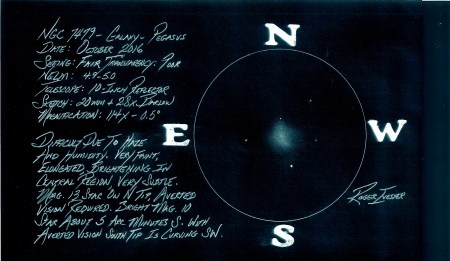
NGC 7479 – Galaxy In Pegasus

October 28, 2016

Observers Challenge link:  october-2016-observers-challenge-ngc-7479 

scanned-image-162930001

NGC 7479 – Galaxy in Pegasus
Date: October 2016
Seeing: Fair Transparency: Poor
NELM: ~4.9 – 5.0
Telescope: 10-inch reflector
Sketch magnification: 114x
Eyepiece: 20 mm + 2.0 Barlow

Description: Very faint, elongated with a brightening and greater concentration in the central region, however, subtle. A mag. 13 star on the north tip in the halo, which required averted vision. A bright mag. 10 star about 5 arc minutes south of the southern tip. With extreme difficulty and using averted vision, I could see the southern tip curving toward the SW. This feature was fleeting and could not hold constantly.

Roger Ivester

Planetary Nebula – NGC 7009 In Aquarius – Also Known As The Saturn Nebula

September 25, 2016

      To read the complete Las Vegas Observer’s Challenge report, click on the following link:

september-2016-observers-challenge-ngc-7009

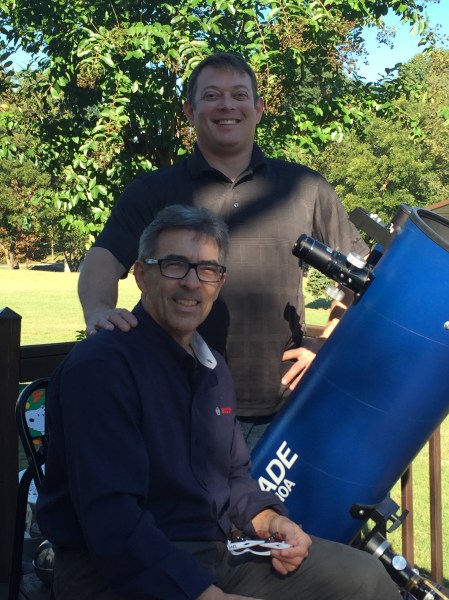
      Our son Brad comes for a visit, and I’ve included a few photos.  Brad was able to participant in the September Observer’s Challenge report.  Roger Ivester

img_4100

A wonderful visit by my son, Brad.

img_4121

Our last picture of the visit.  Debbie and I will miss Brad for sure!  

img_4140

     My interest in amateur astronomy began at about thirteen years of age, during the late 60’s. However, after observing for many years, life got busy and I took a hiatus from amateur astronomy.  

     In the late 80’s, my youngest son Brad, became interested in astronomy, and wanted a telescope.  This spawned my interest, and I was now an amateur astronomer again!   

       In the early 90’s, Brad on occasion would go outside with me, but as a teenager, he had other interest.  I was, however, was very grateful when he would accompany me for an hour or so in the backyard.  Brad, now resides in Las Vegas. 

      This weekend, Brad came to visit (Paw and Gram) as he affectionately calls us.  I thought it would be great if we could observe together once again.  Last night, Friday, September 30 (2016) the both of us were able to observe planetary nebula, NGC 7009, and compare our thoughts at the eyepiece, and make some notes as following:    

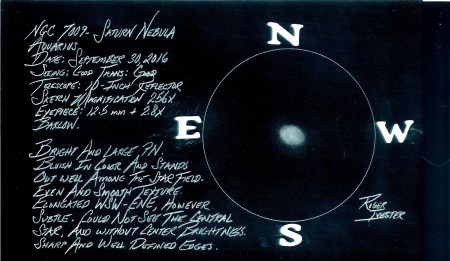
NGC 7009 (Saturn Nebula) in Aquarius:

Date: September 30, 2016
Seeing: Good Transparency: Good
Telescope: 10-inch Newtonian/FL 1143
Sketch magnification: 256x
Eyepiece: 12.5 mm and with the employ of a 2.8x Barlow

At 44x, the planetary appears as a small oval bluish disc, and very small. The seeing was good, so we increased the magnification to 256x. The nebula became elongated, but fairly subtle, with an orientation of WSW – ENE. The surface brightness was very high, and the texture was very smooth and even. The edges were well defined and sharp. No central star could be seen, and there was no center brightness. As hard as we tried, we could not see the ansae or extensions on the ends as seen in photographs. However, an annoying unshielded streetlight in close proximity could have been the cause for this. The contrast was a bit lacking, despite the 5.2 NELM at the zenith. 

Roger Ivester

scanned-image-162750000

The following are just a few of observations of the challenge report:

Jaakko Saloranta of Finland, Dr. James Dire of Hawaii, Glenn Chaple of Massachusetts, and Sue French of New York.   I’m posting the following as representative submissions of the report, as I’ve not received all reports as to-date.   

By Jaakko Saloranta:  Observer from Finland 

Very bright, E-W elongated blue disk visible even with a pair of 8×30 binoculars. Fairly obvious ring structure with two faint extensions visible on both sides of the disk. Central star is buried inside the high surface brightness halo and remains invisible.
4.7-Inch Sky-Watcher @ 228x

Very bright, E-W elongated blue disk visible even with a pair of 8×30 binoculars. Fairly obvious ring structure with two faint extensions visible on both sides of the disk. Central star is buried inside the high surface brightness halo and remains invisible.
22-Inch Capella @ 1058x (observing from California.) 

A breathtaking view. Central star is surrounded by a complex, mottled elliptical ring with knots (W bigger) at both ends. Outer halo is more round, with a brightening in the NW edge.

A breathtaking view. Central star is surrounded by a complex, mottled elliptical ring with knots (W bigger) at both ends. Outer halo is more round, with a brightening in the NW edge.


NGC 7009 – The Saturn Nebula
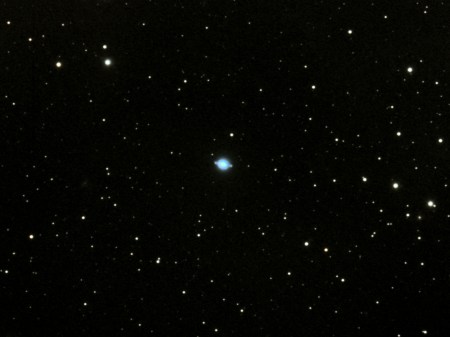
By James R. Dire

The Saturn Nebula, a.k.a NGC7009, is located in Aquarius, just north of the constellation Capricornus. The nebula lies approximately six degrees due north of the star Theta Capricorni (mag 4.1), and one and one-third degree due west of the star Nu Aquarii (mag. 4.5). The nebula also resides within a couple of degrees of both M72 and M73!

NGC7009 is a planetary nebula. The nebula was formed when its host star shed a good amount of its gas when is evolved into a red giant star. The star then evolved into a white dwarf that now resides inside the planetary nebula. Planetary nebulae got their name because at the eyepiece so many of them have the blue color and disk appearance of the planets Uranus and Neptune. In the case of NGC7009, it received its common name, the Saturn Nebula, due to a bar-like feature that resembles Saturn’s rings. However, NGC7009 and all other planetary are not really planets.

In the eyepiece at low power, NGC7009 appear blue and round, almost star-like. A magnification of 100 is required to resolve it into a disk and even higher power is required to see its ring-like bar. The nebula is around 30 arc-sec in size and is magnitude 7.8

My image of NGC7009 was taken earlier this month (Sept. 2016) with a Discovery 10-inch f/6  Newtonian with a Televue Paracorr II coma corrector mounted on a Paramount ME German equatorial (http://www.astrojim.net/KCC%20Observatory.html). I used an SBIG ST-2000XCM CCD camera and the exposure was one hour. The hour-long exposure was necessary to bring out the bar-like feature in the nebula. The brightest star in the image is magnitude 10.   

ngc7009