This is the 8th year anniversary edition of the Observer’s Challenge, which started out as a three month trial. Thanks to all who have participated and made this….the 96th consecutive monthly report possible. The following link is the anniversary report. Enjoy!
FEBRUARY 2017 OBSERVERS CHALLENGE – WINTER ALBIREO
February Observers Challenge: h3945/The Winter Albireo
Despite the fact that thousands of double and multiple stars lie within reach of even the smallest of telescopes, and are visible on all but the worst of nights even in light-polluted skies, they are the most neglected of all deep-sky objects. (Incidentally, these tinted jewels are deep-sky objects, lying as they do beyond the solar system.) Were I to pick one object that epitomizes an overlooked and neglected wonder of the skies, it would surely be this lovely combo. Its ruddy-orange and greenish-blue components, while over a magnitude fainter than its namesake’s, seem more intensely hued to some observers including myself. Indeed, the primary even appears a fiery-red at times (apparently depending on atmospheric conditions). This pair is striking even in a 2-inch glass at 25x and is absolutely superb in a 6-inch reflector at 50x. So why the neglect? Overshadowed by radiant Sirius to its northwest may be one reason. But I suspect that the real cause is its unusual designation. Having neither a Bayer Greek-letter or Flamsteed number on atlases — nor even a Struve or other obvious double star designation — causes most observers to ignore it. The “h” prefix indicates that it’s one of the discoveries of Sir John Herschel, William’s famous son. (Sir William himself discovered some 800 double and multiple stars in addition to the more than 2,000 clusters and nebulae for which he is best known.) In any case, this Albireo clone certainly deserves to be on every showpiece list!
Jim Mullaney,
Supplemental information as provided by Sue French:
“This double also carries the moniker 145 G Canis
Majoris, though the designation is often
incorrectly listed without the G, which
indicates it’s from the 1879 Uranometria
Argentina by Benjamin Apthrop Gould.” Sue French
The following photo of the Winter Albireo by Mario Motta of Massachusetts:

Observing notes by Sue French from New York:
The lovely double star h3945 lies about
halfway along and 38′ west of a line connecting
NGC 2367 and Tau. (This double
also carries the moniker 145 G Canis
Majoris, though the designation is often
incorrectly listed without the G, which
indicates it’s from the 1879 Uranometria
Argentina by Benjamin Apthrop Gould.)
It’s the brightest star in the area and
sports 5.0- and 5.8-magnitude components
26″ apart. Although striking in
appearance, this is only an optical pair
whose unrelated stars lie along the same
line of sight. Astronomy author James
Mullaney dubbed this duo the Winter
Albireo for its resemblance to the famous
gold and blue double in Cygnus. In a
small scope, they seem gold and white to
me. Sue French
Observing notes by Debbie Ivester from North Carolina:
Date: February 25, 2017
Observer: Debbie Ivester
Object: Double Star h3945; Winter Albireo
Date: February 25, 2017
Seeing: Excellent
Telescope: 6-inch f/6 reflector
Magnification: 73x
A beautiful double star, and definitely the most color I’ve ever seen through a telescope. I saw the primary as yellow and the companion as a vivid blue. My color perception was not arbitrary. I looked at this double several times over a thirty minute period, and each time, I saw the same colors. It was very enjoyable to see this most colorful pair. Debbie Ivester
Observing notes by Roger Ivester from North Carolina:
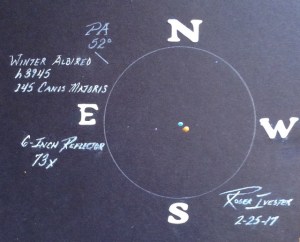
Object: h3945 Double Star in Canis Major – 145 Canis Majoris
This wide and colorful double star is known as the “Winter Albireo” a name coined by author and astronomy lecturer, James Mullaney. The component magnitudes are 5.0 and 5.8 with a wide separation of 26 arcseconds. This double is easy to observe even in the smallest of telescopes. I was able to observe this beautiful double with a 76 mm f/4 reflector, but with subdued colors, as compared to larger telescopes. The following are my notes using three different telescopes:
Date: March 2016
Telescope: 102 mm refractor
Magnification: 82x
Colors: Yellow/blue
Date: February 25, 2017
Telescope: 6-inch f/6 reflector
Magnification: 73x
Primary: Deep Yellow/Aqua
Date: February 13, 2017
Telescope: 76 mm f/4 reflector
Eyepiece: 12.5 mm + 2.8x Barlow
Magnification: 67x
Colors: Yellowish/pale blue
Observing notes by Steve Clougherty from Massachusetts:
A few of us die hard observers finally got around to checking out h3945 last night using a 25 inch Dobsonian in the Ed Knight Observatory in Westford at the ATMoB clubhouse. Despite only fair seeing, the colors were striking!
Gold and pale Blue; best at low magnification using a 13 mm eyepiece for a magnification of 131x. As always, the colors are more pronounced when slightly defocusing the double.
Observing notes by Gus Johnson from Maryland
In April, 1975 I observed h3945, a double star in Canis Major using a 6-inch reflector at 59X. It was very similar to the summer Albireo, in Cygnus. Beautiful, yellow primary and blue companion. I easily resolved it with my 10X40 finder. In October, 1980, I observed it with a 4.25-inch Newtonian at 28X. It displayed exquisite colors! Yellow and Blue
Notes from Peter Bealo from New Hampshire:
As clouds were rolling in from the south at 7:20 PM EST on 2/26/2017 I took a few minutes to observe h3945 with my 80mm f6 apochromatic refractor.
It is indeed a pretty double. Easily split at even 20X, probably would have been no problem with 14 X 70 binoculars, but didn’t have them handy.
With a 9mm eyepiece, the primary appeared yellow with more intense color than the companion. The companion or secondary star was a bluish-aqua. When I switched to a 24mm, the companion color intensity was more blue. Possibly very subjective, but obvious to me! Peter Bealo
Observing notes by Mike McCabe from Massachusetts:
I was first introduced to these stars a few years ago through an article in Sky and Telescope written by James Mullaney. He called the targets on his list the Top 10 Neglected Deep Sky Wonders and over the ensuing years, I’ve found most of them to be very attractive indeed.
Setting down at the scope about an hour after dinner, I was once again presented with this attractive pair in the eyepiece, and they really did look like the Albireo pair that we’re all very familiar with.
Depending on the aperture of the scope I’m using at the time, I see the colors as pale yellow and pale blue, with the saturation appearing deeper in smaller instruments. Comparatively, the color saturation might be just slightly less than that of the real Albireo, but part of that is likely due to the poor seeing down below 20° off the horizon.
Observing notes by Craig Sandler from Massachusetts:
Telescope: 8-inch Schmidt-Cassegrain
Eyepiece: 24 mm
Tallahassee, FL
Date: Jan. 24, 2017
Seeing: Good
Transparency: Good
NELM: 6.0
First, some nomenclature. I first found this beautiful object tooling around with my GoTo in the hand control’s “Constellation” menu item, which will bring up notable objects (NGC, IC, Messier and 2x stars) in a given constellation. Under “Double Stars” for CanMajor, the SE8 database gave the designation “CanMaj 145,” so I’ll always think of it that way. Many prefer the Herschel designation, h3945. And Sue French points out the definitive designation is Canis Majoris G 145, “which indicates it’s from the 1879 Uranometria Argentina by Benjamin Apthrop Gould.”
In any event, I was stunned when it came into view in Petersham, MA right at the beginning of winter/end of fall. For my report, I’m using an observation in January from Florida – the first apparition was when the double star was so low it (and the Trapezium) was so low it was boiling in the atomosphere – quite beautifully, I must say. Anyhow, in January the object was high in the southern sky with a stable sky and was beautiful. I think of it as being the state colors of Massachusetts, plus some orange (for the primary) and some purple (for the secondary). I did my usual (sadly) ballpoint pen sketch, because that night I had limited time and a long agenda. Then on Cape Cod in February, I tried a color sketch just for fun. I was not too pleased with the result, but the process is interesting and pleasing. Once I have observed all the Messiers (two to go, saving M56 for Cherry Springs!) and the “Covington 200” (“Celestial Objects for Modern Telescopes”), I believe I’ll be ready to slooow dooown and give my sketches the practice they deserve. C.S. to all! Craig Sandler
Observing notes by Fred Rayworth from Las Vegas:
I saw one bright orange star and the other was maybe blue at first. It was hard to tell because seeing was bad. The main star, the brighter one was orange and looked much brighter than the other one, even though the mags. weren’t all that much different. Once in a while, when things settled down for a split second, the dimmer companion’s color slipped through and the color, a tint of aqua came through, reminding me just a bit of Uranus or Neptune.
Observing notes by Richard Nugent from Massachusetts:
I had never before observed h3945 so, thanks for the February challenge. What a beautiful double star! I have been observing it over the last month through telescopes ranging from my 10-inch, Joe Henry’s 16-inch, Steve Clougherty’s 18-inch and my 20-inch scope.
I saw the stars as burnt orange and pale blue. The companion blue star’s color seemed muted through the 20-inch, but was more pronounced with the 9-inch aperture mask in place. My favorite view came last Sunday evening through the 10-inch at 50x and good seeing. The colors were quite dazzling! I’ll add this to my list of star party objects…h3945 offers the “Wow!” we always hope for. Thanks again! Richard Nugent
Observing notes by Chris Elledge from Massachusetts:
I was able to split h3945 with 15×70 binoculars tonight (February27th) after my difficulty yesterday with the stars low on the horizon and my not wearing contacts. With the stars higher in the sky and my astigmatism corrected, it wasn’t difficult thanks to their distinct colors. I would describe the primary to be orange and the companion pale blue. Chris Elledge
Observing notes by Sharon Mullaney from Delaware:
Date: February 20, 2017
Observer: Sharon Mullaney
Object: Double Star h3945
Seeing: Very Good
Telescope: 5-inch Schmidt-Cassegrain
Magnification: 50x
A stunning double star – brilliant in color. I saw the primary as bright yellow and the companion as lavender blue. The companion definitely had a purplish hue,
even after checking back in on this double a few times over the next hour. It was a great night to observe! Sharon Mullaney
Observing notes by John Goss from Virginia:
The skies in southwest Virginia were near perfect last night. So, not wanting to waste such a rare opportunity, I tried my luck with a few objects, primarily h 3945. My equipment was an 8-inch reflector f/4 reflector and the eyepiece was a 24 mm, giving 32 x. It was easy to find as it is a straight shot from epsilon through delta Canis Majoris. The brighter component appeared orange-gold. The other one was what I would call a “Carolina Blue.” UNC fans know the shade well.
Yes, h 3945 should be on anyone’s top ten multiple star list. It is well worth any observer’s time, even if he or she doesn’t particularly fancy double stars.
John Jardine Goss
Astronomical League President
http://www.astroleague.org
Observing notes by Glenn Chaple from Massachusetts:
I just returned inside after having made a few small-scope observations of h3945. I studied this beautiful pair with a 60mm f/11 refractor and a 114mm f/8 reflector. Finding h3945 was a simple matter of pointing each scope at an area defined by a line traced from omicron-1 CMa through omicron-2 CMa and extended an equal distance beyond. Experimenting with different eyepieces, I found that h3945 was best split (not too close, not too widely separated) by magnifications between 35X and 50X. The golden yellow color of the primary was obvious in the 60mm scope; the bluish hue of the companion wasn’t as apparent. The colors were more vivid in the reflector, with the primary sporting a rich golden-yellow color, the secondary a soft blue tint. This is definitely a showpiece double! Glenn Chaple
Observing notes by Joseph Rothchild from Massachusetts:
I observed the Winter Albireo tonight with a 6″ f/5 reflector at 53x. The primary appeared copper and the secondary a pale blue. Joseph Rothchild
Observing notes by Sameer S. Bharadwaj from Massachusetts:
I used my 60mm refractor at 30x and then barlowed it to 84x.
Not difficult to find using Sirius, Adhara and Wezen. About the same distance on the other side of Wezen as Adhara. Was at about 24 degrees altitude when I saw it between 7:30 and 8 pm local EST.
Could clearly see a warm orange and cyan blue well separated. The colors are indeed pretty and the contrast is good. Sameer S. Bharadwaj




 rogerivester.com
Recent Comments